Posts Tagged ‘trees’
Way Fun
It’s a little embarrassing how much I enjoyed the ease of large-sized puzzle pieces which allowed me to polish off this beauty in a day at the lake.
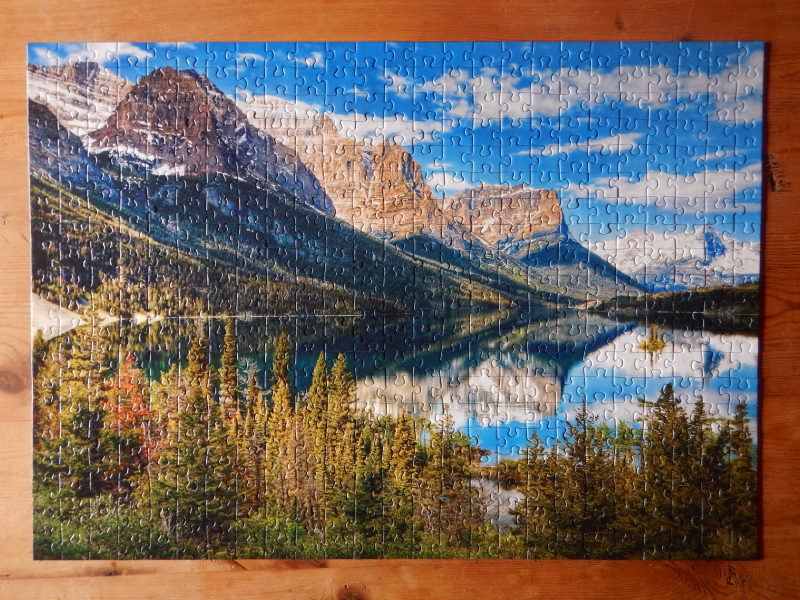

I guess a mental break from my routine was due. My brain soaked up the puzzling like a dry sponge takes on water. Nothing like putting things in order and getting a pretty picture to appreciate as a result. It was a nice antidote for the constant onslaught of changes and challenges life routinely serves up.
The convenience of the large pieces were key to enabling me to get this assembled in a single weekend.
It definitely changed both the visual and tactile features of puzzling that appeal to me, but after finishing as quickly as I did, I rate the tradeoff as an acceptable compromise.
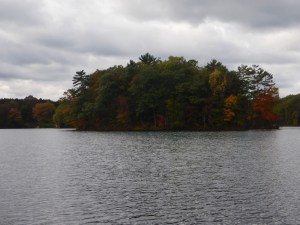
With my project complete by early in the morning yesterday, we had plenty of time to get out for a walk in the middle of the day to take in the beginnings of fall colors around the lake.
The dominance of gray in the sky and gray reflected off the surface of the water, served to mute the true beauty of the few trees showing good fall color.
On our drive home, between periods of sun and one rain shower, we noticed the intensity of color ebbed and flowed inconsistently. Brilliance increased for a while, and suddenly disappeared. Then, as we made our way close to home, the fall colors seemed to pick up again.
One tree on our land caught my attention last Friday, because of the way it stood out as an early adopter.
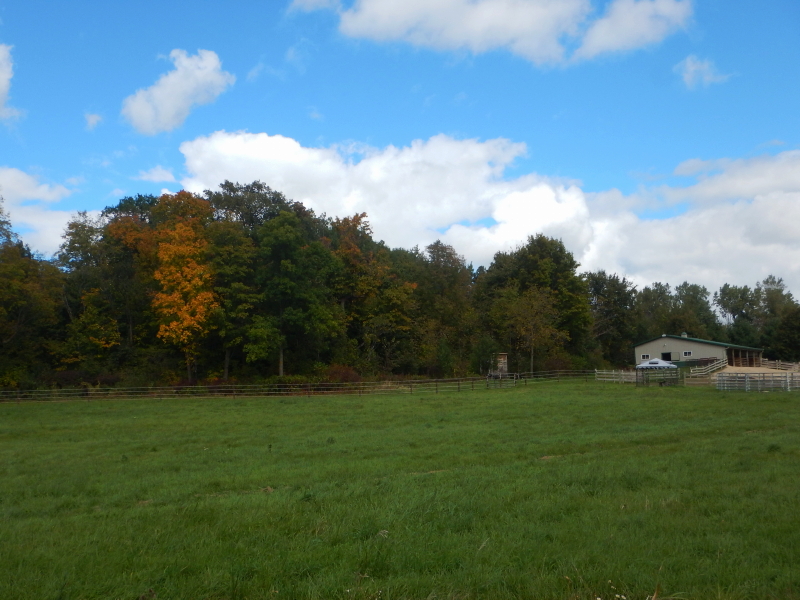
There are a few more trees that decided to join the fun over the weekend. One maple tree by the hay shed is beginning to show deep red in the top third of its branches.
It’s fair to say, the colorful fun is getting ready to break out all over around our place in the very near future.
Sure hope we get some sun and blue skies to enhance the annual spectacle!
.
.
Rock Work
Yesterday was one of those days when the things we thought we might do when we talked about it at breakfast, ended up being different than what we chose to do after stepping out into the day. It was funny that both Cyndie and I lobbied for a refocus to something different.
I wanted to do some rock work and she wanted to transplant some trees.
We started out by the road where the recent tree clearing by the township maintenance crew had uncovered an old rock pile and decaying fence post that marked our property boundary. I wanted to stack a cairn of stones to more purposefully indicate the spot.
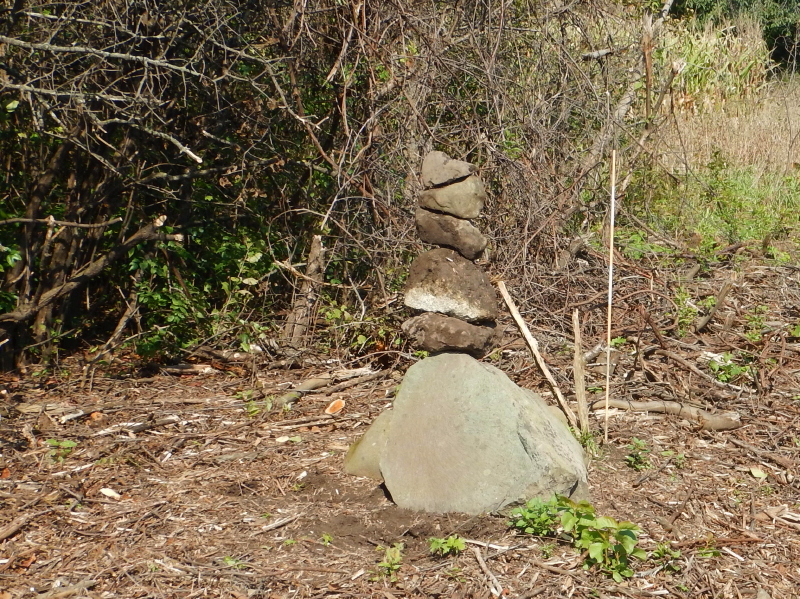
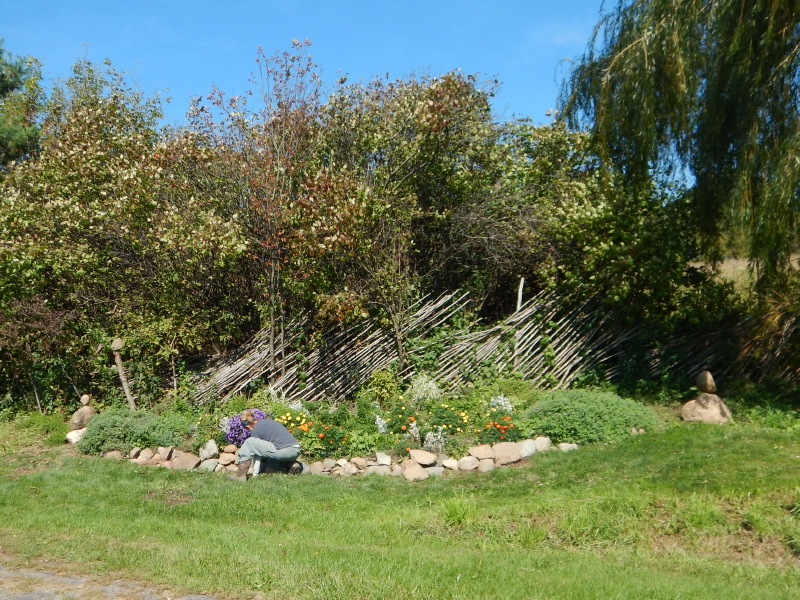
We also dug up a couple of rocks that were pushing their way above ground enough to become a nuisance when mowing. What do I do with extra rocks? Find somewhere to balance them.
I picked Cyndie’s perennial garden.
We moved from there to transplanting volunteer oak trees from places they shouldn’t be to just outside the fence line of the paddock. If they take, the ultimate goal would be for them to provide natural shade for the horses. It’ll take a year to see if they survive the shock we put them through today, but it will take a lot of years to become tall enough to offer real shade.
I’m honestly skeptical about the chances, but if we never try, we’ll never have even a possibility.
The biggest hurdle is the soil. The trees were extricated from sandy soil at the high point of our property and replanted into heavy clay soil by the drainage ditch that crosses our back field.
Time will tell.
Maybe I should think about stacking rocks to make a wall high enough to offer shade. It would probably take as much time as growing trees, but the odds of success are probably better.
.
.
Old Wood
Yesterday was mostly consumed with diesel tractor maintenance, complimented with a brief session of lawn mowing, but there was still time for a stroll through the woods when Julian and Allison stopped by to visit. We came upon an interesting fungal conk growing on the bark of one of our old trees.

This tree suffered significant damage in a tornado that passed over this property two years before we arrived. The top broke off, and I expect the gaping wound that resulted is where the fungus made its way in. Plenty of new growth has sprouted in the years since, but this tree is probably on borrowed time.

It has been here so long that it grew around an old barbed wire fence that was probably put up before the tree had sprouted from the ground.
That can’t be all that good for the tree, either.
In the morning yesterday, while following Delilah on her first walk of the day, I noticed a newly toppled-over dead tree much further into our woods, looking to the left from this tree with the barbed wire and conks.
It is the second one to fall in about a week. I’m wondering if, in the absence of any obvious wind events, maybe the dry spell we are in has contributed to the falling timber.
I’m overdue to be putting in hours as a lumberjack around here. Maybe the old wood is just trying to get my attention.
At least the diesel engine has fresh oil, a clean air filter, and the tractor has new grease in all the fittings. The wood chipper accessory is going to get called to duty relatively soon, I believe.
.
.
We’re Dry
During my commute home yesterday afternoon, I watched clouds thicken and grow dark to the south. When I exited from I94 east and turned toward the southeast heading to River Falls, the view looked a little threatening. Then the radio reported there was only one noteworthy storm worth mentioning. With possible heavy rain amounts, high wind, and hail, in Goodhue and Pierce counties, it included the communities of Red Wing and Hager City.
We live in Pierce county, a short distance north of Red Wing.
Good, I thought. We could use the rain. I just wasn’t fired up about driving in the pouring rain.
When I finally reached Beldenville, the road was soaking wet, but the rain was already done. It must have stopped just before I arrived.
We live a couple of miles north of Beldenville proper, and when I turned onto County J, the pavement was bone dry.
We didn’t get a drop at home.
I stepped out on the deck to take a picture of the drooping sunflower for a representation of how the plants are feeling about our long spell without rain.
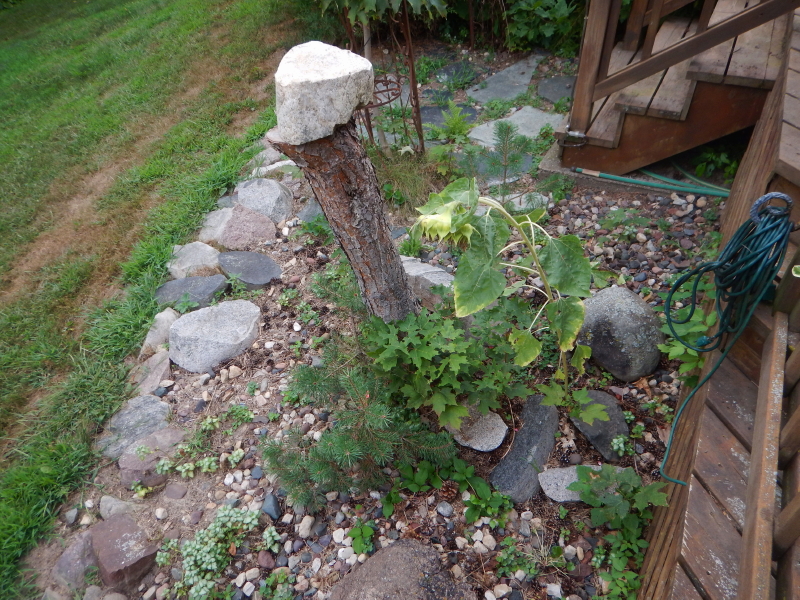
As I stood there, I noticed there was a lot more than just the sunflower that would show up in the frame.
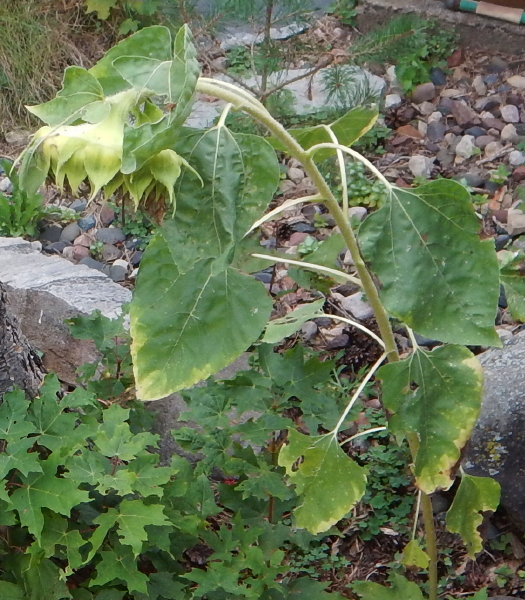
This sunflower made a surprise appearance, most likely growing from birdseed that fell from the feeder nearby. It shot up with robust energy at first. When the ground started to dry out, the growth stunted significantly. It hasn’t looked very happy ever since.
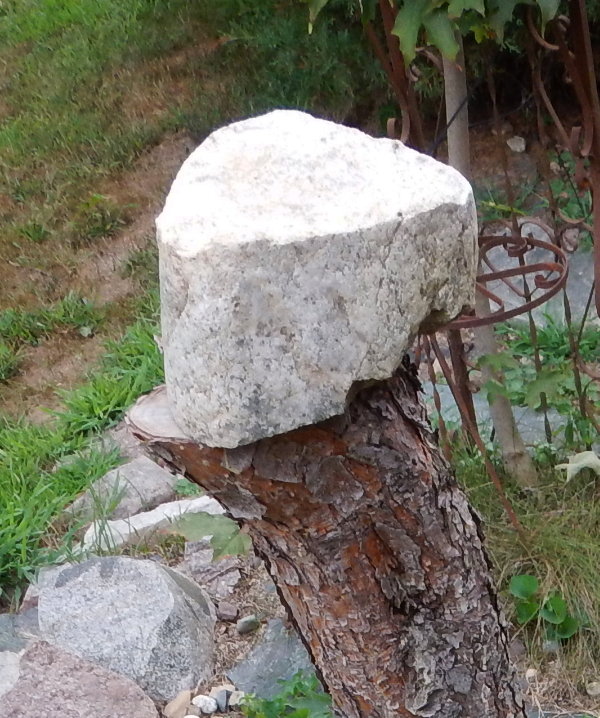
There used to be a big pine tree here. I’m guessing it might have been root bound, based on my recent discovery about the pines out in the field north of the driveway. We left it standing until it was good and dead, then I cut it down, leaving enough of the old trunk to have a nice support for a balanced rock. Using this chiseled stone for a base (probably a remnant from the construction of the field stone chimney on the house), I balanced a large rock that I was only barely able to lift up to the necessary height.
It eventually fell down.
I’ve yet to decide whether to put a different one up there, but I’ve definitely chosen to leave the too heavy one safely on the ground where it landed.
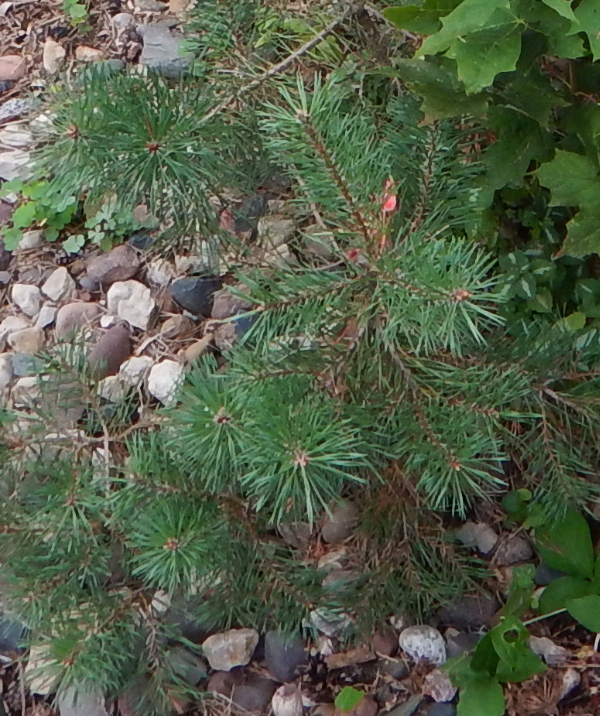
Even though the big tree died, the ground seems to be fertile for a new generation of pines sprouting in its place. There are at least three rising up around that stump, taking advantage of the sunlight available since I cut the big one down.
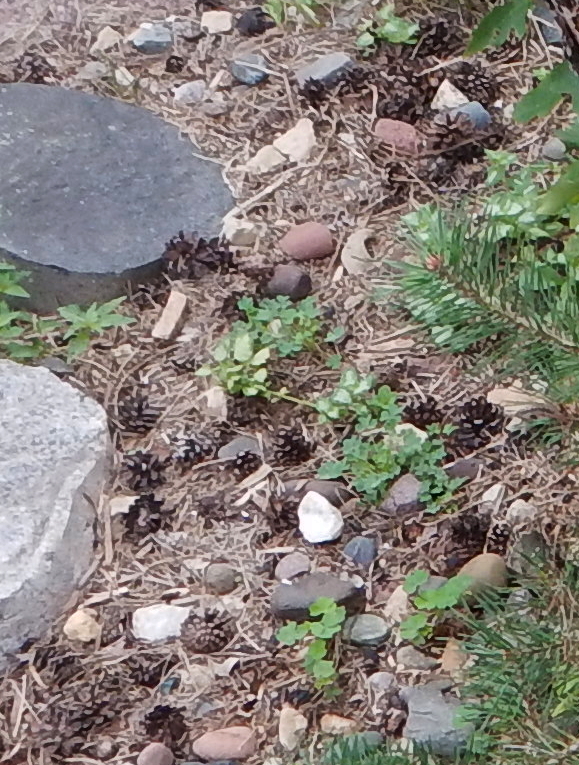
And where do baby trees come from? The number of pine cones remaining from the now-removed tree seem to offer plenty of clues.
Maybe if we come out of this dry spell, more of those seeds will sprout.
.
.
A hint
Walking up toward the house the other day, something new caught my eye. Can you see it?

Probably not. It’s subtle. How about if I zoom in?
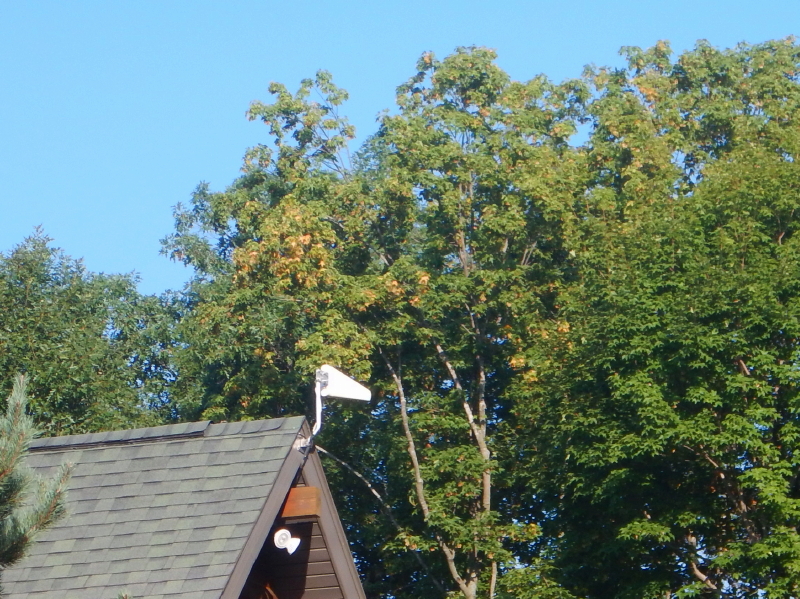
It’s the leaves of the tree beyond the house.
Already?
They are showing the first hint of autumn color on our property.
Yikes.
.
.
Now Ten
I didn’t hear anything from Cyndie yesterday, before she headed to the lake with Melissa and her girls, so I’m guessing there was no sign of what happened to our two missing chickens. Now there are ten.
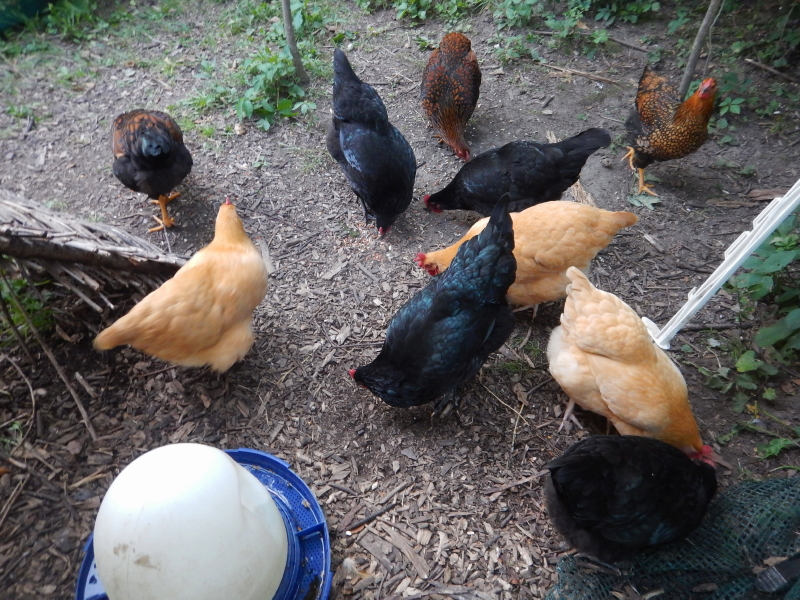
Before Cyndie left, she was very industrious and constructed quite a netted courtyard around the coop for the chickens, so they weren’t confined to quarters all day after all.
The second I got home from work yesterday, I hopped on the lawn tractor to mow all our grass, so I didn’t even chat with Jackie for more than a brief moment to make a plan for Delilah. From the looks of things, I’m guessing she probably assisted in the installation of the coop fencing.
While I was mowing, she headed off to her night job at a local pub/eatery until closing time, so it was just me tending to all the animals, getting them tucked in for the night.
It was a gorgeous August night. It feels a little like nature is at a plateau lately. Even while putting conscious effort into focusing on the immediate moment, there is an unmistakable hint of summer’s end teasing of what comes next.
While walking one of our trails through the woods, I noticed the view through the trees is already opening up beneath the canopy. The late summer shade of our forest has brought an end to many of the lower plants that had started out strong in the early season sun.
That shade provides valuable air conditioning which takes the edge off days like yesterday, when the heat index was climbing into the 90s. It felt a lot hotter while I was commuting through the cities on the steamy pavement than it did when I finally arrived home.
Ahhhh. Living in the country. Huzzah!
It’s a real blessing. But you do have to keep an eye on your chickens.
.
.
Pulling Vines
We are in the time of year when the vines are making surprising daily progress toward swallowing everything they can climb. Heck, some of the vines aren’t even climbing, they are simply smothering the grass.
While I was away this weekend, Cyndie pulled some weed growth near the edge of mowed yard and discovered it was a compound web that had already eliminated much of the grass beneath it.
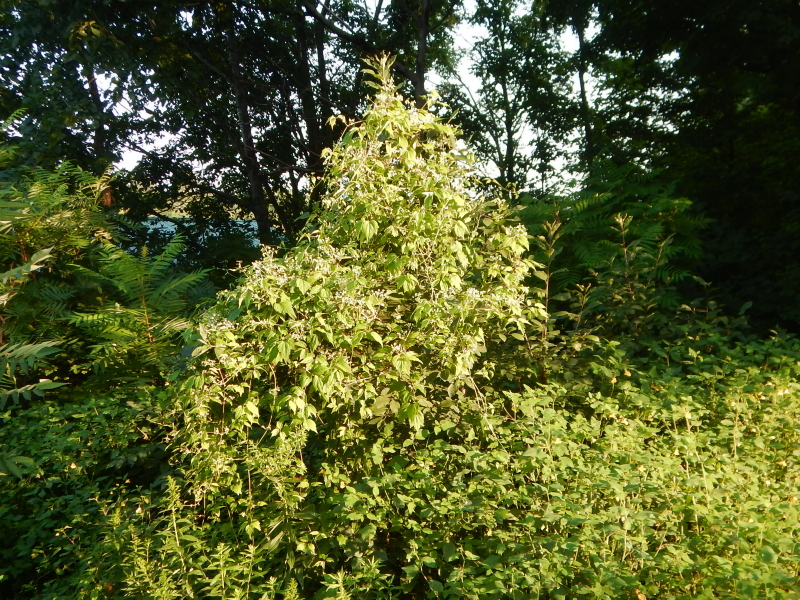
My drive to and from the lake this weekend offered a wide variety of examples showing the aggressive reach of Wild Cucumber. Both trees and farm equipment were getting swallowed in multiple locations.
I have my eye on two spots where this vine has shown up near our north and south borders. My goal would be to keep them confined to the neighbors’ side of the property line.
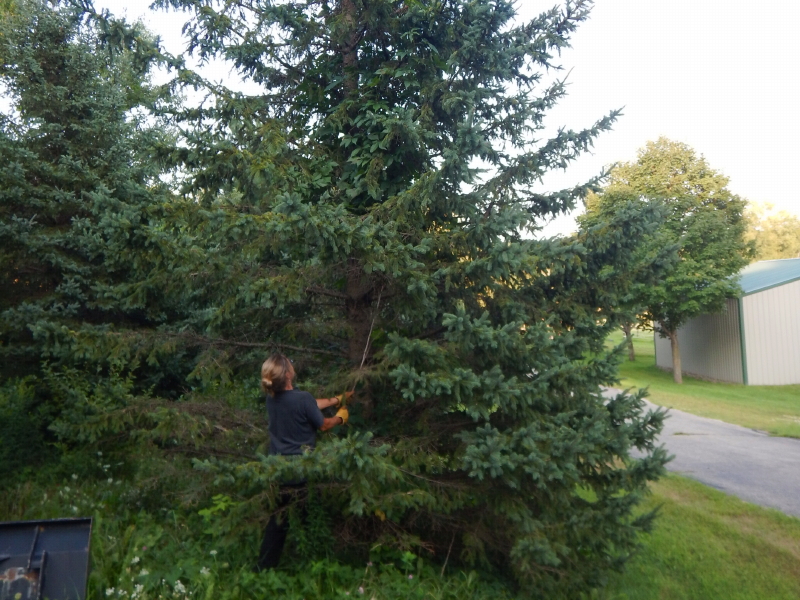
I always pull wild cucumber vines out of our pine trees the instant I notice them. In the case of one of our neighbors who has done nothing yet to protect a prominent pine in the front of his lot, the front of the tree is covered all the way to the top, and beyond.
I check it every day that I drive past.
 Because the wild cucumber is so pervasive, I did some research to identify it. I wanted to learn what I might be risking if I leave it grow on the north border, where I am slowly developing a natural hedge wall.
I have been piling pruned dead branches along this section, and welcome any safe growth through the tangle —it’s been mostly tall grass up to now— that will help hold soil in place during heavy downpours.
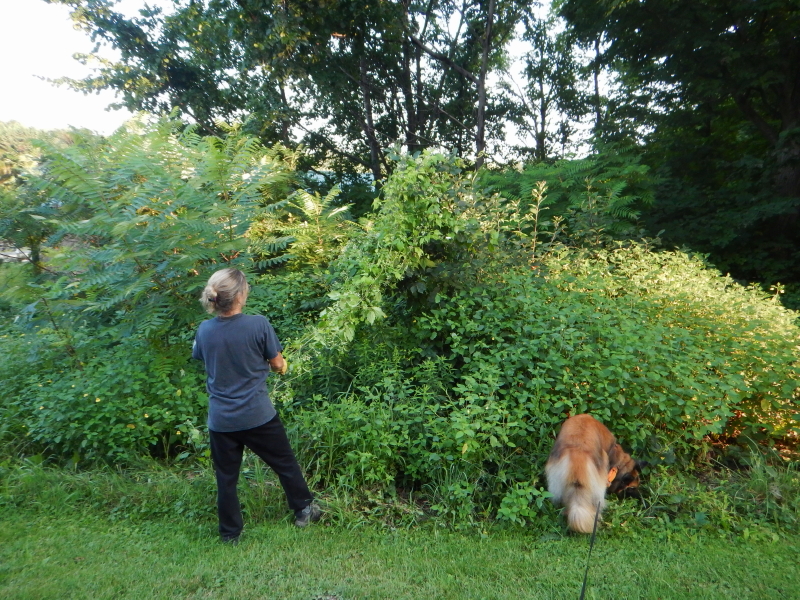
Cyndie and Delilah joined me in a walk to that spot to confirm my research findings. Passing many other varieties of vines along the way that didn’t have the same leaves, I was happy to see my suspicion was spot on.
I’m going to leave it, for now, partly because wild cucumber is native to Wisconsin. If it were an invasive, I’d be less inclined. There are no valuable trees growing along that natural hedge I’m forging, so I’m game to let the wild selection play out with a survival to the fittest mentality.
On our return trek toward the house, Cyndie took a couple of stabs at pulling other vines out of trees.
 .
.
.
.
.
.
.
.
.
We could spend a couple of days wandering the property with a sole focus on vine removal this time of year.
With plenty of other things commanding our attention all the time, saving our preferred plants from vines tends to happen in small, spur of the moment bursts whenever we spot them. It’s generally subject to whether we have available hands while en route toward other tasks.
Vine pulling work is never done.
.
.
Pinnate Leaves
Back when our regional DNR Forester paid us a visit, he pointed out how many ash trees we have. I had been mistaking many of them for butternut trees, but closer inspection, and a noticeable lack of nuts, changed my perspective.
As a result, now my first impression of our trees with pinnate leaves is that they are likely ash.
While we were sitting with the chickens on the edge of our driveway the other day, I gazed skyward and became aware of a large umbrella of the pinnate leaves looming over us. Mentioning it out loud to Cyndie, I assessed it as a big ash that we didn’t even know was in that spot.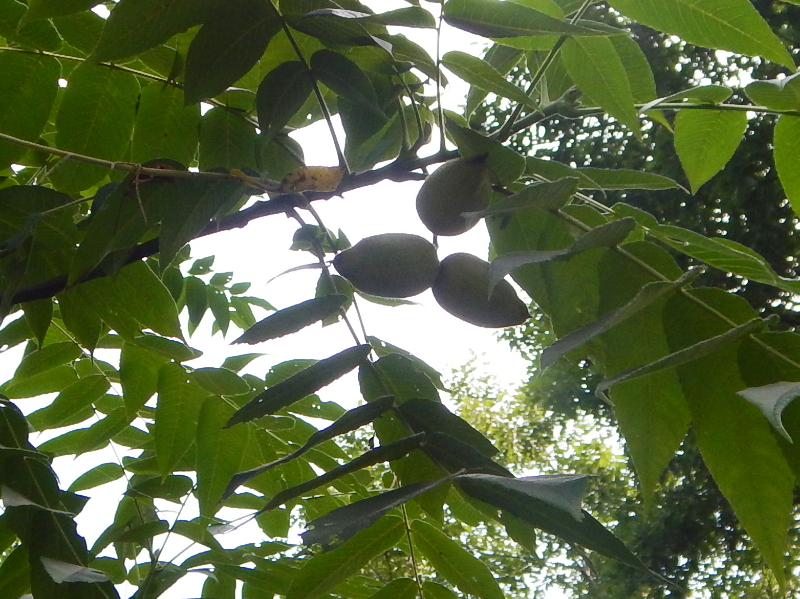
Until I saw the nuts.
Oh! So, it’s back to a butternut again.
From the class we look last winter, I was quickly able to detect one of the simplest identifying differences: the petioles or leaflets of the compound leaf.
The ash tree has about 7 leaflets arranged in opposing orientation along the stem.
On this butternut, I counted repeated occasions of 13 leaflets, and they are arranged in alternate orientation along the stem. Combined with the obvious groupings of nuts, there was little question about what kind of tree this was.
I’m a bit surprised by the significance of the canopy of leaves on this tree because the butternut canker disease is stunting the progress, or outright killing most of the butternut trees in the area. It is possible this tree has an inherent resistance to the fungus.
That would be great luck. Offspring from this tree could lead to additional trees with resistance. Invert the pyramid, I say!
On another note, I received a reply from our Forester about my findings on root girdling on the red pines. He found the report interesting and surmised the trees weren’t planted properly. He still concluded with, “Your trees may have still actually been killed by Diplodia.”
Another fungus. What’s up around here?
I blame climate change.
.
.
Wondering If
While trimming the remaining grass around all the pine trees over the weekend, three things triggered a new hypothesis about our ongoing loss of red pines. I’m wondering if it might have something to do with girdling from the trees being root bound.
I did some searching to see if being root bound might contribute to the way so many of our red pines are coming out of the ground at about a 45° angle before eventually turning to grow straight up, but didn’t find any hint of that connection.

 .
.
.
.
.
.
.
.
.
Then, while writing to describe my latest discoveries to our regional DNR Forester, it struck me that the eighteen inches of heavy, wet snow that fell in May of 2013 tipped many of our trees, but not all of them. In fact, mainly the red pines leaned over. If they were planted without proper attention to the roots, well, a root bound tree would have a hard time standing straight under that kind of load in the wet ground.
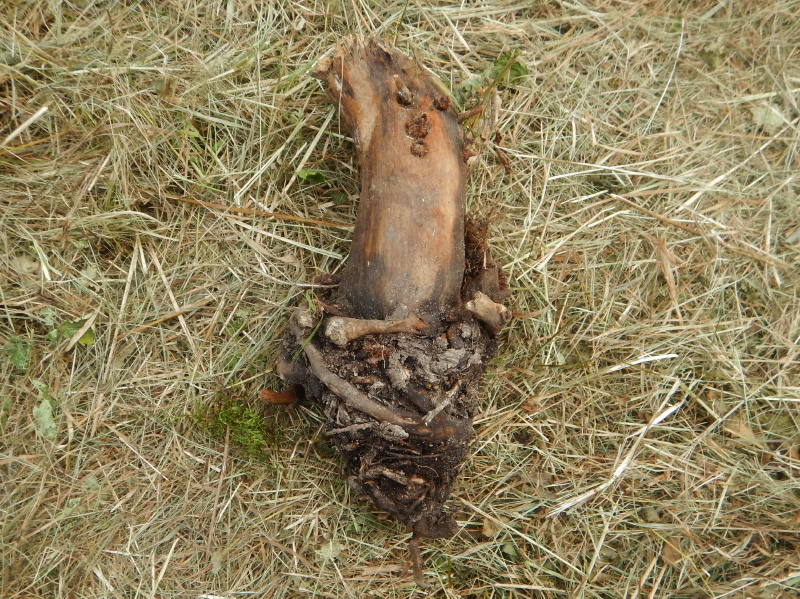
While laboring to walk through the cut growth with the power trimmer on my shoulder, I stumbled over an old stump of a long-dead tree. I was curious about an obvious circular root growth, but just tossed it to the side.
Later, while trimming beneath pine branches, I caught a brief glimpse of a girdling root on one tree which triggered a memory of long ago, when we lost a tree in Eden Prairie to root girdling. It led me to go back and reclaim that old stump for a picture, finally thinking I might be on to something.
 .
.
.
.
.
.
.
.
.
It occurred to me that I should also take a picture of the girdling root I had just spotted on that live tree. I retraced my path to find it again, but to no avail.
I was hot, tired, sweaty, and covered with weeds and grass shrapnel. I didn’t have the energy or mental acuity to execute an intelligent search. I am confident it is out there somewhere, unless maybe it was just an optical illusion that my mind used to help guide me further along this theory I was concocting. I’ll allow for a possibility it was all in my head.
If I receive a response from our Forester that lends credence to my thinking, I’ll undertake a more organized research expedition through that grove of pines again.
I realized, in afterthought, that my tired searching was mainly focused on looking at the leaning red pines, in support of my hypothesis. Maybe the root I noticed had yet to cause a problem, and was on one of the trees that still looked just fine.
It all definitely has me wondering. Did these red pines have already compromised root systems when they were all planted? There are several stumps still in the back yard from trees I cut off at ground level after they died. I could always exhume those remains to collect a little more evidence.
Put that on the “someday” list. For now, I’m going to wait to see if our DNR Forester thinks my latest findings could possibly explain our red pines slowly dying, year after year.
.
.
Extreme Pruning
I understand that there is a significant road right-of-way distance that the township is responsible for managing, but I didn’t think our low-traffic rural road warranted clearance as wide as a county road. Had I known they were going to do such extreme pruning to our road this summer, I wouldn’t have wasted a good part of a day doing a quaint version of the job myself this spring.
Back sometime in May I suppose it was, I had taken the pole-saw to the trees after a close call on my bike. When rolling down our driveway, I couldn’t see if there was anyone coming from up the hill until just as I reached the road. It didn’t allow time for a calm stop, if you know what I mean.
On Thursday afternoon, I started mowing the grass and came upon a very strange item obstructing my progress along our driveway. As I was picking it up, I saw Jackie driving in and I held up the shredded shrapnel of a leg-sized tree for her to see and gave a quizzical expression of “What the heck?”
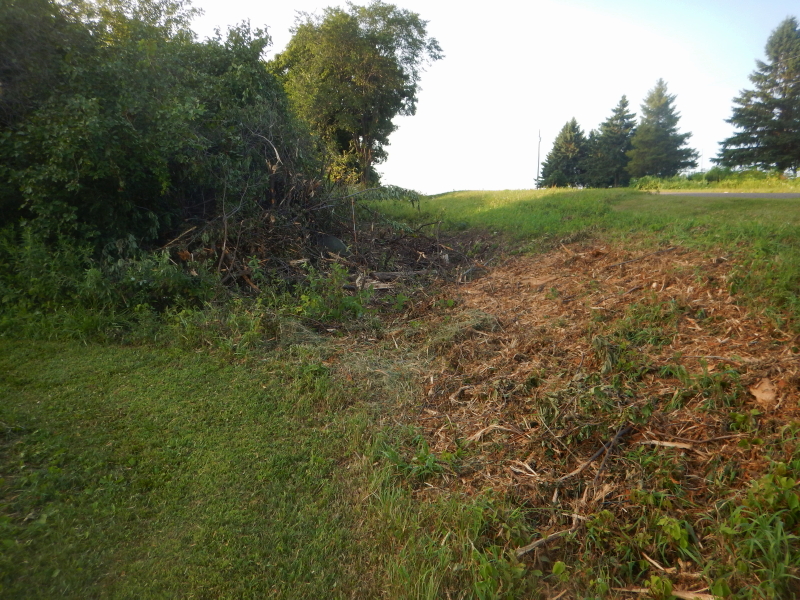 She rolled down her window and told me there had been some serious work done along the road because there were pieces of trees all over our trail.
It surprised me a little, because they had already come by relatively recently to cut the weeds down like they do every year.
This time was different. For the first time since we’ve lived here, they came by with some monster machine that eats trees and spits the pieces out hundreds of feet away.
I would have loved to have been around to see the spectacle, except I don’t think there is a safe distance from which you could view it, based on the size of scary chunks of tree pieces that are now strewn surprisingly long distances away from the scene of the carnage.
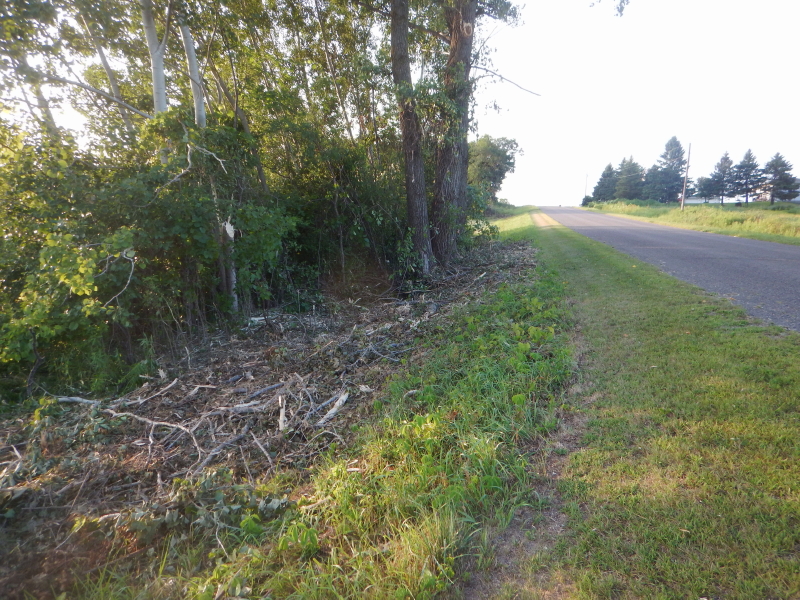
They left the cottonwood trees, though. For now, anyway.

 .
.
.
.
.
.
.
.
.
I wouldn’t be surprised to discover they left them only because the size of those trees would require different equipment.
I’m a little sad that the “efficiency” of using a machine that chews up anything it touches ends up leaving so many shredded half-trees and tangles of branches. The front of our property looks like an advertisement for disarray and neglect.
I want to go cut this poor remnant to the ground.

Or, I suppose I could make a flat cut at the top and balance a stone on it, for accent.
It looks like they left rabbit ears on it. Maybe I should carve a bunny face.
If I could reach as high as their machine, I’d cut off the 18-inch shredded limb stumps on the side of the cottonwoods, the way a proper branch pruning is supposed to be done for a healthy tree.
Maybe their not doing so is a clue about the future of those cottonwoods.
Time will tell.
.
.


 Relative Something