Posts Tagged ‘trees’
A hint
Walking up toward the house the other day, something new caught my eye. Can you see it?

Probably not. It’s subtle. How about if I zoom in?
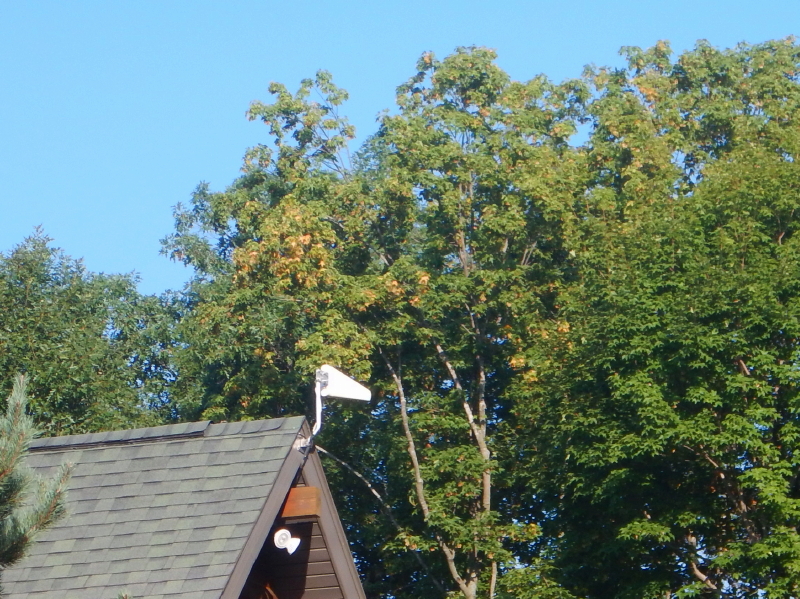
It’s the leaves of the tree beyond the house.
Already?
They are showing the first hint of autumn color on our property.
Yikes.
.
.
Now Ten
I didn’t hear anything from Cyndie yesterday, before she headed to the lake with Melissa and her girls, so I’m guessing there was no sign of what happened to our two missing chickens. Now there are ten.
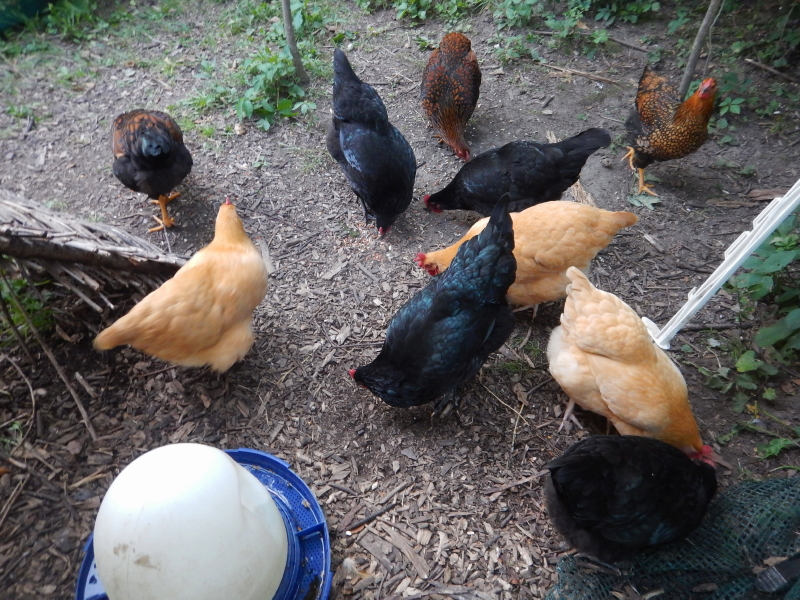
Before Cyndie left, she was very industrious and constructed quite a netted courtyard around the coop for the chickens, so they weren’t confined to quarters all day after all.
The second I got home from work yesterday, I hopped on the lawn tractor to mow all our grass, so I didn’t even chat with Jackie for more than a brief moment to make a plan for Delilah. From the looks of things, I’m guessing she probably assisted in the installation of the coop fencing.
While I was mowing, she headed off to her night job at a local pub/eatery until closing time, so it was just me tending to all the animals, getting them tucked in for the night.
It was a gorgeous August night. It feels a little like nature is at a plateau lately. Even while putting conscious effort into focusing on the immediate moment, there is an unmistakable hint of summer’s end teasing of what comes next.
While walking one of our trails through the woods, I noticed the view through the trees is already opening up beneath the canopy. The late summer shade of our forest has brought an end to many of the lower plants that had started out strong in the early season sun.
That shade provides valuable air conditioning which takes the edge off days like yesterday, when the heat index was climbing into the 90s. It felt a lot hotter while I was commuting through the cities on the steamy pavement than it did when I finally arrived home.
Ahhhh. Living in the country. Huzzah!
It’s a real blessing. But you do have to keep an eye on your chickens.
.
.
Pulling Vines
We are in the time of year when the vines are making surprising daily progress toward swallowing everything they can climb. Heck, some of the vines aren’t even climbing, they are simply smothering the grass.
While I was away this weekend, Cyndie pulled some weed growth near the edge of mowed yard and discovered it was a compound web that had already eliminated much of the grass beneath it.
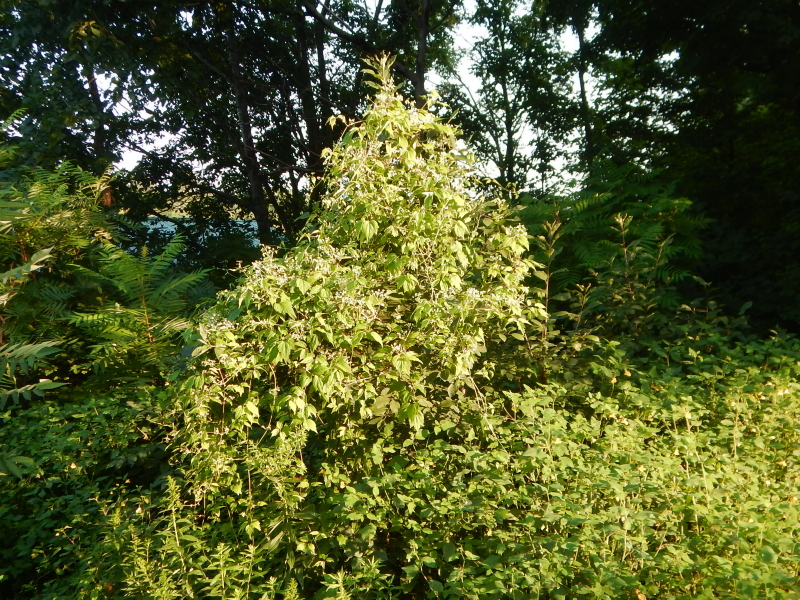
My drive to and from the lake this weekend offered a wide variety of examples showing the aggressive reach of Wild Cucumber. Both trees and farm equipment were getting swallowed in multiple locations.
I have my eye on two spots where this vine has shown up near our north and south borders. My goal would be to keep them confined to the neighbors’ side of the property line.
I always pull wild cucumber vines out of our pine trees the instant I notice them. In the case of one of our neighbors who has done nothing yet to protect a prominent pine in the front of his lot, the front of the tree is covered all the way to the top, and beyond.
I check it every day that I drive past.
 Because the wild cucumber is so pervasive, I did some research to identify it. I wanted to learn what I might be risking if I leave it grow on the north border, where I am slowly developing a natural hedge wall.
I have been piling pruned dead branches along this section, and welcome any safe growth through the tangle —it’s been mostly tall grass up to now— that will help hold soil in place during heavy downpours.
Cyndie and Delilah joined me in a walk to that spot to confirm my research findings. Passing many other varieties of vines along the way that didn’t have the same leaves, I was happy to see my suspicion was spot on.
I’m going to leave it, for now, partly because wild cucumber is native to Wisconsin. If it were an invasive, I’d be less inclined. There are no valuable trees growing along that natural hedge I’m forging, so I’m game to let the wild selection play out with a survival to the fittest mentality.
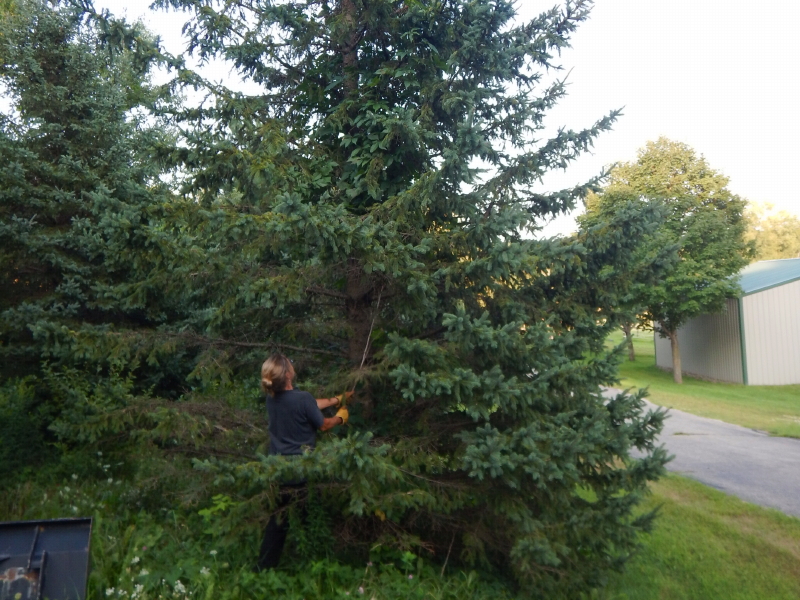
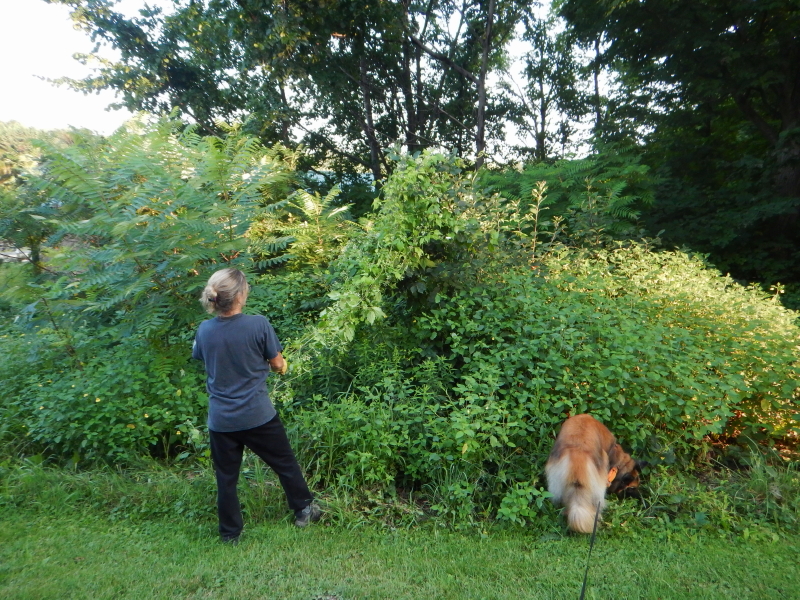
On our return trek toward the house, Cyndie took a couple of stabs at pulling other vines out of trees.
 .
.
.
.
.
.
.
.
.
We could spend a couple of days wandering the property with a sole focus on vine removal this time of year.
With plenty of other things commanding our attention all the time, saving our preferred plants from vines tends to happen in small, spur of the moment bursts whenever we spot them. It’s generally subject to whether we have available hands while en route toward other tasks.
Vine pulling work is never done.
.
.
Pinnate Leaves
Back when our regional DNR Forester paid us a visit, he pointed out how many ash trees we have. I had been mistaking many of them for butternut trees, but closer inspection, and a noticeable lack of nuts, changed my perspective.
As a result, now my first impression of our trees with pinnate leaves is that they are likely ash.
While we were sitting with the chickens on the edge of our driveway the other day, I gazed skyward and became aware of a large umbrella of the pinnate leaves looming over us. Mentioning it out loud to Cyndie, I assessed it as a big ash that we didn’t even know was in that spot.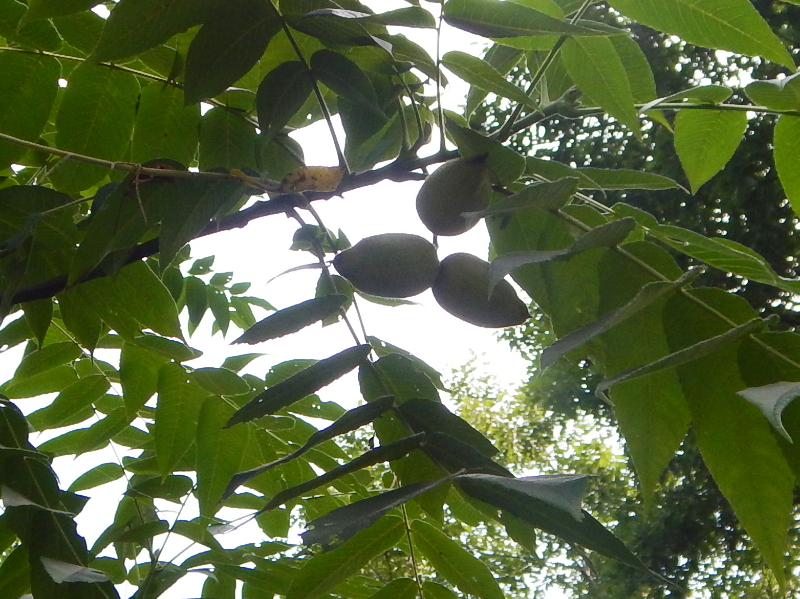
Until I saw the nuts.
Oh! So, it’s back to a butternut again.
From the class we look last winter, I was quickly able to detect one of the simplest identifying differences: the petioles or leaflets of the compound leaf.
The ash tree has about 7 leaflets arranged in opposing orientation along the stem.
On this butternut, I counted repeated occasions of 13 leaflets, and they are arranged in alternate orientation along the stem. Combined with the obvious groupings of nuts, there was little question about what kind of tree this was.
I’m a bit surprised by the significance of the canopy of leaves on this tree because the butternut canker disease is stunting the progress, or outright killing most of the butternut trees in the area. It is possible this tree has an inherent resistance to the fungus.
That would be great luck. Offspring from this tree could lead to additional trees with resistance. Invert the pyramid, I say!
On another note, I received a reply from our Forester about my findings on root girdling on the red pines. He found the report interesting and surmised the trees weren’t planted properly. He still concluded with, “Your trees may have still actually been killed by Diplodia.”
Another fungus. What’s up around here?
I blame climate change.
.
.
Wondering If
While trimming the remaining grass around all the pine trees over the weekend, three things triggered a new hypothesis about our ongoing loss of red pines. I’m wondering if it might have something to do with girdling from the trees being root bound.
I did some searching to see if being root bound might contribute to the way so many of our red pines are coming out of the ground at about a 45° angle before eventually turning to grow straight up, but didn’t find any hint of that connection.

 .
.
.
.
.
.
.
.
.
Then, while writing to describe my latest discoveries to our regional DNR Forester, it struck me that the eighteen inches of heavy, wet snow that fell in May of 2013 tipped many of our trees, but not all of them. In fact, mainly the red pines leaned over. If they were planted without proper attention to the roots, well, a root bound tree would have a hard time standing straight under that kind of load in the wet ground.
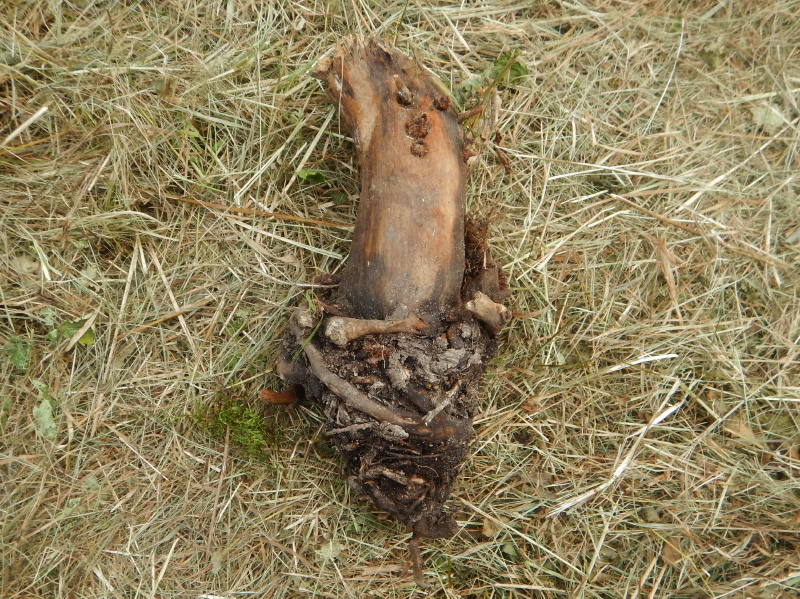
While laboring to walk through the cut growth with the power trimmer on my shoulder, I stumbled over an old stump of a long-dead tree. I was curious about an obvious circular root growth, but just tossed it to the side.
Later, while trimming beneath pine branches, I caught a brief glimpse of a girdling root on one tree which triggered a memory of long ago, when we lost a tree in Eden Prairie to root girdling. It led me to go back and reclaim that old stump for a picture, finally thinking I might be on to something.
 .
.
.
.
.
.
.
.
.
It occurred to me that I should also take a picture of the girdling root I had just spotted on that live tree. I retraced my path to find it again, but to no avail.
I was hot, tired, sweaty, and covered with weeds and grass shrapnel. I didn’t have the energy or mental acuity to execute an intelligent search. I am confident it is out there somewhere, unless maybe it was just an optical illusion that my mind used to help guide me further along this theory I was concocting. I’ll allow for a possibility it was all in my head.
If I receive a response from our Forester that lends credence to my thinking, I’ll undertake a more organized research expedition through that grove of pines again.
I realized, in afterthought, that my tired searching was mainly focused on looking at the leaning red pines, in support of my hypothesis. Maybe the root I noticed had yet to cause a problem, and was on one of the trees that still looked just fine.
It all definitely has me wondering. Did these red pines have already compromised root systems when they were all planted? There are several stumps still in the back yard from trees I cut off at ground level after they died. I could always exhume those remains to collect a little more evidence.
Put that on the “someday” list. For now, I’m going to wait to see if our DNR Forester thinks my latest findings could possibly explain our red pines slowly dying, year after year.
.
.
Extreme Pruning
I understand that there is a significant road right-of-way distance that the township is responsible for managing, but I didn’t think our low-traffic rural road warranted clearance as wide as a county road. Had I known they were going to do such extreme pruning to our road this summer, I wouldn’t have wasted a good part of a day doing a quaint version of the job myself this spring.
Back sometime in May I suppose it was, I had taken the pole-saw to the trees after a close call on my bike. When rolling down our driveway, I couldn’t see if there was anyone coming from up the hill until just as I reached the road. It didn’t allow time for a calm stop, if you know what I mean.
On Thursday afternoon, I started mowing the grass and came upon a very strange item obstructing my progress along our driveway. As I was picking it up, I saw Jackie driving in and I held up the shredded shrapnel of a leg-sized tree for her to see and gave a quizzical expression of “What the heck?”
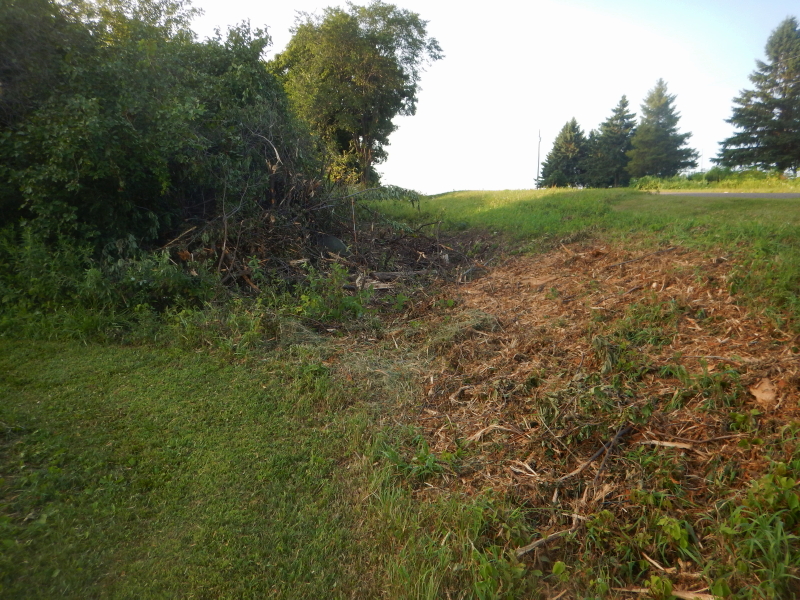 She rolled down her window and told me there had been some serious work done along the road because there were pieces of trees all over our trail.
It surprised me a little, because they had already come by relatively recently to cut the weeds down like they do every year.
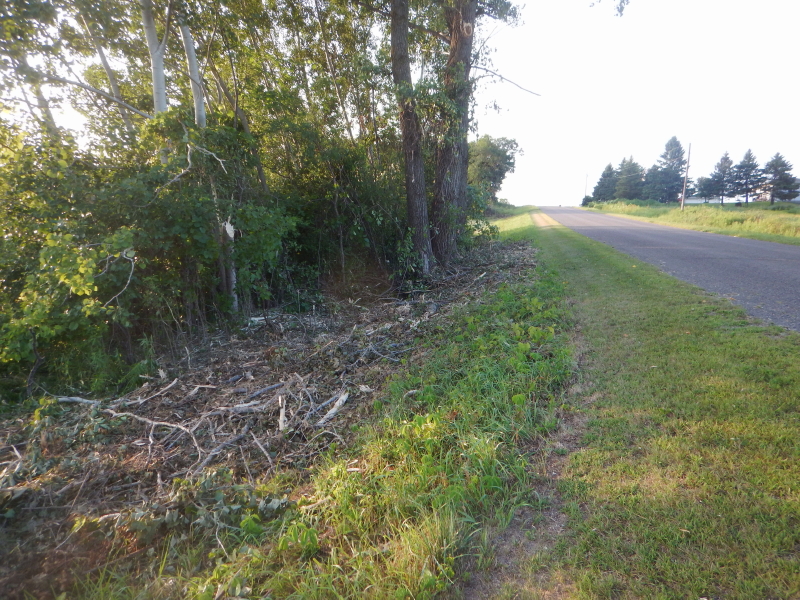
This time was different. For the first time since we’ve lived here, they came by with some monster machine that eats trees and spits the pieces out hundreds of feet away.
I would have loved to have been around to see the spectacle, except I don’t think there is a safe distance from which you could view it, based on the size of scary chunks of tree pieces that are now strewn surprisingly long distances away from the scene of the carnage.
They left the cottonwood trees, though. For now, anyway.

 .
.
.
.
.
.
.
.
.
I wouldn’t be surprised to discover they left them only because the size of those trees would require different equipment.
I’m a little sad that the “efficiency” of using a machine that chews up anything it touches ends up leaving so many shredded half-trees and tangles of branches. The front of our property looks like an advertisement for disarray and neglect.
I want to go cut this poor remnant to the ground.

Or, I suppose I could make a flat cut at the top and balance a stone on it, for accent.
It looks like they left rabbit ears on it. Maybe I should carve a bunny face.
If I could reach as high as their machine, I’d cut off the 18-inch shredded limb stumps on the side of the cottonwoods, the way a proper branch pruning is supposed to be done for a healthy tree.
Maybe their not doing so is a clue about the future of those cottonwoods.
Time will tell.
.
.
Core Four
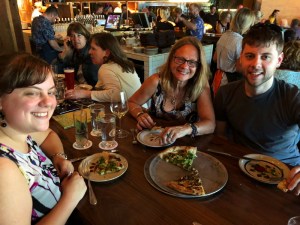
Well, I’m glad that’s finally over. We got all that crazy birthday celebrating out of the way for Cyndie yesterday with a dinner out for the core four –us and our two adult children. That takes care of that for another year.
Oh, have you met Cyndie’s family of origin? Last night was far from the end of birthday festivities for her. There still remains almost a week of planned events, including family coming in from out-of-town, more dinners out, music and dinner at the Dakota downtown, a dinner in, and who knows what else they have yet to reveal.
Yesterday, Cyndie treated herself to a spa/massage session in the morning and topped off her day with the core four dinner at the very trendy “Young Joni” restaurant in North Minneapolis. It was too popular to get an open reservation, so we settled on sitting at the bar to eat.
I would say the popularity is deserved. We had an excellent experience.
After we got home, we learned the restaurant was a product of our friend Mike Wilkus’ architectural firm. No wonder it felt so comfortable to us.
While walking Delilah when I got home, I remembered to tend to a tree that caught my attention when touring the property on Sunday with the DNR Forester.
Don’t be this guy: Five years ago we had a wicked spring snowstorm that dropped 18 inches of snow on the 2nd/3rd of May. Many trees were damaged. To save one pine, I tied a rope to secure it to another tree to keep it from tipping all the way over. Then I forgot about. For five years.

In an attempt to save the tree, I girdled it by neglecting to check and adjust the support.
Oops.
Never mind.
That’s not what I meant to do.
At least the birds appear to be getting something out of the tree, but I guarantee you, they are not getting anything close to the fine cuisine the four of us enjoyed for Cyndie’s birthday dinner last night.
.
.
New Information
Sixty years ago today, before I was even born, the best thing that could ever happen for me took place. With eternal gratitude to Fred and Marie Friswold, today, June 4th, I boast to the world that it is Cyndie’s birthday!
Happy Birthday, my love!
After a jam-packed weekend of social events and more, we begin this week with new information and new energy.
First, after a scheduled appointment for our vet to visit and give the horses their spring shots, we came up with a plan for how we will proceed into the summer grazing season. Both Cayenne and Hunter are showing signs of good health with their sensitive laminitic front hooves. The diet of reduced portions has their weight under control, and more importantly, it has been achieved with minimal evidence of angst from the horses.
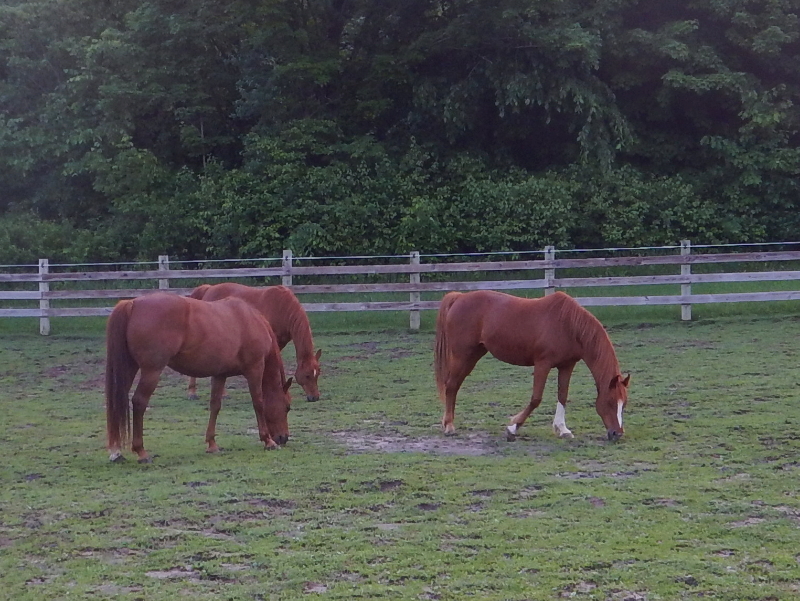 Going forward, we are going to work on getting them used to wearing muzzles to slow down their pasture grazing. We will then feed them dry hay in the morning to fill them up and give them muzzled access to a previously mowed (shorter grass = smaller bites of cake) pasture in the afternoons. They will be confined to the dry paddocks overnight, with no added hay available until the next morning.
Most important for us will be the attitude the horses have about their situation. If they are okay with it, that will be the definition of acceptability. If they balk over any of it, we will work to adjust accordingly. Our goal is to keep their weight down, yet give them some time to enjoy the freedom to move about in the open pasture and “graze” as close to normal as possible.
The next big thing that we learned came as a result of a visit from our local DNR Forester yesterday. My key takeaway from that consultation was the value of cutting trees beneath the canopy of mature trees we favor. Growth that reaches up to encroach on the lower branches of the favored tree should be removed.
He asserted that the primary focus is on providing the most sunlight to encourage growth, but protecting lower branches from competition will also help keep the mature trees healthy.
My first inclination is never to cut down any tree, but our Forester convinced me that cutting some will enhance others. I need to get more comfortable pruning entire trees, in the way I am comfortable pruning a few branches to shape a single tree.
He suggested clear cutting some areas, like stands of aspen, to open up sunlight and entice energized bursts of new growth to expand the grove. It seems so counter-intuitive. I want more trees, not less. Apparently, a little loss now, produces bigger gains later. In his mind, it doesn’t take that long.

Time is a relative thing. I’m not feeling that patient.
I was surprised to learn that he felt our highest priority should be to work on removing invasive garlic mustard. I did a quick Google search and the response was rich with states battling the troublesome intruder. Our Forester said we should pull the plants, bag them in plastic garbage bags and throw them in the trash.
Among the many other battles we are already waging, like vines, common buckthorn, and poison ivy, we now will move garlic mustard to the top priority.
Oh, joy.
.
.
Spontaneous Transplantation
Last night presented one of those moments that would unfold without us having a clue where it would ultimately lead. Thankfully, due to Cyndie’s willingness to run with it, we took a step that was long overdue.
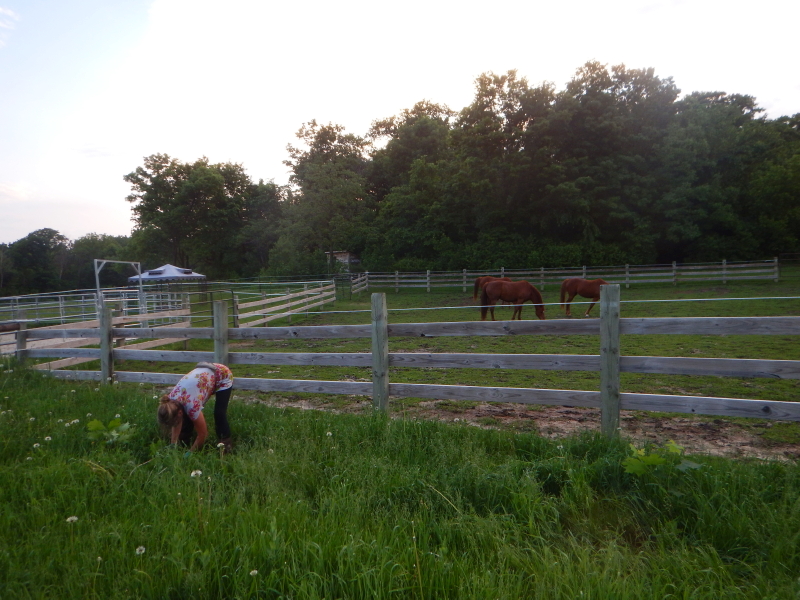
She transplanted some volunteer sprouts of oak and maple trees.
It started with her walking the dog and me doing some work in the shop. I had the door open and some music playing. Suddenly, Delilah popped in to say hello. Cyndie paused to trim some growth around the vicinity.
While pulling weeds, she discovered the saturated ground made it easy to pull out the new tree sprouts.
We’ve been talking about transplanting trees for weeks, but never really formulated a plan on where they would go when we finally take action. Since she now had a stack of multiple beauties fresh out of the ground, it presented an urgency to decide on a new location for them.
I honestly have no idea why I didn’t come up with this before, but it hit me in an instant that planting them just outside the paddock fence would someday offer a natural shade for the horses inside the fence.
 So, that’s what Cyndie did.
It will require some care to give these babies a fair chance at survival, but given the vast number of new sprouts showing up every spring, we will always have plenty of opportunities to try again, in case of any failures.
This is another thing that I would love to have done years ago, to have already taken advantage of that time for growth. The shade I’m looking forward to could be a decade away, to get the trees tall enough and filled out enough to cast a useful shadow.
It’s like our story about growing our own asparagus. People told us that it takes at least three years after planting to start harvesting stalks. For some silly reason, that information repeatedly caused us to not take action. Inexplicably, our response to something that required waiting a significant amount of time for results was to do nothing. Over and over again.
After three years, I mentioned that if we had just planted some when we first talked about the possibility, we could be harvesting already.
 Then Cyndie came across the brilliant idea of not planting from seed, but buying a 2-year-old plant and burying it in the ground.
We are learning to get out of our own way.
In this regard, the spontaneity becomes our secret weapon. We will always get more progress if we just do it, and not wait for the “perfect” plan. We need to not worry so much about the possibility of failure.
My old mode of thinking involved not wanting to work hard on planting trees if they are just going to die, but I’m getting over that now. Maybe the four tries to succeed in the center of our labyrinth have softened my resistance.
We transplanted this group yesterday without any planning or preparation.
I have no idea what the result will be, but at least we have taken the required first step, thanks to Cyndie’s adventurous spontaneous effort.
.
.
Forest View
I’m no expert, but I’m willing to venture a guess that a tree that sprouts leaves in the spring, but can’t get them to grow any larger than the tip of a finger, is going through the slow process of dying.
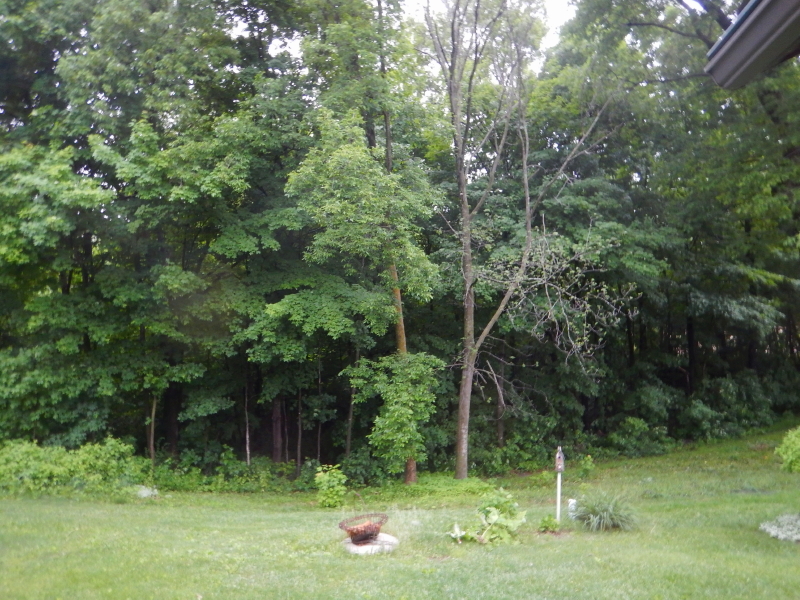 I’ve been watching this tree out our bathroom window for several weeks. It is particularly noticeable because all the rest of the trees around it opened up gorgeous full-sized leaves on their branches.
That standout stalled at the earliest stage of sprouting leaves.
I’m now doubting its likelihood of catching up.
Looking out that window yesterday, it occurred to me how many months of the year that view opens deep into the wooded slope, looking across a carpet of brown fallen leaves covering the ground.
That spot is a favorite for rambunctious squirrels that put on Ninja Warrior obstacle course demonstrations, bringing Delilah to an uncontrollable outburst of window-screen destruction and flurries of loud barking in the front porch.
This time of year, that section of forest becomes an enchanting mystery. I love the darkness that develops under the canopy of shady leafed-out trees. When the sun is really bright, it makes that darkness even more intense.
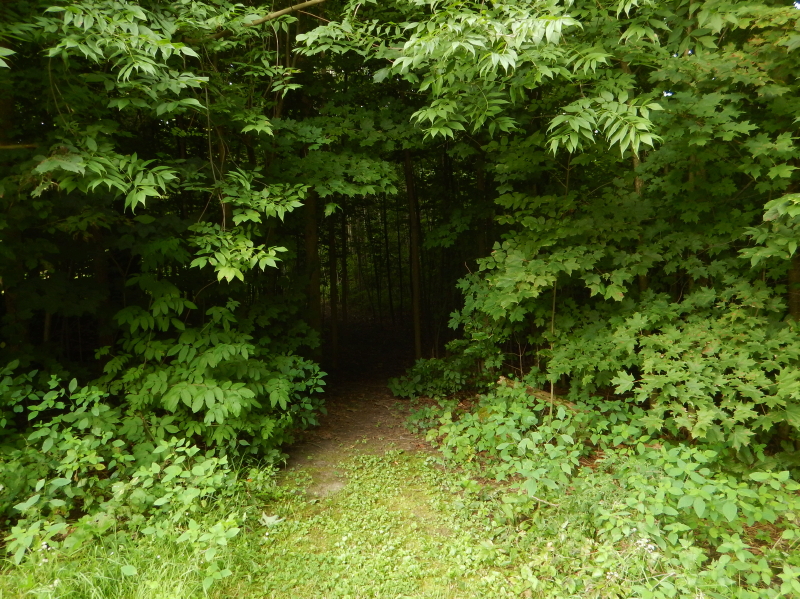 Last year, in August, I posted about the Inviting Portals that beckon a visit into the benefits of breathing the forest air. I find those darkened openings irresistibly captivating.
I’m convinced that I receive equally beneficial psychological rewards simply from absorbing the glorious views of the walls of trees that tower along the edges of our forest and fields.
It’s never clear what the change from bare trees to leafy ones will bring. Branches along the trail that were overhead all winter will often surprise me with how much they droop under the added weight of leaves come spring.
After a brief, yet energized thunderstorm yesterday afternoon, some of the young trees around the house failed to hold their posture under the added weight of wetted leaves.
So, we’ve got trees with not enough leaves and trees with more leaves than they can support, but they are each an exception. The rest of the forest is as picturesque as ever now, providing views that invite and inspire.
Forest views that feed my soul tremendously.
.
.


