Posts Tagged ‘ash trees’
Stunted Growth
For all the glorious trees we get to enjoy in our woods, there are plenty that are far from thriving. It can be frustrating to watch a tree year after year and not see healthy growth. I try to console myself with the fact that they haven’t completely died yet, but the way they linger for years without new signs of vigor just ends up being a long, slow slide toward eventually disappearing.
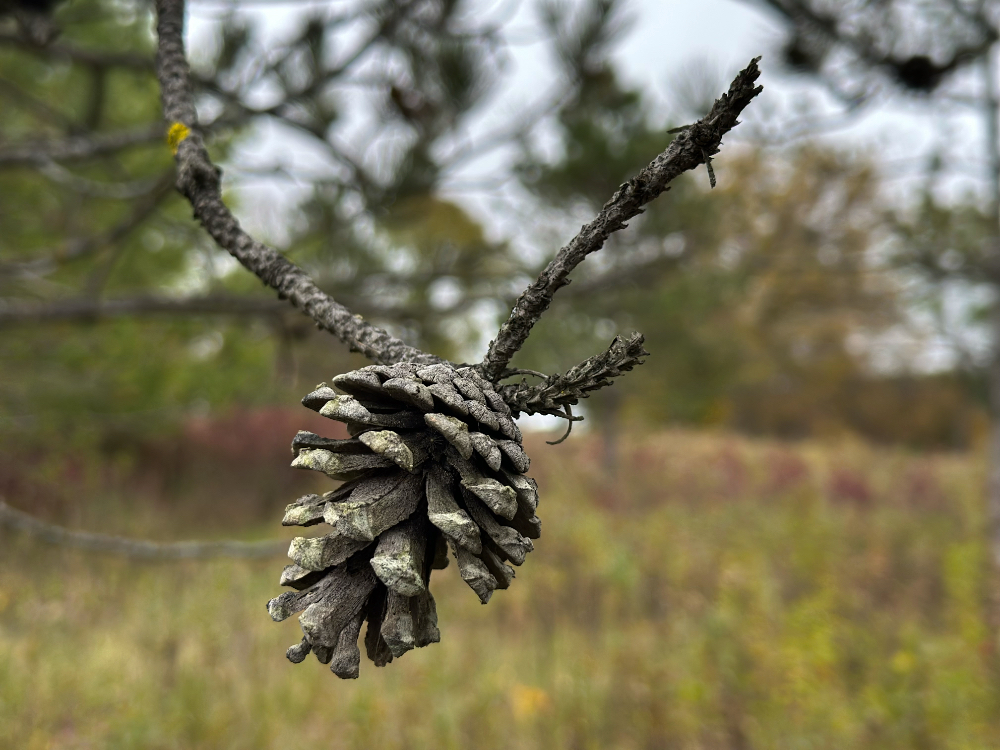
There are a couple of pines in our north loop field that serve as examples of what I am talking about.
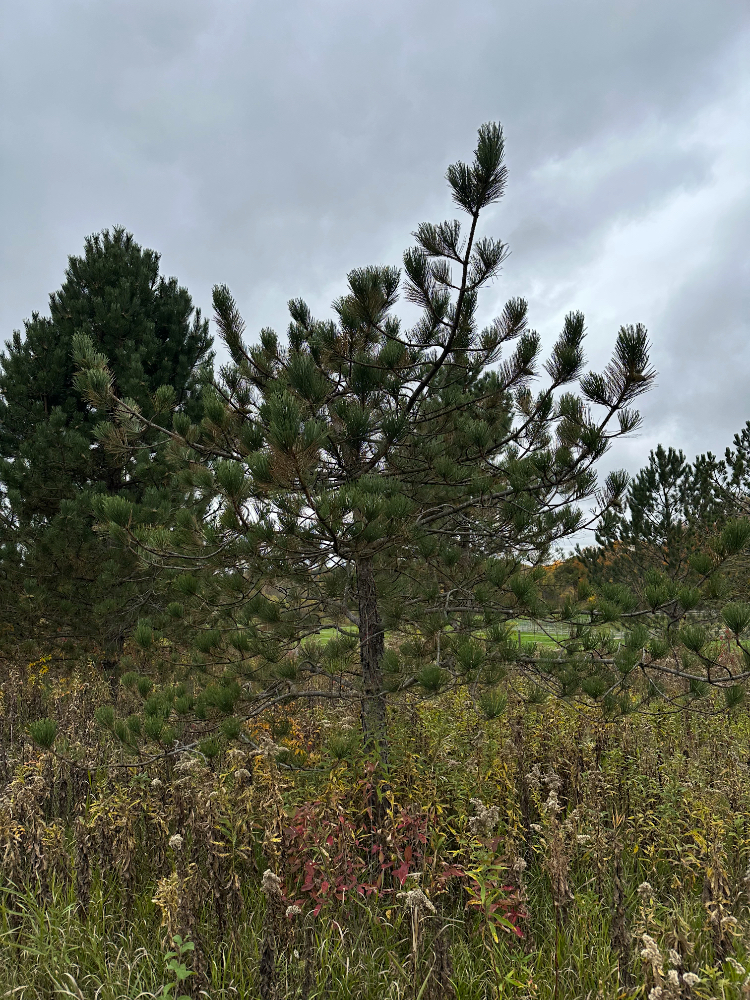
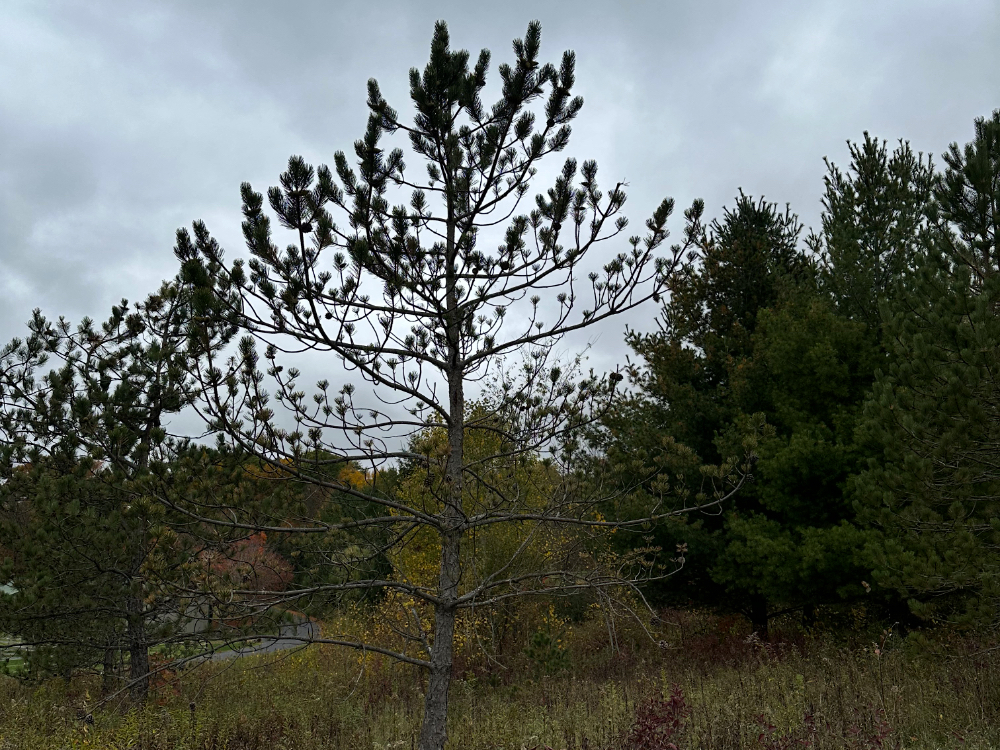
In both cases, look at the fullness of the trees behind them. These scrawny trees are missing something the other trees are getting. I don’t know whether all the pines in this area were intentionally planted years ago, but I suspect most of them were, and I believe many of them were put in the ground with the roots poorly arranged. We’ve lost quite a few that looked like the trees were strangled by their own roots.
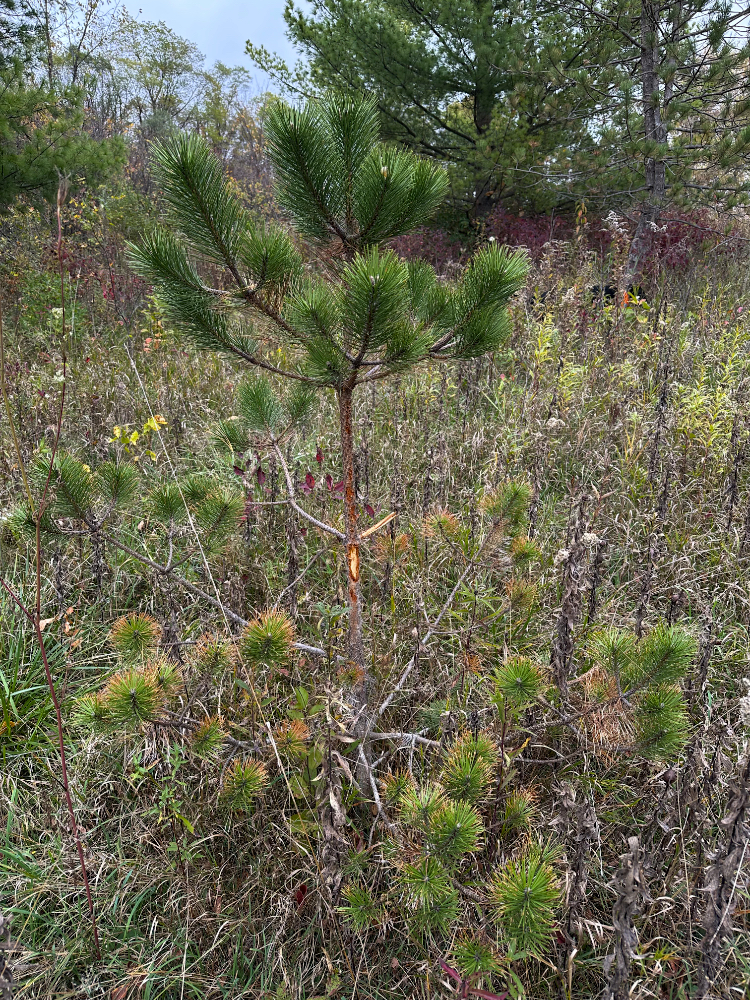
This field is also heavily trafficked by deer. They can be pretty ruthless on small trees. The little tree in the image above has a big portion of its middle munched. I’ve decided to gamble on letting the deer have some trees and hoping there will be enough other sprouts that grow past the most vulnerable stage and become future contributors to an overhead canopy I envision happening in our north loop field someday.
I don’t expect to have any ash trees being a part of that future.
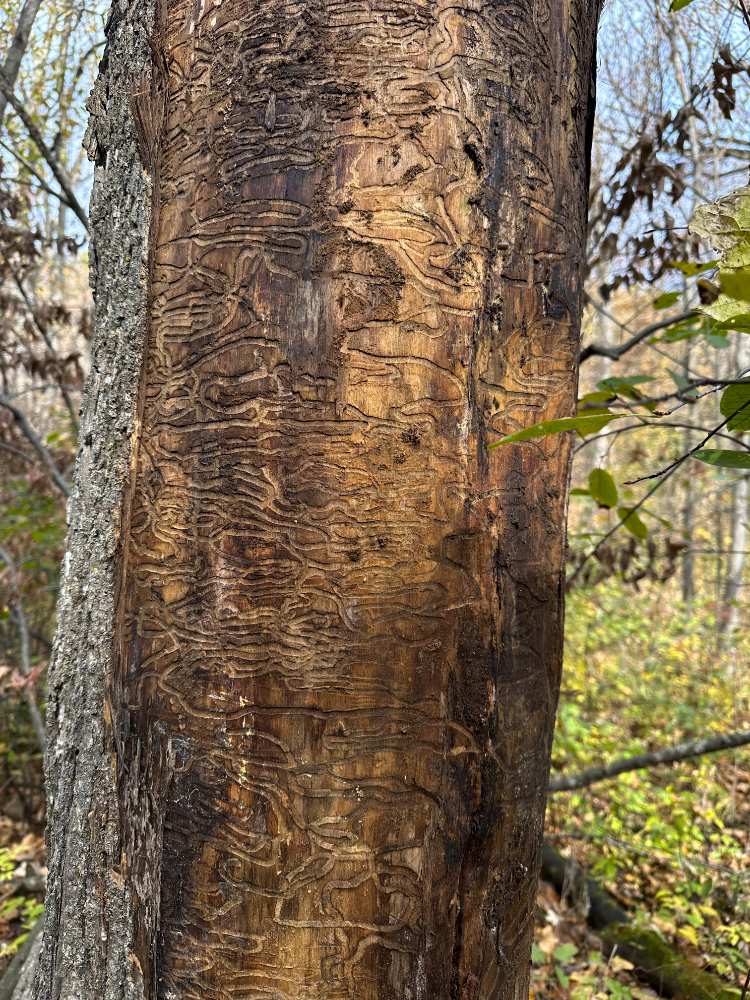
If you’ve never seen the damage caused by the emerald ash borer beetle, we’ve got plenty of evidence for exhibit A.
There are probably as many ailing trees in our woods as there are healthy ones. A forest certainly isn’t a static system. Birth and death are happening constantly, so I never try to think of it as needing to exist in one specific way. I feel good about trying to help the more desirable trees flourish and being conscientious about controlling any takeover by invasives.
I’m choosing not to fight to avoid losing some types of trees and hoping that whichever trees successfully adapt to the warming climate and increasingly destructive storms will make for an inviting forest to visit for many years after I’m gone.
If we keep seeing occurrences of stunted growth like the pines in the north loop, that future forest I’m envisioning will just take a longer time to happen.
.
.
Early Sprouts
Into the woods we headed, Cyndie with a plastic bag in hand, Asher and I tagging along randomly behind. It was a multipurpose jaunt to give Asher some free time outside, to take advantage of some welcome sunshine, and to eradicate as much invasive garlic mustard as possible.

We had just come from having pulled up a thick sheet of black plastic that had covered a poison ivy patch beside a pathway for two growing seasons. I thought we would find nothing but black dirt beneath, but there was a bleached-out layer of a dead, straw-looking mat of grasses that remained.
Since I tend to get overwhelmed when the invasives we are after show up everywhere I look, I let Cyndie focus on the garlic mustard, and I kept an eye out for vines on tree trunks. Even though I felt sure I had already scoured the area we were in for vines visible at the base of trees, I kept finding a remarkable number of cases.
During a pause in my efforts, the thought occurred to me that I should have taken a picture of what I was finding. The reason that hadn’t happened was that each time I would see vines, I jumped into action, yanking them off the tree and pulling up the other end from the dirt as far as I could before it broke. I think there is a fear that if I look away for an instant, I won’t be able to see it again when I look back.
I think vines might be shape shifters. There may be a secret technique to getting rid of them, though. It seemed to work for me. I decided to finally take that picture of them after thinking of it, and lo and behold, I wasn’t able to find a single instance of any more vines on trees in that area of our woods.
Speaking of that part of our woods, it is an area with a lot of ash trees, all of which are gradually succumbing to their inevitable demise via the emerald ash borer beetle. Have you seen what it looks like when an ash tree gets stressed?

They sprout sucker growth in a last gasp attempt to regenerate. Does this ever work for a tree? We don’t expect any of our ash trees to survive, but their demise takes a drawn-out 3-5 years. It’s an ugly thing to witness.
On a more beautiful note, the lawn of our backyard is sprinkled with more than just grass because we have little pink flowers that accent much of the slope, and the first blossoms of the year have begun to appear.

Thank goodness those little beauties haven’t been declared invasive and needing to be pulled by the roots. Our turf sports a natural look not found on sports fields and golf courses. Wildflowers are welcome here.
.
.
Early Hints
In the wee hours of Monday morning, I stepped out on the deck at the lake to look for evidence of the Perseid Meteor shower. I had seen one meteor flash in the predawn hours a day earlier when looking through the bathroom window. It was the weekend of peak activity so I plotted to get a better view the next night. In roughly 10-12 minutes, I saw two streaks.
At 2 o’clock in the morning, that was not thrilling enough to keep me out of bed.
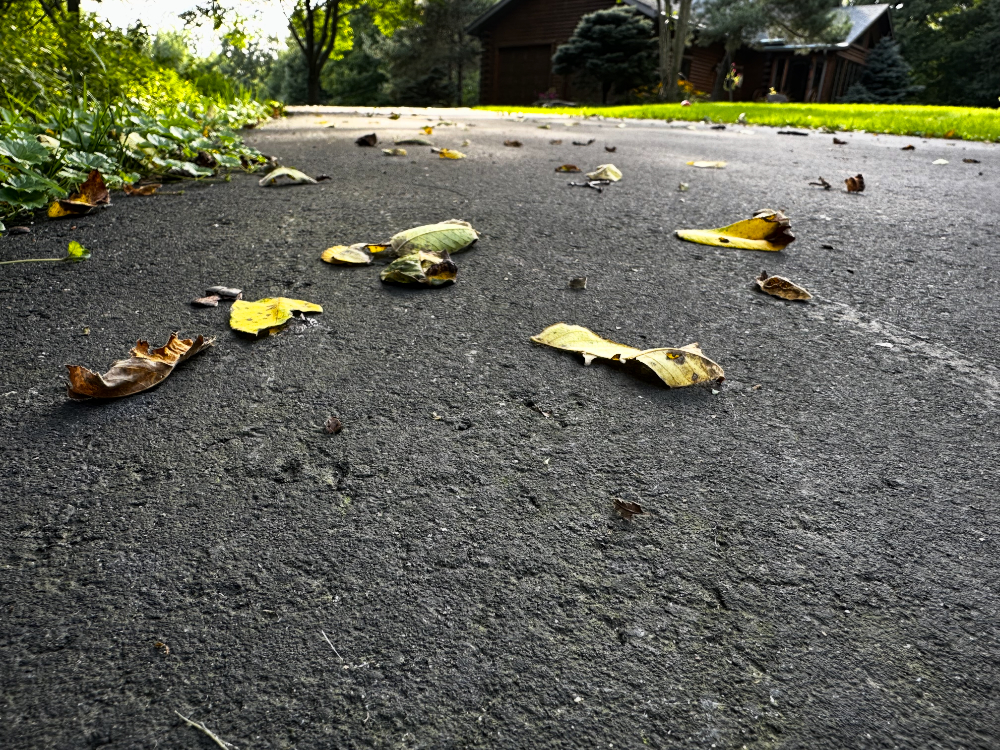
The arrival of the Perseids is a hint of the waning days of summer. Yesterday I noticed another early hint scattered on our driveway.
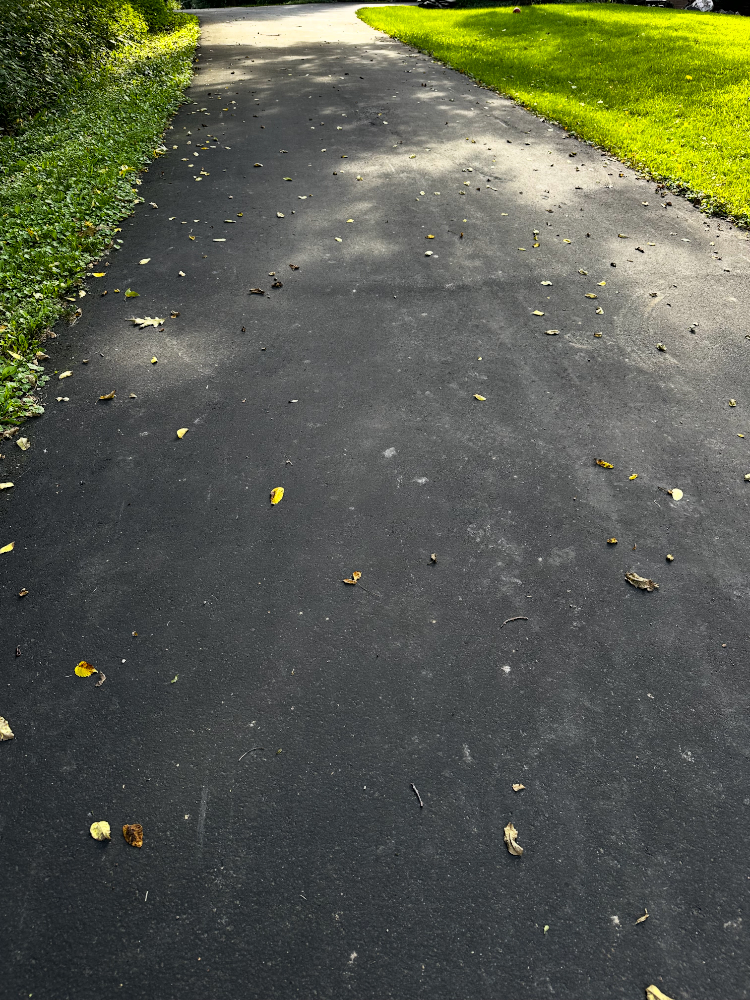
Those aren’t healthy green leaves that have fallen. The change in sunrise and sunset is just starting to be noticeable. The combination of these two phenomena amplifies the perception of the next season looming in our future.
Cyndie recently commented about how barren some spots on our forest floor are. I pointed out the areas of local farm fields where crops didn’t grow this year. The common factor in these areas is water saturation. Plenty of the low ground in our woods understory stayed so wet it drowned new growth.
I made two trips to River Falls yesterday, which took me past tree removal happening on the property of one of our nearby neighbors. They reported emerald ash borer was killing their big old ash trees. That’s an early hint of what is to come for ash trees everywhere around here.
My trek to River Falls was to consult with my doctor about two issues that I have failed to will away with wishful thinking. The shoulder I injured in a fall last February continues to give me enough pain and weakness that I need to find out if there is a tear that can’t heal on its own. More recently, I’ve started to experience pain that matches sciatica. The doctor suspects degenerating discs in my lower back are leading to pressure on the nerve.
I’ve got an appointment for an MRI to see what is going on in the shoulder, a prescription for a short round of steroids, and orders for physical therapy to address both the back and shoulder. Are my recent problems an early hint of my next level of aging?
News reports recently have featured a scientific study that claims people don’t age at a steady gradual rate. Apparently, we experience bursts of rapid aging in our mid-40s and early 60s. Oof.
The fact that I needed to show my new Medicare card at my clinic visit certainly helped to make me feel not as young as I used to be.
.
.
Pinnate Leaves
Back when our regional DNR Forester paid us a visit, he pointed out how many ash trees we have. I had been mistaking many of them for butternut trees, but closer inspection, and a noticeable lack of nuts, changed my perspective.
As a result, now my first impression of our trees with pinnate leaves is that they are likely ash.
While we were sitting with the chickens on the edge of our driveway the other day, I gazed skyward and became aware of a large umbrella of the pinnate leaves looming over us. Mentioning it out loud to Cyndie, I assessed it as a big ash that we didn’t even know was in that spot.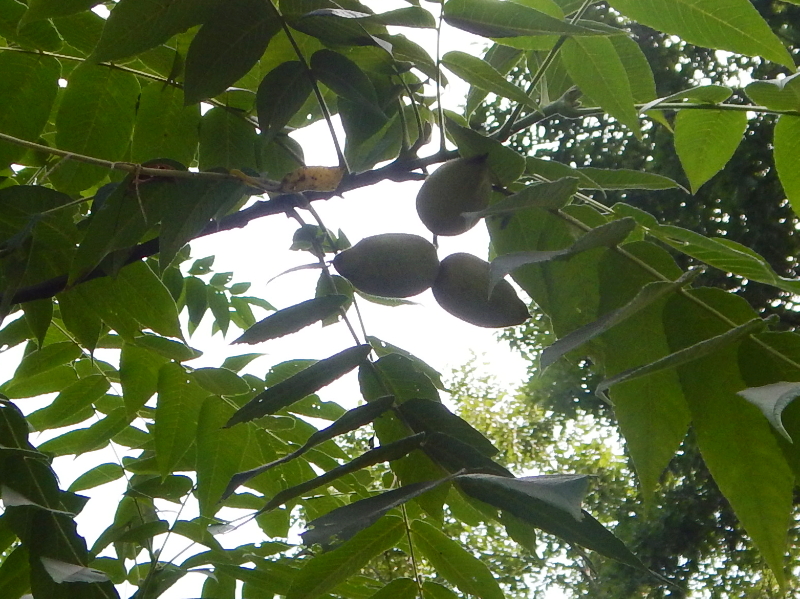
Until I saw the nuts.
Oh! So, it’s back to a butternut again.
From the class we look last winter, I was quickly able to detect one of the simplest identifying differences: the petioles or leaflets of the compound leaf.
The ash tree has about 7 leaflets arranged in opposing orientation along the stem.
On this butternut, I counted repeated occasions of 13 leaflets, and they are arranged in alternate orientation along the stem. Combined with the obvious groupings of nuts, there was little question about what kind of tree this was.
I’m a bit surprised by the significance of the canopy of leaves on this tree because the butternut canker disease is stunting the progress, or outright killing most of the butternut trees in the area. It is possible this tree has an inherent resistance to the fungus.
That would be great luck. Offspring from this tree could lead to additional trees with resistance. Invert the pyramid, I say!
On another note, I received a reply from our Forester about my findings on root girdling on the red pines. He found the report interesting and surmised the trees weren’t planted properly. He still concluded with, “Your trees may have still actually been killed by Diplodia.”
Another fungus. What’s up around here?
I blame climate change.
.
.