Winch Works
I discovered that my problem with the dead winch on our ATV wasn’t the winch or the solenoid. It all works just fine if the wires are properly segregated. What would mess with the wiring?
 RODENT invaders!
What is the deal with mice and chipmunks that they choose to chew on wires? Does the plastic coating taste good to them? Are they trying to get more copper in their diet?
The other question I have, from driving past farm after farm with equipment parked outside year round, is how they deal with the constant threat of damage from nesting critters.
We leave our truck parked outside most of the time, and now when we lift the hood there is the disconcerting sound of collected acorns rolling down inside the lid.
The heat tapes that our gutter installer put in the problem spots of our roof and routed through the downspout and into the garage to the AC outlets only lasted one year before rodents chewed through both of them.
Maybe this explains why one of our neighbors has so many outdoor cats. A way to keep the rodents at bay.
.
.
.
.
.
.
.
.
.
.
.
Where
.
.
where are all the people
we meet along the way
for just a moment
for days, weeks, even months
sometimes years
who then vanish
for any number of reasons
they’re just gone
from our lives
as we all bob along
in life’s flow
from place to place
one job to the next
or schools
or towns that became home
surrounded by even more people
we don’t know at all
coexisting with strangers
extras in our movie
always there
but not really there at all
mobile mannequins
starring in their own biopics
that oddly don’t interact with ours
as scenes play out side by side
day after day
on the highways, in restaurants, and stores
the paths of our parks
with pets in tow
all these people we don’t even know
without the ones we did for a time
who’ve exited, stage left
while we continue on
with our small cast of family
and unique special friends
floating together
where the current goes
in the mysterious sea
of humanity
.
.
.
.
.
.
.
.
.
.
.
It’ll Do
I have seen perfection. This is not it. I have witnessed the results of master craftsmanship next door at the lake place. First you flawlessly prepare the logs, then you apply coat after coat of tung oil to get a beautiful finish that will protect your logs from the elements.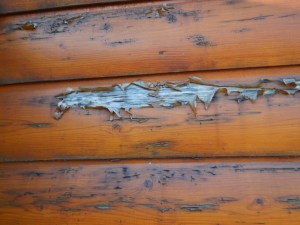
I don’t have it in me.
Currently distracted with trying to do the necessary lumberjack work around here, tend to the all-too-frequent lawn mowing requirements, manage the unending supply of manure to be composted, fix fences, maintain trails, replace the ATV winch, cut the over growing pastures, rake the round pen, fill in the growing ravines in the paddocks, and work the day-job, I have elected to try getting away with doing an almost embarrassingly perfunctory job of patching the most needy bad spots on the house and shop garage.
If I actually execute this plan, it will be a big accomplishment of overcoming my perfectionistic tendencies.
Yesterday after work I ran a little test to see if putting the least amount of effort toward the task will produce a passable result. We have the advantage of already having plenty of cans of stain that were left by the previous owners, but I have no idea about the shelf life of this stuff, so the advantage comes without providing much in the way of confidence.
 I followed up on a tip to use compressed air to help remove the old flaking finish, but quickly found my tank isn’t designed for the task. The pressure drops rather quickly, greatly reducing the effectiveness. After testing a few other methods, I settled on doing a rather superficial job of surface cleaning.
I was excited to find a stirring apparatus stored with the stain that I can connect to my drill for thoroughly mixing the product. The one half-filled can I opened looked fine to my untrained eye, so after a good stir, I dipped in a brush and started painting the stuff on the siding.
It may not look ideal and it probably isn’t going to provide maximum protection, but it is better than doing nothing at all, which was the option we went with last fall.
All things considered, I’m hopeful this effort will suffice for getting through another winter, at the very least.
.
.
.
.
.
.
.
.
.
.
.
Entryway 2.1
 Back in the first week of August, I posted about the bush at the front door of our house dying an unexplained death. A few days after I published the picture, I arrived home from work to find the dead branches all gone.
Cyndie had cut it back to the main trunk, saving that for me in case I wanted to balance some rocks on it.
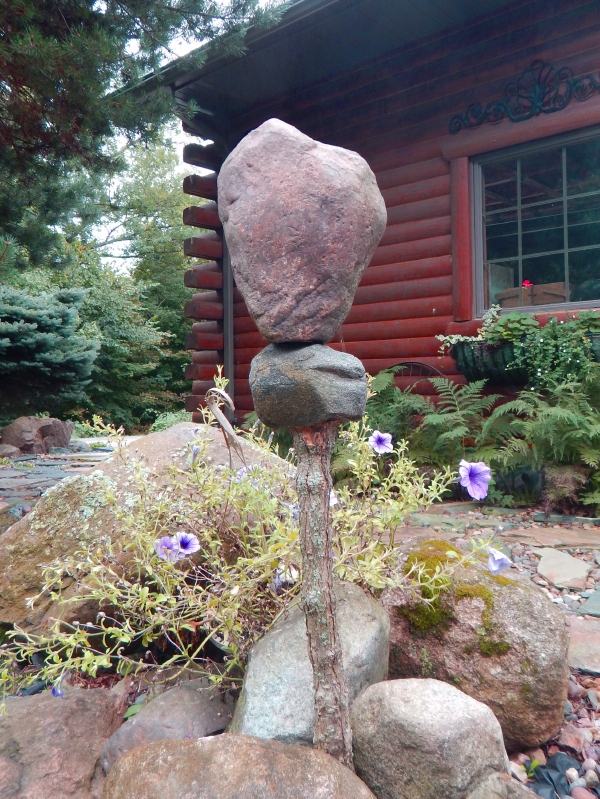 That was all the invitation I needed.
I didn’t actually believe this would last as long as it has. When I pass by with the lawn tractor while mowing, I fully expect the stone to topple over from the vibration, but it has survived multiple mowings thus far without falling. There have been a few rainy and windy days, too, but it continues to stand.
I never expect balanced rocks to last, but when they endure for long periods of time, I grow increasingly attached to them. It becomes hard to try something fresh after they come down, because I get more interested in trying to get back what we had before.
That’s probably a good metaphorical life-lesson for me right there.
I’ll ponder that as I gaze a while longer at the mesmerizing balanced stone.
.
.
.
.
.
.
.
.
.
.
.
Unsurprising Revelation
It does not surprise me one bit that recently discovered documents reveal the influence the sugar industry applied to deflect attention away from sugar and toward saturated fats as the culprit in a link with heart disease back in the 1960s.
 This successfully contributed to a national campaign to reduce fat in our diets. How ironic that the net result some 50+ years later is an epidemic of obesity.
I bet that’s not hard on people’s hearts.
A trade group called the Sugar Research Foundation, known today as the Sugar Association, paid three Harvard scientists to publish a report and made it clear that they wanted the results to favor sugar. The rest is history. Bravo. They have profited handsomely and altered the health of a nation for the worse.
The food industry responded by reducing fat in their products, and adding sugar.
.
Please, read the labels of processed foods you eat and pay attention to both the serving size and the grams of sugar. You won’t be able to see what percentage of the daily recommended amount of sugar the food contains, because industry lobbyists have successfully influenced politicians to keep that incriminating fact out of sight.
We have to do the math ourselves. Be informed. Eat smart. Be healthy.
Good luck. You will be up against an industry that is banking on people not stopping themselves.
.
.
.
.
.
.
.
.
.
.
Feel It?
 The sun set at 7:30 last night. The last two nights were chilly enough to require sleeping well-tucked under the covers. Change is upon us once again. We have color showing up in the trees. I was inspired to apply a new coat of waterproofing to my boots.
There is no doubt about what lies in store for us in the weeks ahead.
Shorter days and colder temperatures bring a shift in priorities. I need to start identifying items that shouldn’t freeze and moving them to safe storage.
It occurs to me now that I still haven’t fixed the winch on the Grizzly, which I will need for the snow plow blade this winter.
How’s that for living in the moment? I’m already thinking about snow season.
 While I’m focused on the future, the sunny September weather is serving up some delicious days. It wasn’t lost on me yesterday, as I basked in the warm glowing sunshine with the cool gusts of wind.
Cyndie started the day working with clients in the arena space and later moved to the round pen. It had dried up wonderfully, allowing activities to proceed as intended.
This time of year is pretty dreamy around here, when it isn’t rainy. It’s my favorite.
At the same time, it tends to bring with it a feeling that the other shoe is about to drop.
I can feel it coming.
.
.
.
.
.
.
.
.
.
.
.
Definitely Wet
Cyndie is leading a workshop session this weekend, which normally involves use of the round pen. Friday, in preparation, she spent some time pulling weeds from the sand because the wetness made the chore easy. After that, the plan was to drag the pen with the rake behind the ATV.
Unfortunately, it was too wet for the 4-wheeler. I waited until yesterday and then checked on whether I should try raking it by hand. It was even wetter than she had described.
That happens around here. After a day of sun, when you’d think the ground should be getting dryer, it actually gets wetter. It takes a day or two for the ground water to make its way through our property from land above ours.
Yesterday morning the round pen sand was like soup in places.
—For some reason, that picture tends to look reversed to me upon first viewing, so that the footprints appear raised up above the background. Sometimes it is a struggle to get my brain to correct the perception, but when it suddenly does, I find it almost impossible to go back and see it as I previously had. An interesting optical illusion.—
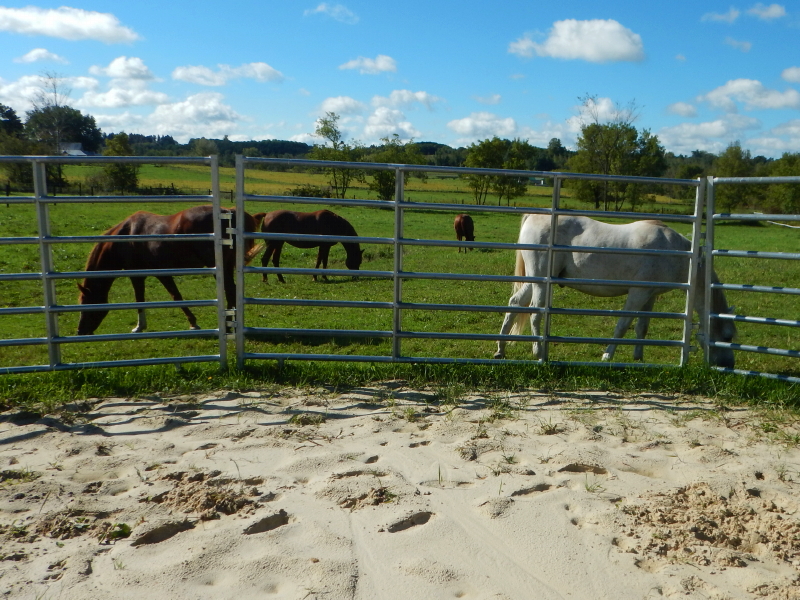 While I was raking the muddy slop, the horses meandered over to offer their moral support, grazing nearby.
I’ll check the sand again this morning, in case the low dew point temperature, sunshine, and breezes of yesterday helped dry things enough to make it useable, but I’ll be surprised if it did. I was mowing through standing water in a few places yesterday afternoon.
The grounds are definitely wet around here, top to bottom.
.
.
.
.
.
.
.
.
.
.
.
.
Uncharacteristic Wetness
Over and over, day after day, waves of precipitation have been dumping rain on top of the rain from the day before. Even though we might get a couple of dry days every so often between the waves, it hasn’t been enough time for the ground to drain.
This isn’t the kind of weather we usually get at this time of year. In my lifetime, the middle of summer would be when lawns started to turn brown and required watering. As fall arrived, the creek beds and swamps would all be dry.
That doesn’t seem to be happening anymore. Last year, I was surprised that I had to keep mowing the lawn just as frequently in the fall as I did in the spring. Now it is happening again, although this year it is even worse. I can’t keep up with mowing the fast-growing grass because the rain has been too persistent.

 .
.
.
.
.
.
.
.
.
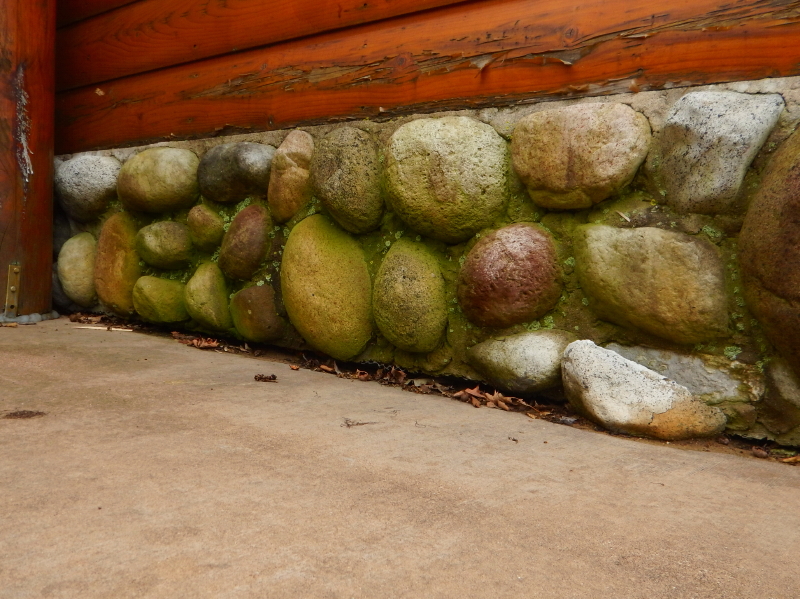
The wetness this year has led to the dermatitis our horses are dealing with, and yesterday I noticed the excessive moisture is starting to show up on the house and garage. The step to the front door of our house stayed wet along the seam and was showing signs of moss growth. The stones along the base of the garage are turning green with algae.
It feels like the climate is changing.
I wonder if anyone is looking into the possibility.
.
.
.
.
.
.
.
.
.
.
Not There
It has been 15 months since I began paying attention to how much sugar I was consuming on a daily basis and trying to achieve a level closer to the World Health Organization’s recommendation of limiting sugar to only 5-10% of my daily calories. Prior to that time, I was consuming the daily total and more by the completion of my breakfasts. By the end of the days, I was likely hitting somewhere around quadruple the recommended amount.
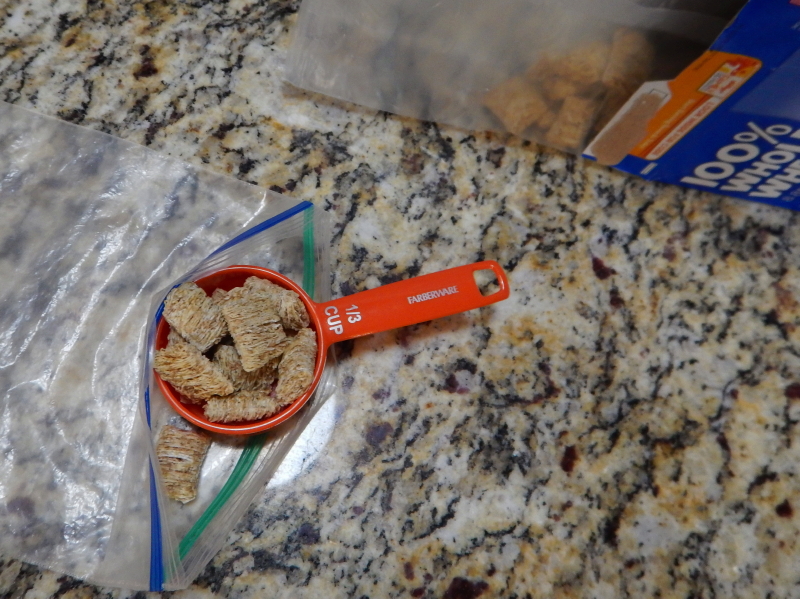 For more than a year I have been measuring the amount of cereal and yogurt I serve myself to keep the serving size small enough to provide no more than 10 grams of sugar per meal. Based on a 2000 calorie per day diet, I was aiming to stay below around 200 of those calories to come from sugar.
One gram of sugar contains 3.87 calories.
One trick with my plan is keeping the total calories at the daily target of 2000. The average American diet all too easily exceeds that amount. So, by wanting to reduce my sugar intake, I found myself also bringing my total calories down. That is not something I ever bothered measuring before this effort.
I simply knew that I should aim for a balance of obvious healthy choices. At the same time, an addict will respond to urges that exceed what they know to be healthy. I was addicted to sugar.
Not only were the lab results for my blood work revealing I was pre-diabetic, I was uncomfortably pudging out. The love-handles and belly bulge, the flabby arms, and my usual full face were ever present and slowly expanding.
My main goal was to appease the pressure from my doctor to get my numbers down for glycosylated hemoglobin, or HbA1c. After a year of working on it, I was looking forward to this year’s physical to learn the results of my efforts.
Much to my surprise, I’m not there yet.
Two years ago, my HbA1c reading came in at 5.8. My clinic seeks a level of <5.7, so I was just barely outside their “normal” range. Thus, the diagnosis of “pre-diabetic.”
My results this time, after a year of attention to my sugar intake, came in at 5.9.
Humpf.
Doc says there may be some genetics involved, as well as the fact that as we age our pancreas function deteriorates. I figure it’s because I had eaten so many of Cyndie’s sweet caramel rolls over the years, it will take me longer than a year to purge the glucose from my system.
So, my HbA1c may not have come down where the doctor wants to see it, but in the past year I have pleasantly reduced most of that flab that I never liked and I’ve dropped 8 pounds since my last visit to the clinic.
I’ll claim that small victory and keep measuring my sugar grams in search of a lower number for the level of my hemoglobin-bound-to-glucose next year. I want to keep my diet below the daily amount of recommended sugar to help my body as much as possible.
My poor pancreas isn’t gettin’ any younger.
.
.
.
.
.
.
.
.
.
.
.
New Affliction
What now? Last week, Cyndie alerted to what she thought was a cut wound above one of Hunter’s back hooves. She tried treating it by washing and applying an antiseptic and then we went away for the weekend. Upon our return, it appeared to be scabbing over, but it also seemed to be spreading.
An online search produced a pretty accurate match for mud fever. Not fun. She made an appointment with our vet to move up the annual fall visit to today so we can take care of this as quickly as possible.
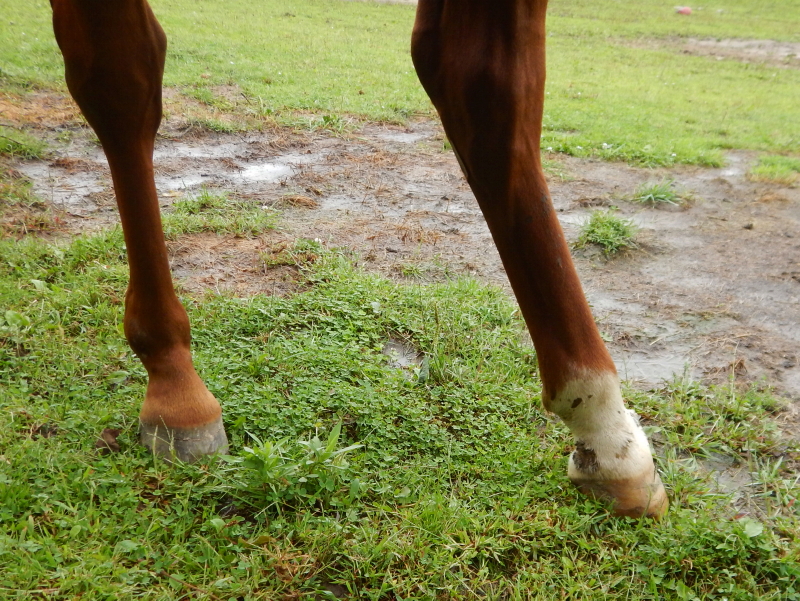 The poor guy appears to be favoring it quite a bit and it is visibly swollen. Cyndie thinks it is getting painful for him, as he won’t let her do anything with it now.
The vet will be able to sedate Hunter which will allow them to clean it up and treat the disease.
We assume the frequent rains and prolonged resulting wetness we have been enduring is a contributing factor. One response to that will be to keep him stabled in the barn. Oh joy.
But I will accept that outcome if it will cut this disease short. From what I have read about it, this pastern dermatitis is not something we want to mess with. It is contagious, difficult to treat, and can quickly become a very serious condition.
Send us some love and healing to Hunter!
.
.
.
.
.
.
.
.
.


