Posts Tagged ‘trees’
Micro Climates
This morning while walking the trails with Delilah instead of lingering in bed to write this blog post, (because Cyndie is gone for 10-days to Guatemala visiting Dunia and family, helping guide some equine-assisted seminars while there) I was struck anew by how different our property is in as little as a few feet separation.
In the woods, the prominent grouping of trees change from oaks and maples to butternut and poplar. The trail transitions from hard soil to mossy to grassy to muddy to sticks and dirt.
 .
.
.
.
.
.
.
.
.
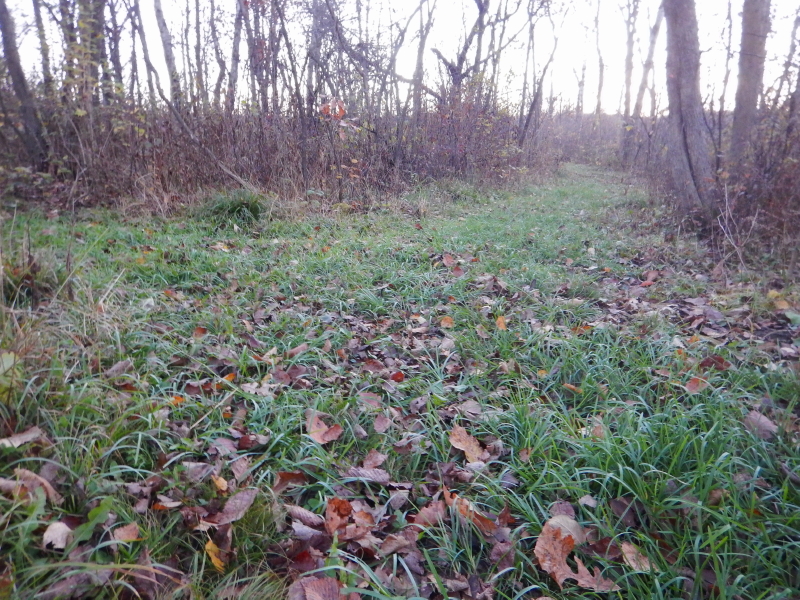
I paused to take a picture of a spot that grows a beautiful carpet of medium-length grass and Delilah photobombed it. I like it!
Popping out of the woods, suddenly we are walking beside open fields, each that have their own characteristics of differing grasses, prominent weeds, and volunteer trees trying to grow. Of course, we also have paddocks with horses in them.
Cayenne had isolated herself away from the rest of the herd by grazing a spot that dead-ended around the round pen and she was making her way back to the paddock upon noticing Delilah and I approaching. I figured the morning feed was her priority, but when dog and I came around the bend I found her nose to nose with Hunter.
He received her invitation and they set about grooming each other before coming up to eat the morning serving from their feed pans.
Standing with the horses, the muddy trail at the bottom of the hill in the woods seems like it must be miles away.
It is only a minute away by foot.
.
.
.
.
.
.
.
.
.
.
.

Paving Paradise
We are experimenting with a new way to improve a particularly wet and muddy portion of one trail through our woods. Originally, I was hoping we could simply cover it with wood chips. It worked for a while, but we haven’t been chipping branches frequently enough to produce the supply needed to cover all of our trails.
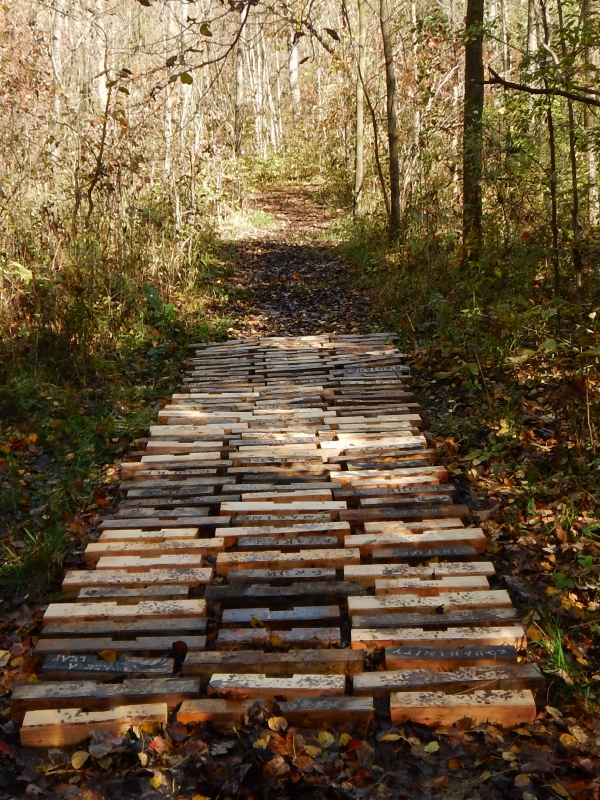 The piles of wood blocks that I have been pulling off pallets salvaged from the day-job are suddenly proving valuable. Instantly, we have gone from having too many of these lying around, to not having enough to cover the muddy lengths of trail that need the most help.
It is interesting to consider the path (no pun intended) these pieces of former trees have traveled. Somewhere, trees are cut down and milled into boards. Then the wood gets cut into these shapes and nailed to pallets. The company that manufactures the products we receive at the day-job mount their units onto the pallets for shipment and charge the end customer for the wood.
We have asked if they wanted the pallets returned for reuse, but like so many other things in today’s world, since already paid for, they apparently weren’t worth the trouble. We end up with perfectly good, single-use pallets out of brand-new wood, albeit with four odd blocks nailed to the tops.
I’ve been pulling the nails to remove the blocks and using the pallets as a floor in my wood shed and beneath stored hay in the hay shed. I also claimed boards off some pallets to build hay feeding boxes for the 4 stalls in the barn. All the while, the odd blocks that were removed have been piling up.
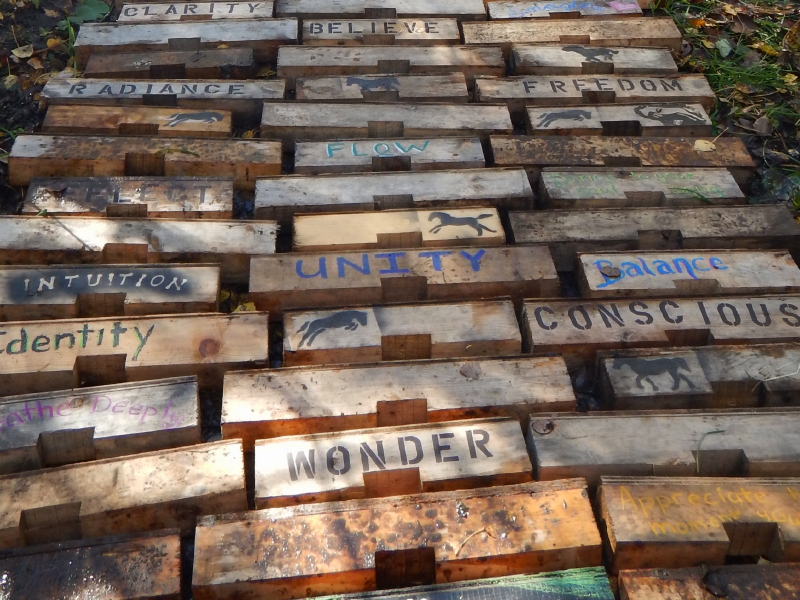 When Cyndie started looking into a boardwalk as a way to get up out of the mud on our trails, we landed on the idea of using the blocks. She wanted to add some words of inspiration and enlisted Anneliese to join her in creating the enhancements.
Yesterday we laid down the first test run. So far, so good. Only a couple more miles to go. I hope there will soon be a lot of new orders for that equipment at the day-job.
It is poetic justice that we’ve found a way to ultimately bring this pallet wood full-circle, placing it on a forest floor once again.
.
.
.
.
.
.
.
.
.
.
.
Different Look
Even though it happens every year, I still find it amazing to witness the change that evolves in a forest at this time of year. I look at it every day, but it seems to happen mysteriously. Space just opens up and all of a sudden you realize it is possible to see through to the other side of a grove of trees.
A couple of months ago, it looked like this:
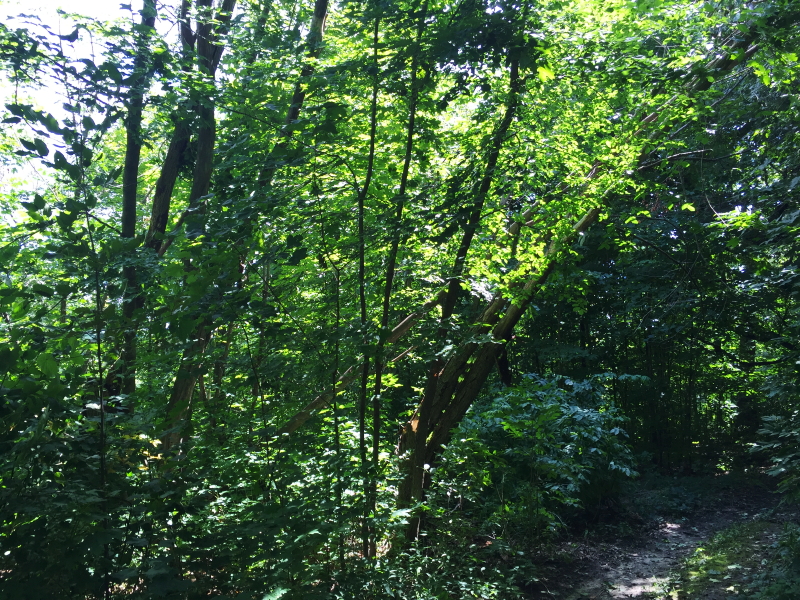 Yesterday afternoon, it looked like this:
 The forecast for temperatures tonight and tomorrow morning includes the possibility of frost. That means it is time to drain and coil our garden hoses, and blow out the buried line that runs down to the labyrinth spigot. I even heard use of the word “snow” in predictions for areas of northern Minnesota.
Regardless the overall general warming of temperatures around the globe, we still get cold enough here in the winter to have snow.
I love that our weather changes dramatically with each season, but it would be nice if just once, the seasons weren’t in such a hurry to come and go.
.
.
.
.
.
.
.
.
.
.
.
Autumn Ambiance
 I stepped outside to search for some fall scenery to photograph after I got home from work yesterday and was rewarded well beyond my expectations. It helps to never grow too accustomed to the beautiful surroundings we enjoy here.
It would be a shame to ever take this gorgeous place for granted.
The key factor yesterday was that it wasn’t raining. There was actually some blue sky visible. With a high pressure system moving in, we are hoping to for several dry days in a row. It is likely to deliver a dose of our best of autumn weather.
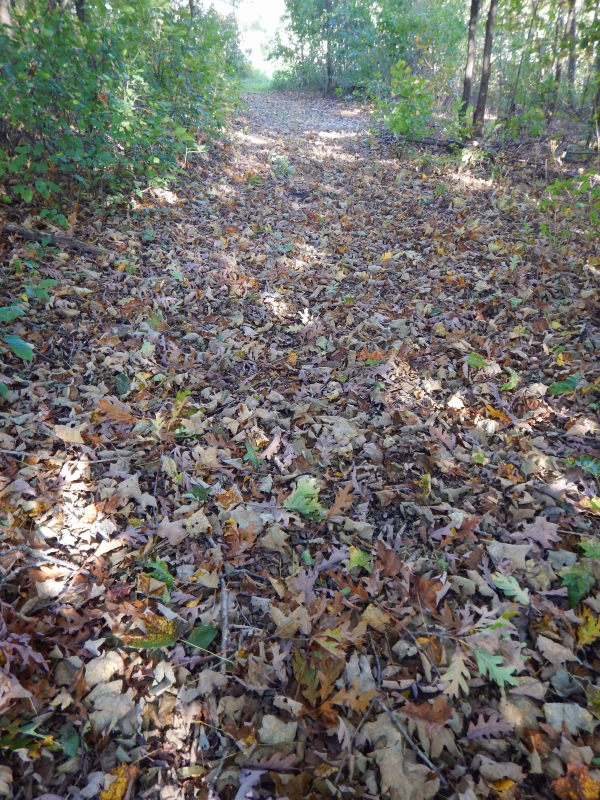 Many of our trails are developing a carpet of fallen leaves that provide a crunch when you walk. More importantly, they are filling the air with the unmistakable scent of the season. When I walk toward the pastures and pop out of the trees, the horses show signs of wondering what huge creature is making all that racket.
Just this huge creature, is all.
When I got down to our Rowcliffe Forest Garden Labyrinth, the sunlight was getting low. Cyndie had recently mowed and weeded the labyrinth, which gave it a well-tended glow anyway.
I walked to the far side and paused to stare at the beauty all around me. I was looking away from the entrance for the shortest of moments, and when I turned back around I was startled by the sudden silent presence of a lone young deer happily standing nearby.
It was as if it had magically materialized in the spot. I realized right away that it was totally unaware of me standing there. When it stepped through our fence and walked into the pasture to graze, I stealthily moved to a rock nearby and lifted my camera to capture the scene in video…
.
.
.
.
.
.
.
.
.
.
.
.
Bitter Discovery
There is a tree beside the shop garage with a canopy that overhangs a significant portion of the roof. There is no mistaking that it is a nut-tree, because this time of year it starts dropping its fruit with a bang. If they hit just right, it can make a sound like a shot from a rifle. Even if they don’t hit just right, the clank is unpleasantly startling if you are close, and surprisingly loud if you are further away.
That initial report is followed by an amusing rattle as the seed pod rolls down the slant of the metal roof. You can hear them gaining speed as they approach the edge, where they then drop down to another metal roof that covers the entry door, before rolling off that surface to the ground.
The driveway in front of the garage is getting littered with nuts, so I decided to collect a few of them. I was under the impression that this tree was just like the many other nut trees on our property, butternut trees. Since the nuts of the butternut tree are known for having a good flavor, every fall I feel like we should be collecting them for use somehow.
We did take a crack at it the first year we were here, but while waiting for them to dry out, they got all funky and we threw them away. I wanted to try again. I encouraged Cyndie to start collecting them and look up ways to prepare them for consumption.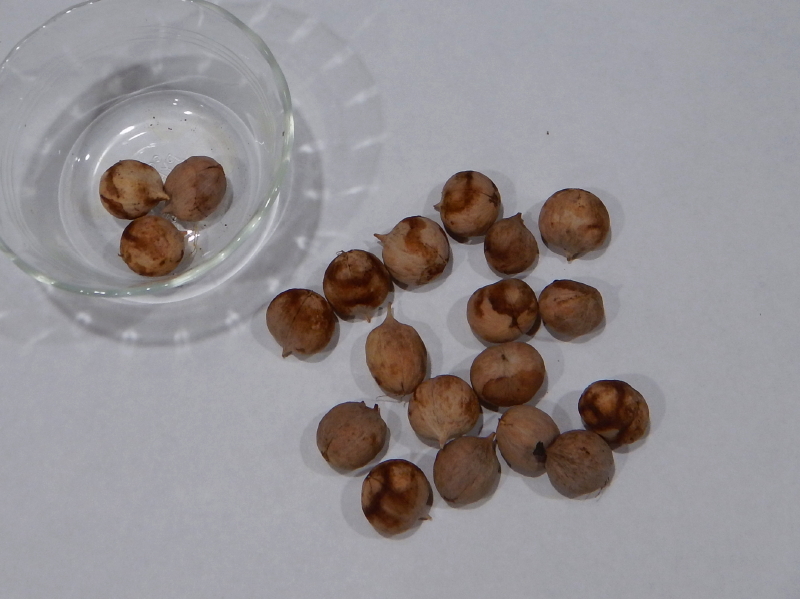
A day later she was asking me to look into it, because these didn’t look like the pictures she was finding for butternuts.
Sure enough, I quickly discovered these were not butternuts. This tree is a bitternut hickory, providing just the opposite of good flavor. I think it is funny that it took me this many years to figure out it was a different nut.
While researching a comparison of the two types of trees I stumbled upon an alarming detail about the butternut tree. It produces a toxin that can stunt growth or even kill certain susceptible plants in the vicinity of its roots.
Included in the list of susceptible plants: white pine and red pine.
Could that be what has been taking out our pines?
Plenty of the details match what we have witnessed in the last few years.
If I find out cedar trees can tolerate the toxin, that’s what I’d like to plant in place of those lost pines.
.
.
.
.
.
.
.
.
.
.
.
Different Ropes
 Ours weren’t the only ropes hanging in the trees over the weekend. The woods were thick with spider webs that were made all the more impressive by the drops of 100% humidity clinging to them. It was impossible to move around in pursuit of our goals without repeatedly disrupting some very impressive architecture.
Cyndie let out an audible startle when she suddenly came upon a chest-high web with the spider perched right in the center. It was probably just finishing a meal.
I tried to capture some of the wonder of this beauty from several different angles. I wanted to get that big leaf out of the frame and finally just reached out to nudge it aside, but it was firmly attached as a primary support. I had to leave it right where it was.
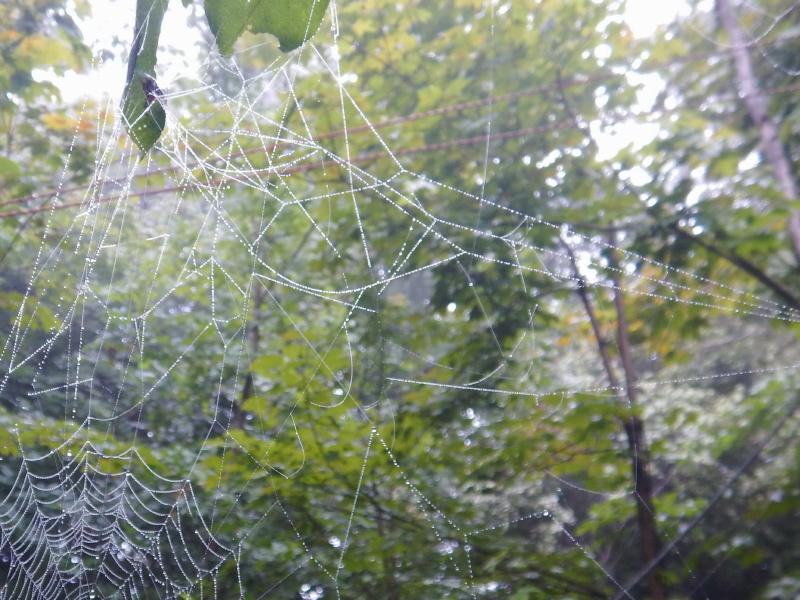 It really was the quintessential web design for the most part, but then the web maker seemed to veer off into a dramatic free form array of supports, angles, and lines.
It looked abstract enough to imply the spider may have been tipping back some fermented fruit or something. At the same time, it’s quite possible it was sheer brilliance to establish a framework on which the rest of the traditional web could rely.
You be the judge.
.
.
.
.
.
.
.
.
.
.
.
.
Incremental Progress
Thanks to the added support of our son, Julian, I made it another step closer to bringing down the last two ‘widow maker’ tipped trees in our woods yesterday. He arrived in the morning to assist me in finalizing the installation of our new signal booster for cell phones and internet connection. In the afternoon, I had him out in the woods, lending a hand with tree work.
Just having him standing by boosted my confidence to attempt a cut I had only observed in demonstration videos to release the tension of a hung-up tree and get the base onto the ground.
After that, we started the tedious exercise of tossing a leader over a high branch so we could string ropes to pull the tree back from the direction of lean. It is a daunting task.
This morning, in a thick fog that has the forest dripping wet, I plan to attach a come-along in a test of geometrical physics. I have no idea whether I have the right angles and properly placed force to coerce this dead weight off its tangled perch, but I’m happy to experiment.
The final measure of success won’t be whether I am able to get it to fall. No, my celebration will hopefully be over getting it to topple over anywhere that isn’t on top of me.
One added bit of drama this morning is that I am hoping to achieve it in a narrow of window of time before a looming thunderstorm arrives from the west.
Never a dull moment.
.
.
.
.
.
.
.
.
.
.
.
Downed Trees
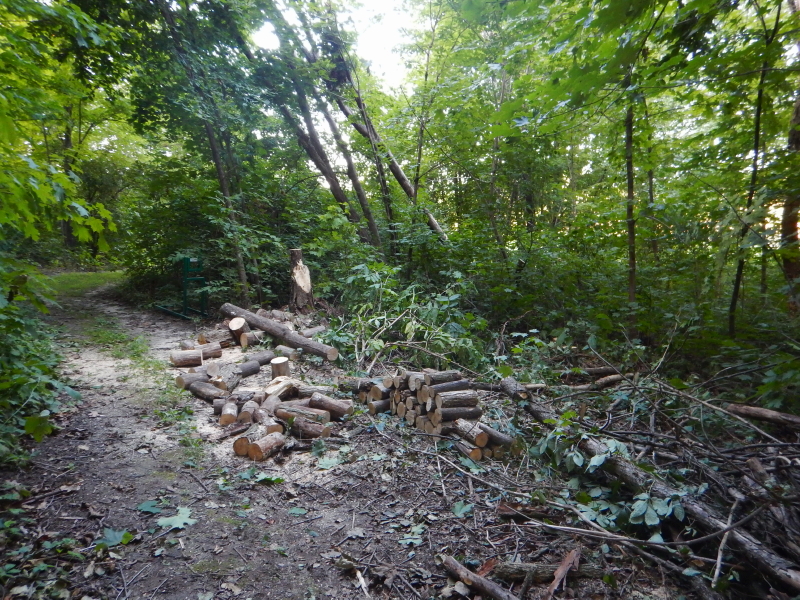 On Monday after work, I ripped into the task of cutting up the dead trees a storm had pushed over, and which I had recently shoved the rest of the way to the ground with the tractor.
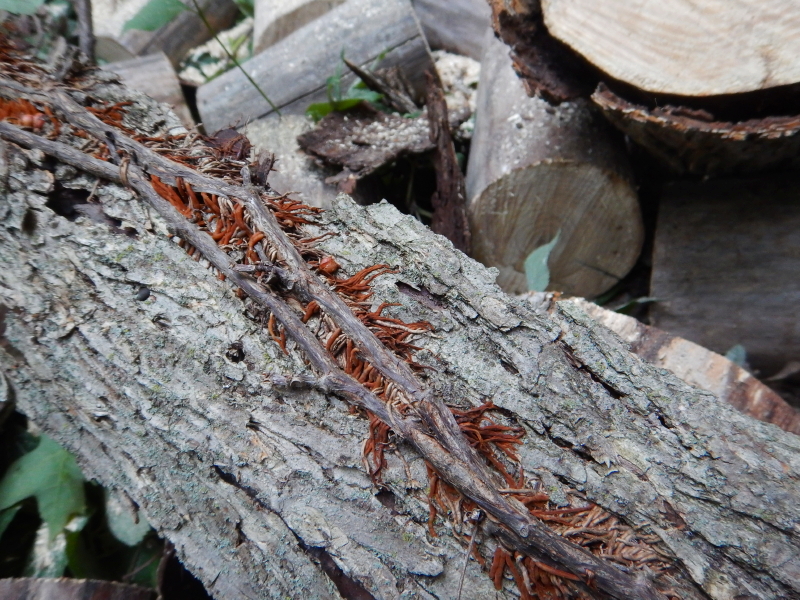
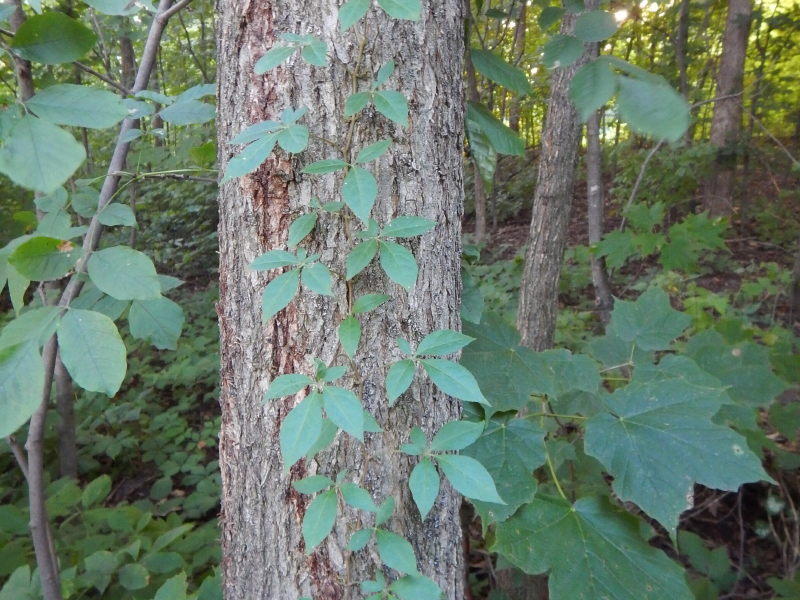
I quickly figured out what was holding up all the wind-blown trees. Regular readers may recall that I mentioned a while back that vines seemed to be thriving this year. Well, there are vines everywhere in the area of these dead trees.
It’s unclear to me whether the vines are responsible for the demise of the trees, or not. I think most of this bunch are butternut trees, which are commonly killed by a fungal butternut canker disease, Sirococcus clavigignenti-juglandacearum. Go ahead, read that out loud.
The vines might look like they took over the trees, but they may simply have climbed up trees that were already giving up the ghost.
 .
.
.
.
.
.
.
.
.
My uneducated guess is that the vine is Virginia Creeper, based on image comparisons found online. One interesting data point supporting my suspicion is this tidbit:
People should be careful when they see Virginia Creeper, because there may be Poison Ivy around also. The two plants almost always grow together.
I’ve well documented there is no shortage of poison ivy growing on our acres.
The tendrils of the stalks grab and hold the bark of the trees with incredible tenacity. It is comical how the dead trees will gladly slough off the bark, but the vines maintain a grip that results in long dangling empty tree skins hanging down from the canopy.
While cutting up the assortment of trees that made it to the ground, I came upon two vine-covered dead snags still standing just behind the spot vacated by the others. They were about half the diameter of those in the ground, so I made quick work of felling them and expanding the evening’s cutting task.
So much was accomplished, yet so much remains. The 3 trees still hung up, visible in the background of the picture above, are going to be a lot more difficult to get on the ground. I’m thinking ropes and a come-along may be involved in my next attempt. These trees are not in reach of the tractor.
Better yet, maybe the next storm that hits will be blowing in the other direction, and will push them down for me.
A guy can dream.
.
.
.
.
.
.
.
.
.
.
.
Tractor Timber
Despite the inherent risks in dealing with trees that have blown over, but remain hung up in the branches of other trees beside them, I chose to see if I could push them over using the loader on our tractor.
Whether or not it made any sense to try, I forged ahead on the idea that it just might work.
First, I needed to attach the loader bucket that I’ve recently taken to storing at one end of the hay shed.
The following is pretty much how the previous week unfolded for me, in terms of frustrations.
As I approached the hay shed on the tractor, I realized the trailer on the back of the truck was parked directly in front of the spot I needed to reach. Keys to the truck were up at the house.
I caught sight of Cyndie just crossing the yard and shouted to ask if she could grab the keys.
She turned the key and the starter stuttered the staccato clatter of “not enough battery.”
“Not again! Not now!”
 For some unidentified reason, this happens at very unpredictable odd intervals. The truck needed to have its battery charged again. It was parked far enough away that it would require an extension cord, and then I realized the nearest outlet was dead because I had borrowed the circuit breaker last fall to use for the waterer over the winter.
I swapped out the breaker, got the battery charging, and decided to do some lawn mowing. All that served to do was intensify my frustration over the odd problem of the middle blade not cutting and the outside blades cutting low. Something more than just a broken bracket must have gone wrong when it failed last week.
I did the bare minimum of ugly mowing and then put it away to start the truck.
All that frustration before I could get to the task I intended.
Compared to those hassles, the rest of my project went swimmingly. I pulled up to the trees, lifted the bucket to test the weight, and after an initial slip, successfully pushed the trees over with a resounding crash.

Yikes. It was both scary and satisfying.
Most of all, it wasn’t frustrating.
.
.
.
.
.
.
.
.
.
.
.


 Relative Something