Posts Tagged ‘limestone screenings’
Bad Chemistry
I am no chemist, but I know what transpired and the results were annoying and stinky, to say the least. This story starts in the dry days of the past summer. Days that became weeks of dry earth and high heat.
Wait, the story needs to start long before that. Skip all the way back to when we first got horses on this property in 2013. The first years we were here were rather wet ones. Put horses on wet ground and what do you get? Mud. Lots and lots of mud.
In the early years, there were several times when we were forced to put up a temporary fence around part of the gravel between the barn and hay shed so the horses could spend a little time off the mud.
The remedy to that mess came in the form of limestone screenings. Our local excavator suggested the crushed and screened limestone as a solution to the slippery mud. It worked brilliantly, although our slopes lend to a fair amount of erosion of the screenings during heavy rains.
The excavator had a solution for that, too. Keep an extra pile of lime screenings on hand to fill in the ravines. It actually worked for us. The weight of horses packs the surface and the hot sun bakes it to a solid surface that keeps the horses out of the mud.
The only downside I’ve seen is the dustiness of the screenings as a ground cover. Horses repeatedly stomp their feet to shake off flies and flies are relentless, so there is a non-stop kicking up of dust.
Anyone who lives down a gravel road knows about dust kicked up when the road is dry. One trick used to control dusty gravel roads is magnesium chloride. It will absorb moisture and leave the road looking a little damp.
What the heck. We gave it a try. Lo and behold, it reduced the dust the horses were kicking up and breathing under the barn overhang.
Jump forward to this past summer when it was hot and dry for weeks and Cyndie found herself spreading more and more magnesium chloride crystals in the area around the overhang. Maybe we used too much.
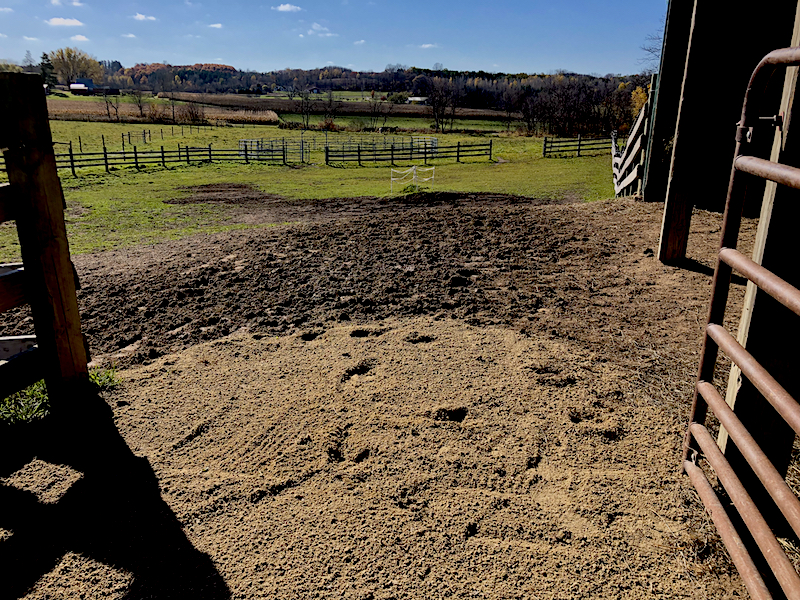 Last week we received some solid rain at an even rate for many hours at a time that was more than we’ve seen for months. The limestone screenings just beyond the overhang turned into a mare-urine enhanced stinky slurry of muddy, slippery limestone mush.
I wish we could magically extract the magnesium chloride, but lacking the chemistry knowledge of what substance might absorb those molecules, I opted for covering it with more limestone. It’ll either provide more material for the mush or it will bury the stinky stuff and get packed by the horses as the ground dries and hopefully will last until the next big wet spell.
That leads to the next complication as the temperature drops. When it becomes dangerously icy in the winter, magnesium chloride crystals work well to melt the ice around that sloping area.
Maybe I need to create a concoction of two parts limestone screening and one part magnesium chloride for ice melt to avoid ending up with more magnesium than lime.
The bad chemistry is actually a mixture of horses, big slopes, and slippery surfaces. There are only two of those three that we would seek to eliminate in this case.
.
.
Good Footing
It’s the time of year again when the thawing ground turns to mud, especially in areas where the horses walk. The first couple of years after we moved here were extremely wet in the spring, so we got a thorough lesson in worst case scenarios. The best thing that came from that was a recommendation for using limestone screenings in our paddocks.
I was unsure, at first. The searches for information we conducted tended toward extensive projects involving removal of all topsoil to some significant depth, and then installing expensive plastic grids and laying down thick layers of sand or crushed stone.
We opted for the least complicated idea, as a first test. We simply spread a thick layer of limestone screenings over the existing soil. The first time it rained, I figured we had made a big mistake. The lime screenings took on the water and became like thick, wet concrete. The horses sank right down in it. If it got below freezing overnight, the endless craters of their hoof prints would create an almost unnavigable landscape until the next thaw.
All it took was added time for the screenings to cycle through being packed down by the horses and baked by the sun, to set into a firm base that could support the horse’s weight. Other than the setbacks of losing a lot of material when heavy downpours created deep rills and washed screenings away, the overall result was proving to be worthy.
We simply ordered more limestone screenings and filled in the voids. So far this year, the surface is holding. Look at the dramatic difference from the areas we haven’t covered yet:
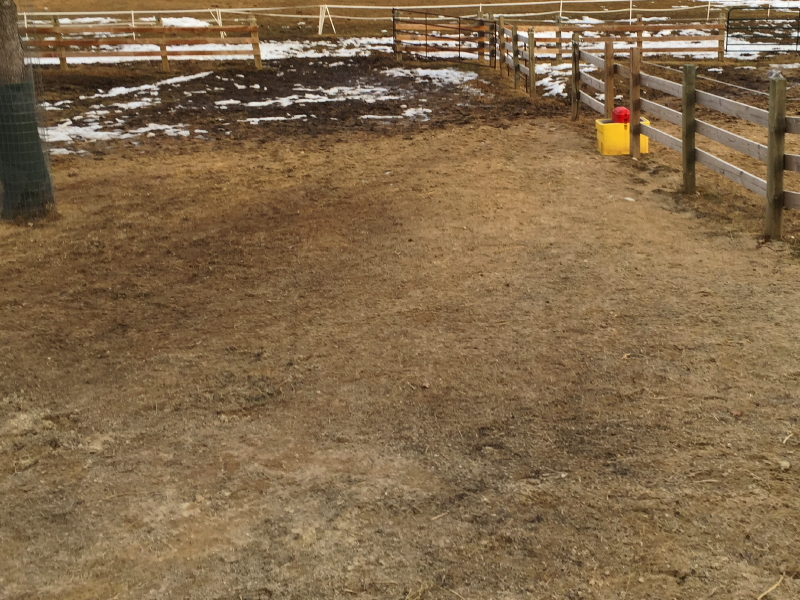
 .
.
.
.
.
.
.
.
.
We definitely need to order more, as we have yet to cover the critical heavy traffic areas around, and through, gate openings. The big challenge with bringing in more loads of screenings is the damage caused by the trucks delivering the heavy weight. We need to determine the right compromise of cost per benefit. A smaller truck would do less damage, but having smaller loads delivered drives up the cost a huge amount.
I find it hard to decide how to calculate the cost of damage that the full-sized truck does. Mostly, it costs me peace of mind, as it bums me out to break up more of the asphalt or get deep compressed ruts on our land. We figure the driveway is already a lost cause, so it becomes a matter of tolerating the additional damage until we take on the project of resurfacing it. Getting rid of the deep ruts hasn’t been a piece of cake, either, and who knows what damage it is doing to roots or my buried drain tubes.
For the most part, we plan to confine dump trucks to our driveway, and we will just have to move the delivered loads to any final destinations using our tractor.
Here’s a shot of Hunter showing how nice and dry the footing is on the well-set limestone screenings up near the barn. Niiiiice.
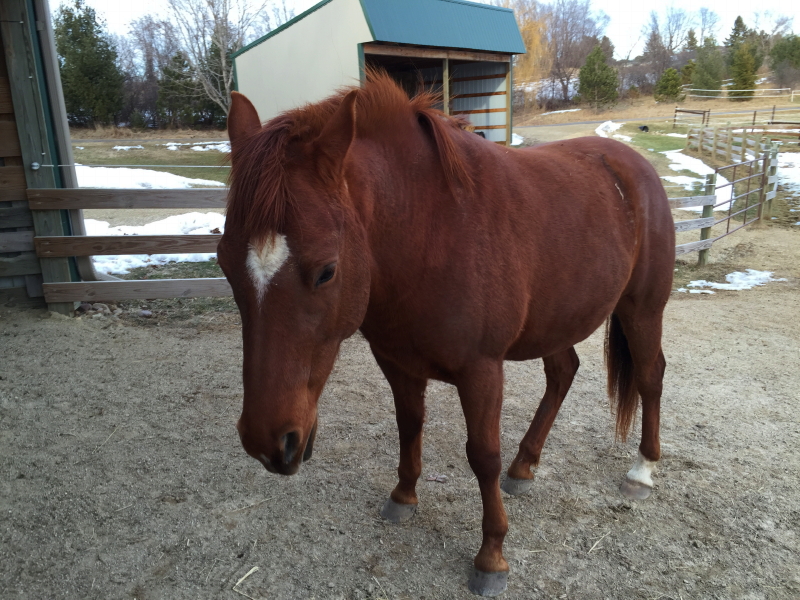 No complex process of soil removal and inorganic sub-surface installation. Just limestone screenings dumped on top of the existing surface and spread out to a depth of 6-8 inches. Oh, and time. About a year of horse traffic, hot sun interspersed with soaking rain, more limestone screenings to replace what runs off, more sun, and more packing. Walaah. Good footing.
.
.
.
.
.
.
.
.
.
.


 Relative Something