Posts Tagged ‘trees’
Long Goodbye
We are thoroughly enjoying what is turning out to be a superb stretch of end-of-summer weather this week. It makes me realize how many times earlier in the season we were subject to rainy days that interfered with our plans. Summer is showing us some mercy and executing a precious long goodbye with warm sunshine bathing the leaves that are transitioning to their brilliant fall colors.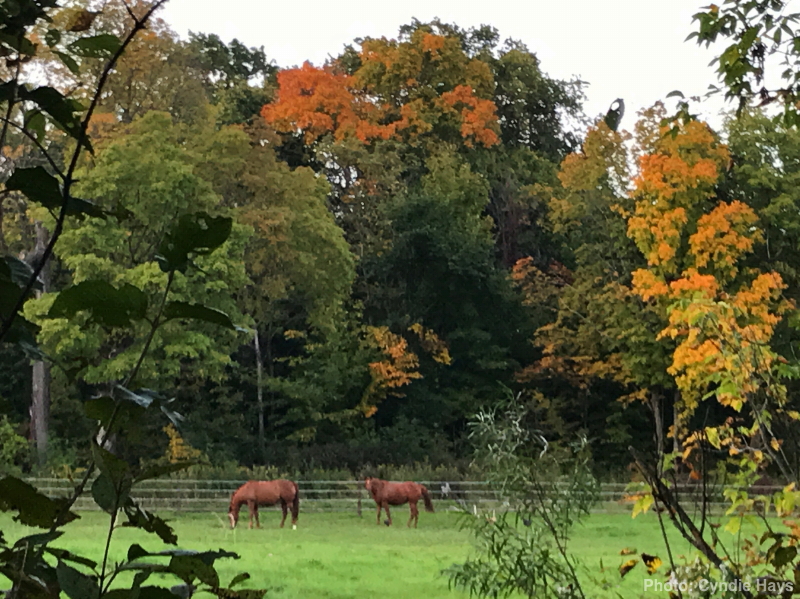
Now if we only had some big plans scheduled for these gorgeous days. Instead, our next event is happening this coming Saturday, when the forecast changes from all sunshine to chances of rain. Timing is everything.
In the mean time, we are soaking up the beauty and relishing the picture-perfect summery-ness of these waning days.
.
Doesn’t this just make you want to sit a spell?

.
.
.
.
.
.
.
.
.
.
.
.
.
.
Getting Orange
Things are growing more orange around here. Yesterday at breakfast, Cyndie called me to come look at the difference in color of our eggs, compared to the ones purchased at the grocery store. Looks like the free-range diet of our three chickens is producing deep color in the yolks, seen on the right, below.

We spent the Labor Day holiday doing a lot of work, for a day off. Starting with a couple of hours cleaning out the compost area, using the loader bucket on the diesel tractor. There’s now plenty of room to store a winter’s worth of manure, just in case winter gets around to showing up.
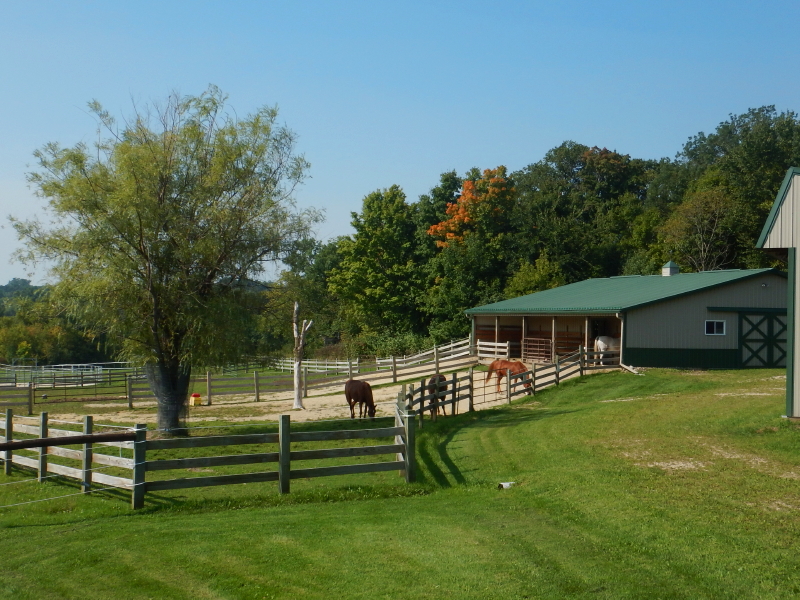 Then we split up and Cyndie used the power trimmer in the labyrinth, while I entered a race against time to get the hayfield mowed before it rained.
Looking back toward the horses, I spotted another splash of orange color erupting from the green of our tree line.
It’s beginning to feel a lot like September.
At the end of a long day’s effort, we put our tools away and headed for the house under the drops of a perfect late-summer rain shower.
.
.
.
.
.
.
.
.
.
.
.
.
.
Periodic Maintenance
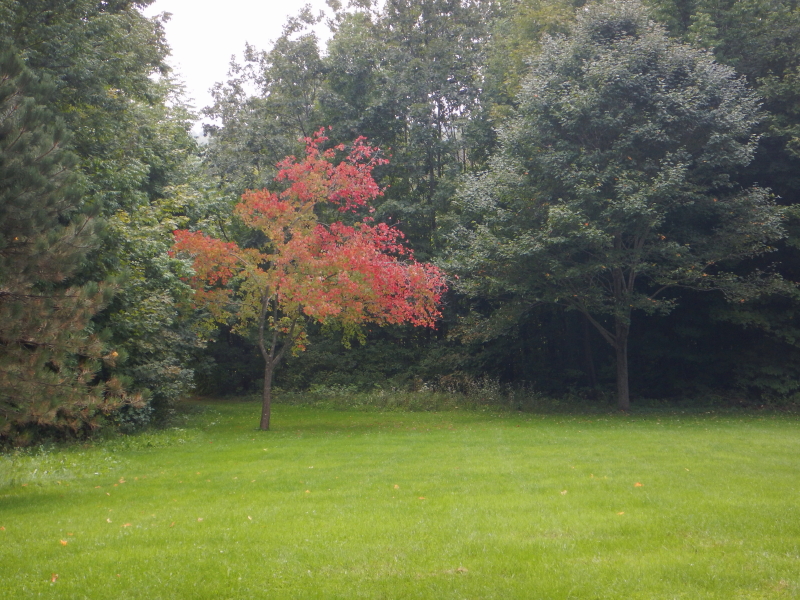 That tree in our back yard which leads the way in changing colors is cranking it up to full blaze now that we have arrived within the month of September. This image doesn’t to justice to the view, because our sunlight was muted by the smoke of wild fires in Canada and the western U.S. most of the day yesterday.
I spent time in the morning consulting with a specialist from our county soil conservation office as he surveyed the situation where the neighbor’s tilled corn field is overflowing my silt fence. According to him, we have done all the right things for drainage on our property, adding that compared to other sites he reviews, our problems are not very significant.
My perfectionism sees it otherwise.
He did basically fault the neighbor, of whom I gathered he didn’t hold a high opinion. The best fix to hold the soil would be for the neighbor to plant hay in that field, instead of corn. I don’t have any idea if that is something I might be able to influence, but I will suggest it at the first opportunity.
On my end, I learned that the silt fence does require maintenance to remove material when it starts to fill, because he said it is obviously functioning as intended.
I will do that, but I will also add another short section of silt fence above it and then start building a berm of branches between the two, eventually creating a thicket of wild growing weeds and trees.
Since it is so late in the growing season, such a barrier will take a year to become the filter I envision, but just having the skeleton of tree limbs in place before winter will provide an additional place for the silt to build up and start a foundation for a natural barrier.
Looking at the drainage swale below our paddocks and across the pastures, the advice was to periodically reshape the high spots by digging those out as well. Funny me. I had it in my head that there was a one-time solution where I could shape the swale properly and then never deal with it again.
Why should it be any different from the periodic maintenance required on everything else?
Lawns need to be mowed, septic tanks need pumping, engines need oil changes, rugs need vacuuming, animals need feeding, relationships need tending. There aren’t many things that can be ignored indefinitely.
Land needs management. I guess I won’t argue with that logic.
Though, given that, seems to me that days need more hours.
.
.
.
.
.
.
.
.
.
.
.
.
.
Waning Days
In the slow but steady march of days away from one season and toward the next, we have now arrived to chilly mornings, complete darkness when I wake up for the day-job, and leaves changing from green to red.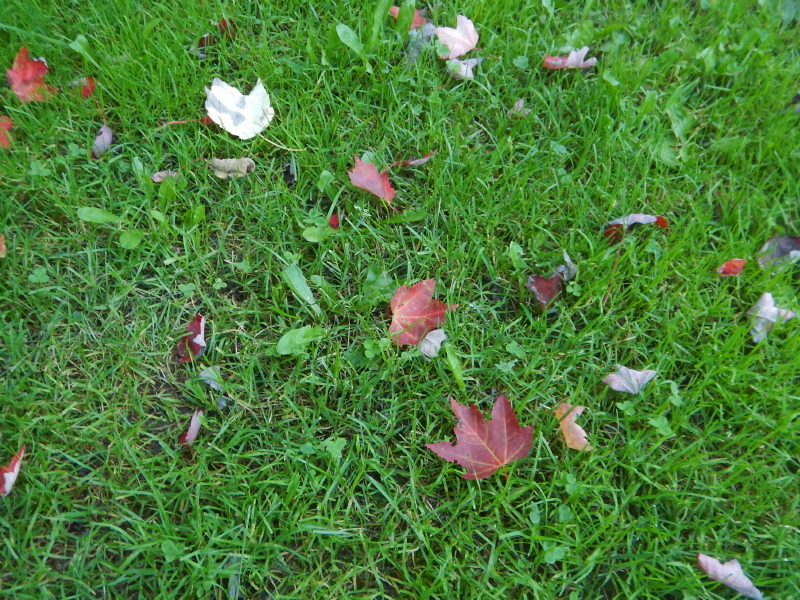
Last week when I mowed, I noticed this sprinkling of color in the grass beneath the maple tree that always turns the earliest. It’s become a reliable harbinger of the beginning of the end of summer for us.
I should be thrilled. Autumn has always been my favorite season. But I think that is changing. Maybe, with age, I am developing a more balanced perspective. I think it feels more accurate now to frame my view as appreciating all the seasons equally.
Today is the first day of the Minnesota State Fair. That means a lot more to me in theory than it does in practice. I rarely attend the fair anymore, however, the memories I hold from past visits, and the one year I worked a booth there, are a thread that keeps me feeling connected, whether I go or not. It is a blast of activity that serves as an exclamation mark at the end of summer.
 It all has me feeling a little melancholy, which is rather uncharacteristic for me this time of year. Luckily, it can’t last, as the season of wood fires brings me great joy, and we have already lit a couple in the fireplace to ward off a bit of chill in the last few days.
Bring on the fall sports, the spectacular colors, the crisp air, the end of bugs, the time between mowing and shoveling, the harvest festivals, and Cyndie’s apple crisps.
The waning days of summer become the waxing days of autumn. Bring it on, I say.
.
.
.
.
.
.
.
.
.
.
.
.
.
Tree Love
It always seems to come back to the trees for me. Even though our horses are key to the whole operation, they don’t provide near the atmosphere here (literally) as do the trees.
Despite my love of trees, I find it unsatisfyingly easy to take them for granted. Today’s post is an effort to make up for that.
I discovered a long time ago that trees and I share a similar limit to high altitudes. Every time I get above the tree line in mountainous regions, I begin to feel ill. I guess, if they don’t have enough oxygen to thrive, I don’t either.
Wintervale has some nice grazing available on open fields, but as you can see in this image, our forest of trees tower right up to the back of the barn. Our log house is nestled, out of sight, behind the first few of those green monsters.
When the french doors to the deck are open, we are effectively forest bathing from within our living room, breathing in the aromatic phytoncides.
I love the shade our trees offer, the sounds they make in the wind, the changes they display through the seasons, and the wood they provide when they die.
 I have never been responsible for as many acres of trees as we have now, and though the task is often daunting, I am incredibly grateful to have the opportunity. Tending the forest isn’t as simple as mowing the fields, but I definitely prefer it.
The primary stepping off point for our adventure to seek out and eventually purchase this Wintervale paradise was our visit to Ian Rowcliffe in Portugal. It is wonderfully fitting that Ian and I first discovered each other in an online community discussion item on the subject of trees, about seven years earlier.
For some reason the other day, I cropped out the hammock in the image I posted on Sunday.
I think I like this one better. It tells more of the truth. Makes me feel like napping every time I look at it, though.
My life would be so much drearier without all the majestic maples, oak, poplar, pine, elm, ash, and butternut crowns forming a canopy over the back half of our precious plot. I absolutely love our trees.
*****
An addendum to yesterday’s post: In case you were curious, the intuition was fading, as it took me a couple tries to get to the bottom of the problem, but I eventually found the reason the pump wasn’t coming on was a tripped ground fault interrupt. Problem easily solved.
.
.
.
.
.
.
.
.
.
.
.
.
.
Writers Know
Writers know what it’s like to experience a brilliant barrage of thoughts while toiling away on some repetitive task, mentally composing a compelling essay of significant import, only to find it all has collapsed into simple drivel when finally seated with pen in hand or keyboard at the ready.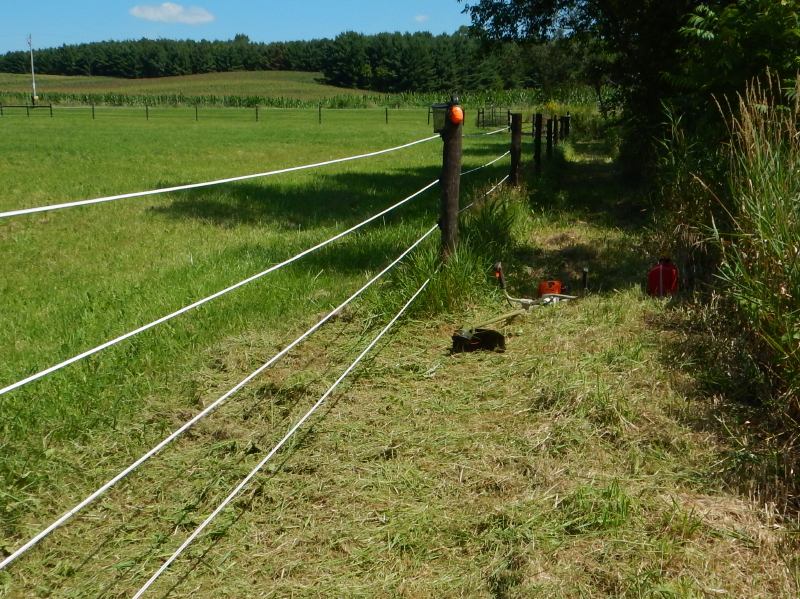
This morning, all I have left to offer you from yesterday’s hours of impressive insights are a few wisps of assurance that it likely would have been good reading, if I had captured the words in the moment. To my good pleasure, it did serve to entertain me while I muscled my way down our fence line, a foot at a time, cutting down the growth of grass and weeds that were swallowing the bottom wire and posts.
It’s possible that a key point in the evaporation of the wise and witty dialogue that was rolling along in my head occurred when I paused for a post-lunch rest in the hammock.
 I remember gazing up at the spectacular old maple from which I was suspended and snapping a picture. Shortly after that, my consciousness was swallowed by a nap. Not just any nap, but the unrivaled bliss of the summer afternoon slumber in the weightlessness of fabric hanging between two glorious trees.
Yesterday’s mental essay? You’ll have to trust me on its brilliance. If it was all that worthy, I figure it will show up again someday when I am prepared to adequately capture it.
I’ll keep my eye out for it.
.
.
.
.
.
.
.
.
.
.
.
.
Disappearing House
Two years ago, in the springtime, I mounted a bird house on the tall stump of a pine tree that had died, and then I took a picture of it.
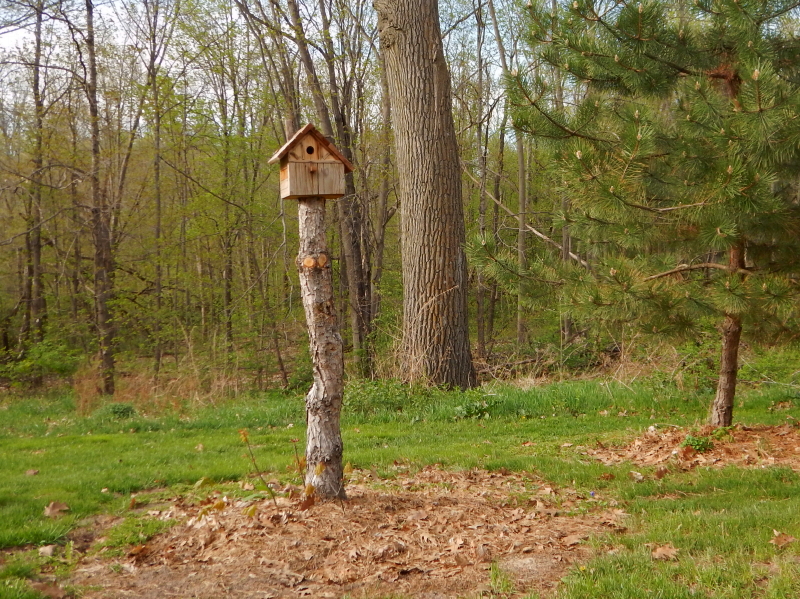 Even then, two tiny volunteer tree sprouts can be seen making an appearance at the base.
When squirrels bury acorns, trees often follow. When oaks sprout, we are not in a hurry to remove them, even when they appear in locations that may not be ideal. Who doesn’t want more oak trees surrounding them?
The same can’t be said for the scourge of box elder, common buckthorn, and thorny American plum that overtake all the neglected spaces along property lines and ditches. When they try to spread their way into our managed grounds, they meet with swift action.
This is what two years of oak growth looks like when you let nature do its thing:
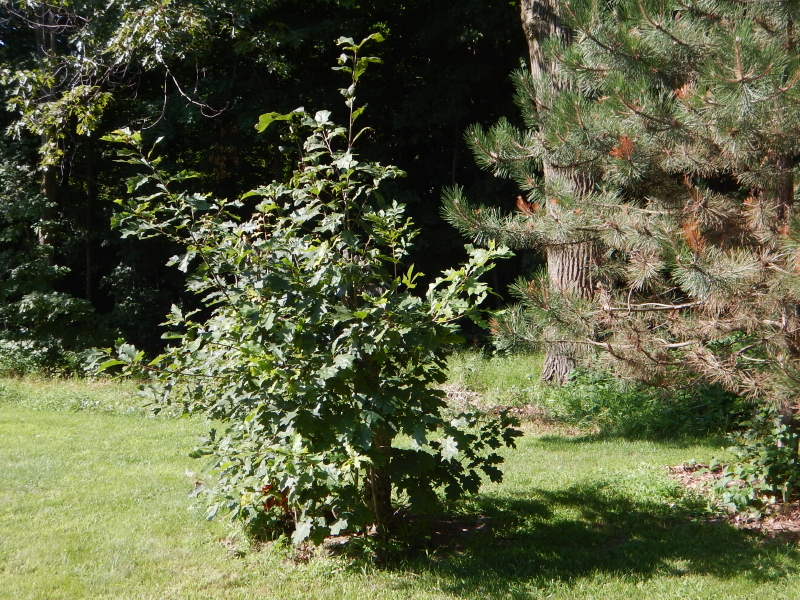
Where did the bird house go?
It is reaching the point where some serious pruning is warranted to convert this little oak shrub into a future healthy tree.
While I’m on the subject of trees, I will report a surprising turn of events for a lot of the long needle pine trees that were looking like goners last year. Many have produced an amazing effort to sprout green needles on almost all of the lower portions that looked completely dead last fall.
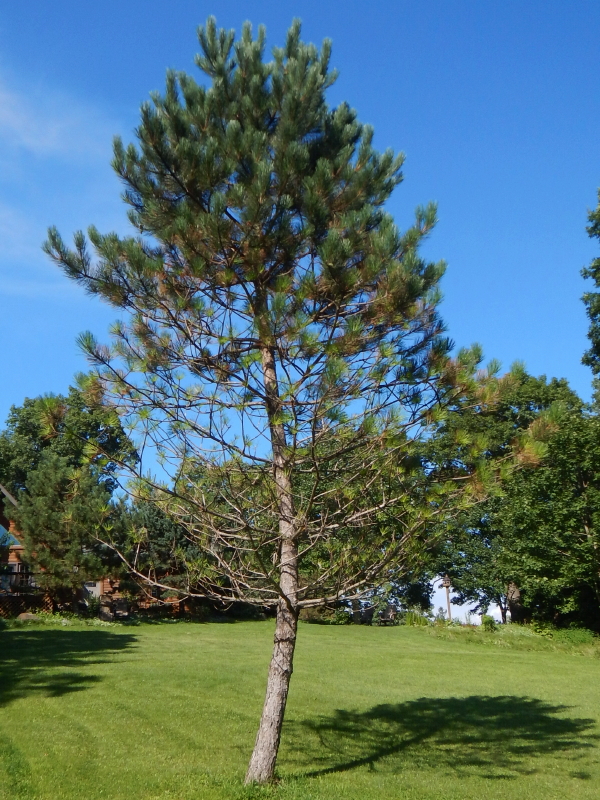
For the previous several years, the pines would try to sprout new growth on the dead-looking lower branches in the spring, but it proved futile in just a matter of weeks afterward.
This summer they seem to be enduring just fine. Temporary reprieve? Or, signs of hope for a future full-recovery?
We’re going to imagine it a step toward recovery. It is helping me to understand the amazing resilience of growing things, and justifies my tendency to be slow in making decisions about giving up on plants without giving them the potential of another season to get over whatever might be dragging them down.
Maybe soon I will be able to remove the bird house from the stump and hang it from a branch in a new maturing oak tree in our front yard. Not that I think that pine stump will be making a comeback anytime in the future.
.
.
.
.
.
.
.
.
.
.
.
.
.
Growing Hope
Our hope is growing for the maple tree we transplanted to the center of the labyrinth. If you are keeping score, this is the 4th time we have tried to move a maple sapling from beneath one of the character-filled old giants lining the driving path along the back pasture fence line.

This tree is currently holding its leaves longer into the summer than any of the previous attempts did. Between our extra effort and the favorable weather conditions this year, I’m finally allowing myself to hope this one will take, maybe even flourish!
It’s funny how much I want certain things to grow, while at the same time wishing others wouldn’t. It would be just great if the weeds currently sprouting in the hay-field would just take the rest of the summer off. I’d love it if the tree-climbing vines would cease and desist. And the poison ivy that is thriving here could make me very happy if it would just shrivel up and die.
Maybe I should try to transplant the things I don’t want. I could do a mediocre job and watch them wilt away.
Do plants fall for reverse psychology?
The growth along the fence lines has been neglected for too long and has become both a nuisance and an eyesore. Cyndie, back when she had the use of both arms, was doing a heroic job of landscape maintenance using the Stihl power trimmer. In her absence, the fence lines have been ignored, as I’ve been putting my focus on the lawn and the main part of the fields.
As it is, I haven’t even kept up with the fields. There is still one section of pasture that I haven’t cut all summer, and it has gotten about as overgrown as possible.
Even though I am behind on the mowing, it occurred to me last night that we shouldn’t feel too bad about the state of things. Over the last two weekends, we have given up over 4 days to entertainment activities which borrowed entirely from time I would have been tackling chores on the property.
It appears that I am my own worst enemy when it comes to interfering with my ability to get things done. I better review Wintervale’s time-off policy and see if there has been a violation of the guidelines.
Now, if I could only figure out where the HR department is around here…
.
.
.
.
.
.
.
.
.
.
.
.
.
Natural Medicine
During my drive to work earlier this week, I heard this inspiring story on public radio about an increasing trend for Forest Bathing, a practice that started in Japan back in the early 1990s.
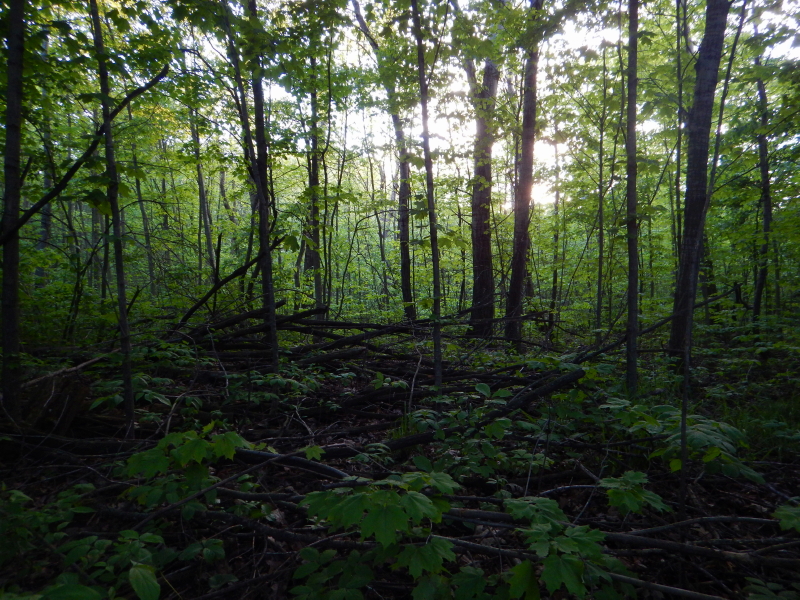 It’s what we do almost every day at our place. Each time we walk Delilah along the perimeter trail through our woods we are breathing healthy phytoncides emitted by the plants and trees. This reduces stress levels and boosts our immune systems.
Wandering along the trail among the trees while listening to all the bird-calls and the sounds of rustling leaves is inspiring enough on its own, but add in some of nature’s medicinal forest air filling your lungs and you enjoy quite the bonus!
Forest bathing is a perfect complement for the workshops Cyndie leads with the horses and labyrinth. It has always been part of the experience here, but we never described it with as much clarity as the variety of published articles on the subject are now offering.
I believe that giving the experience some specific definition of what is happening serves to enhance the results. Thank you MPR!
In my mind, nature has always seemed the best when it comes to medicine.
.
.
.
.
.
.
.
.
.
.
.
.
.
Final Step
It starts out as luscious green grass. The horses eat it and their bodies process it. They spread it on the ground for me to scoop up and shape into big piles. In the piles, microorganisms take action and the temperature climbs to around 160° (F). Eventually, things settle down and the pile cools.
At that point, it’s ready for use feeding growing things which puts that luscious green back where it came from at the start. The final step is loading some bags for sharing our wealth with others.
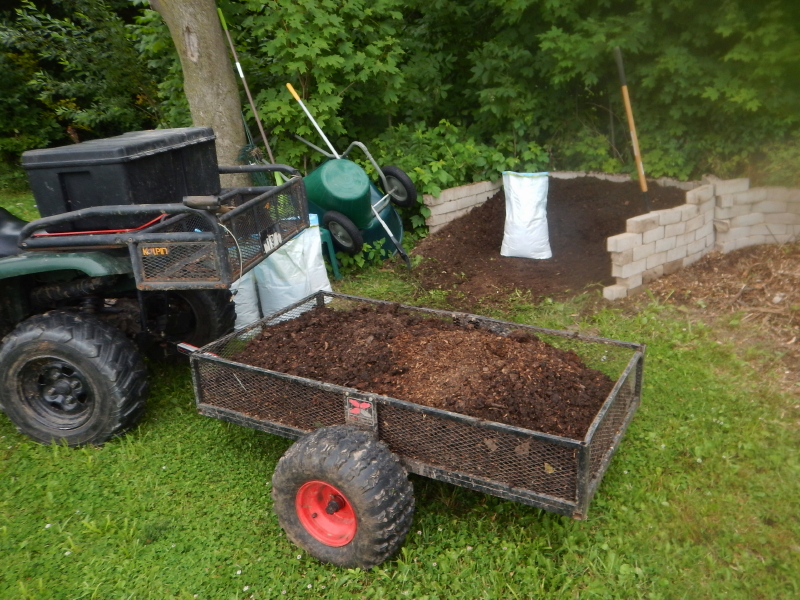
 .
.
.
.
.
.
.
.
.
My project yesterday was a little more involved than usual after the chickens showed up to offer assistance. Their version of helping seems to always involve getting as much in the way as they possibly can. I tried negotiating with them, but it seems as though they don’t understand English.
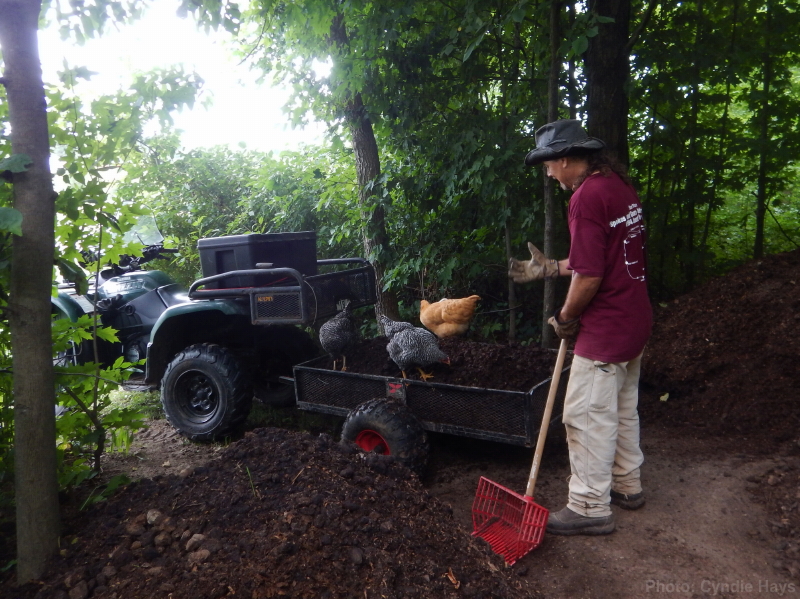 Compost work was interrupted by lunch, after which our attention shifted to the north pasture. With Cyndie assisting, we pulled the posts with a chain and the loader bucket of the diesel tractor, which cleared the way for me to mow the overgrown field.
Well, not exactly. The evergreen trees in that field have gotten so big, the tractor doesn’t fit between many of them anymore. It becomes a maze of weaving around groups of trees that are often too close together to provide easy weaving.
It was certainly more trouble than I could manage, in terms of getting the field to look decently mowed. I did achieve a wonderful version of the ‘bad haircut.’
The night ended with a small setback, as the chickens made their way into the tree over the compost piles again before we could entice them to the coop. It seems as though the training for that may not have a final step, but will be a repeating exercise for some time to come.
.
.
.
.
.
.
.
.
.
.
.
.
.


