Posts Tagged ‘spring’
Going Slow
We are in a bit of a rush this morning. After staying out late last night at Gary’s for dinner and music, we are hosting brunch for Cyndie’s family in a couple of hours. Although we started preparations early yesterday, there is much to be done right down to the last minute.
Care for our animals does not get postponed, so we end up feeling like we are trying to do two things at once. The natural result of that is, we try to rush everything we do.
I gotta say, rushing things tends not to be my favorite mode. I definitely prefer going slow, especially when it comes to being with our horses. Even when there is more to be done than there is time for, I can’t help pausing in the morning sun, breathing in the spring air, and just being quiet around the herd for a few moments.

 .
.
.
.
.
.
.
.
.
I ponder over the incredible saturation of soil we are currently in the middle of, amplified right now by the 4.5 inches of rain that has fallen over the last two days. I marvel at how quickly –overnight!– the rain greened up the grass. I smile at the new buds popping open throughout our woods.
It definitely feels like spring has sprung.
Growing things obviously aren’t going slow now, so my pauses to enjoy will become squeezed between frantic efforts to keep up with the mowing and trimming that is already on the verge of demanding attention in some spots.
Life can be a delicate balance of hurrying up and slowing down all at the same time.
See? Opposites attract!
.
.
.
.
.
.
.
.
.
.
.
.
Mud Happens
It’s that time of year. One good reason we want woodchips for our trails is the mudfest we are faced with in low areas and avenues where ground water makes its way down to these lower areas.
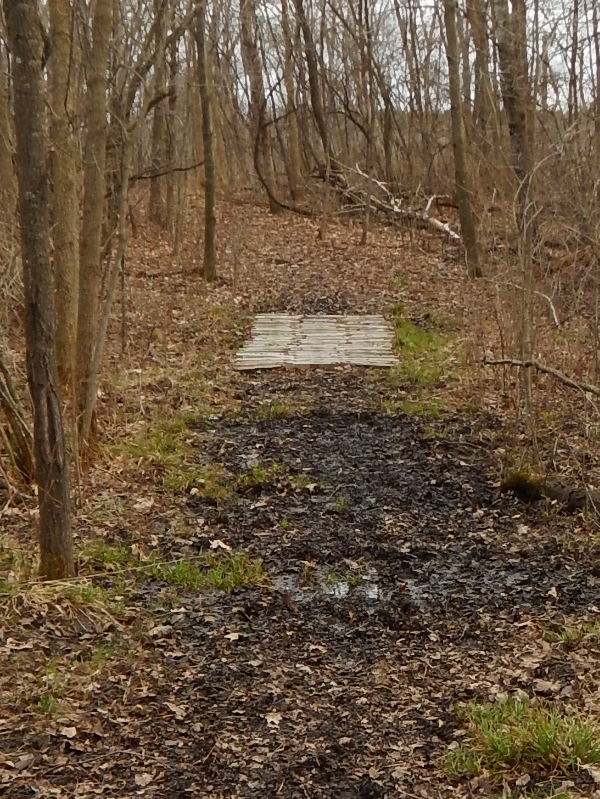
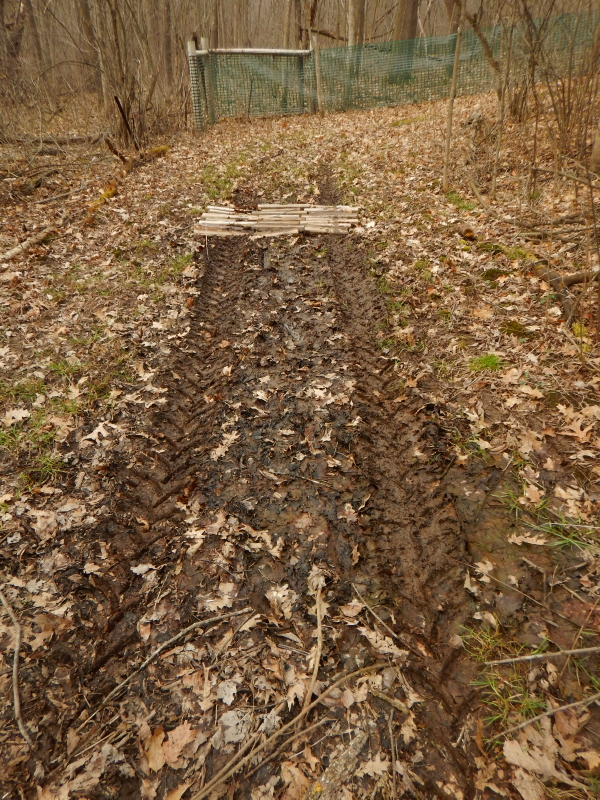 .
.
.
.
.
.
.
.
.
.
.
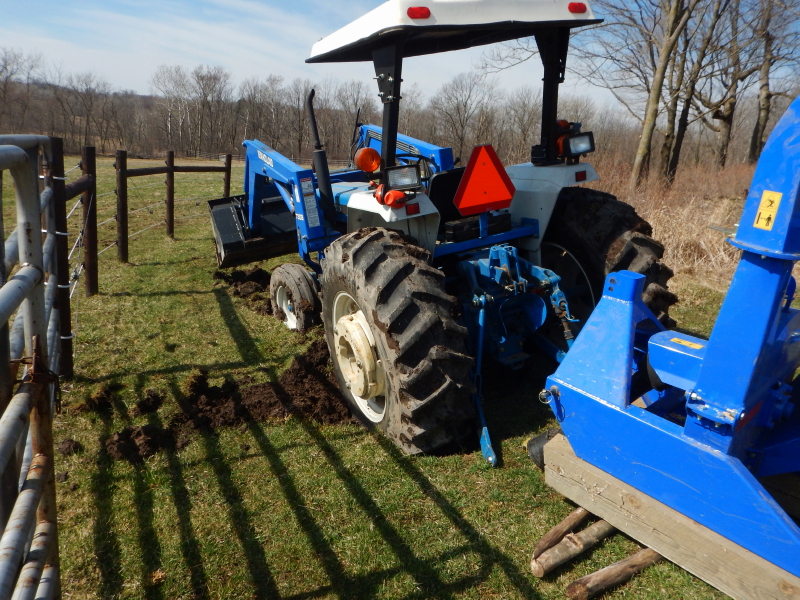
There is a trick to getting the woodchips, though. You need to get to the piles of branches without getting stuck in the mud!
 .
.
.
.
.
.
.
.
.
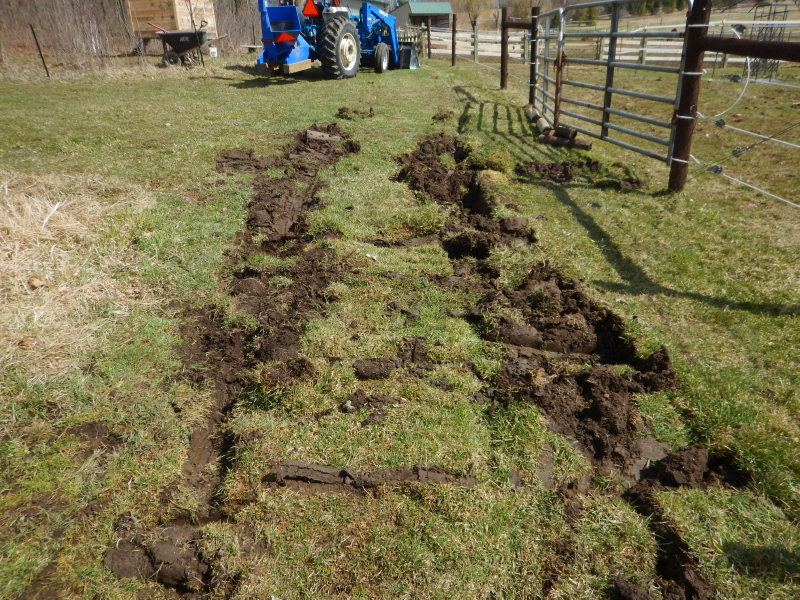
The ground looked innocuous enough, subtly covered with turf. Beneath that facade of grass hid a soft soup of mushy mud that pulled the tractor tires ever-deeper with each attempt to move either forward or back.
Ultimately, Cyndie and I outsmarted the soft soil with precisely placed scraps of wood fence posts behind the tires while I manipulated the loader bucket to push the tractor backwards.
I think it’s going to take a long time to replace the divots along that stretch. It’s going to need to wait until the mud gets a lot less soupy for real repairs to take hold.
.
.
.
.
.
.
.
.
.
.
.
.
Soft Ground
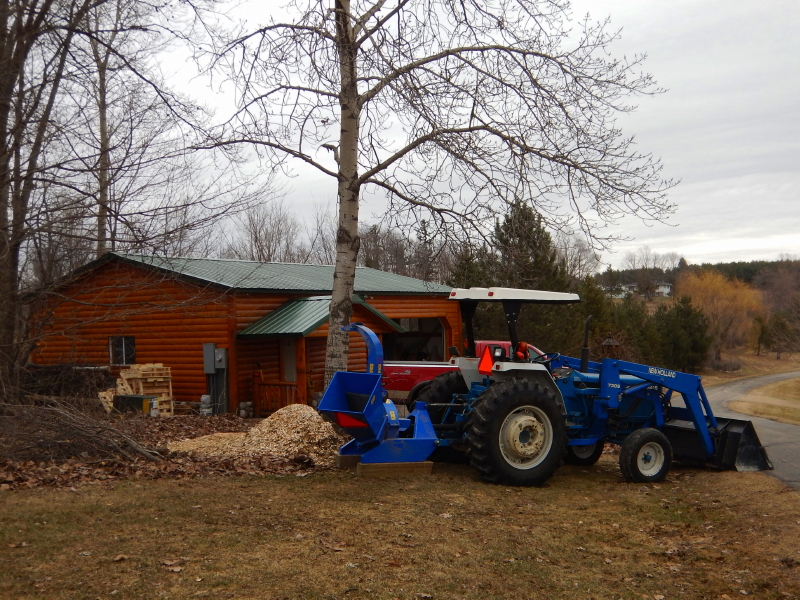 Nature didn’t live up to what the forecasters had predicted for us on Sunday. The temperature struggled to approach 50° (F) and the sky never really cleared enough to allow the sun to make much difference. Despite the less-than-inspiring conditions, Cyndie and I rallied our energies to pull out the wood chipper for another round of chewing up brush piles.
Since we are in the wonderful season when the top layer of soil is freezing and thawing daily, I had hoped to park the tractor on the driveway again, near the next largest pile of branches. Unfortunately, that meant the chute would be pointed directly into the wind and everything coming out would blow right back at the tractor.
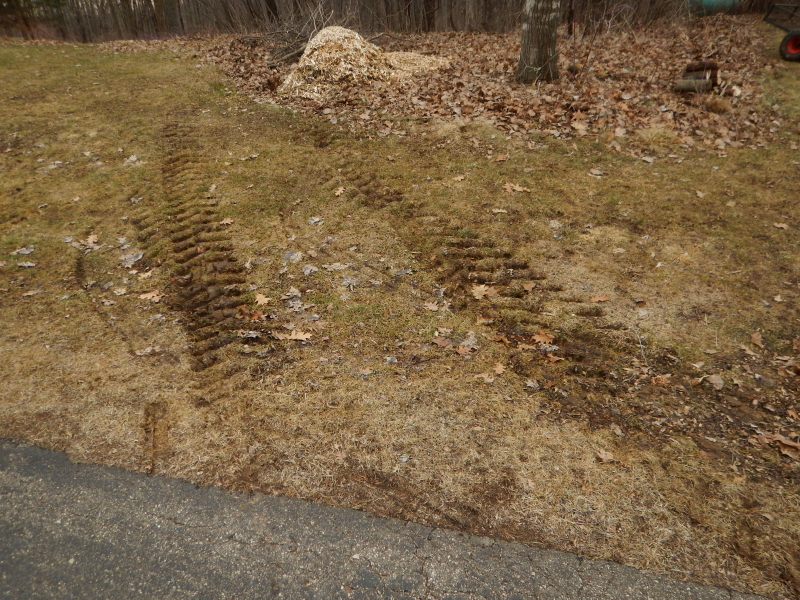 Plan B had me moving a short distance off the pavement so we could point in a direction where the wind wouldn’t be a problem. Things progressed swimmingly until I apparently tossed in a limb that too closely resembled the petrified oak branches that foiled our efforts last time out.
I instantly realized I had completely forgotten to shop for more robust shear bolts after the previous go-round when the hardware replacement broke as fast as I installed it. Details, details.
I think I’ll remember to buy new bolts this time, especially if I do it on the way home from work today. No time like the present.
.
.
.
.
.
.
.
.
.
.
.
.
Snow Goes
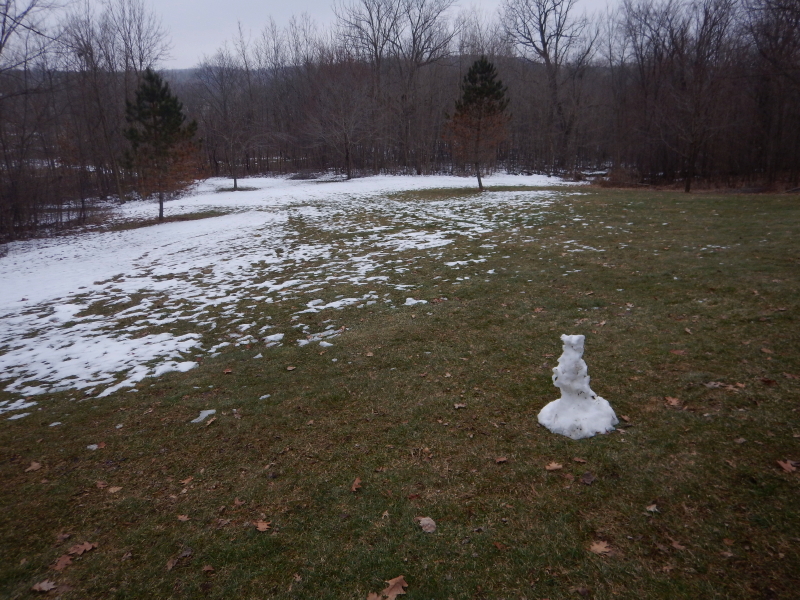 The month of March arrives with its saying about lambs and lions, but the climate confusion we have going may require we come up with a new definition for the chaos of winter’s departure. Last week’s snow is fading fast around here now.
The little snowman that Sara made on Saturday has become just a fraction of his old self in the back yard.
In a week and a half we’ll be moving clocks again to shift the days an hour forward. Will it inspire me to get anything more accomplished in the evenings after work? I don’t know.
There is plenty to be done, but my motivation has been lacking by the time I get home from the commute. Of course, yesterday it happened to be a gloomy gray day.
 If the sun is out and the air gets warm, I expect there will be an added spring in my step.
With the grounds wet and soft, I can turn my attention to some machine maintenance that is more than due, and there is always wood to be split.
Indoors, we have an appointment tonight for a quote on window replacements, and then I have a dishwasher door that needs the counter-balance spring mechanisms replaced.
I don’t see a day on the calendar marked for lollygagging around anywhere in the near future.
Do I need to make an appointment for that?
.
.
.
.
.
.
.
.
.
.
.
Adding Oxygen
A sure sign of spring being in full swing is when we finally start dealing with the piles of manure that accumulate in the paddocks over winter. Yesterday, I dug into one of the two big ones.
 We generally build up the piles in the paddock and then ignore them. As a result, they don’t make stellar progress in breaking down. However, over time they do settle noticeably. Seeing them get flat is usually a trigger for me to take action to turn the pile.
Since the pile yesterday had been left untended for weeks, it made for a vivid example of the transition possible when putting in the effort to turn it over, reshape it and add air.
The micro organisms that do the composting will use up all available water and oxygen in the pile. If it isn’t replenished, the process stalls. In the case of this pile, the neglect had foiled things before all the moisture was removed, so it was still wet enough, but it needed some air get the process going again.
In the image you can see the old, dry, flattened portion on the right, and the freshly turned, taller pile I was turning it into on the left.
While I was working, Hunter sauntered over to visit. I acknowledged him, but didn’t stop what I was doing. He didn’t move as I maneuvered the pitch fork to toss the pile without hitting him, but only narrowly missing him. He kept inhaling loudly, absorbing the earthy smells emanating from the newly oxygenated mass.
I breathed heavily, right along with him as I worked. Soon, I noticed his eyes were getting droopy. He was just chilling near me as I toiled away.
It reminded me of the time, years ago, when I was just getting to know the horses. Hunter approached me while I was raking up the winter’s-worth of accumulated manure, and he laid down next to me. I was so shocked by his action that I called Cyndie to check on the situation. She seemed thrilled by his behavior and assured me that it was an indication he was entirely comfortable with my presence and I could simply continue to rake while he rested beside me.
It’s precious knowing he still likes to hang with me like that as I work.
.
.
.
.
.
.
.
.
.
.
Those Days
It’s been one of those days lately at the day job. Several of those days, actually. So, on my off-day of the week, I’m still grinding away on the work email to address issues. Issues that come in bunches. Bunches of issues that I prefer not occur.
But they do.
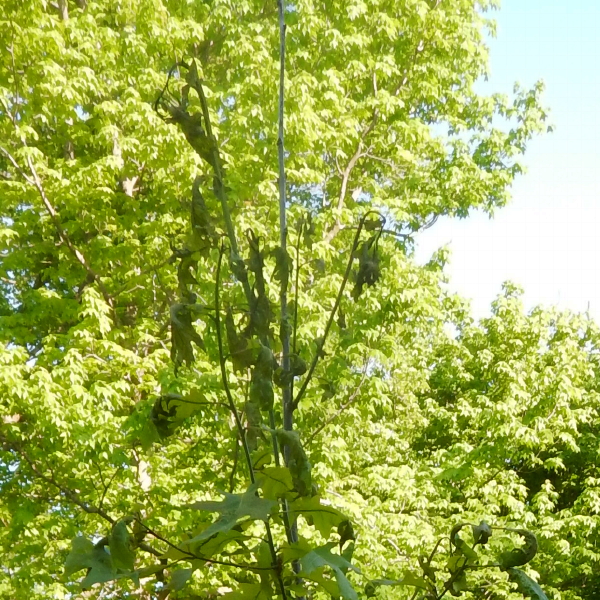 I looked out the bedroom window this morning and spotted a volunteer oak sapling that I staked up last year in hopes it would become well established and fill a void created by the loss of a pine. The new leaves are all wilted and sad.
It got me thinking that the same thing would likely have occurred to the new transplanted maple in the center of our labyrinth, had it actually sprouted new buds this spring.
So is it a good thing that it didn’t grow?
Maybe I’ll look at it that way. By not thriving after being transplanted, it avoided the fate of frozen new growth last weekend. Smart little tree.
It’s been one of those springs, thus far.

.
.
.
.
.
.
.
.
.
.
Rebalancing Act
We are checking off a string of spring chores this weekend, and it has given me a chance to replace the rock that months ago toppled from its delicately balanced perch atop another on the tall stump of a pine tree. It’s been on the ground so long that I’ve actually forgotten what it was that contributed to the fall, but I think it was high winds.
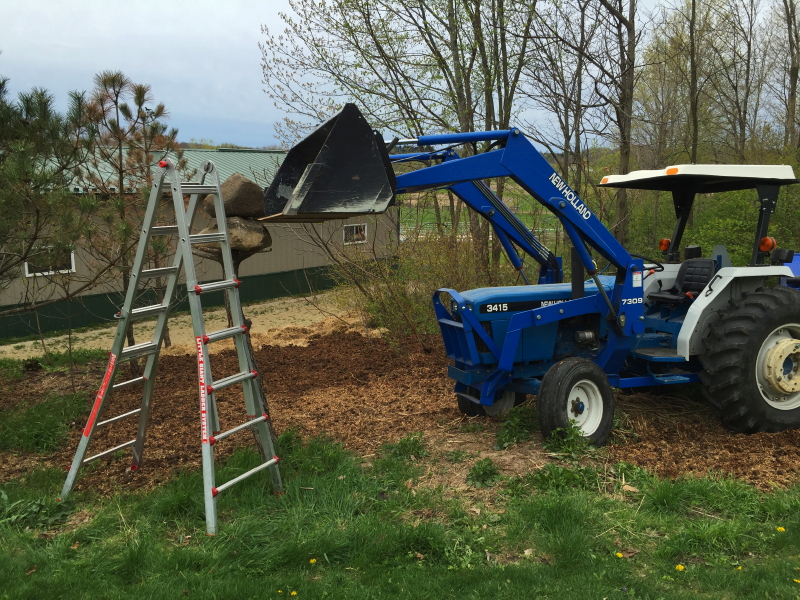 I never expect these balancing installations to last, but the two on that topped pine trunk had exceeded my expectations for so long that I was rather surprised when it finally did collapse.
I had the diesel tractor out to use the loader for pressing down a fence post that was being pushed up by the springtime thawing and freezing of the ground. It worked incredibly well for that purpose, by the way, quickly returning the post to the desired level. “Like butta,” as they say.
It won handily over the other method I tried, in two locations where the ground was way too saturated with water to support the weight of the tractor. Pounding the posts with a sledge only moved them a small amount, and required a great deal more effort.
 When it came to my rebalancing act, I first tried hefting the fallen rock up the ladder, but that attempt only succeeded in knocking the lower rock to the ground, too. There is no way I can lift that lower rock, so that meant I needed the bucket. In a moment of inspiration, I deviated from the previous orientation and flipped the base rock over this time.
I don’t know if this orientation will last any longer, but I’m liking the new look. That’s what it’s really all about. I like to look at balanced rocks.
.
.
.
.
.
.
.
.
.
.
.
Springing Along
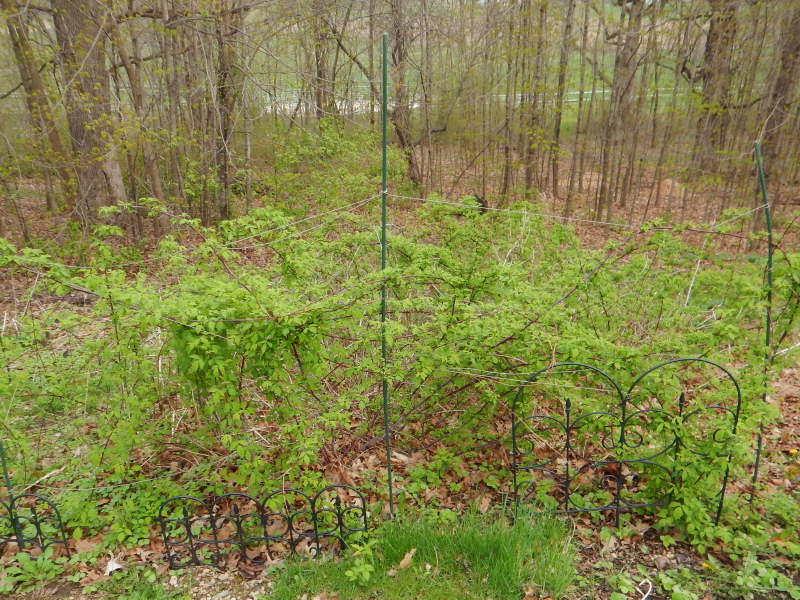 The season of spring is springing along nicely at Wintervale. The leaves have started making an appearance on a variety of shrubs and saplings. The raspberry bushes in particular have shown dramatic development in the last few days. It is hard to tell whether the recent rains triggered this, or it was just coincidental timing, and would have happened at this time, anyway.
It amazes me how quickly the initial sprouts of foliage obscure the view into our woods. Very soon, there will be so many green leaves, we won’t be able to see more than the outer surfaces.
I’m wishing I could remember this moment long-term in order to hold it as a reference for comparison with the other extremes of the stark bare branches of winter and the view-obscuring green leaves of summer. Every season seems to last just long enough that I mentally fall into a trap of perceiving views as if a present state is the only way it could ever be.
When the forest is fully leafed out, I find it hard to comprehend that just months earlier, it was the complete opposite.
Though most areas of our yard have yet to be mowed, I already needed to cut one section a second time.
I sense that summer is just a short blink away from replacing spring, and the expanding leaves on trees and bushes will be leading the charge in the days ahead.
.
.
.
.
.
.
.
.
.
.
.
Hazardous Conditions
Yesterday, while working outside for long hours in the spring wind, we exposed ourselves to enough tree pollen to cause significant irritation to our delicate tissues. I think I also successfully altered the weather to shut down precipitation here for some time.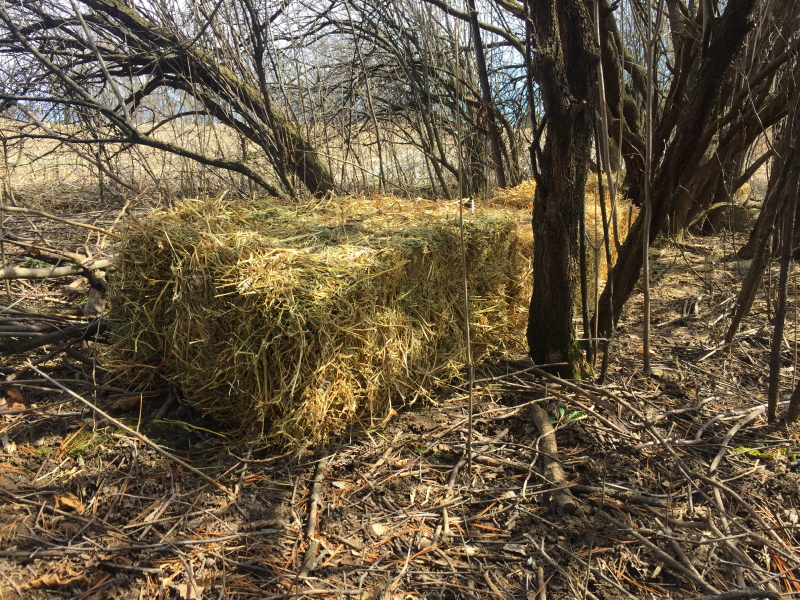
While my nose dripped at an ever-increasing rate, I built a barrier of old, moldy hay bales in the trees by our uphill neighbor’s corn field.
During heavy rain, the water comes off that field in a torrent and washes sediment onto our property. Lately, it has started to fill in a drainage trench beside our driveway.
Oddly enough, I actually wanted it to rain today, so I could see if my creation worked as intended, but the forecast shows no precipitation expected in the days ahead.
Given that, I guess my project worked. It has stopped the sediment from pouring into our trench, hasn’t it?
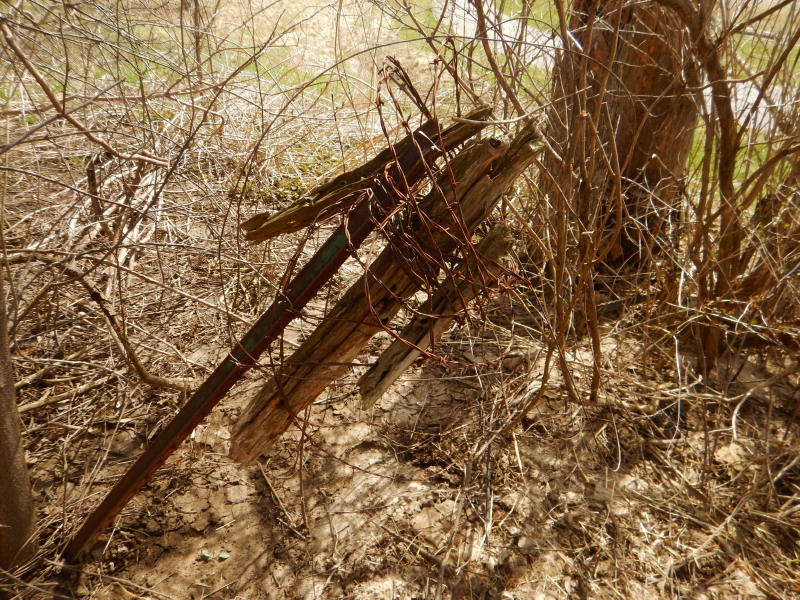
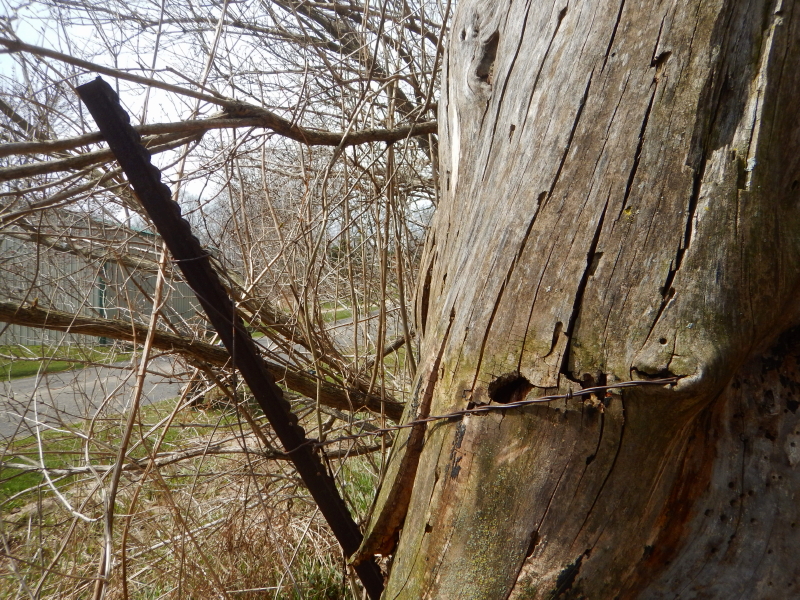
While I was working in the tangled bramble of uncontrolled growth that forms the border between our property and that cultivated field to the north of us, I decided to finally address a remnant of rusted barbed wire fencing that had been swallowed by a tree.
 .
.
.
.
.
.
.
.
.
The tree had long ago been cut off, leaving a stump that was about the height of a fence post. Made sense, since the barbed wire ran through the tree, it was already functioning as a fence post.
Removing the rusted fencing was made easier by the fact the tree was rotting to pieces. So much of it came apart simply by prying at it with one of the old fence posts that I found myself struggling near the end, to finish it off in the same manner. Eventually, logic, and my increasingly irritating allergic reactions to pollen, led me to hasten the task by way of the chain saw.
The area looks like it has been through a serious spring cleaning now, with the added benefit of opening up visibility to the area where water flows off the neighbor’s field. It is easier to see if the barrier I built is doing the job of keeping sediment out of our ditch.
Sneeze. Cough. Drip. Stinging blink. It’s the hazardous working conditions of spring!
.
.
.
.
.
.
.
.
.
.
.
Freezing Wet
You know what is worse than freezing cold? Freezing wet. It is one condition for which we would never question whether or not to move the horses indoors. Our horses do a pretty good job of enduring exposure to snow and cold, but when it comes to rain at freezing temperatures, they need shelter.
Regardless the pleasure of early warmth we enjoyed throughout much of the month of March, the trend recently has shifted significantly away from pleasant.
 It has us burning fires in the fireplace and cuddling up under blankets, drinking hot drinks.
I suppose there is a lesson for us somewhere in this situation about patience, but I don’t really need to be tempted by early warmth to get the lesson about being patient for the spring growing season to truly arrive. I’m sure I could learn it just as well with winter staying winter the whole time, and lasting well into April.
If I had any sense I’d be using this time to change the oil in the lawn tractor and finish preparing it for the long mowing season that lies ahead. The cold and wet may be lingering, but logic dictates it will eventually end.
When it does, growing things definitely won’t hesitate to respond.
.
.
.
.
.
.
.
.
.
.


 Relative Something