Posts Tagged ‘quick fix’
Custom Solution
We were moving our gas grill off the deck when one of the doors fell to the ground. Cyndie found a bolt with a nut on it lying there, but I couldn’t figure out what had broken or how it had been attached. As far as I could tell, the bolt was just functioning as a post that the door pivoted on. First impression was that a new bolt would solve the problem, but I knew it was more complicated than that.
There wasn’t a way to screw a replacement bolt back on, so the trick would be to mount the bolt in a way that would leave just the threaded portion exposed to mate with the hole in the bottom corner of the door.
Based on the space I was working with, it would likely require a very thin nut. One possibility would be to grind down a standard-width nut to something much skinnier, but I had another idea.
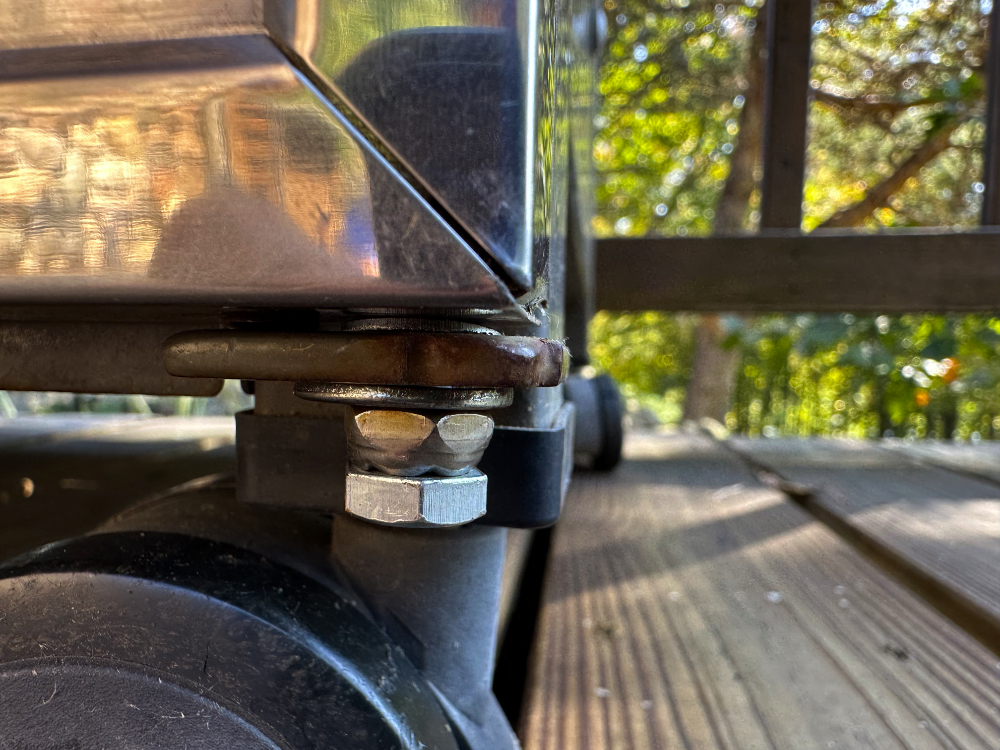 I found a washer with a center hole one size smaller than the replacement 1/4-20 bolt I was going to use. I planned to try tapping threads into that washer. My first challenge was how to hold that little washer in order to cut threads into it.
After a couple of failed attempts to clamp it directly into a bench vise, I pinched the edge of the washer with a vise-grip pliers and then clamped the pliers into the bench vise. The little washer was just thick enough to accept a fraction of threads, and that proved to be enough to spin it on the bolt.
I don’t know if you were able to follow all that, but in the accompanying photo, the little washer I tapped is directly between the bottom of the door and the brown portion of the grill frame. Somewhat to my surprise, it worked to hold the bolt that is coming from below to protrude up into the door.
That’s all I needed. Color me chuffed. I had paused mowing to help move things back onto the deck and then ran into this nuisance of a task. My goal was to find a quick fix and get back to mowing. Given all the steps I ended up taking, it was quick enough and successful enough, and gave me a boost of satisfaction that my ingenuity produced a custom solution that worked on the first try.
The experience acquired from a career in manufacturing continues to pay dividends in my retirement. I bought us a little more time with that old grill, but its days are numbered. It is admittedly well beyond its “Best If Used By” date.
.
.
Yay Internet!
Amid all the clutter and junk on the internet, the social disasters and false information of the great technological curse of the century that we can’t live without, this week I was able to enjoy one of the gems that occasionally make life better for those in search of answers.
The overly complex Denon receiver for my home theater unexpectedly went silent one day. I sensed something was amiss right away upon power-up because the tell-tale click of relays engaging was absent. There are so many features that we aren’t utilizing, it’s difficult to know what buttons are even pertinent to my situation, let alone which one might have been inadvertently toggled.
It is so rare that I even look closely at the displays on that unit or the power distribution module beneath it that I couldn’t tell if something was lighting up different than usual. In fact, something I did find hinted at an over-current surge which was certainly believable given the stormy weather that transpired on Tuesday when no one was home.
I was prepared to deal with disconnecting everything and sending in the receiver for professional service, but not without spending a little quality time using my digital meter to step through rudimentary troubleshooting. The light on the sub-woofer was not coming on, so I started there.
Measured good voltage at the power plug, pulled the fuse and happily found that intact. Like magic, reconnecting everything brought the sub-woofer back to life. The power light came back on.
Next step, remove AC voltage to the receiver and let that sit for a few minutes. Not so lucky on the magical reset there.
The final step before finding a service center was to see what the manual offered. After spending more time than I wanted to waste in the manuals file in the den and not finding what I wanted, I went to the computer.
Before even downloading a manual for review, in the search for my unit, I included the words: “loss of audio out to speakers.”
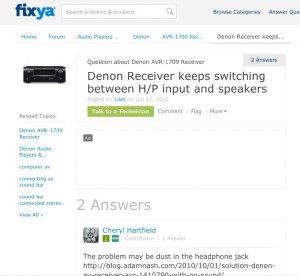 Multiple forums with a variety of similar issues on Denon units appeared.
“The problem may be dust in the headphone jack.”
Really?
That was certainly something I could investigate myself. I grabbed a 1/4″ headphone plug and headed up the spiral stairs to the loft. After a very technical step of blowing into the headphone jack on the front of the receiver, I plugged in the phones.
Music!
The output amplifiers are not blown! I unplugged the jack and the room speakers came to life.
Imagine if I had taken the time to disconnect all the wires and pack up the unit to be shipped for service for that repair.
Thank you, internet. Thank you.
.
.
Patch Worked
On Sunday, I just happened to stumble upon the fact that the snow-melt flowing down our drainage swale from beneath the driveway wasn’t coming out of the culvert.
“What the…!?”
I hustled to the other side of the driveway, and sure enough, the rushing water was disappearing beneath the mouth of the culvert. Nice.
I tell ya, property ownership is a trip.
I tried an on-the-fly patch in attempt to plug the opening enough to coerce the water to flow through the culvert, not beneath it. I dumped in sand and hay, plus tried stomping some of the residual snow to fill the void, but the water was moving with such momentum that my plug didn’t stop the flow.
I needed something impermeable. Old empty bags of feed came to mind, especially as they were also closest at hand. I cut open a bag and tried laying it as a sheet over the opening in hope the water pressure would push it in place to fill the opening beneath the mouth of the culvert.
The bag was more inclined to float.
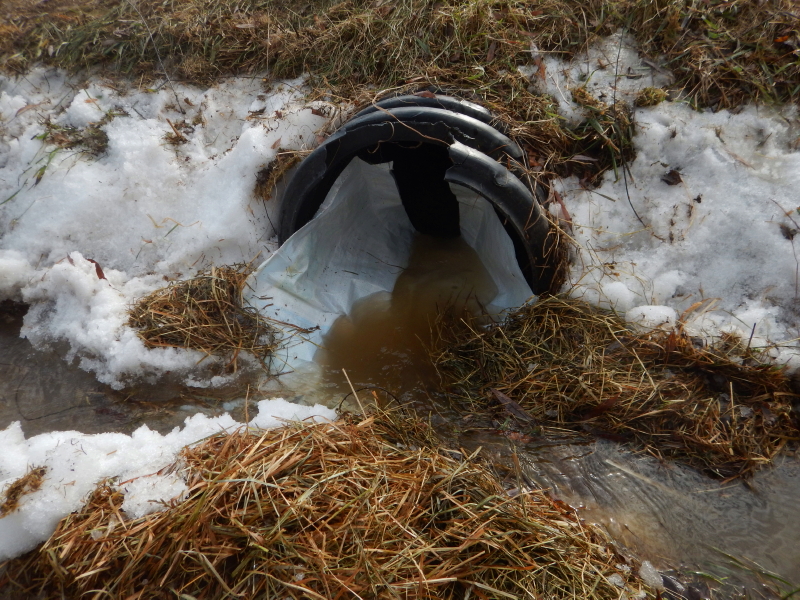 I struggled to hurriedly push it below the freezing-cold water where I could cover it with hay and sand to redirect flow into the culvert. It started to work a little bit, so I worked harder to get the edges down to where water wouldn’t flow beneath it. Soon, it became obvious I needed to do something just upstream from there, so I added a second bag and placed a shovel on it to hold that one in place.
It wasn’t perfect, but it was better than nothing, so I left it at that, fully expecting to find one or both of the bags out of place and wreaking havoc on desired flow sometime later.
Then yesterday’s rain storms arrived. Driving home, I noticed the ditches were filled with standing water and the creeks were running at full capacity with runoff. This time of year, rain water can’t soak into the soil because the ground is mostly frozen. I held little hope for the hastily placed feed bags at the mouth of our culvert.
Draining rain water was running at full tilt through the culvert under the road at the south border of our property when I arrived home. I stopped the car when I reached the problem culvert under our driveway and stepped out into the rain. First, I walked to the outlet side and was pleased to see heavy flow coming out of the culvert.
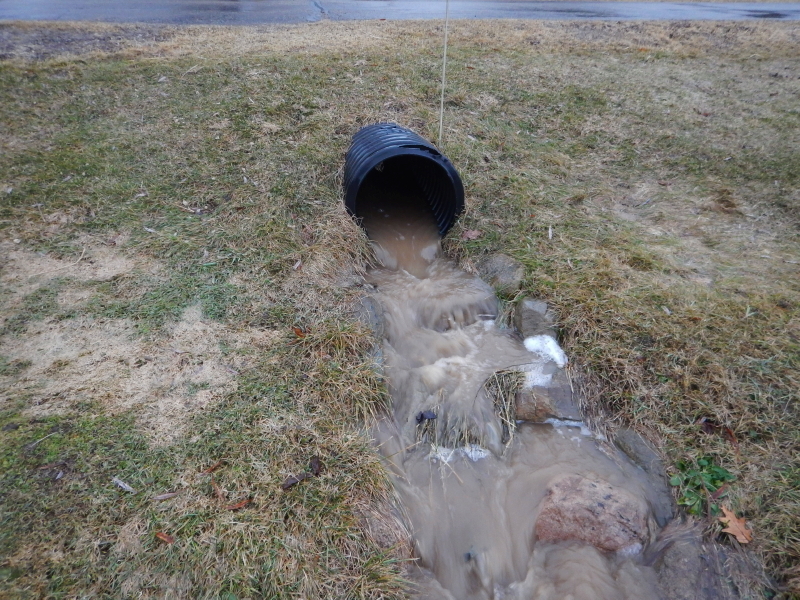
Crossing to the other side, I was amazed to find both bags still positioned where I had placed them. The one funneling water into the culvert had flopped over sideways a bit, but it seemed to be holding in place down below. I pulled it back again to catch as much water as possible and deemed it a success.
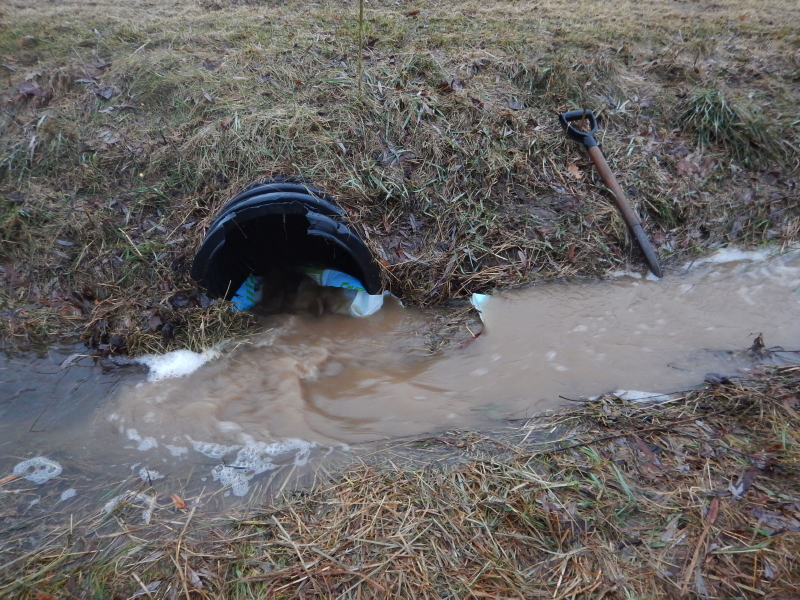
A more permanent fix will wait until there’s no water flowing, but for now, that crazy patch is certainly performing beyond my expectations. With the weather we are experiencing this winter, there is no telling when that opportunity for a permanent fix will arrive.
It will be no surprise to me if I find one or both of those bags down stream before their services are no longer needed. Stay tuned for further developments.
.
.
.
.
.
.
.
.
.
.
.
.
.


 Relative Something