Posts Tagged ‘property management’
Makin’ Mud
When the snow disappeared from the ground in our hayfield, the ruts from the tractor that had picked up the round bails during winter became clearly visible. Those tire tracks weren’t a concern for me until I could see the drainage swale water was following them instead of flowing straight in the direction we want.
Then I had an “aha moment.”
If the water was following tire tracks, I just needed to make some new tracks.
I decided to try using the ATV. Knowing it wasn’t as heavy as a big tractor, I accepted the chance it might not make the impressions I wanted, but it was safer than bringing out the diesel and getting it stuck in the mud. The surface is already too soft to be in the field with the big tractor.
With the plow blade still on the front, I added cement pavers to the basket on the back for added weight and headed into the field. Back and forth I drove, working to re-establish the track we want the water to follow.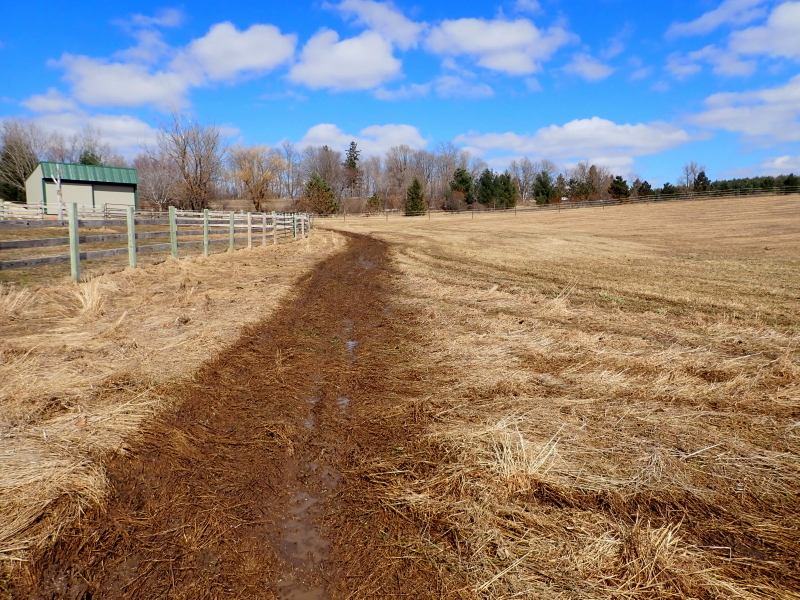
The ATV, plow blade, and I got splattered with mud, even though the path was grass-covered, but I think I succeeded in creating a new preferred route to the curving ruts left by the hay bale tractor.
Now we just wait for the next dose of precipitation to see it work.
.
.
Buckthorn Season
In addition to looking for antlered bucks in the woods this time of year, I am also hunting for buckthorn. Common buckthorn is an invasive tree that I strive to control on our property. In the fall, buckthorn holds its deep green leaves longer than most other growth in our forests, making it easier to spot.
It’s not foolproof though, because I always seem to find a large enough tree that reveals I must have missed it the year before. I think the main reason for this is buckthorn is not the only growth that still has leaves after the majority of the forest turns brown and barren. There is at least one other bush that confuses my hunt.
 The main difference I have found is the relative color of green, as can be seen in the picture I took yesterday while Delilah and I were forging our way off-trail to dispatch every invasive we could find. The batch of leaves on the left are a buckthorn I just cut down that must have been missed the year before. The noticeably lighter green leaves on the right are the primary bush that complicates my identifying the unwelcome buckthorn.
When I look into the trees on my neighbor’s unmanaged land, there is an obvious spread of green growth, but ours holds just a fraction of that, only a few of which are the deep green buckthorn.
With this year’s quick jump to Arctic cold and several doses of early snow, the buckthorn hunting season has been shortened. Luckily, I had already done a first-pass through to address the sprouts of growth that are small enough to easily pull by hand before the ground started to freeze.
At that time, I didn’t have my hand saw with me, so I took a mental note of the larger trees I wanted to come back to cut down. When I set out to do that yesterday, I almost failed to find that tree shown in this picture. I needed to get to a place where just the right angle of view made it stand out.
Delilah loves that we need to roam into the middle of the areas we rarely visit, as she is able to find all sorts of disgusting things left behind by the wild forest animals that romp around on our land.
I’m satisfied with the progress this year and ready to consider the hunt complete. There was less growth than previous years, so our efforts are definitely paying off. The view into the adjacent property confirms it.
Our woods look distinctly more managed and that makes trekking through them for year-round forest bathing that much more rewarding.
Huzzah!
.
.
Other Diversions
While I have been consumed with our deck refurbishment it might seem like nothing else has been happening around here. That’s almost true. Even though I haven’t touched a vast number of the other projects deserving attention, there is one exciting thing happening that doesn’t require any effort from us at all.
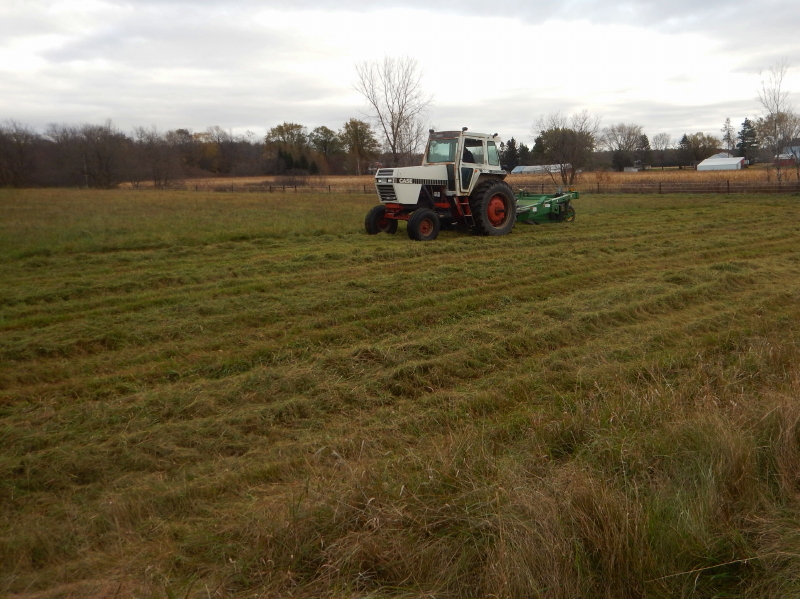 Sunday afternoon the neighbors renting our fields sent someone over to do a last cut of hay after the first frost. I don’t know how it works, but we are happy that our fields will be cropped for the winter months.
There is some evidence that the tractor tires found a couple of muddy spots, but to my surprise, it wasn’t nearly as bad as I expected. The ground is still as wet as a spring day in our region.
I will be very curious to watch how the rest of the raking and baling process plays out. The 7-day weather forecast looks promising for lack of precipitation, other than the light snow flurries we received after dark last night.
When they tried baling during the summer, it rained almost every day and the cut hay never got a chance to dry. That was when they gave up the cuttings to a beef farmer who rolled some ugly round bales out of the mess.
This hay will go to feed llamas. I’m going to guess they aren’t as picky as horses can be about the hay they are served in the dead of winter.
The air on Sunday was filled with tractor sounds as our neighbor to the north was harvesting his field of soybeans at the same time our fields were being cut.
The neighborhood “Next Door” app is popping with a rash of new members signing on in what I assume is a renewed push by someone to generate interest. We posted some of our “for sale” items there and enjoyed meeting several people who stopped by to shop. This weekend we are hosting a dinner with one couple to get to know them better.
In no time the earth will be frozen, snow will cover the land, and everyone will retreat to their winter cocoons for months of semi-hibernation.
It always amazes me we can live so close, but rarely cross paths with most of our neighbors, even when the weather is inviting. Winter just amplifies the rarity of interactions, beyond the sympathetic waves of acknowledgment when plowing out the ends of our driveways.
.
.
Freeze Prep
I put these chores off for longer than usual this year, but the time finally came last night to blow out the underground water line down to the labyrinth garden and remove the pond pump and filter. We also brought garden hoses into the shop in preparation for this morning’s freezing temperatures.
When it warms up tomorrow or Saturday, we’ll lay those hoses out on the driveway incline to assure they drain and then we can coil them up for winter storage.
I almost forgot about the waterer in the paddock, but Cyndie thought to mention it. We hadn’t been checking since the horses left and rainwater had collected because we didn’t think to pull the stopper out of the drain. The water had gotten a little green.
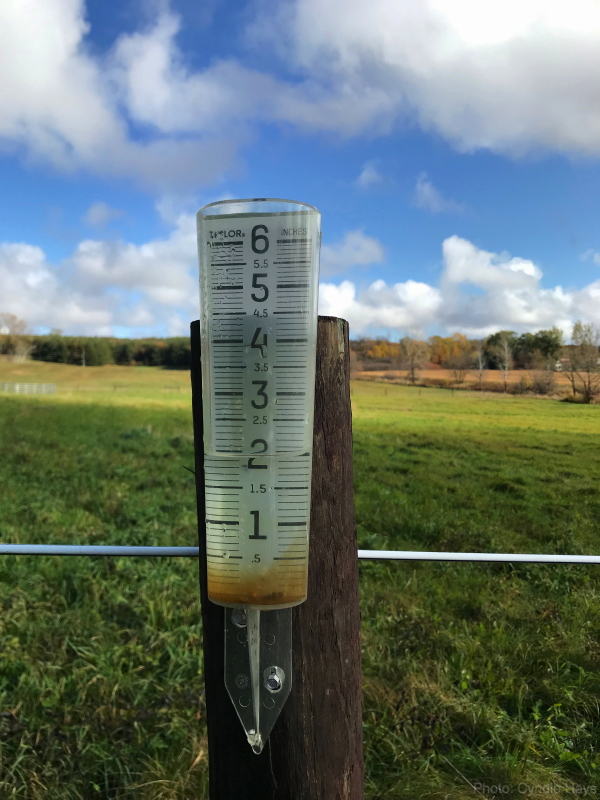 Thankfully, Cyndie remembered to dump the rain gauge down by the labyrinth so water won’t freeze in there and crack it. We learned about that the hard way. This happens to be plastic rain gauge number two down there.
It feels good to finally have these little chores addressed.
I’ve been a little neglectful of other things around here during the long days of focus on the deck. With the late first freeze, I’ve been able to get away with it until now. The average first freeze for the Twin Cities is October 11.
While working on the waterer in the paddock, my hands got incredibly cold, giving me a vivid dose of the discomfort which awaits in the coming days. That classic biting sting of freezing fingers.
Time to dig out our gloves and mittens.
Brrrr.
.
.
Digging Out
I’m not confident this is the final chapter of our woodchuck pest, but yesterday I dug out the window well to reclaim our egress space for the basement bedroom. You may recall I posted this image of the early evidence of a burrowing invader making a mess outside the window.
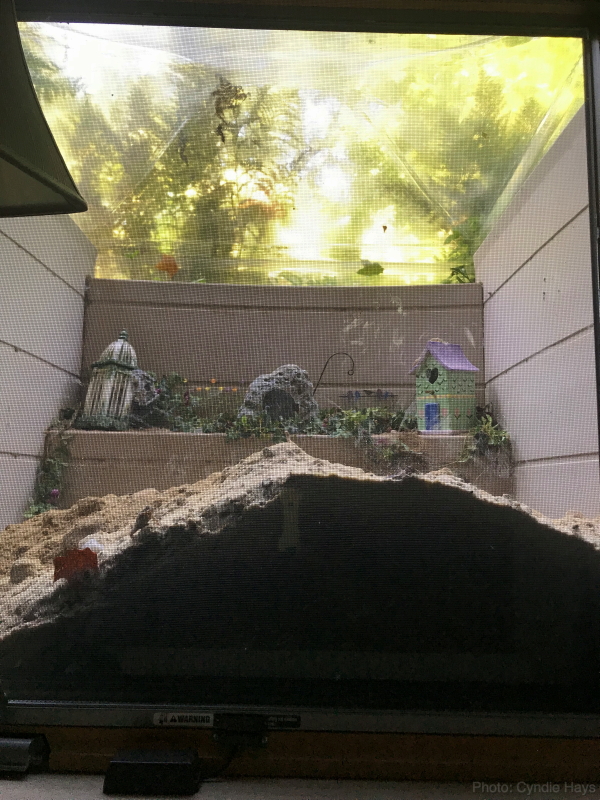
We did eventually enlist the services of a professional with wild animal extraction expertise, but the results weren’t exactly what we had in mind.
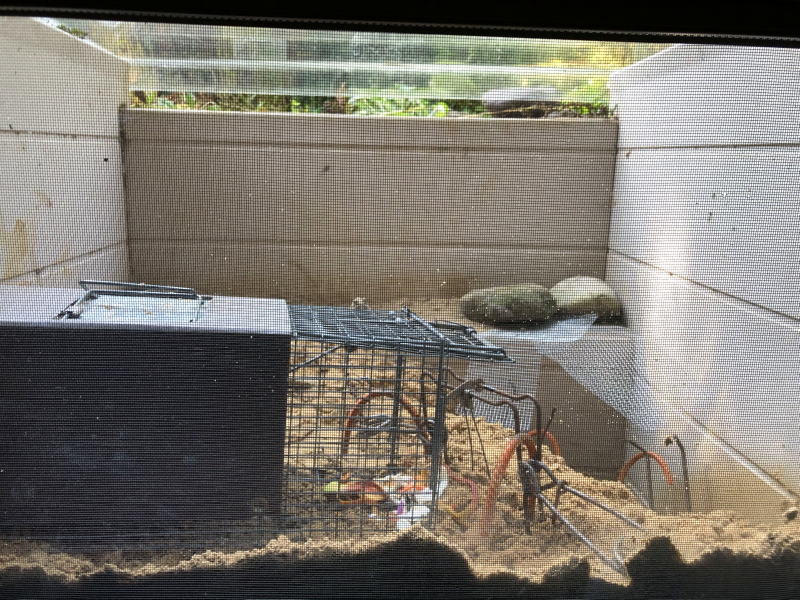
Initially, he set a trap across the opening of the hole. When that didn’t do the trick and the displaced sand filled over half the height of the window, he came back and added a second baited trap.
Days passed with little evidence of activity, but one trap tripped. The trail camera he added captured one image of the critter going under the little opening beneath the plastic cover over the window well, so he suggested we block that with a piece of wood.
The plan was to reset the trap one last time with the opening blocked. If there was no activity, we could assume the pest was on the outside and would no longer have access.
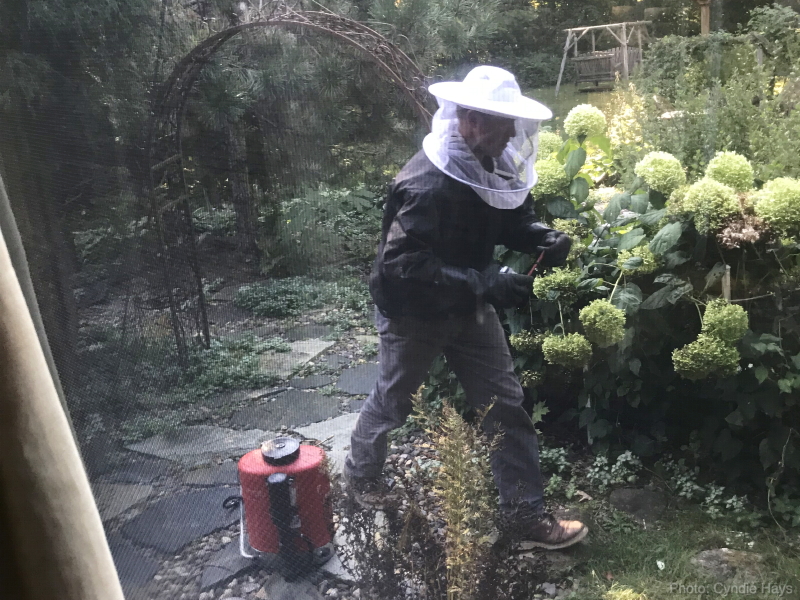
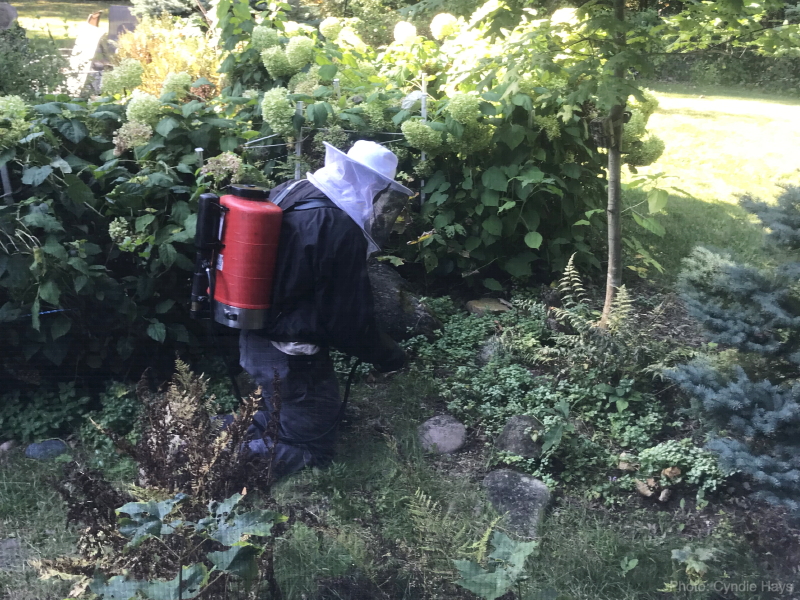
While he was setting things up for that last time, Cyndie warned him to be careful of the wasps showing up nearby. He spotted the ground nest a few feet away and offered to take care of it, at a discount, since he was already on site.
 .
.
.
.
.
.
.
.
.
Ultimately, those ended up being the only pests he visibly dispatched.
Yesterday, we noticed he had removed his traps, as planned since there was no additional activity. That was my cue to dig out the well and replace the cover.
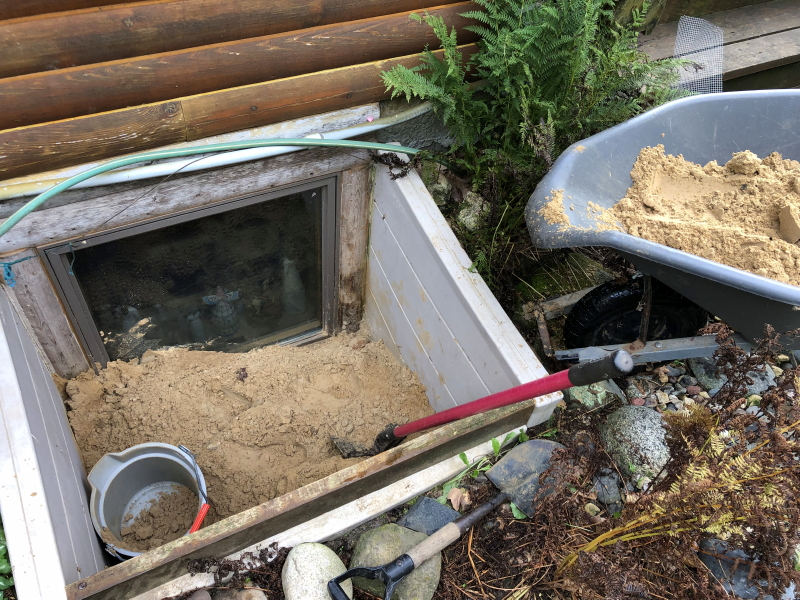
I sure wish I could put all that sand back where it came from, but hardly any of it fit back into the hole in the corner. The rest had to be hauled away for use filling various washout voids around the yard.
In the absence of an actual capture, I will not be surprised if new burrowing shows up someplace else around the house.
It’s becoming pretty much the norm around here.
.
.
Trailer Appreciation
Boy am I ever glad to have a trailer for the ATV again. This weekend I put it to good use hauling logs out of the woods and cleaning up failed attempts at round bales in our fields.
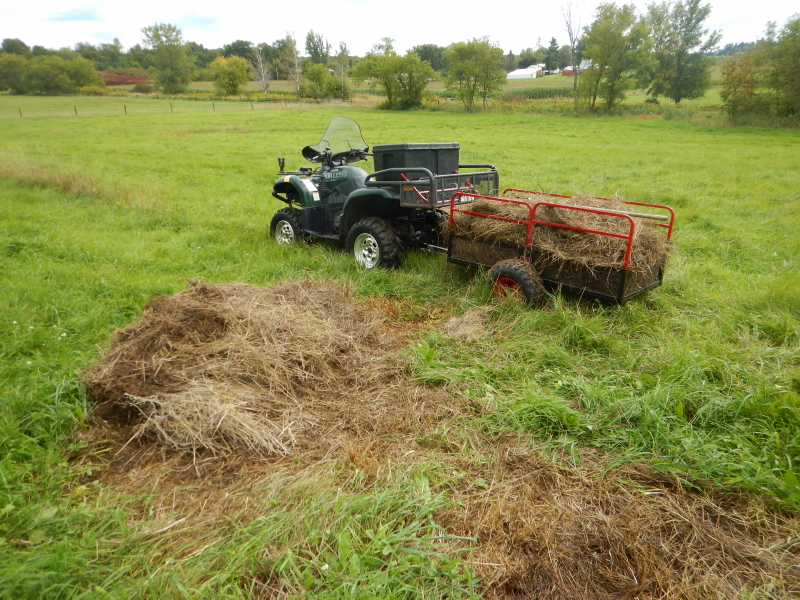
The neighbors who rented our fields this summer did not have much success trying to get bales out of it. I feel for them. There never seemed to be enough consecutive dry days to finish the job. Instead, the cut hay got soaked by rain. They tried raking it out in hopes of drying the cut grass, but then it rained on the windrows.
Eventually, they enlisted a beef farmer to claim the wet hay, because cows are a lot less picky about moldy hay. He created some relatively ugly looking round bales, maybe since he was working with old, wet hay. By the time he finally tried picking up the bales and hauling them away, five of them fell apart. He just left those where they lay, creating dead spots in our fields.

I guess that is the land owner’s responsibility.
My first challenge in removing the old piles was forking the heavy, wet, moldy hay into the trailer. The second challenge was figuring out what to do with it. I generally use old hay as natural fill, but none of the many spots where we could use fill are easy to reach.
The worst spot was along our property line behind Cyndie’s perennial garden. Instead of being able to dump the load all at once, I needed to empty the trailer one pitch fork-full at a time, carrying each about 35-yards through an obstacle course of low hanging branches and a single fence wire I needed to duck under.
I only bumped my head about 3-dozen times while making repeated trips in and out.
It is super to have the trailer again, but it doesn’t fill or empty itself automatically and it can’t navigate the obstacle course behind the garden. I guess I wasn’t thinking about how much work I have to do whenever I endeavor to use the trailer.
It has me thinking I should have given more thought to that desire to replace the one Cyndie sold.
.
.
Weekend Alone
Cyndie is out of town with her parents this holiday weekend, so I am the sole pet guardian. Was this supposed to be easier after we no longer had horses? A certain high-energy dog has shown no problem filling in the space. The invisible protective border we need to maintain between her jaws and our flock of free-ranging chickens complicates my including Delilah as a companion for many of my projects around the property.
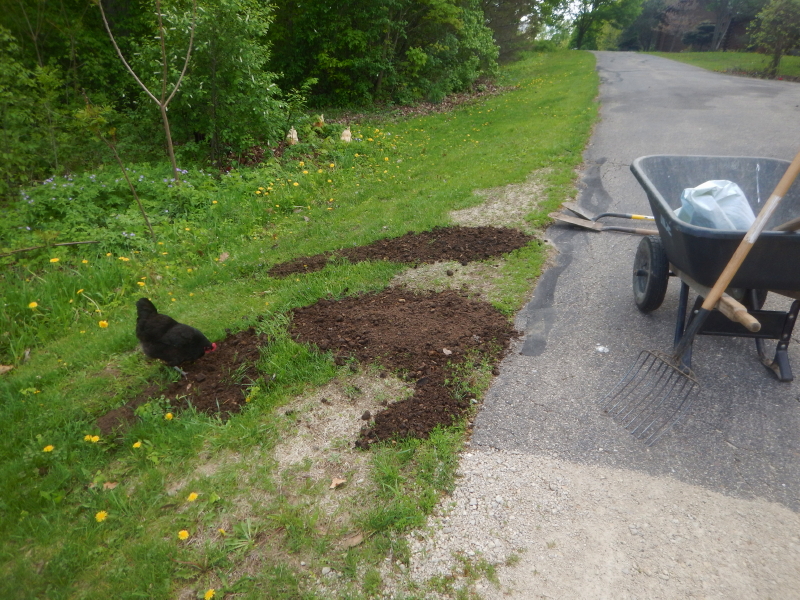 I let her tag along when venturing to the far side of our land with a wheelbarrow (we haven’t replaced the ATV trailer yet) to fetch some black dirt from a pile left over from the first year we moved here and had fence work done. I have been mixing dirt with composted manure to fill some holes in the yard. One was started by burrowing rodents and the other by spinning wheels of the New Holland tractor, both voids then expanded by rainstorm flowing runoff.
I need to leave Delilah behind when collecting compost because that task is a chicken magnet. They love helping when worms and other crawly critters might be involved.
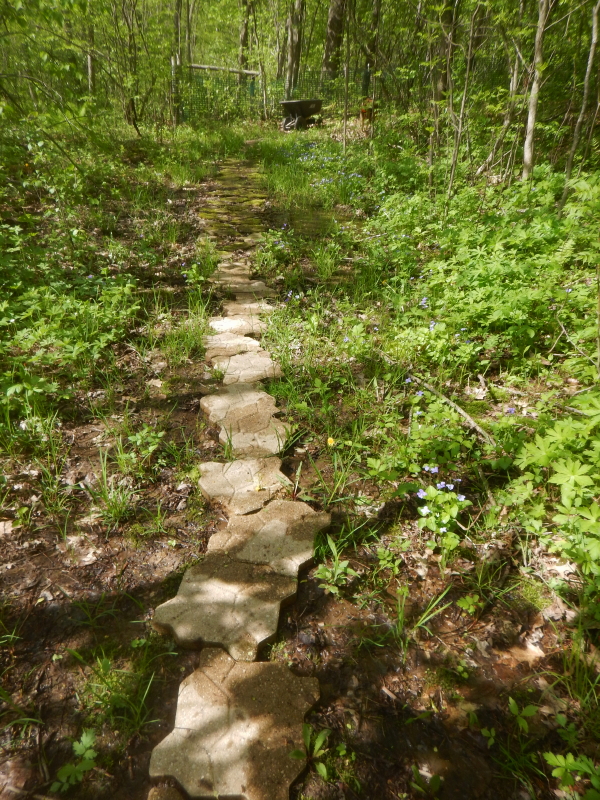
Heading deep into the western woods is far enough from chicken territory that I’m comfortable hitching Delilah’s leash to the wheelbarrow, half hoping she might consider helping to pull in the desired direction. We hauled more pavers to the ever-expanding length of our trail that is messy mud.
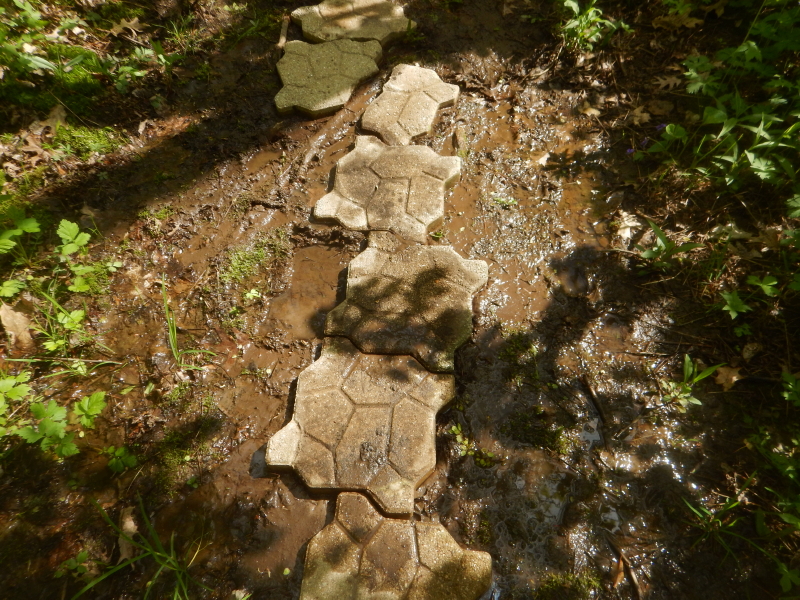
Originally, I laid it out with a wider spread, but after walking on it and navigating the ATV on the trail, I’ve changed to more of a single file pattern. Simple stepping stones is all that’s needed in keeping up out of the sloppy muck.
 .
.
.
.
.
.
.
.
.
.
.
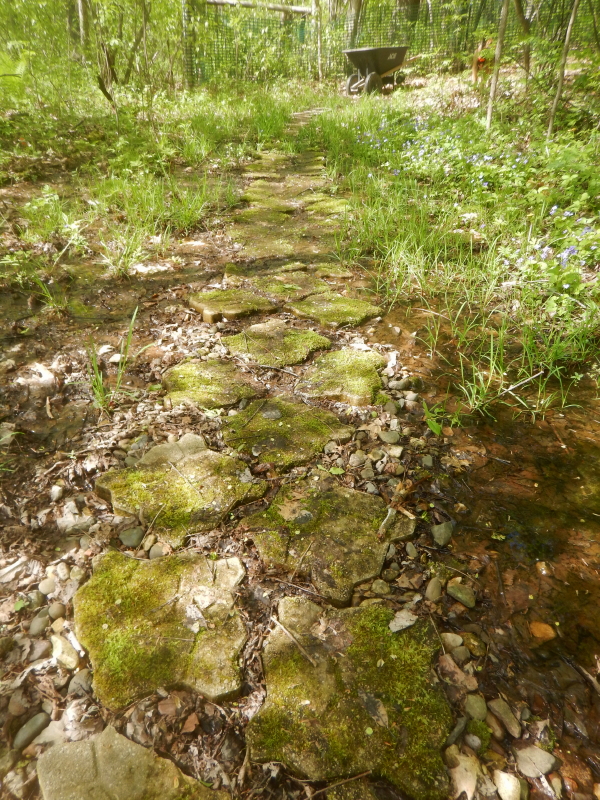
Do you see how nicely the moss adorns blocks that have been there a while?
All these small projects were diversions from mowing grass, hoping that waiting a day might allow a small fraction of drying to occur. That is despite my knowing from experience that it takes more than two days for the slow flow of excess groundwater to trickle down and out of here.
The sun can be shining bright for two days after a spell of rain and that’s when the low areas will be at their wettest. If we are lucky enough to have two more dry days, the footing starts to firm up again. Too bad that won’t be the case this week.
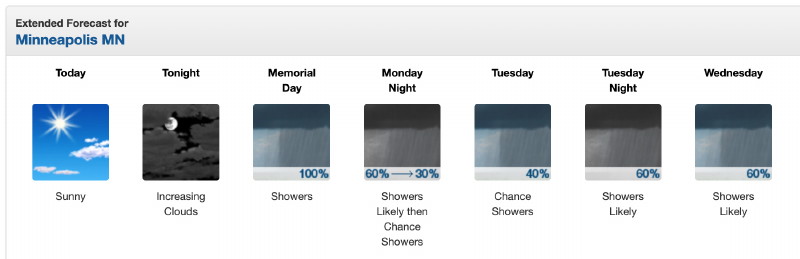
Delilah will be stuck in the kennel again. I gotta mow today.
.
.
Big Changes
Last Sunday, Wintervale declared a “Snow Emergency,” restricting any parking on either side of our driveway until June, but it looks like that will be rescinded very soon. The weather has changed in a big way, from cold and snow, to chilly rain. 
The liquid precipitation yesterday made short work of the snow that had collected on tree branches, instantly changing the landscape views. The woods now have an incongruous appearance with so much snow still on the ground, but the trees all wet and dark.
At this point, the deep snowpack is absorbing the bulk of the water that is falling from the sky, but the situation should get interesting after a couple days of increasingly intense rain.
After the saturation point is reached, the water will start the great migration that ultimately takes it to the Gulf of Mexico. Can you say, “flooding?”
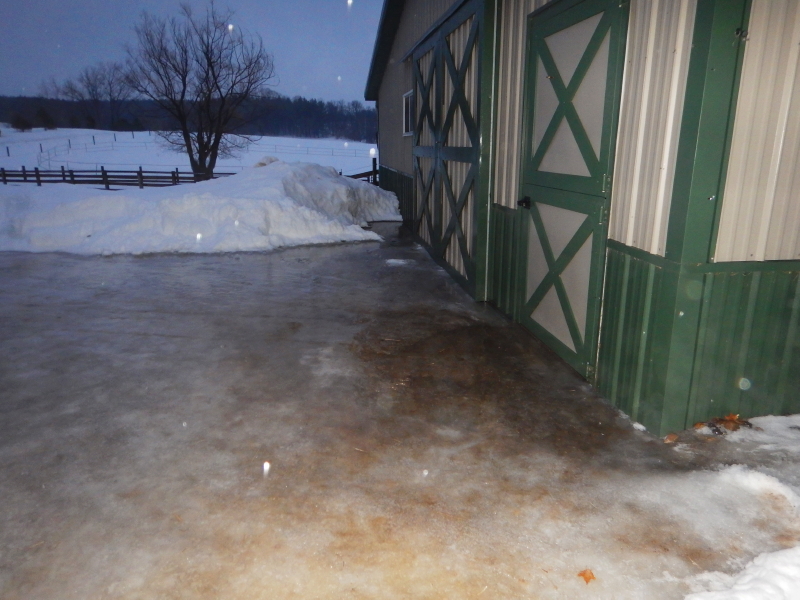 The glacier on the front side of the barn already has a lake forming on top, and the piles of snow on either side look like they aren’t going to offer an outlet any time soon. I may resort to a little creative drainage engineering to avoid the water choosing its own alternative route through the inside of the barn.
Up by the house, on the hill where I boasted about not worrying about flood concerns, I noticed the water running down the gutters wasn’t flowing out the end of the ice-packed downspout.
As a result, it isn’t directed away from the house, finding its way, instead, right where we don’t want it, along the foundation.
That situation shouldn’t last long, but in the land of freeze and thaw, I never like seeing any water pooling where it isn’t welcome.
Funny, how the landscaping which used to slope away from the house in November, takes on a variety of gradients after months of settling, being heaved by frost, and burrowed in by rodent pests. The results are rarely favorable.
Meanwhile, it is refreshing to have this glimpse of the next season making its rapid appearance. It’s WAY too early to expect such luck, but I would be thrilled if don’t have to plow again until next year.
On that note, I should probably make sure the lawn mower blades are sharp and ready to go.
Big changes are underway!
.
.
Inescapable Icecapades
Winter conditions on our land have devolved steadily ever since the combination of that day-long rain, followed by a hard freeze. This is despite last weekends’ several days of above freezing temperatures. The melts and re-freezes just seem to compound the disasters of ice that are building up in so many places.
The driveway around the barn is barely navigable.

The paddocks have become practically skate-able.

As I crested the last hill approaching our driveway on my commute home from work yesterday, I noticed debris in the road, but before I could react, I heard the “pop” of glass breaking.
I spent the next half hour with a push broom, trying to clean up the remains of a broken bottle that was scattered across several yards in front of our property, muttering to myself over what goes through a person’s mind that they are willing to toss their trash out the window.
Especially, in front of our beautiful land!
Our weather forecast is suggesting another few days ahead with temperatures expected to climb above freezing. Even with the promise of some partial sunshine, it isn’t clear whether the mild trend will add more treacherous ice to our low spots, or shrink our several skating rinks.
At this point, I think what we truly need to improve conditions is a significant amount of snow to fall. Seems a little reversed logic, doesn’t it?
.
.
Red Marks
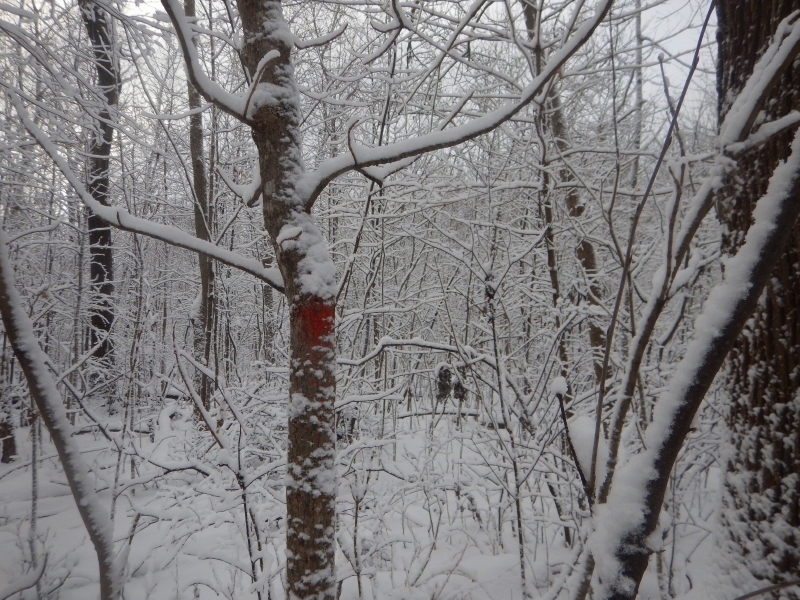
For months now we have been walking past trees in our woods that are marked for removal with a red spot. It was more subtle when the forest was lush and green. Now that there aren’t any leaves on the trees, those red marks are impossible to miss.

When our local DNR agent responded to our invitation to walk our woods, we learned our most valuable trees are the oaks, and that they will be kept healthiest if we remove competition growing directly beneath their canopy. I mentioned it would be a challenge for me to identify what is good and what is bad.
You know how much of an aversion I have to cutting down live trees.
He was quick to volunteer to return later and mark trees for removal. Most of them are relatively small diameter and will be easy to bring down. Cyndie and I decided yesterday was a good time to start on the project.
Heck, I can’t drive the tractor anywhere yet, so we may as well create piles of branches to be chipped at a later date.
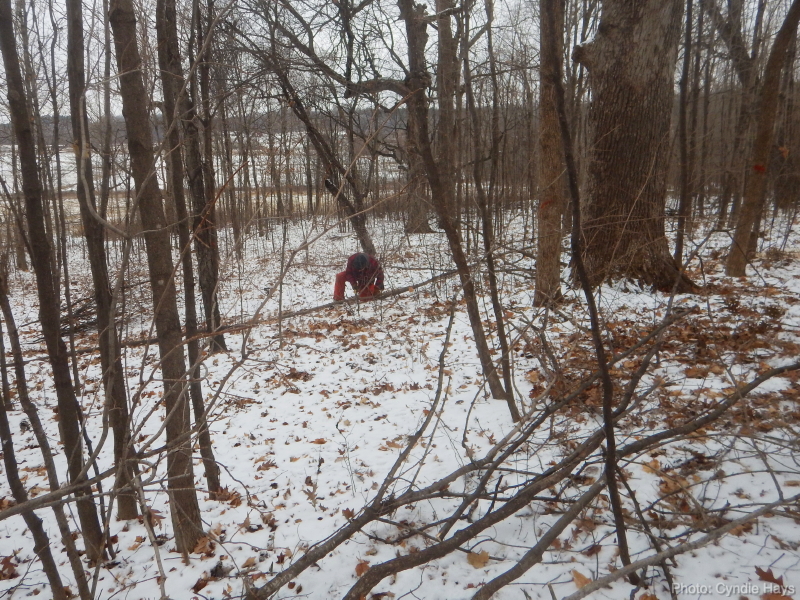 About those red marks… When you get a chainsaw in your hands, suddenly trees with red dots show up at every turn. Maybe that is because I just chose to start with the trees right below the driveway. Some of our biggest oaks are right there (hence the thick carpet of leaves that land on the yard) and that meant a lot of trees to be culled all the way around each of the large oak trunks.
I took some solace in being able to see visible evidence of just the problem our DNR forester described. Oak trees stop feeding lower limbs when other growth begins to encroach from below. That can lead to a lopsided or top-heavy oak.
When we pulled down the smaller trees, it was easy to see the number of bottom oak branches that had already been left for dead.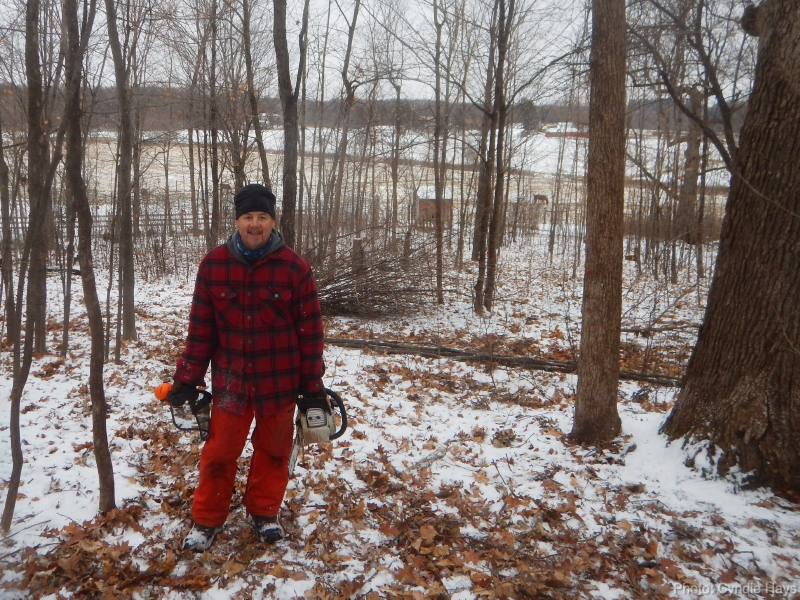
Unfortunately, we grew weary after just a couple of hours of cutting up and piling branches of the easiest trees felled. Several substantial sized red-marked trees remain. That will be a project for another day.
I may just move on further into the woods where I know there are a lot of small (easy) red-marked trees, before returning to take down the larger diameter encroachers by the driveway.
That project will be delayed a little bit now, though, as the more immediate pressing need is for plowing and shoveling snow. We received a decent amount of sticky flakes yesterday afternoon and overnight.
So much for easily spotting those red marked trees…
.
.


 Relative Something