Posts Tagged ‘poison ivy’
Lotta Tree
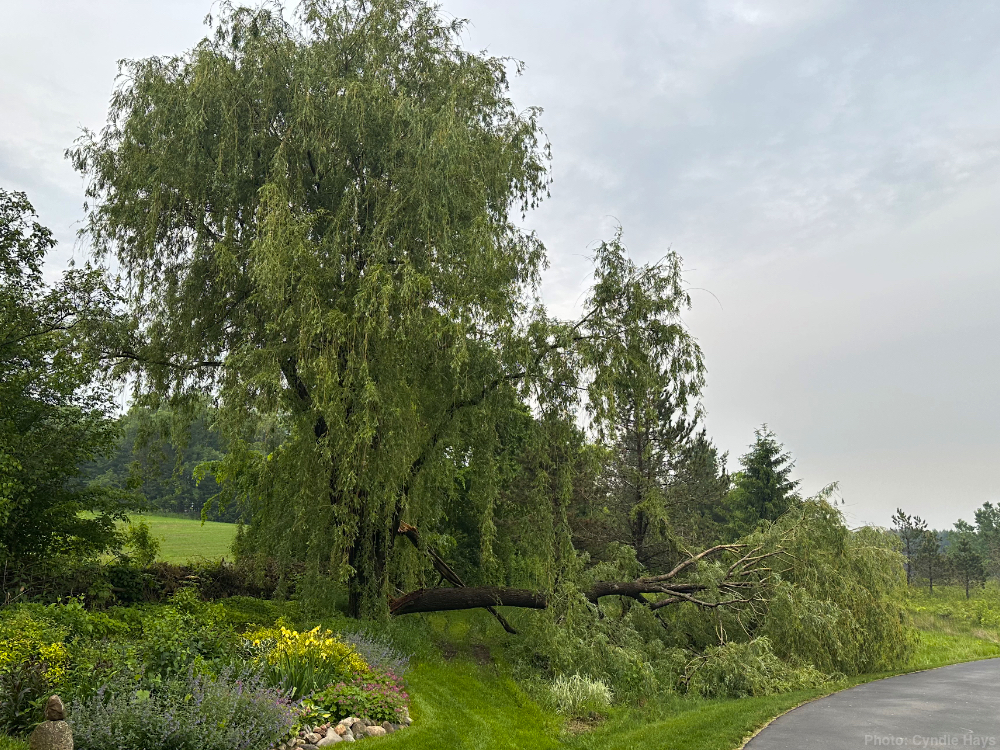
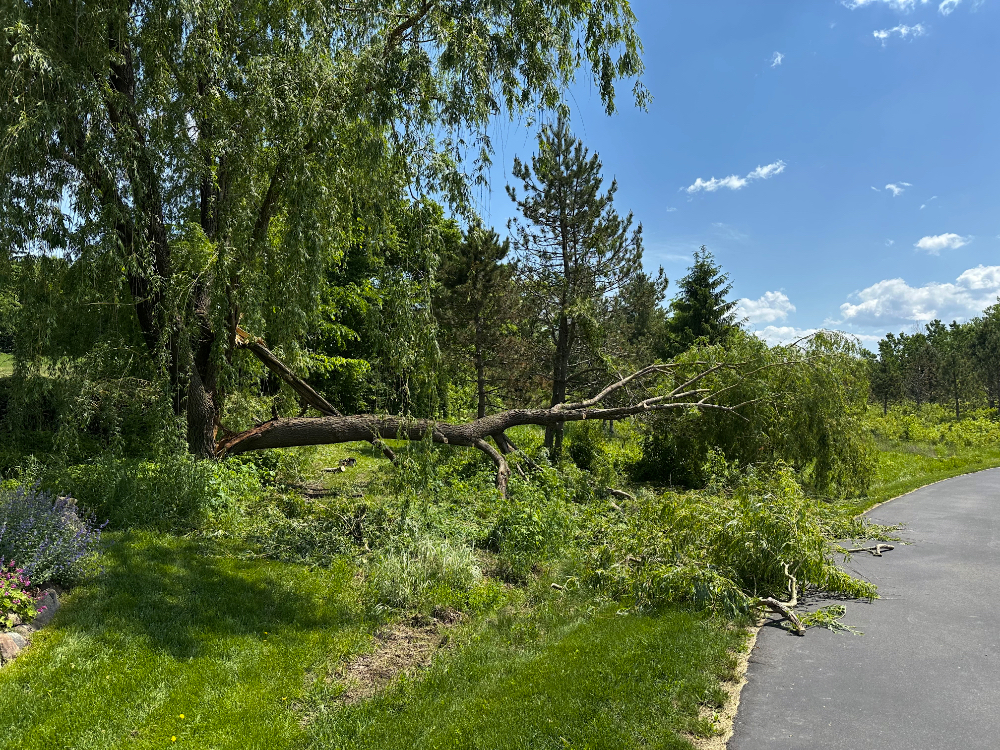
It happened again. This time, the big willow tree by Cyndie’s perennial garden lost a third of its trunk when the added water weight from the more than 2 inches of rainfall brought down the section with the most lean.
 .
.
.
.
.
.
.
.
.
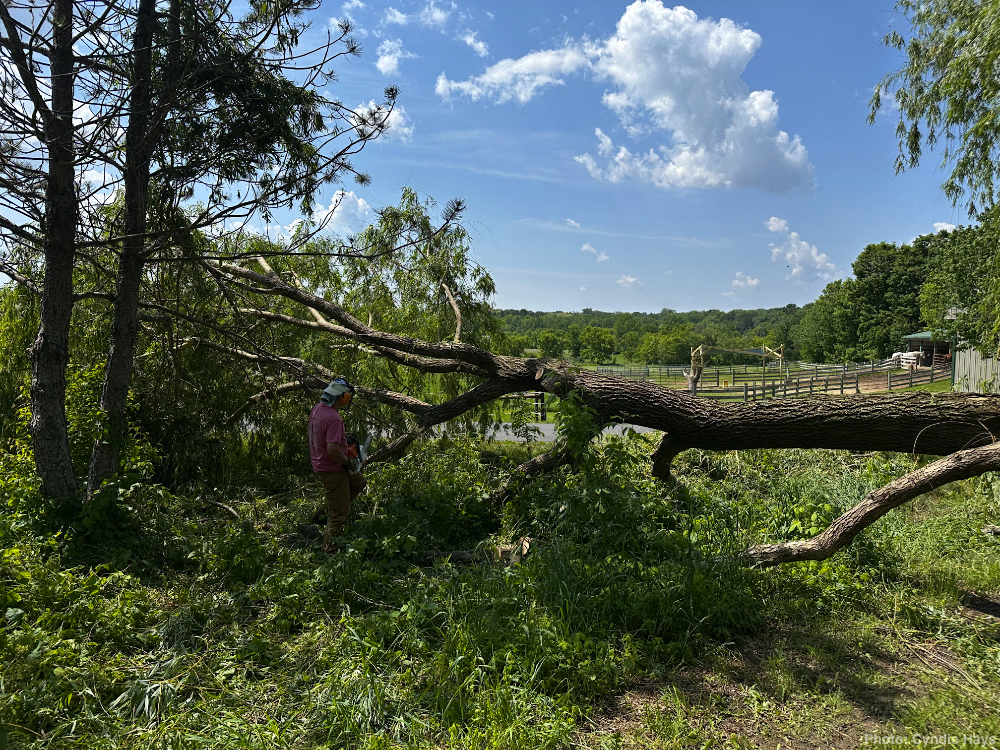
To make clean-up more interesting, it dropped into one of the more hearty patches of poison ivy on our property. Generally, we avoid setting foot anywhere the poison ivy grows. Yesterday, with a heavy dew soaking everything, we found ourselves up to our elbows in poison ivy. I fell down into it once when a branch I was tugging on broke free. Cyndie got splashed in the eye by moisture from the mix of ivy and tree leaves as she pulled branches out of the tangled mess.
It will be a miracle if one of us doesn’t break out in a rash in the next few days. We vigorously washed with special soap and tossed our clothes aside for segregated laundering.
I worked my way into the now-horizontal crown of the tree with the big chainsaw, being careful to avoid cutting something that was under tension that would either pinch the blade or shift the heavy trunk. When I had cut as much as I could reach, it became clear I would need to get the pole saw.

After I had removed as much of the weight as possible from the extended limbs, I started in on the biggest parts of the trunk. At one point, a trip up to the shop garage was required to get a pry bar to roll the beast so I could finish cuts. Throughout the entire effort, which consumed our whole day, we only needed to wrestle free the pinched chainsaw blade three times.
It seemed a little unfair that we were doing this again so soon after wrangling the fallen maple tree in the backyard. It was doubly worse because of the added hazards of poison ivy everywhere we worked. However, the saddest part about the timing of all this was that it was Cyndie’s birthday. Cutting up and tossing branches was not the spa day she would have preferred.
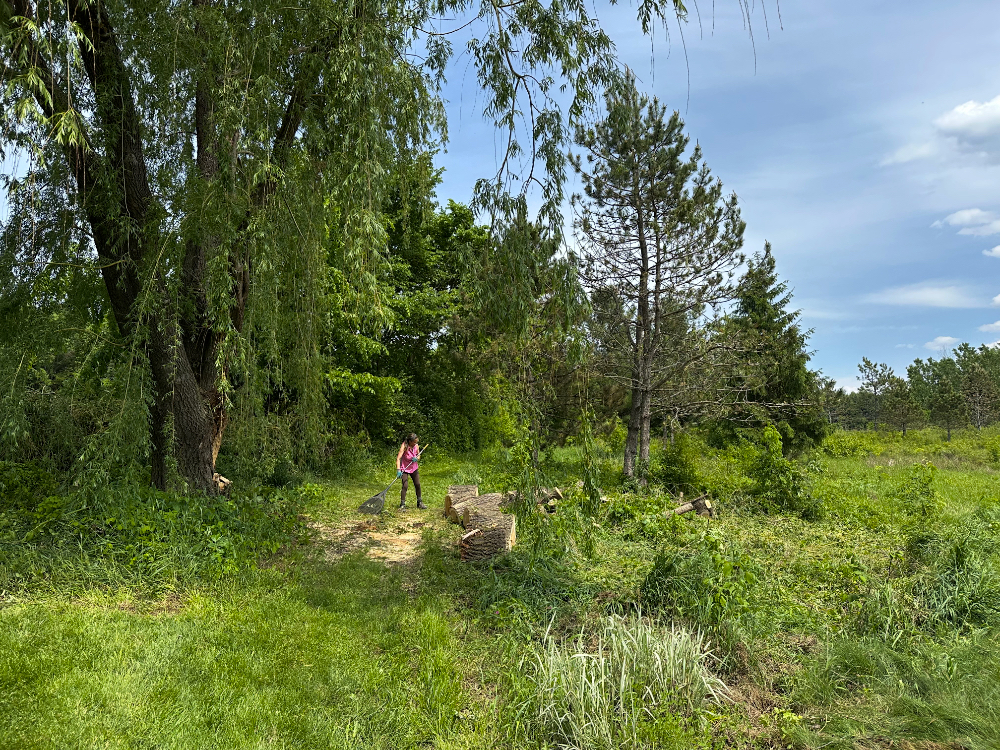
That was a lot of tree to process. We put all three sizes of our STIHL chainsaws to good use on the relatively soft wood. Man, that battery-powered trimmer saw is a handy tool for pruning branches.
Our priority of getting that work done was related to the fact that we are heading up to the lake today for the weekend with Cyndie’s mom, Marie. After the big physical effort to get through all that tree, we are looking forward to a few days of R & R on Big Round Lake.
.
.
Plastic Goats
Sure, we could get goats to control the patches of poison ivy on our land, but we don’t need large swaths eaten down to a moonscape. We want a more targeted approach and one that will cost us less than goats. We are taking a shot at using plastic and/or cardboard to cover specific patches where the problem plant is most entrenched.
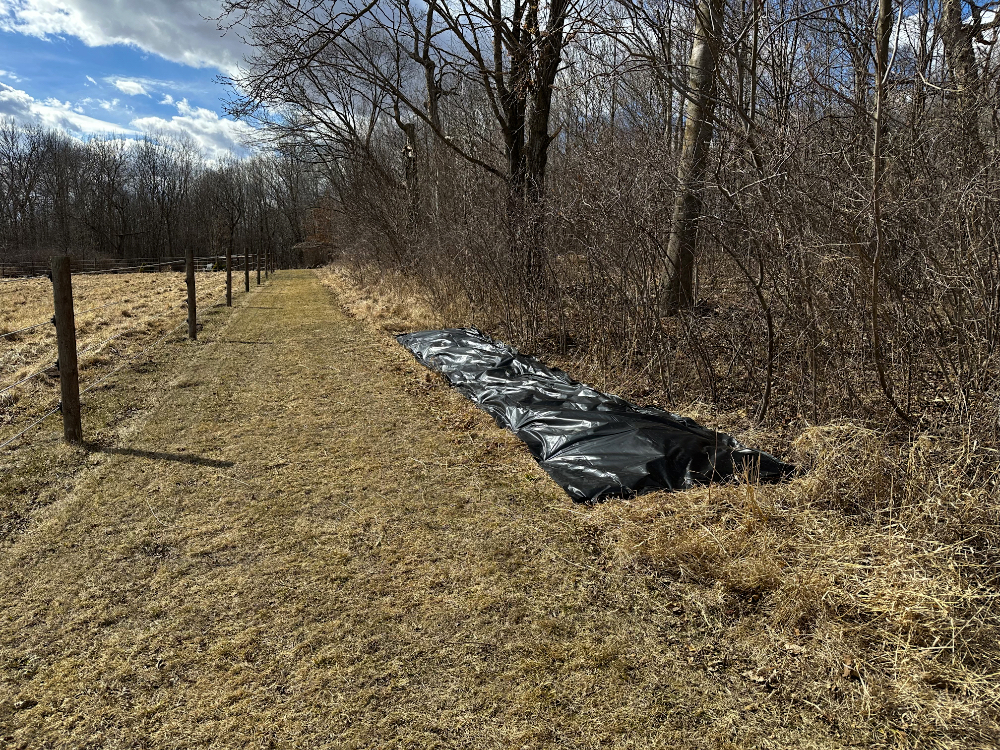
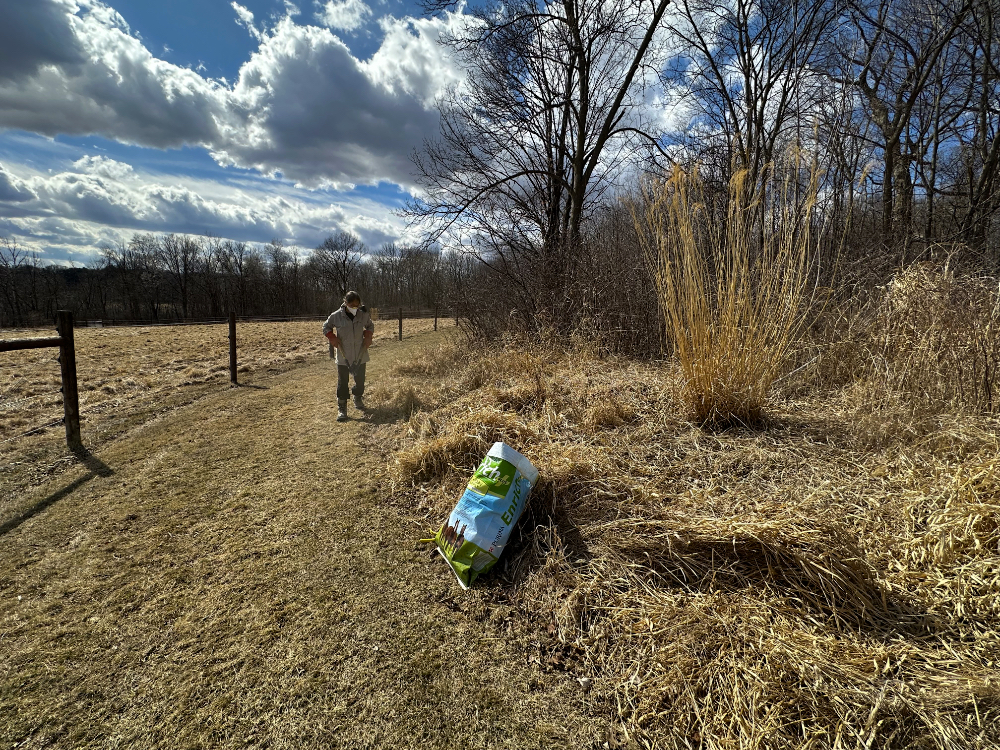
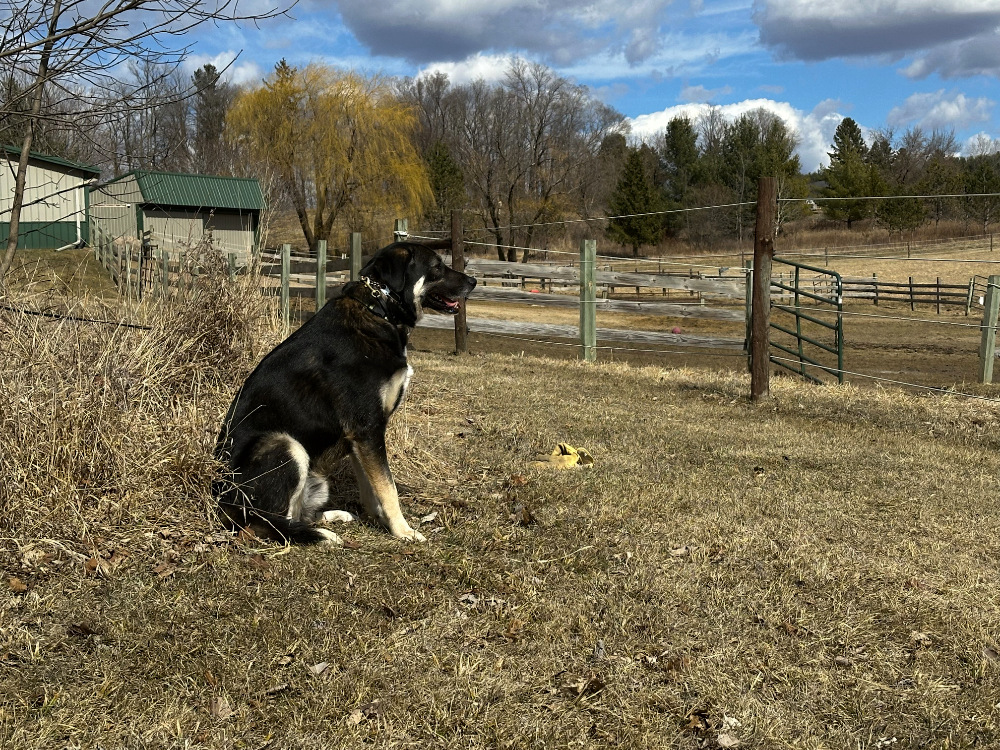
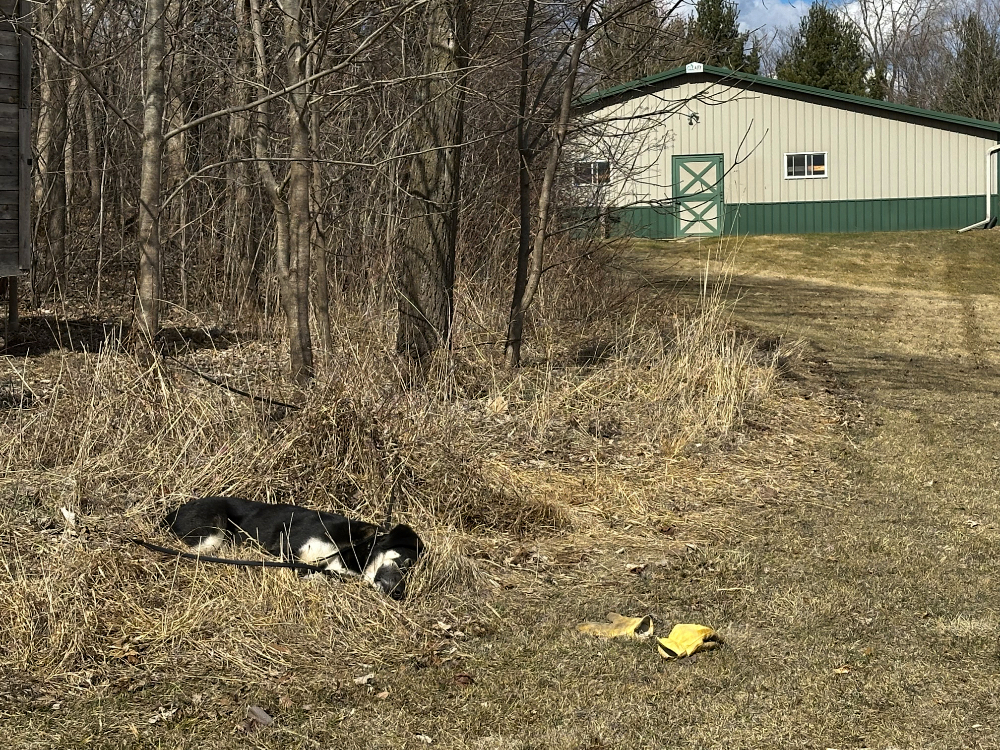
The hope is to turn just a select strip into a miniature moonscape. Since this method kills everything beneath the plastic, it’s not different from spraying entire swaths with a solution of vinegar/salt/dish soap concoctions, so we may experiment with that in a different location. Cyndie donned protective gear and worked to cut out the woody stems of poison ivy with berries that are very easily seen right now. She left her good gloves behind with Asher to stand guard.
 .
.
.
.
.
.
.
.
.
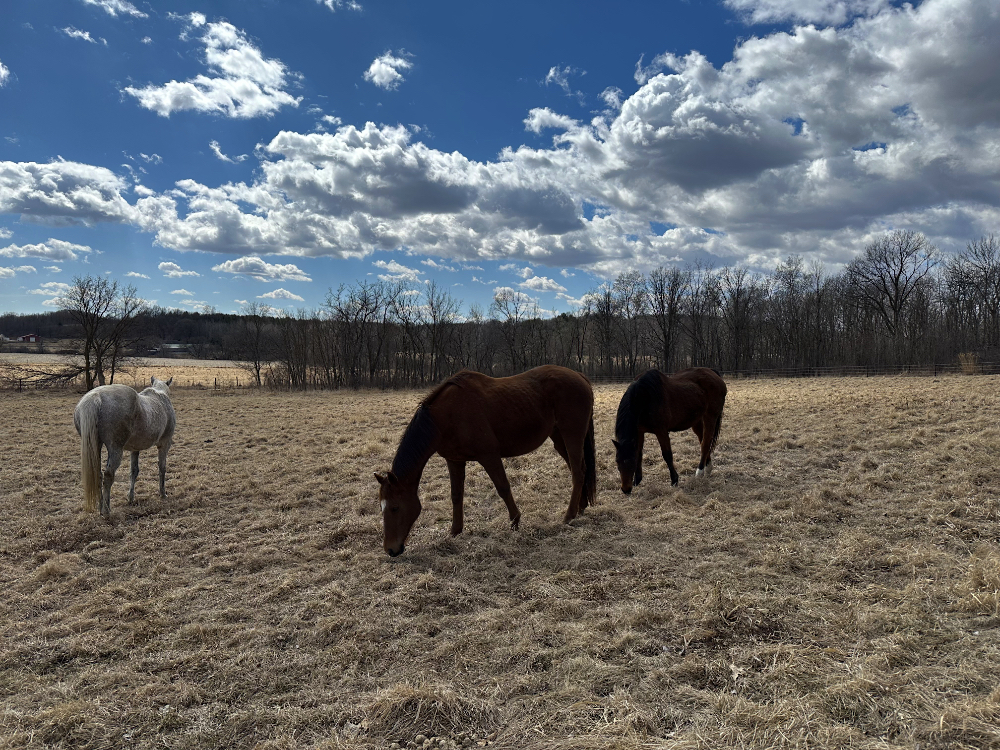
The horses came over to see what was up and lingered in the vicinity for a short while, grazing the dead grass and any new sprouts beneath that might be showing up.
I decided to make myself useful and worked to cut out the grapevine stems from the other side of the brush where Cyndie was working.
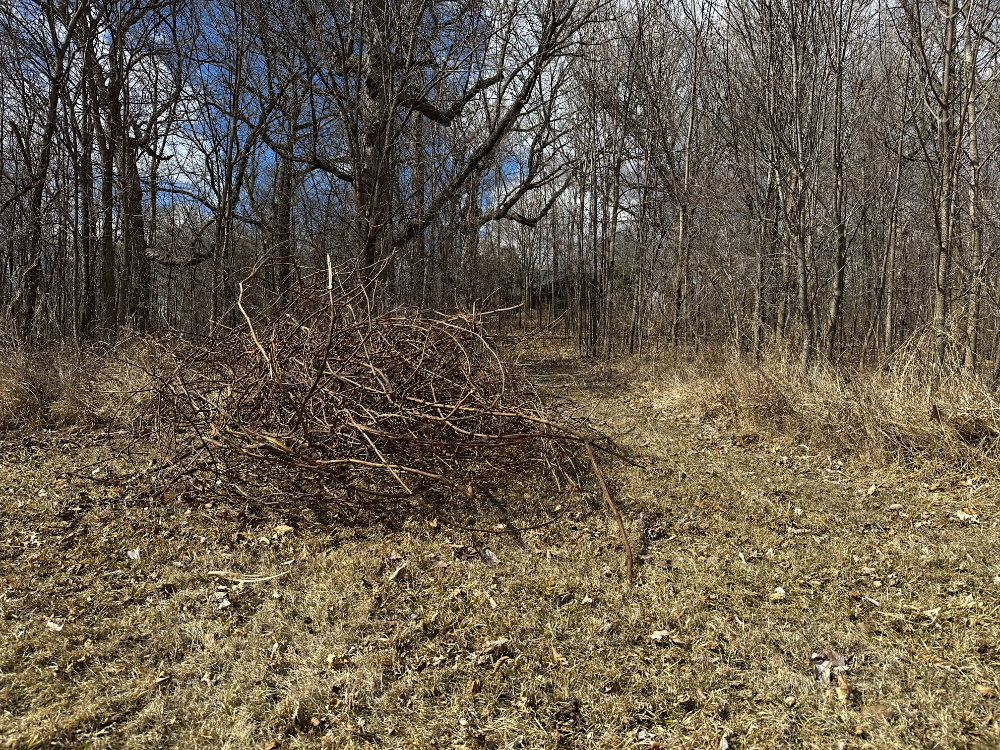
Anywhere on our property that we don’t regularly walk through is pretty much guaranteed to have grape vines seeking to become the dominant species, bending branches and entire trees down into submission. Trying to keep them at bay could be a full-time job. I yanked as many strands as possible from the branches of the bushes that were being swallowed and made a pile of vines.
I guess we worked for longer than Asher could stay awake.
We’ll wait a growing season and then see if we can encourage a desirable ground cover to fill in areas that have been under our plastic version of leaf-munching goats. The weather patterns of the last two years produced the largest expansion of poison ivy since we’ve lived here. It would be nice if we could make some headway in the other direction this year.
.
.
Vines Again
While walking through the woods yesterday with Cyndie and Asher, we decided to knock down as many of the broken and tipped trees and branches as we could reach and deal with using my pruning saw. Inadvertently, that ended up including freeing up some trees from the grip of vines as we came upon them. For as much energy we have put toward de-vining our trees over the years, it continues to surprise me to find how many we must have overlooked. In addition to that, there are plenty where vines were cut out previously but have resprouted, requiring another round of attempted eradication.
One common vine we have seen many times in the middle of the fully shaded woods grabs a firm hold on the bark and has a very impressive web of roots tangling great lengths across the forest floor.
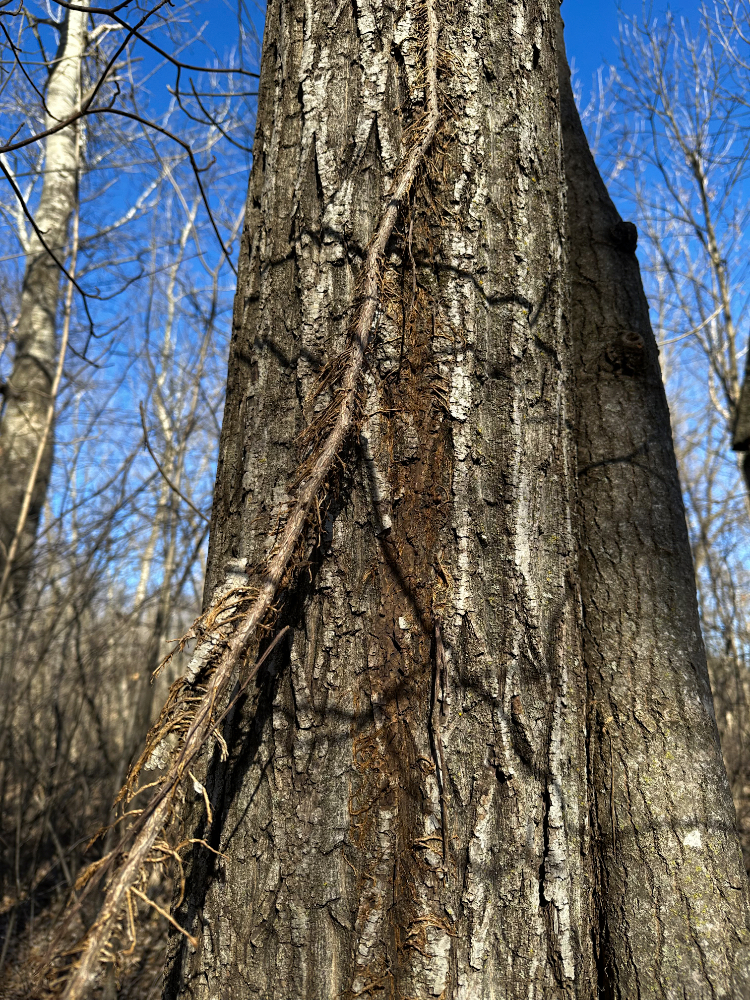
Out of curiosity, I did some image searches for similar-looking vines on tree trunks, and to my surprise, the most common and repeated match identified it as poison ivy. Oops. Really?
I have a pretty good handle on identifying the three leaves of poison ivy plants and have never seen any greenery on these hairy vines on the trees, so I never connected the two. Also, I have never experienced a rash outbreak after messing with the vines in the woods, which surprises me since I react pretty easily when having contact with the low-growing plants in the sunny expanses around our property.
I consider myself lucky and will be giving these vines in the woods a little more respect when coming across them in the future. I will definitely be looking more closely for signs of the telltale leaves in the woods during the growing season.
Part of the problem probably stems from the fact that we don’t see very far into the thick woods off the trail during the growing season, and there are so many green leaves that we’re less likely to spot poison ivy leaves among all the others. Out on the edges where it grows in the sun, it is very easy to see.
While standing in the middle of a section of the woods off-trail yesterday, I spotted a curious pattern of young hornbeam (also called ironwood) trees that had sprouted around the trunk of a large poplar tree.
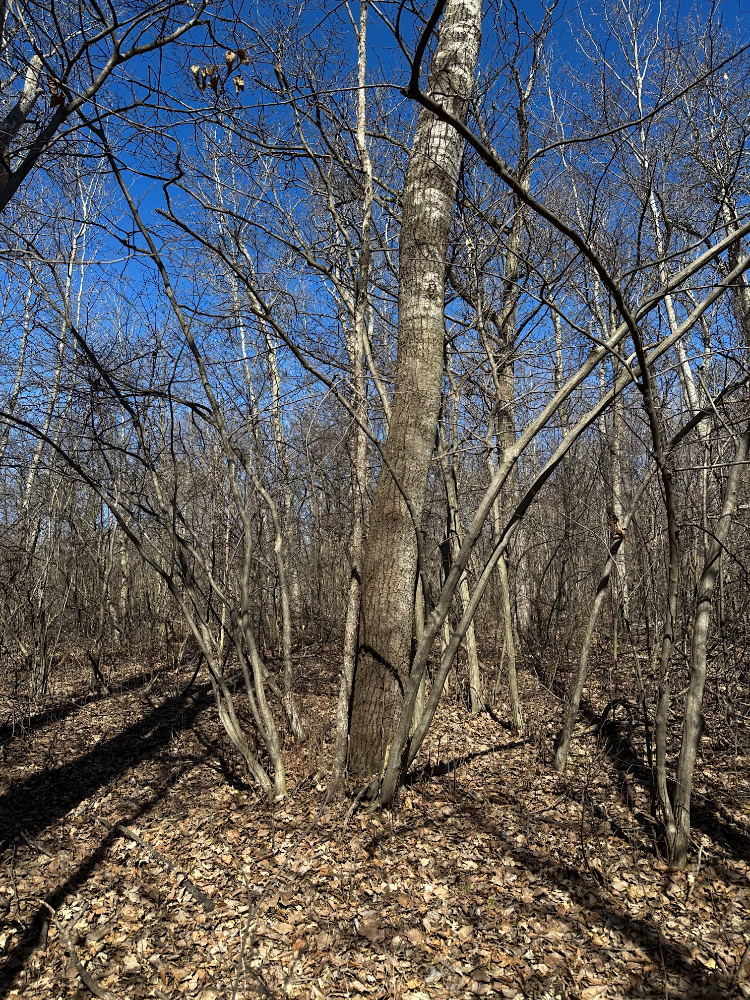
I am curious what led to this arrangement. The way the hornbeam trees are growing in something of a circle mimics the pattern of new growth after we cut down a tree, and the energy stored in the roots sends up a ring of new shoots around its circumference. Could something like that have happened here, and the poplar (a much faster-growing tree) just happened to emerge in the middle of them? I don’t really know what else to think, given my lack of education in the intricacies of tree species and their growth. Whatever, it is certainly an interesting sight.
Much more common and easy to identify are the numerous grapevines sprouting up from almost everywhere, but especially from places where we have cut them out before. That plant is VERY good at spouting new life from any fragments left in contact with the ground.
This time of year, before any leaves have sprouted open, is prime time for us to do vine hunting… again.
.
.
Anecdotal Evidence
Before I launch into today’s thoughts and opinions of *This* John W. Hays, let me just report that the re-installation of a battery in our generator was accomplished without difficulty. It went back in a lot easier than it came out. We are once again prepared for any calamity that might knock out power at home.
Today, however, we are not at home.

 .
.
.
.
.
.
.
.
.
Can you say, “Lake place?” My favoritest of places (away from home)?
Cyndie and I listened to a podcast about brains, neuroplasticity, and autonomic nervous systems on the drive up, making the trip go by in a blink. We stopped in Cumberland for an ice cream treat and met another couple from the Twin Cities heading to their cabin. They pressed hard to sell us (maybe successfully) on attending the annual Rutabaga Festival in August.
The lake place provided some anecdotal evidence of the changing climate. First, the mosquitos have made an early appearance with an intensity that is much more reminiscent of mid-summer. Second, the trillium blossoms that are usually at their glorious best on Memorial weekend look a little past peak already. Having cleared tree branches last November (when we were up here and Cyndie shattered her ankle) there is a new visibility of trillium on the slope below the house.

Third, the poison ivy that could frequently be found on that slope is making visible gains in both directions, toward the lake below and into the mowed areas above. This expansion mirrors what is happening at home. The growing season is a little longer with the warmup in spring happening earlier and the hard freeze in fall happening later. Poison ivy seems to be thriving with these changes.
We left Asher at home this weekend with a sitter who will tend to the horses as well. Before we left, Cyndie wrote a detailed essay on how to care for Asher so the sitter would know exactly what the pup needs and when. Some of them were simple, like bedtime.
An hour and fifty minutes beyond that time last night, Cyndie got a text with a photo of Asher seated nicely beside the sitter by the fire pit out back of the house. I told her that the dog is going to love it when we go away and leave him with the sitter because all those dang rules the parents have get loosened.
Today is work day and we will probably focus on cleaning the beach. I haven’t checked the temperature of the water yet but if it looks so much like summer around here, maybe it will be warm enough for a swim when chores are done.
The evidence is yet to be revealed.
.
.
Looking Good
I’m in the final countdown of days before leaving tomorrow for my annual vacation week of biking and camping with the Tour of Minnesota. I feel reasonably prepared, both mentally and physically. Yesterday, we worked on a few projects with immediate visual rewards on the landscape around our house and on our north loop trail to get everything looking good before I go.
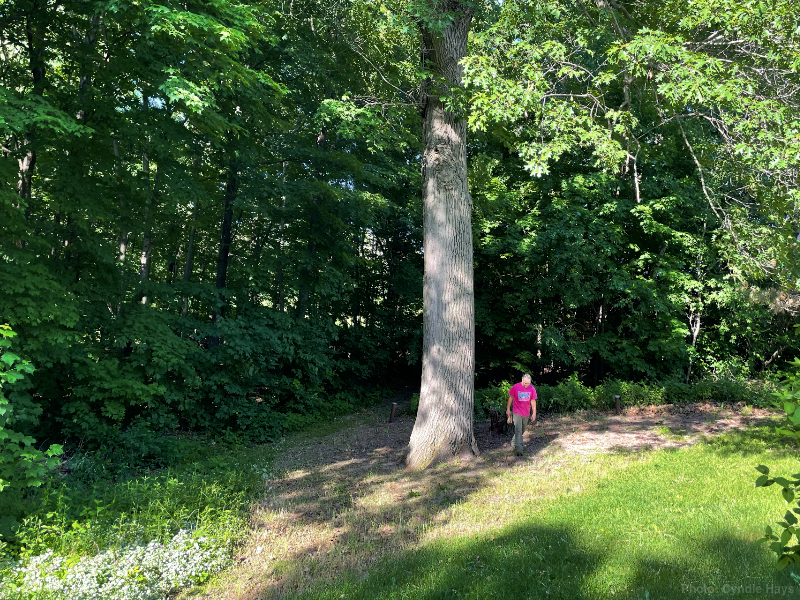 We received notification from our county that it was time to have our septic system inspected and yesterday the tank was pumped and deemed to be in good working order. That’s always a relief to know. Cyndie and I mustered the initiative to use the occasion to clean up the overgrowth in our drain field.
I was reminded of our visit to Ian’s place in Portugal in 2010 when he and I cleared the bramble that had covered a spring he hadn’t seen in years. I uncovered an old tree stump that I had forgotten was there when we cleaned up the crazy tangle of things growing among the wild raspberry bushes since the last time we cut back the growth there.
After that was done I got out the diesel tractor and mowed down the thistle and poison ivy as well as the edges of our north loop trail. If I somehow avoid getting a rash after the wild thrashing of so much of the troublesome ivy it will be a big surprise to me.
Next, we spent time trimming branches near our backyard fire pit. I started with a pole saw that proved entirely inadequate and ultimately brought out the pole chainsaw and the big chainsaw to clear all that looked deserving. It is always interesting to discover there are more things to cut than we originally expected. Once you get in there and take out the first layer, the next obvious candidates suddenly pop into view.
While I had the main chainsaw out, I finally dispatched the last dying pine tree that was in the middle of the back yard.
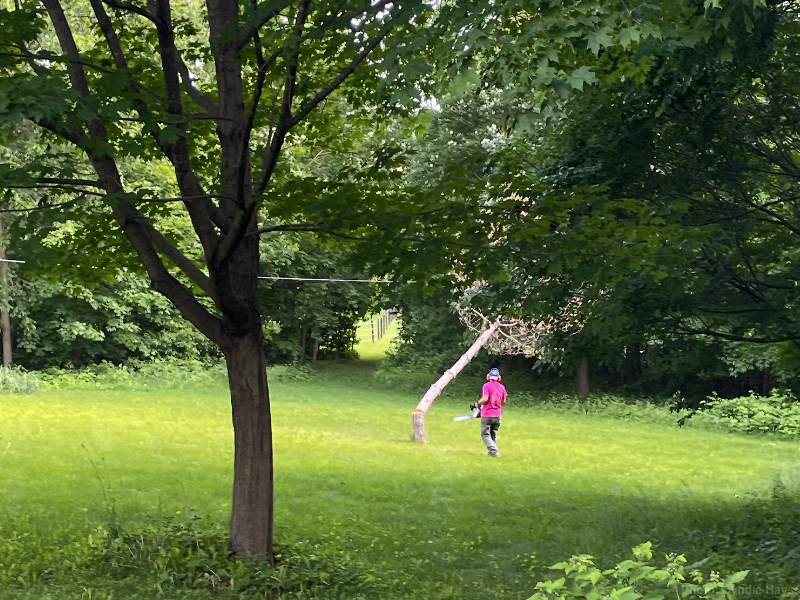
Cyndie captured the shot just as the tree was falling. There is only one dying pine tree left back there now. It is on the side of the yard and doesn’t stand out as obviously so it can linger a while longer. We have already got enough branches to clean up after all the cutting that was accomplished yesterday.
Today, I will mow the grass with the lawn tractor to get this place looking its best before I leave Cyndie to deal with everything for a week.
That should be completed with plenty of time to spare for packing my things before Saturday’s departure. Despite having done this June week of biking and camping more than twenty times before, I still struggle with the decision making about what I really need to bring.
At this point, it sounds like the week is going to start out hot. That should make it easier to pack light.
.
.
Big Swing
The temperature took a big swing of over 30°(F) in one day and we went from a high heat advisory on Monday to cool and wet yesterday.
I decided to take advantage of the rainy weather and started pulling weeds. I soon found myself pulling thistle that was mixed with poison ivy. That was enough to get me to change my focus to a different area where vines are taking over. Both projects turned out to be more overwhelming than handwork can solve.
I’m going to need to bring out the brush cutter on the back of the diesel tractor to interrupt the unwelcome trends growing in these two areas. We seem to have arrived at the peak vine growing time of the year as they are showing up everywhere we turn and in greater density than either Cyndie or I recall noticing in the previous ten years.
It’s hard to know if we are making any headway in controlling the vines because previous years’ efforts seem meaningless under the current onslaught of multiple climbing species showing up far and wide.
Speaking of big swings, I snapped a photo of Cyndie trying to interrupt a budding dreadlock in Mix’s tail while the mare was gobbling her morning feed.
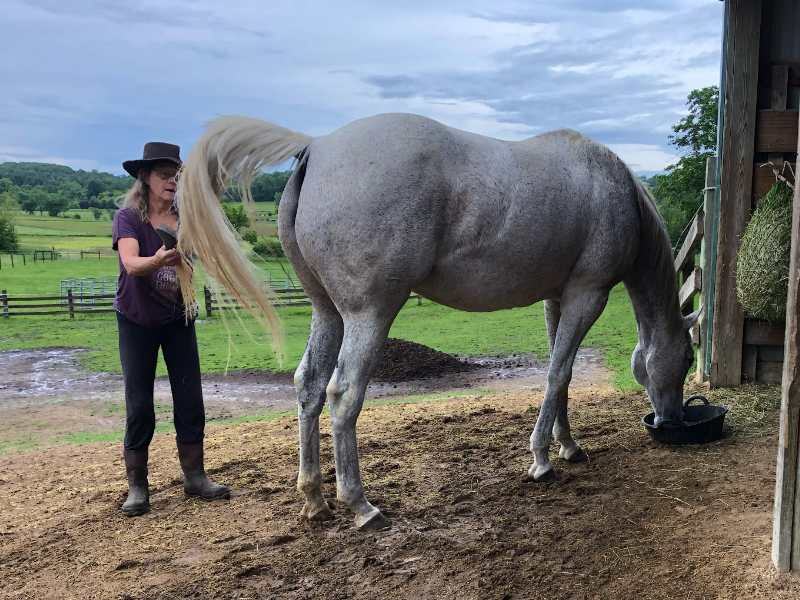
It speaks volumes that Mix was agreeable to the annoying activity going on behind her while she ate. The horses really are allowing themselves to receive more attention from us every day. It’s wonderfully rewarding.
It’s a big swing from how they were behaving when they first arrived, a little over a year ago now.
.
.
Danger Zone
Green growth is bursting at breakneck speed everywhere we turn this time of year. As much as I dream of letting nature have its way to grow unhindered, experience reveals a number of ways intervention offers room for improvement. Pruning becomes a responsibility, really, to offset the alternative look of neglect.
After enlisting the professional help of tree trimmers to prune and fell trees on our 20 acres, I have an endless amount of clean-up to do in their wake. Historically, I have failed to keep up with the felled lumber that hired help has scattered around our forest floor so I am striving to change that this time.
My effort started with the large willow tree that was first on the list of trees needing attention this spring and which got pruned to a much greater degree than I expected.
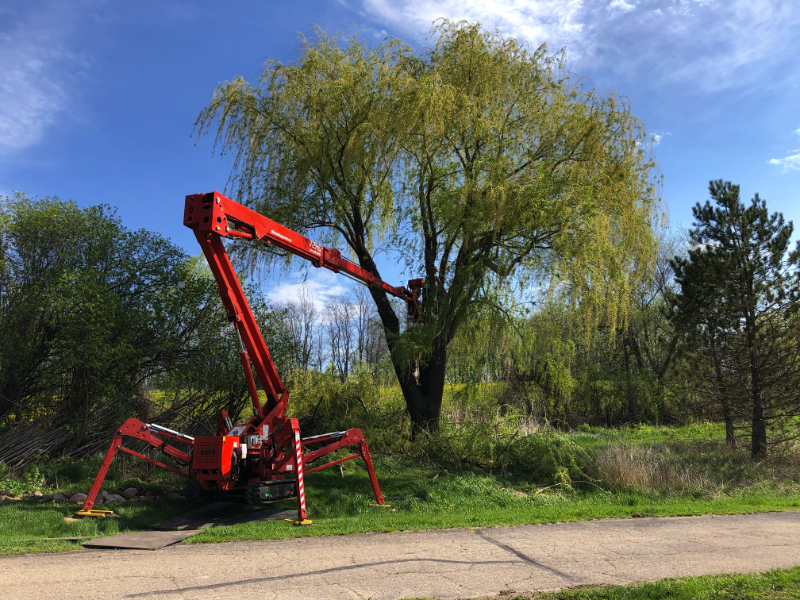
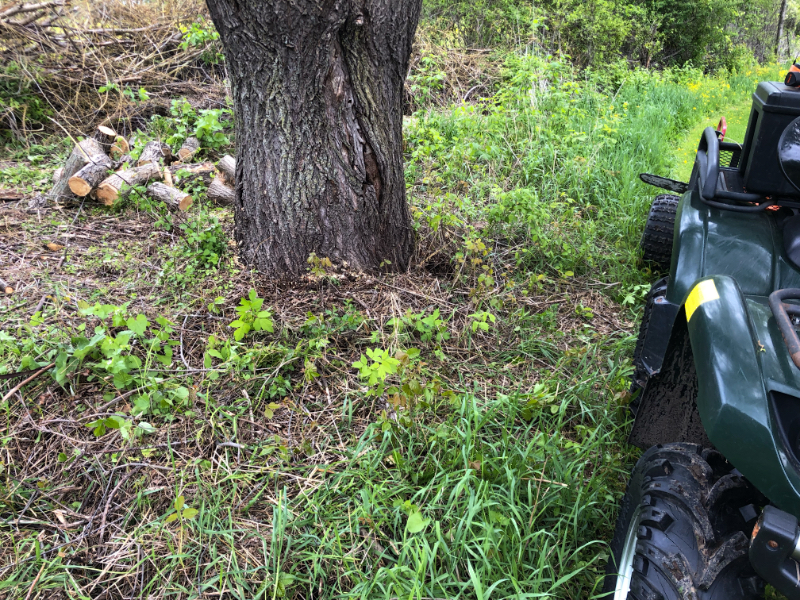
Yesterday, I worked to finish cutting up and splitting the last of the large branches scattered beneath the tree after the pruners were finished. The closer I got to completing the effort of clearing the tangle of branches and limbs laying around the trunk of the tree, the more obvious it became that I was working in a danger zone of poison ivy.
 .
.
.
.
.
.
.
.
.
The shiny leaves of three with a tinge of redness in the early period of sprouting were everywhere beneath this willow. Everything that I picked up had a high probability of having been in contact with the dreaded rash-inducing plants but I was knee-deep and hours long into the project so I decided to just keep going.
With extra consciousness to quit reaching my gloved hands up to my face, I forged ahead cutting, splitting, and stacking limbs in the woodshed for drying.
It felt a little insane to be plodding back and forth in growth that was filled with so much poison ivy but I decided it was a risk I needed to face to complete the bigger task at hand. It feels great to have the ground around the tree entirely picked up after the pruning. Now I only have twenty or thirty others left deserving similar treatment.
Thankfully, there aren’t any others surrounded by as much poison ivy as this willow.
At the end of my many outdoor projects, I carefully got out of my clothes and piled them in the basement to be laundered and then hit the shower with special oil-busting soap that I lathered and lathered in hopes of surviving the danger with minimal reaction.
I can hope that I wasn’t breathing aerosolized particles of the oil during the tree branch cutting and clearing efforts. My body doesn’t have a good history of inhaling the irritating essence of poison ivy.
.
.
Leave It
There are multiple meanings to the title, Leave It. There is always a little sadness in needing to leave the lake place, but today that is what we will be doing. There is also the old adage about poison ivy: Leaves of three, Let it be. Lastly, leaves are the theme of images for today’s post.
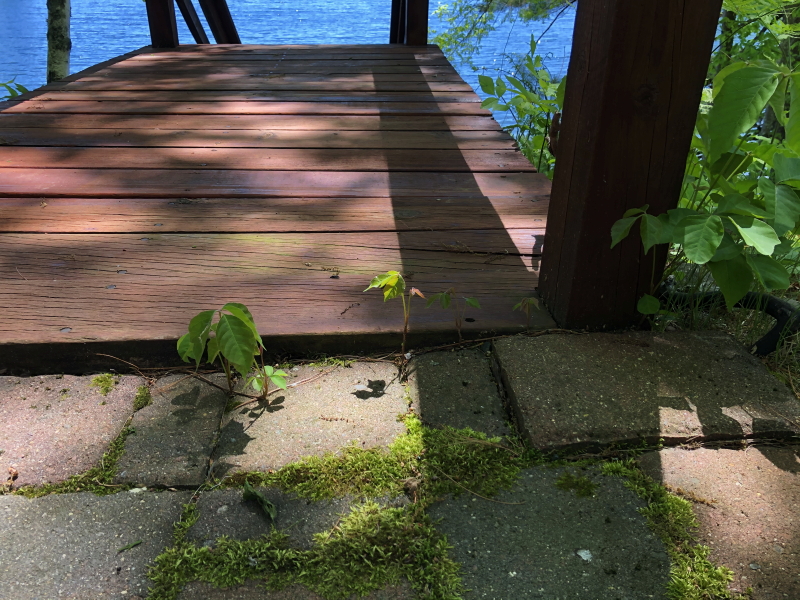
Starting with a sprout of poison ivy in a very inconvenient location.
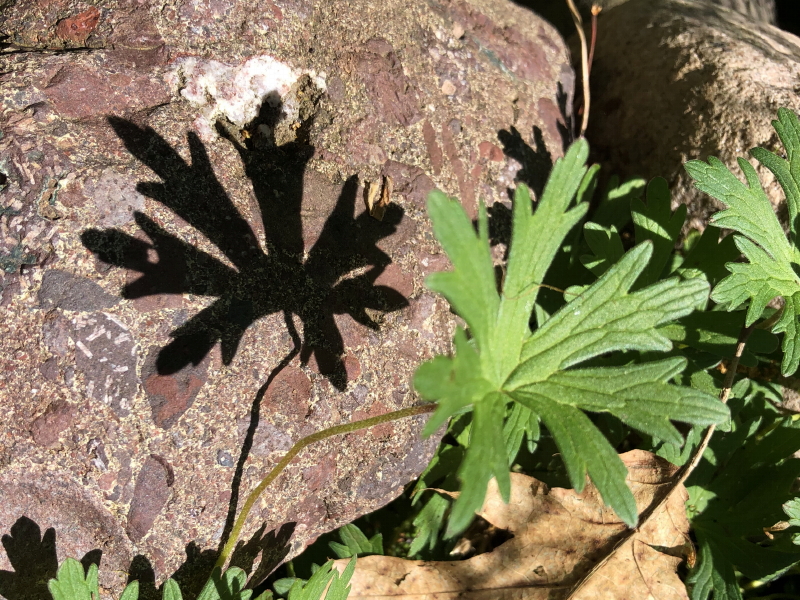
A leaf shadow that seems about as perfect as the leaf itself.
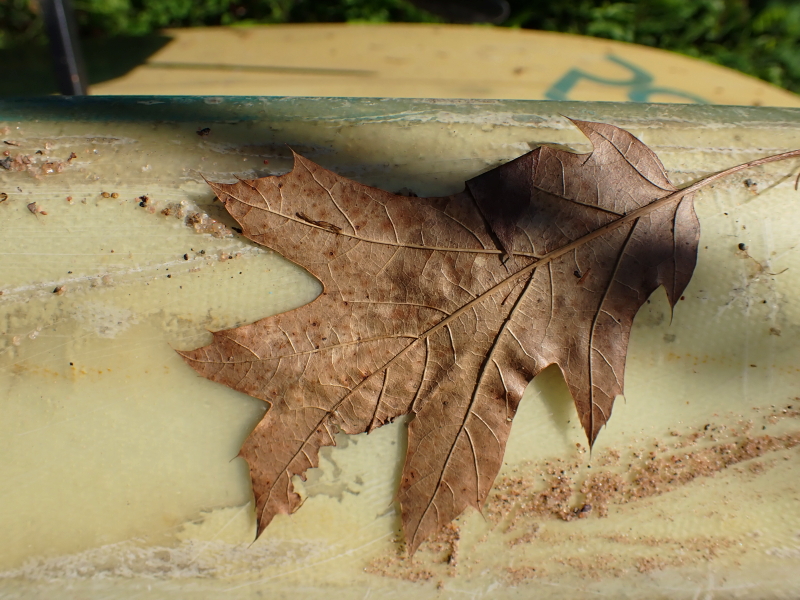
There was an old oak leaf stuck to the side of this aging stand-up paddleboard.
Finally, a frame-filled immersion in the wonderful patterns of hosta leaves.
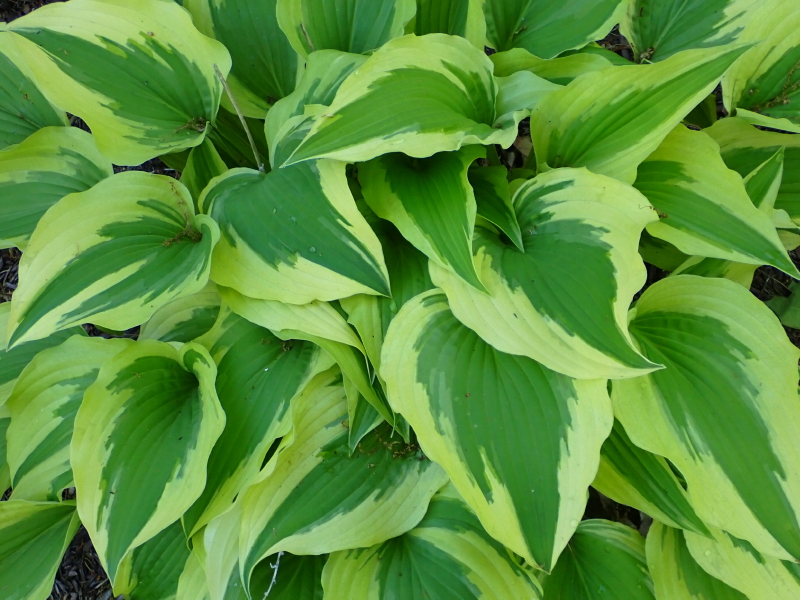
I’m going to leave it at that.
Happy Memorial Day to readers in the U.S. We will spend the day driving home and hopefully transplanting a few trilliums after we arrive.
.
.
Spot It
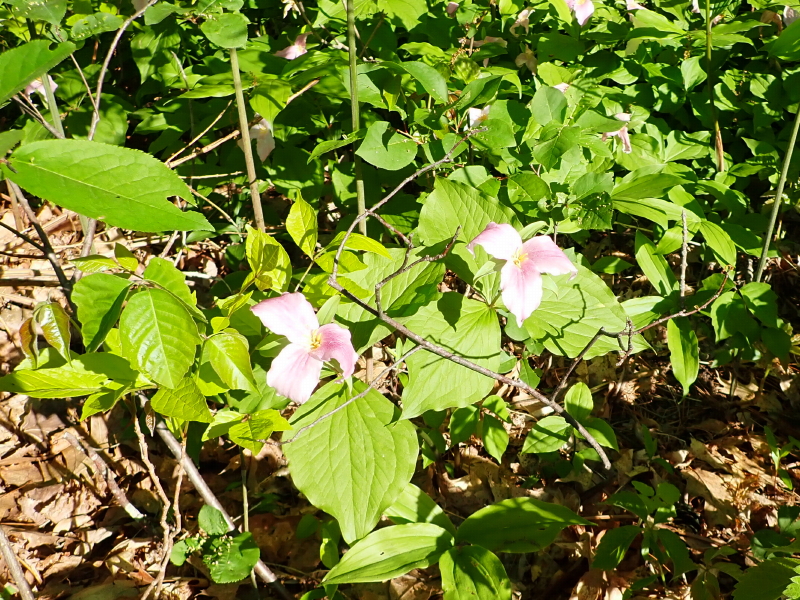
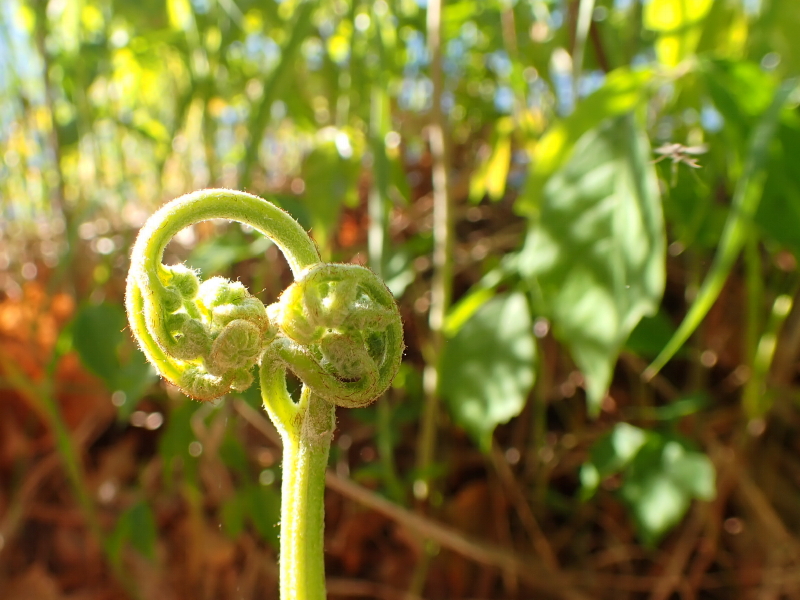
Can you find the secondary features hiding in plain sight in these images captured throughout my day yesterday?
 .
.
.
.
.
.
.
.
.

 .
.
.
.
.
.
.
.
.

.
.
.
.
.
How many did you identify?
That was purple-tinted trillium alright, but did you notice the poison ivy directly beside it on the left?
There was some complex chirping coming from the pine tree. Is that a nuthatch? You tell me. I didn’t have a long lens.
The coiled-up young fern was the focus and I didn’t notice the mosquito until viewing the image on my computer.
What was that lurking beneath the water, obscured by the wavy reflections? The old snapping turtle hanging out on the boat lift.
.
.
Holding Out
Turns out, our adult Golden Laced Wyandotte layer hen has been holding out on us. Yesterday, Cyndie’s mom, Marie, along with Sara and Althea, stopped by to see the new chicks on their way home from the lake place. While they were here, the group took a stroll to find the three adult hens free-ranging away on the property.
When they heard the Wyandotte cooing in a thicket of growth, closer inspection revealed she was sitting on a batch of seven eggs!

Why that little stinker.
When I got home and Cyndie shared some pictures of the scene with me, the thing that stood out more than the eggs was the appearance of poison ivy leaves around the spot.

That chicken really doesn’t seem to want us to take her eggs.
For that matter, I suddenly have very little interest in handling that hen! Her feathers are probably covered in poison ivy oils. I start to feel phantom itches all over just thinking about it, and I didn’t even touch any of the hens or eggs yesterday.
I touched a lot of cute little “henlets,” though.
Whose idea was it to allow our chickens to free-range around here, anyway? A fenced run off the coop would be a lot simpler than all the risks due to predators and the hens’ creativity with laying locations.
Speaking of predators, I believe there is now one less fox we need to worry about. Yesterday morning, just as I turned off our street on the way to work at the crack of dawn, I saw a roadkill fox in the oncoming lane.
I’m a little surprised no other marauders discovered the pile of eggs free for the taking from the ground in the last week. Maybe that bodes well for the chances of continued good luck for the last three surviving hens from our 2018 batch.
If it weren’t for the occasional random incursions of passing bands of coyotes, our regular number of free-ranging adults might increase from the usual three that we always end up with toward the end of their productive egg-laying years.
When we were in this same situation two years ago, with 3 adults and a new brood of twelve young-uns that we expected would need merging together, the adults all got taken by a fox over a series of a few days. Sad as that was, it saved us the hassle of introducing the different aged birds to each other.
This time, I may need to actually follow through on a plan to remodel the inside of the coop to add a barrier that will provide shared-but-segregated accommodations for some period of introduction.
We never run out of new things to learn around here. Particularly, how to outsmart a hen that decides she’s too good for the silly nest boxes in the coop for laying her precious eggs.
.
.


 Relative Something