Posts Tagged ‘forest management’
Healthy Complexity
The weather was gorgeous yesterday, allowing me to take on the project of clearing our trails of fallen trees that came down in high winds that accompanied recent snowstorms. There was one large poplar that we’ve been needing to step over as it landed across our most-used path on morning walks with Asher.
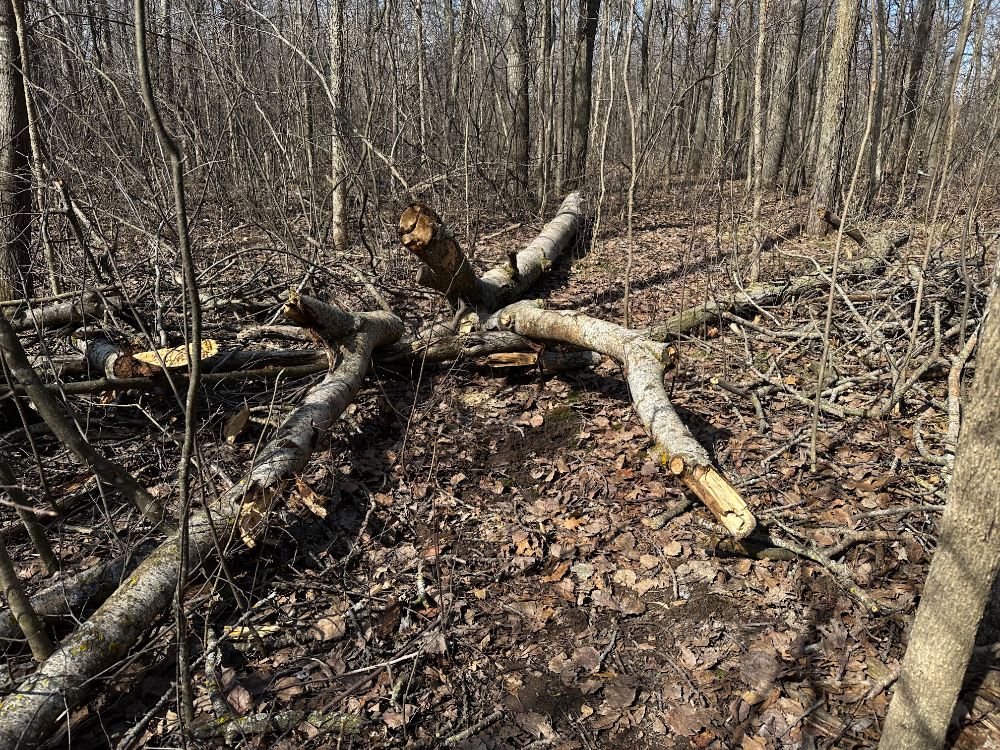
When it came down, it knocked another tree over, and they both landed at an intersection of two pathways, interfering with both. We don’t need the firewood. I’ve got a backlog of cut wood waiting to be split.
No problem. I have a new inspiration upon the discovery of author/forester Ethan Tapper and his advice on maintaining a healthy forest.
.
.
I now feel we have permission to leave downed wood lying on the ground as future nutrients for the soil, cover for wildlife, and protection from overbrowsing by deer.
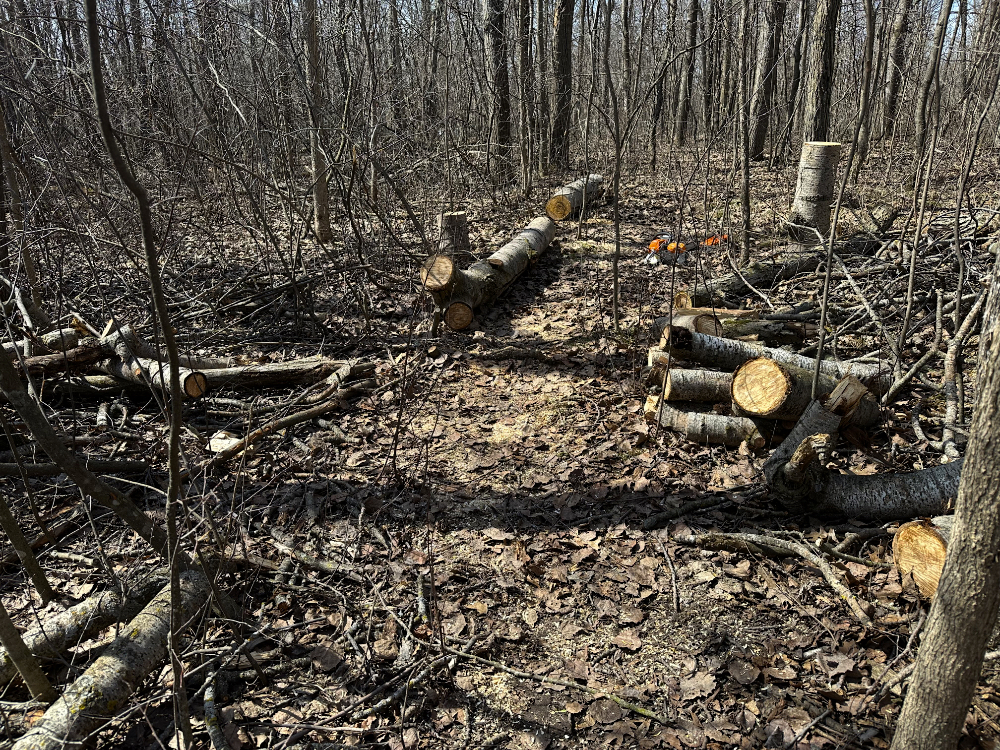
We just have to recalibrate our sensibilities as to what looks like neglect and start framing it as healthy complexity.
.
.
Poplars Aging
Even though we walk our woods every day, I still find myself surprised by how the view can change from time to time. We often find ourselves asking whether something catching our attention is new or different from the last time we passed that way.
I suppose that reveals how tenuous our memory for such detail is. That doesn’t bode well for measuring how much our aging mental capacity is fading. Somewhere in my future, I hope there is a way to tell the difference between my current memory lapses and whatever diagnosable level of degradation there is that earns a medical term.
It seems to me that any of our declining capacities that fail to meet a doctor’s minimum level for diagnosis can all be lumped into the general category of simply getting old.
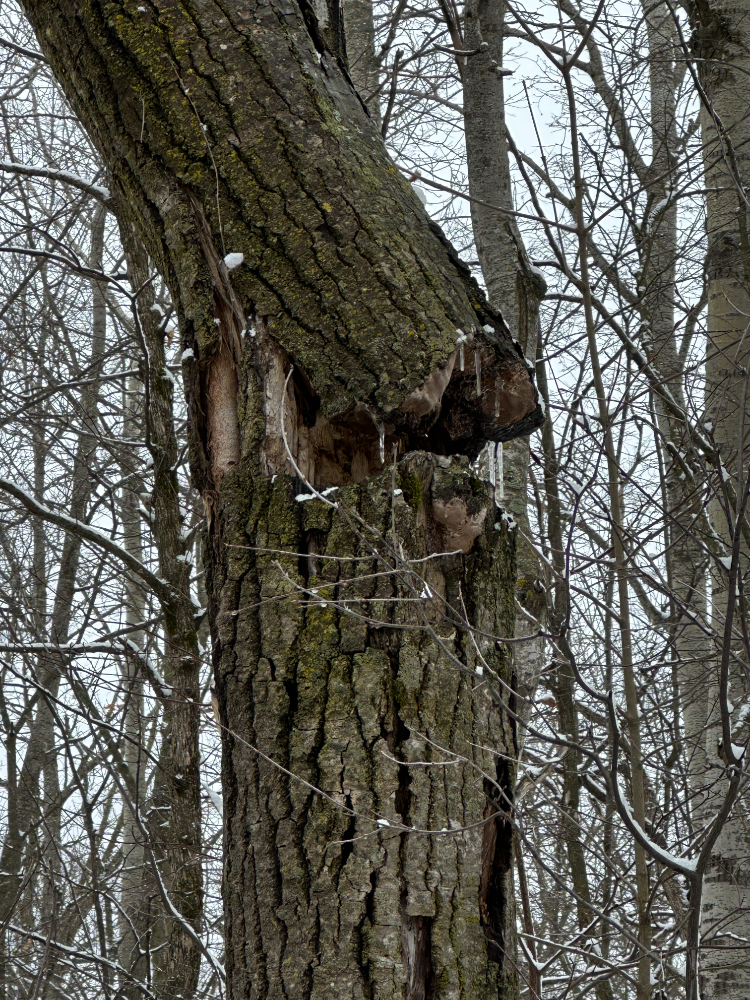 So, the thing that caught my eye yesterday in our woods is that a large number of our tallest trees in a section of mostly ash and poplar are looking rather old. And the ash trees that aren’t old are showing signs of failure from the dreaded emerald ash borer insect.
I fear that the fate that has befallen one particular poplar is likely to happen again to quite a few others in the general vicinity.
At least I haven’t forgotten that this hazardous situation has been looming for almost three years. I don’t always remember the exact location, but knowing it’s out there somewhere, a brief search usually is all it takes to find it.
It’s a heck of a lot easier right now with the tree trunks clearly exposed.
Which is precisely why I noticed how many look as if they are approaching the end of their natural lifespan.
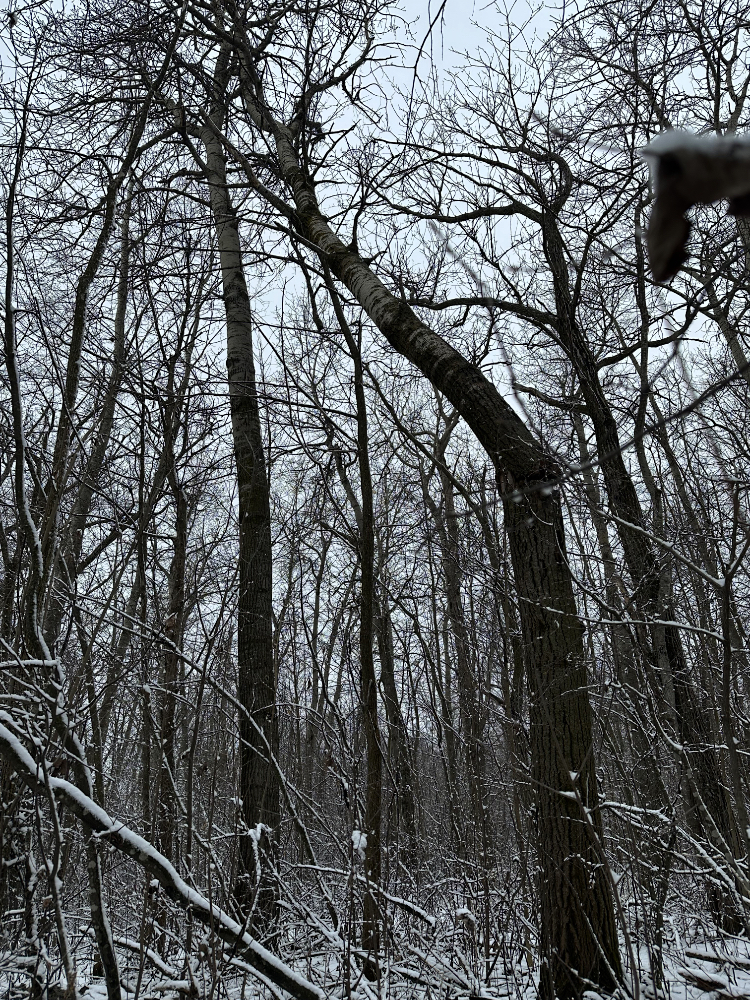
The break in that tree is so high up, and the top so thoroughly tangled in the tree it fell into, that I am not planning to interfere with what nature has in store for it. I’m guessing that the next big wind incident that impacts that portion of our woods will create several more snapped trunks just like that one.
It will be a great day when we find that something has knocked that widow-maker to the ground, especially if it happens when we are nowhere near it.
Until it falls, I will continue to use it as a check on my memory. If I come upon this busted tree trunk and don’t remember having seen it before, it will be time to have that talk with my doc.
Unfortunately, the less obvious situations –or should I say, less unique– like a tree completely down on the ground, tend to confuse either Cyndie or me on a regular basis. I blame it on the changing angle of daylight during our walks. We frequently find ourselves asking one another whether a certain tree down is new or one that’s been there for a while.
One of the blessings of the forest becoming filled with the green growth of summer is that it becomes hard to see what’s going on with the trees that aren’t right on the edges of the trails. Out of sight, out of mind.
It gives us less to worry about in the woods for a few months each year.
.
.
Third Time
I’m beginning to think the universe is trying to tell us something via large trees crashing to the ground. For the third time in an uncharacteristically short number of weeks (and the second time that I have been able to witness it with my own eyes), a massive compound limb snapped from its trunk and smashed to the ground. This time, it was an oak tree.
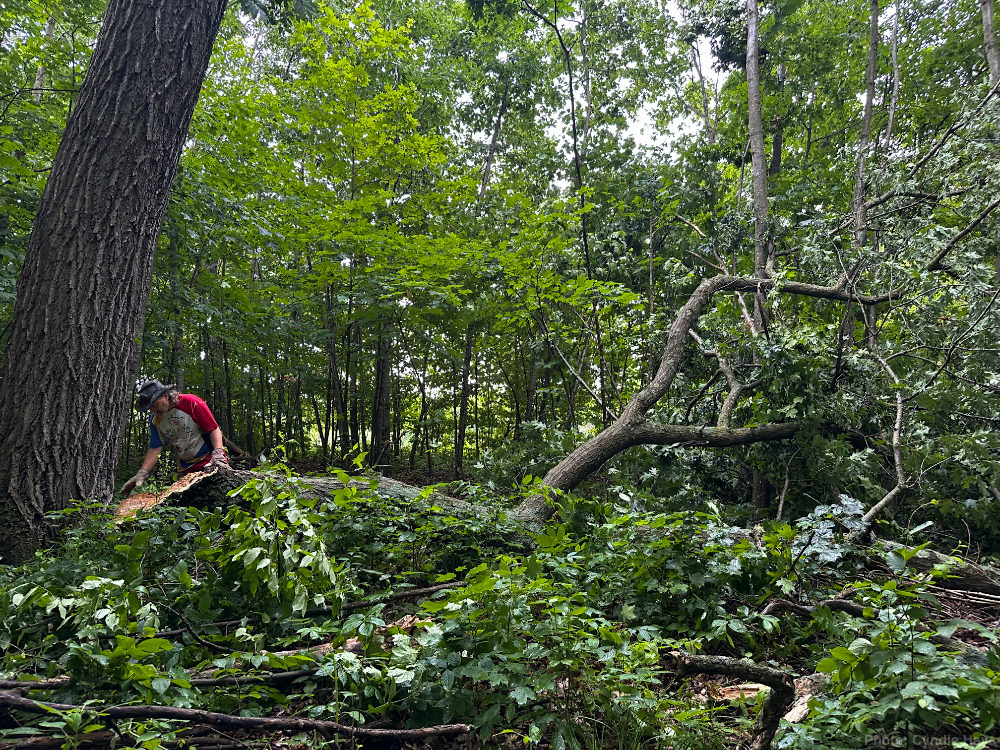
What did we do to deserve this? Cyndie and I were walking Asher first thing in the morning when, just to our left, the cracking sound started without any obvious trigger. It wasn’t windy. The huge portion of the tree simply cracked off and smothered everything it landed on with a dramatic, clamorous thrashing.
I didn’t have it in me to spend the day cutting it up, so we ignored it for the rest of the day, but it’s blocking one of our paths through the woods and will need to be dealt with eventually.
When I think about the number of trees that I have recently tented beneath without knowing a thing about the health of the branches above me, this gives me pause. We had no reason to suspect this oak of ours was at risk.
We are both still marveling over the fact that we were standing right there to witness it as it fell.
I don’t know what lesson I should be taking from these trees crashing to the ground lately, but it is getting a little creepy. It’s also getting a little less calming to take long ‘forest bathing’ walks through our trees.
Since things commonly happen in threes, we are hoping this will be the end of whatever exercise this is that has us cutting up limbs and branches with chainsaws.
When we bought this property twelve and a half years ago, I had no idea how much work it would be to tend to the forested acres. The more time I spend in these woods, the more I learn about how often trees and branches fall to the ground for a variety of mysterious reasons.
I never expected so many of them to be this darned big.
.
.
Vines Again
While walking through the woods yesterday with Cyndie and Asher, we decided to knock down as many of the broken and tipped trees and branches as we could reach and deal with using my pruning saw. Inadvertently, that ended up including freeing up some trees from the grip of vines as we came upon them. For as much energy we have put toward de-vining our trees over the years, it continues to surprise me to find how many we must have overlooked. In addition to that, there are plenty where vines were cut out previously but have resprouted, requiring another round of attempted eradication.
One common vine we have seen many times in the middle of the fully shaded woods grabs a firm hold on the bark and has a very impressive web of roots tangling great lengths across the forest floor.
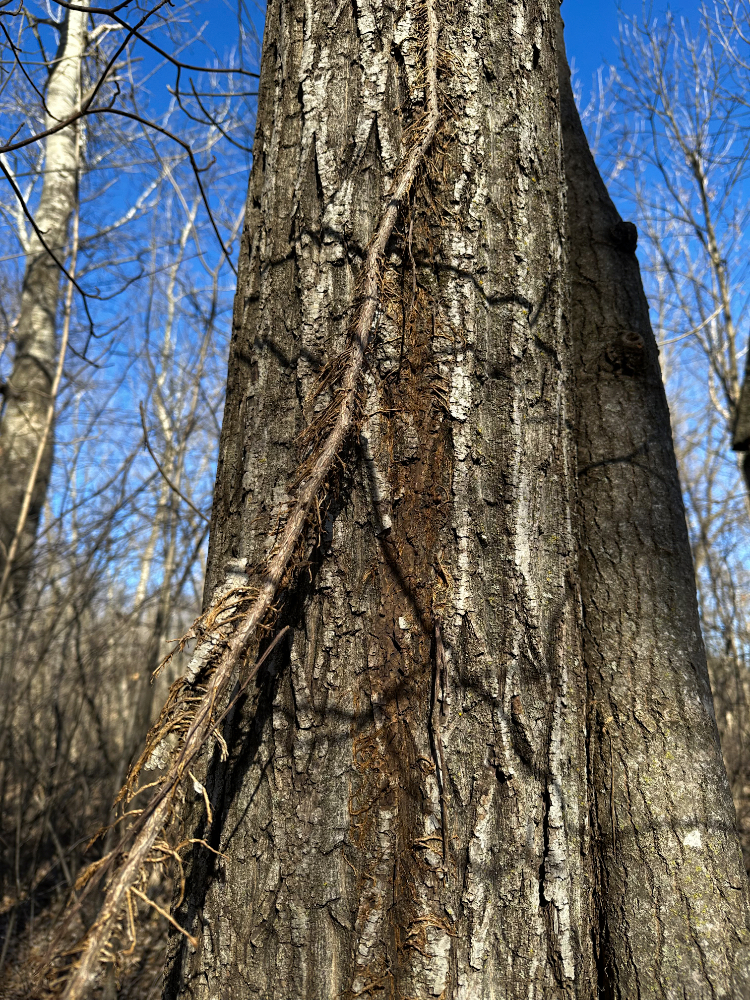
Out of curiosity, I did some image searches for similar-looking vines on tree trunks, and to my surprise, the most common and repeated match identified it as poison ivy. Oops. Really?
I have a pretty good handle on identifying the three leaves of poison ivy plants and have never seen any greenery on these hairy vines on the trees, so I never connected the two. Also, I have never experienced a rash outbreak after messing with the vines in the woods, which surprises me since I react pretty easily when having contact with the low-growing plants in the sunny expanses around our property.
I consider myself lucky and will be giving these vines in the woods a little more respect when coming across them in the future. I will definitely be looking more closely for signs of the telltale leaves in the woods during the growing season.
Part of the problem probably stems from the fact that we don’t see very far into the thick woods off the trail during the growing season, and there are so many green leaves that we’re less likely to spot poison ivy leaves among all the others. Out on the edges where it grows in the sun, it is very easy to see.
While standing in the middle of a section of the woods off-trail yesterday, I spotted a curious pattern of young hornbeam (also called ironwood) trees that had sprouted around the trunk of a large poplar tree.
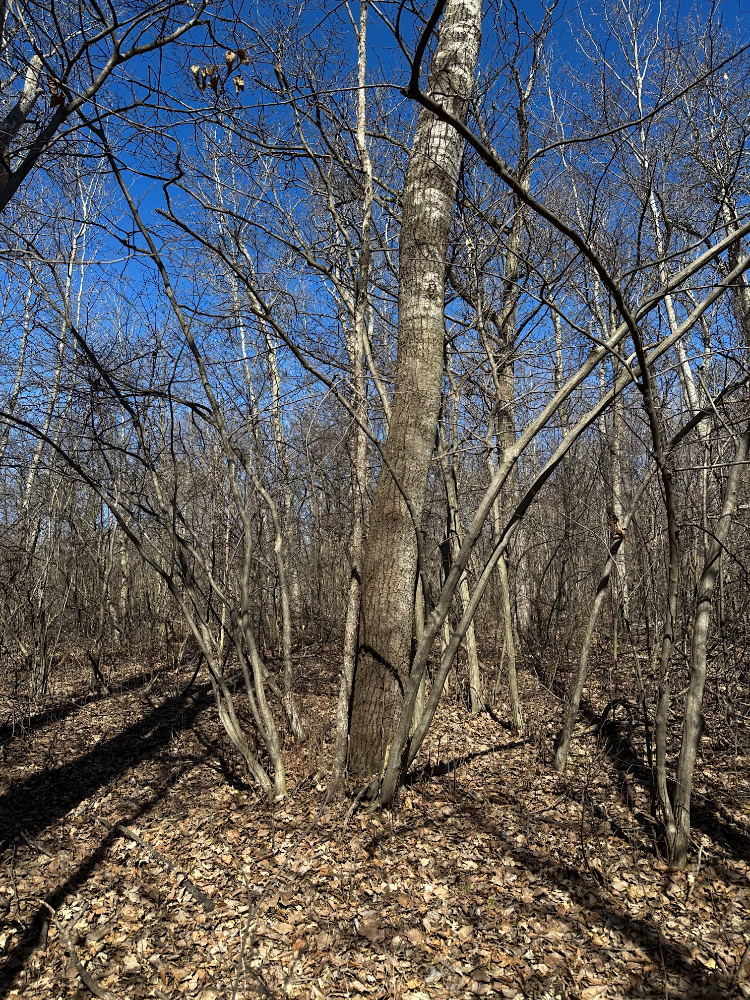
I am curious what led to this arrangement. The way the hornbeam trees are growing in something of a circle mimics the pattern of new growth after we cut down a tree, and the energy stored in the roots sends up a ring of new shoots around its circumference. Could something like that have happened here, and the poplar (a much faster-growing tree) just happened to emerge in the middle of them? I don’t really know what else to think, given my lack of education in the intricacies of tree species and their growth. Whatever, it is certainly an interesting sight.
Much more common and easy to identify are the numerous grapevines sprouting up from almost everywhere, but especially from places where we have cut them out before. That plant is VERY good at spouting new life from any fragments left in contact with the ground.
This time of year, before any leaves have sprouted open, is prime time for us to do vine hunting… again.
.
.
Impressive Overachievement
It’s been over two weeks since Asher and I discovered a fallen tree leaning across one of our trails in the woods. At the time, Cyndie was in Florida and I needed to wait for her to get home before bringing out the big chainsaw –a tool I’ve agreed to never use when home alone– to clear the path.
 .
.
.
.
.
.
.
.
.
Alas, this many days later and I’ve allowed myself to disregard that project. In my way of thinking, I should get out the Grizzly ATV and hook up the trailer to haul the saw into the woods and carry the wood back out. Then, I realized I should be resting my shoulder to allow it to better heal, and holding the big saw seemed a bit much.
I decided the tree could hang there for a while since it was easy enough to duck under. It is unsurprisingly easy for me to put off chores for some other time.
With our continued dry weather and the forest as dormant as ever, each time we walk around in there I spot another vine to be removed from smothering one of our trees. Cutting down vines takes a lot less effort since I can easily hand-carry the trusty Stihl mini chainsaw on walks with Asher.
I remembered to grab it yesterday to cut out another gigantic woody grapevine that I’ve walked past countless times and somehow ignored until now. I didn’t even try to pull it out of the tree. Just cut out a six-foot section of it and carried on with following Asher along the path.
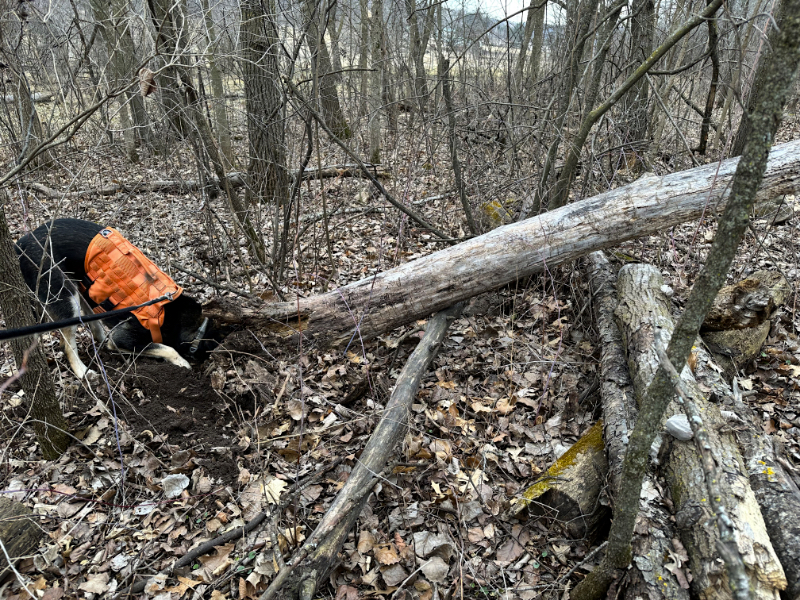
Then we came upon the tree leaning across the trail. Hmm. Mini saw in hand. Fully charged battery. Could it handle a job this size?
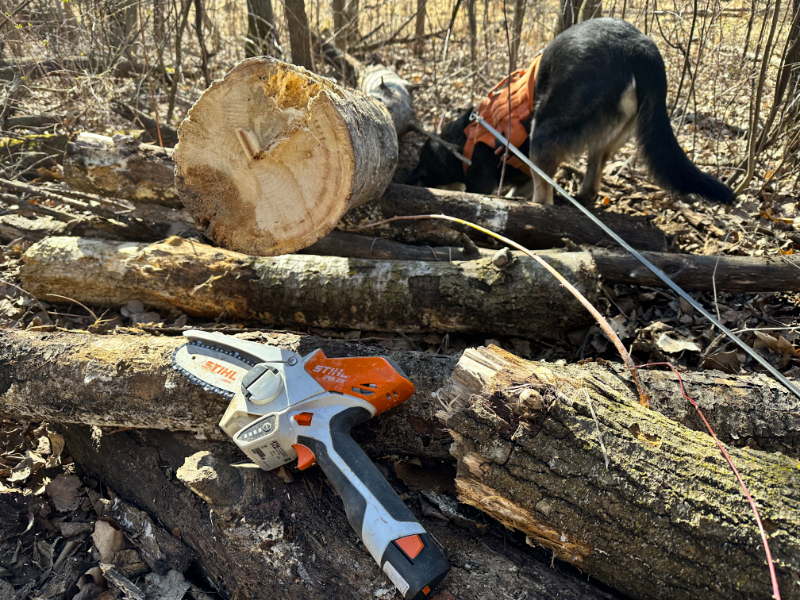
Yes, yes that little branch pruner could. You may notice there were already a number of cut sections of fallen trees on the ground in that spot. For now, I cleared the pathway and left the freshly cut pieces on the pile.
Asher became fixated anew on whatever the heck might have been living in the dirt under all the chunks of wood.
Our dog is tenacious when it comes to digging for critters, but that Stihl GTA 26 is an even more impressive overachiever.
.
.
Big Gusts
Even though the temperature reached the mid-60s (F) yesterday, the strong winds and general cloudiness kept it feeling more like spring than summer. The dramatic gusts got to be a little intimidating at times. The sound of air racing through the branches of our pine trees can get downright spooky.
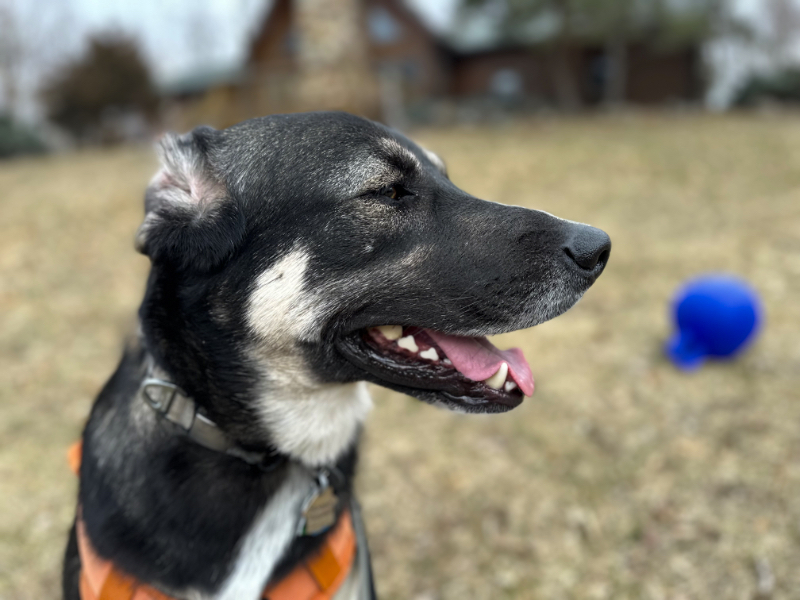
Asher is always checking the scent that rides the wind from the properties south of us. It leaves me curious about what he picks up. My first guess would be cats.
I can’t imagine he was able to pick out anything particular from the gales yesterday that were strong enough to flop his ears back.
By late afternoon, my weather app warned of lightning in the vicinity. That was the first time in months I’ve seen that. According to the radar, storms were popping up right overhead and quickly blowing off to the northeast.
As we walked through the woods earlier, I struggled to figure out if there were any new trees tipped over among the ones that have been leaning long enough that I should recognize them by now. They all look alike after a while. The sure thing is when something comes down across one of our trails, like this one did:
From its appearance, it had been long dead before being blown down. Dead trees that haven’t been knocked down yet are, per what Steve R. taught me, “vertical firewood storage.” Now I’ll have to convert this to horizontal stacked firewood.
Asher took great interest in inspecting the base and the hole it exposed after succumbing to the wind.
The wind kept blowing after dark last night so I will get another chance this morning to test my memory of pre-existing widow-makers when Asher and I head out for our usual routine in the next hour or so. I will not be surprised if there are more new “leaners” today than there were yesterday.
.
.
Vine Interruption
What started as a typical walk through the woods with Asher yesterday afternoon suddenly shifted on a whim to become an industrious “de-vining” effort. Because it is easy to navigate off the beaten paths this time of year, I frequently allow Asher to wander wherever his nose takes him. Sometimes he turns me around enough that I lose my bearings. Asher can bring me to spots where I’ve never stood before.
In one such spot, I noticed a trunk of grapevine that was thicker than my wrist. We have a general policy of favoring our trees over opportunistic vines but some of these in the center of thick growth have evaded our notice long enough to become monstrosities. The problem is that the rare times I discover such huge vines I don’t have the tools with me to do anything about it.
Yesterday, I decided to act on my chance. With Asher unknowingly tagging along, we marched the long walk back to the shop to get the small chainsaw trimmer and then back again to take on the large, woody vine trunks.
There were more than I realized. In every direction I turned, there were additional branches of the serpentine limbs either climbing another tree or putting new roots into the ground. With the power of that saw, I severed the link between every large chunk I could find.
I’m not sure what I will do with them, but I brought back a couple of trophies from the wildly twisting large sections.
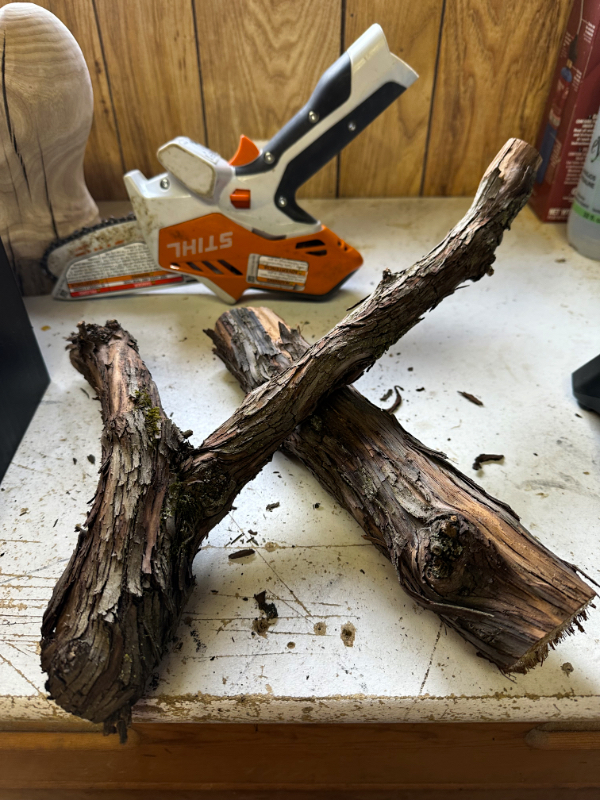
I had tethered Asher to a nearby tree while I worked to find as many of the aggressive tree-climbing troublemakers in sight. Upon exhausting myself of the effort and returning to collect him, I found Asher gnawing on a bone he had found near a large hole he had dug.
I sensed we both headed back to the house with a similar air of accomplishment.
Now, if I can somehow maintain the surveillance in that thicket throughout the coming growing season, that would be just great. Otherwise, they will just return with a gusto unmatched by all the many plants we actually prefer to see thriving in our forest.
.
.
Big Effort
On a walk through the woods yesterday afternoon we came upon evidence of an industrious effort scattered beneath one of our large trees.

Little pieces of the tree had fallen in a wide array around the tree, leaving the snow peppered with holes. The first reaction was to look up to see where this was all coming from.
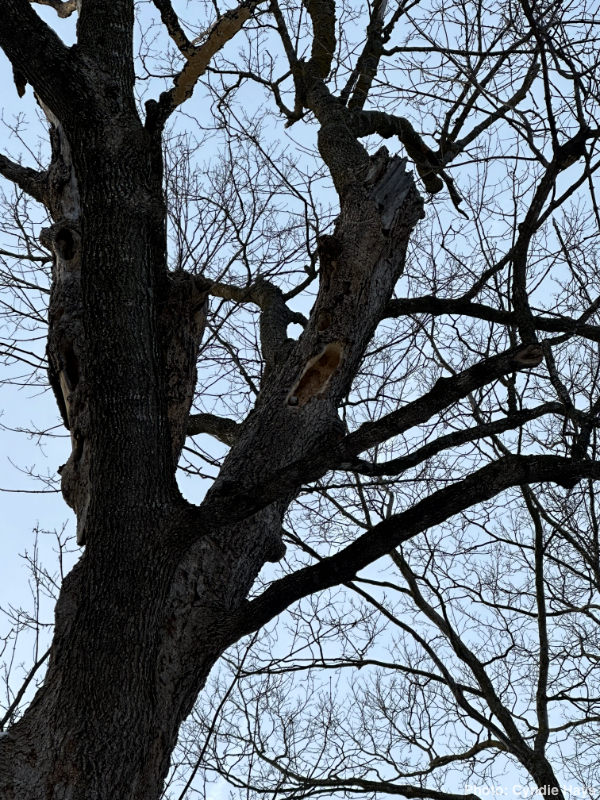
The gaping hole high up in the trunk of the tree was easy to spot. We didn’t know the project was still ongoing until Cyndie saw new pieces of wood falling near us.
There was so much wood shrapnel scattered on the ground, our assumption immediately leapt to visions of a large woodpecker, but that wasn’t the case.
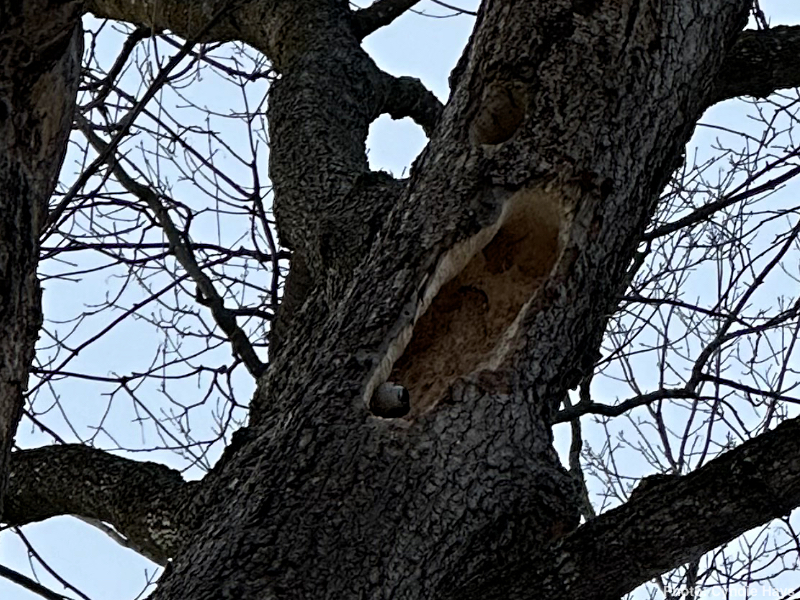
There was a little chickadee busily hopping around and tossing down pieces of the tree. I have no idea why it would want to have such a large opening. The tree probably wasn’t very happy about the size of the wound. This has me wondering about the longevity of this tree. I’m not very skilled at deducing the well-being of trees when they have no leaves.
I’ll need to keep an eye on it next spring and summer to see if the end is near. It won’t surprise me much if turns out to be in the process of slowly dying as trees tend to do. We already have a rather significant number of old trees with the largest diameter trunks that are showing evidence of decline.
It’s giving me more incentive to nurture as many of the trees as possible with the next-largest trunks to give them the best chances for prolonging their years of continued growth. Ours is definitely not an “old-growth” forest, but it has a decent number of trees that are old enough to be mother trees.
We want to help allow our trees to be able to help one another as much as possible.
I should probably give them more hugs.
.
.
Rewarding Work
Taking advantage of Asher being occupied at a doggie daycare appointment yesterday, I jumped into outdoor chores that the warm November has graciously continued to make possible. First on my agenda was the most visible out the front door.
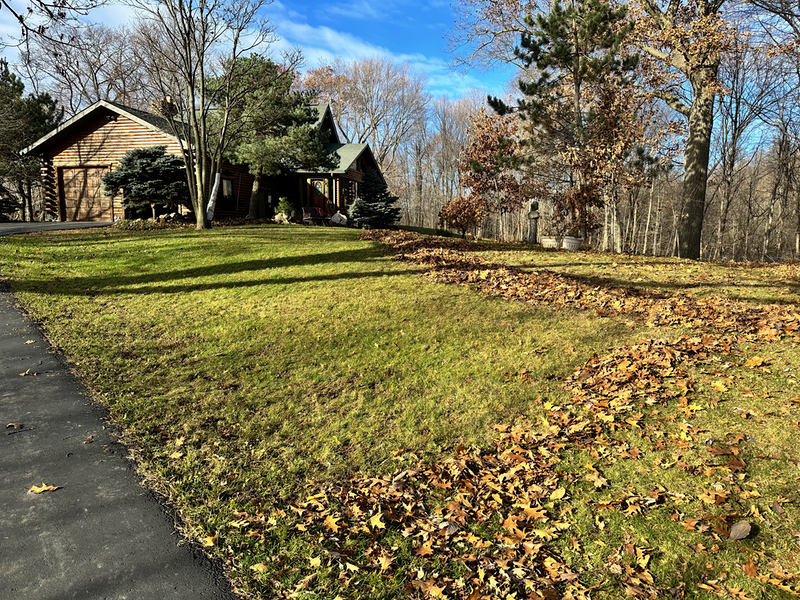
Leaves have been blown into every nook and cranny around the house after several days of crazy gusting winds. It clearly reveals air patterns as they move around objects. Massive piles of leaves accumulate in certain areas beside spots that are blown bare even though we wish a mulch of ground cover would remain.
Clearing the mat of leaves off the lawn grass offers a wonderful visual reward. Bring on the snow.
After raking, I headed into the trees to finish my annual survey for Common Buckthorn sprouts. After all the leaves of desired trees have disappeared, the Buckthorn leaves that hold their green later in the season become easy to spot.
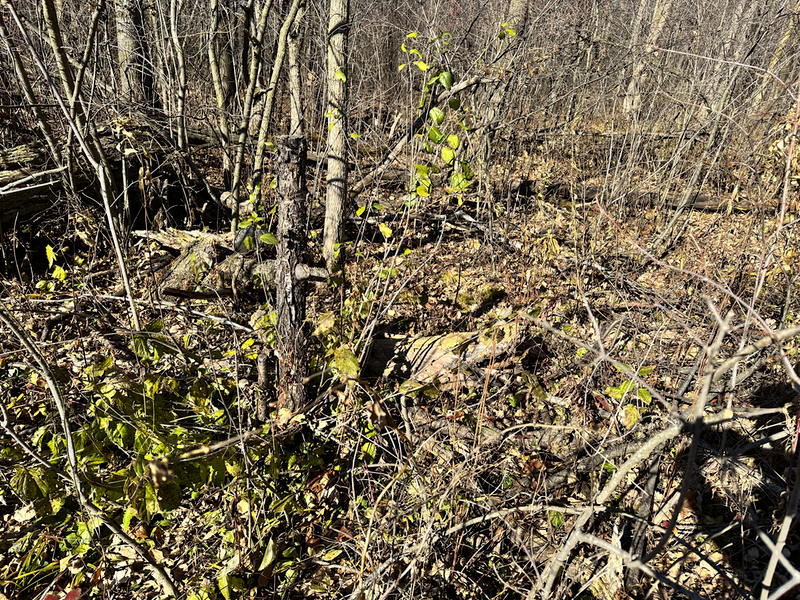
My slow and steady method involves cutting existing trees that were too large to pull out by the roots. I saw them off at an easily visible height, returning every year to trim off the sucker sprouts that try to salvage some future life.
It only takes a year or two before the root structure gives up trying. I admit to experiencing a mean sense of enjoyment over the invasive wasting its energy on a lost cause. Instead of the root structure sending out new sprouts across the ground, it tries growing up the severed trunk.
This keeps the new growth localized and easy for me to control. Any new sprouts that I see in different locations are easy to pull by the roots at this point. I’ve been patrolling these woods for 11 years now. Buckthorn growth is doomed on our acreage, despite it having a strong presence in the neighbor’s woods surrounding us.
The success I have achieved in eliminating the invasive shrubs/trees in our woods is one of the more rewarding of my forest management accomplishments.
Today, we stay out of the woods for a week and a day while orange-clad shooters try to reduce the size of the deer herds that roam. This morning, we were greeted with three gunshots down the hill near our bedroom window before we had even gotten out of bed.
I don’t venture out to learn if the shooter was successful or not. Staying away, and keeping Asher leashed, are my responses to the presence of hunting rifles.
.
.
Madness Method
It is the season for easy sighting of the invasive Common Buckthorn which we regularly seek out for elimination from our woods. The leaves of Buckthorn hold a deep green color longer than most other undergrowth in the fall. Now is the time when I can spot what was previously obscured by other summer growth in the woods and venture off-trail to cut back any progress made by the pernicious invader since last year.
The small sprouts that pop up from seeds dropped by birds are easy to pull by hand. New sprouts that emerge out of a root structure that was already in existence don’t pull as well. If I bring a shovel with me on these missions, a lot of those can be dug up. Anything that has made it to “tree” size presents a bigger challenge.
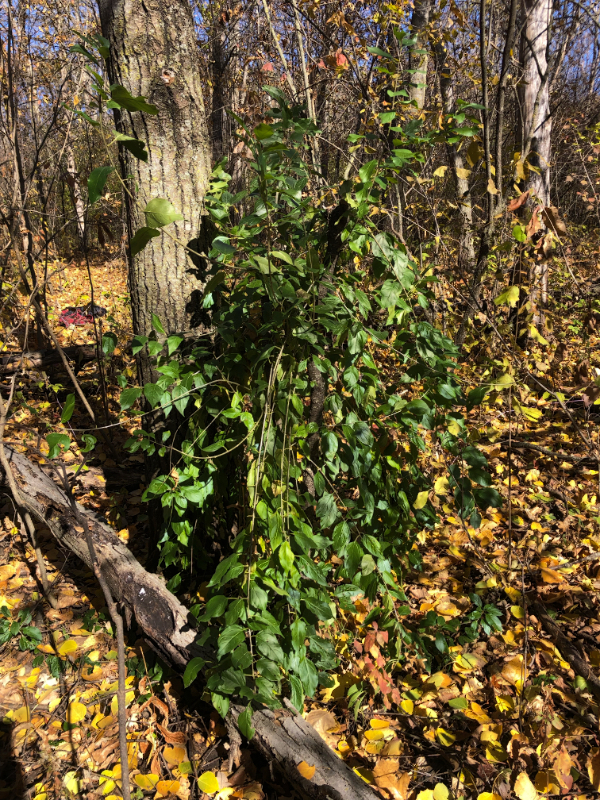
I have decided on a process that I call my method of madness, partly as a result of a handsaw being all I was carrying way back when I first started cutting Buckthorn on our property. I cut off the trees at a height of 3 or 4 feet so the stump will be noticeable the next time I pass by, knowing there will be subsequent growth since I don’t apply an herbicide to the cut.
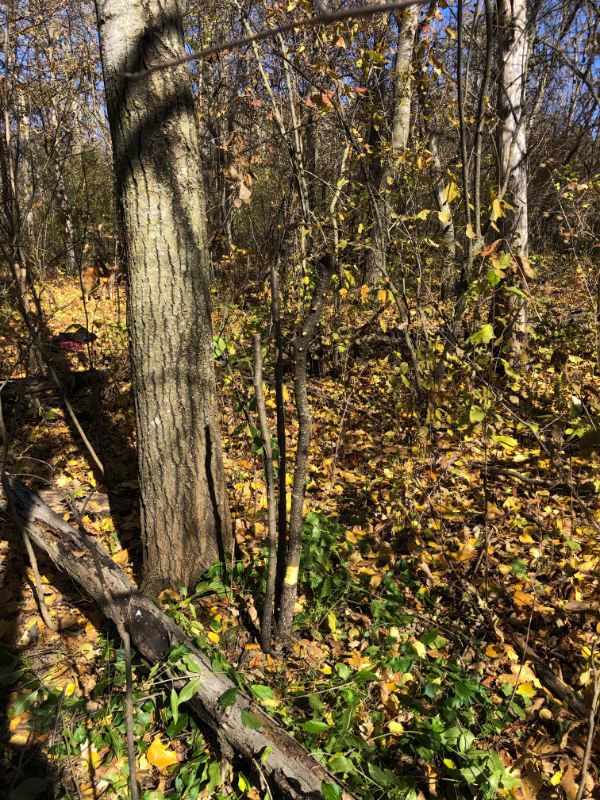
This process wouldn’t be practical if I wasn’t constantly walking through these woods and following up each year on the re-sprouting stumps. After a while, new sprouts will stop showing up. Here are before and after images of one example of my madness:
 .
.
.
.
.
.
.
.
.
.
.
This year I have also removed a section of bark on some of the stumps to see if that will prevent new sprouts above the break.
I found an interesting video from the University of Minnesota Extension that reveals how Buckthorn has become a winter haven for soybean aphids. An added incentive for farmers to pay attention to the invasive growing beside their crop fields.
.
Boggles my mind that people figure out stuff like this. Who noticed the aphids were going to the Buckthorn and laying eggs that survive the winter?
Seems like madness to me.
.
.


 Relative Something