Posts Tagged ‘drainage swale’
Working Alone
My high hope of building a footbridge in a single weekend fell victim to my need to accomplish all the tasks without a helper and also my being the sole entertainer for Delilah’s high-energy needs.
Add in the less-than-ideal windy and cold spring weather, plus the limitations of the batteries for my cordless circular saw, and my inability to finish by the end of the day yesterday was not all that surprising.
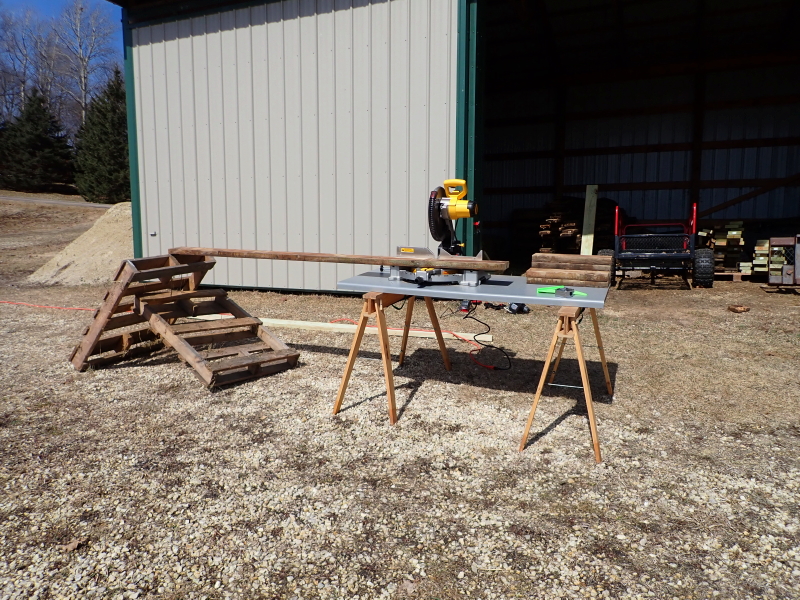
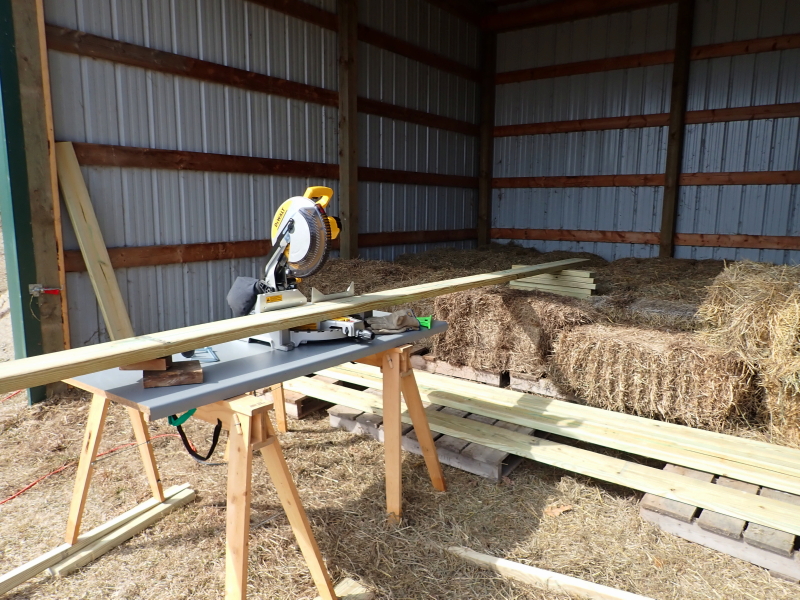
I resorted to two different solutions for supporting the long boards that I cut. That treated lumber is really heavy compared to the remnants of the old cedar deck boards I’m using for bracing.
 .
.
.
.
.
.
.
.
The pallets had a tendency to collapse, so I switched up to plan B on the second day: old moldy hay bales. That provided welcome consistency.
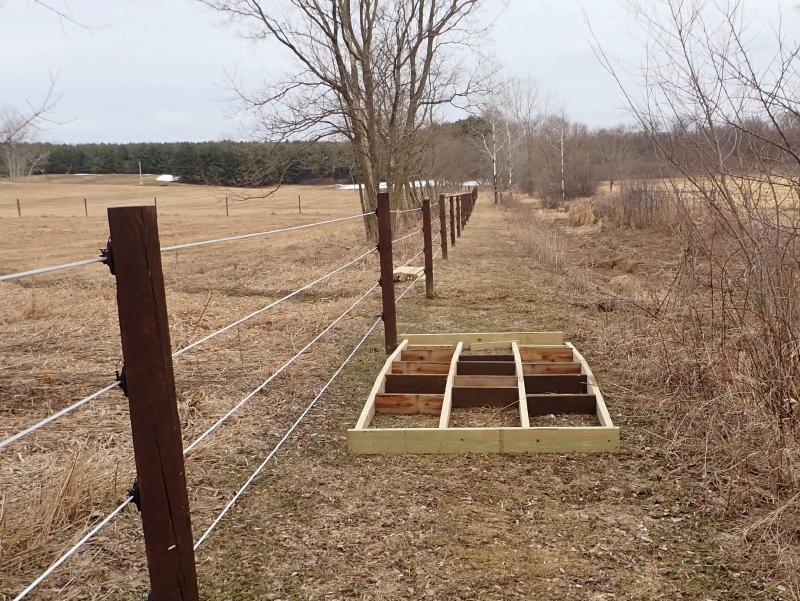
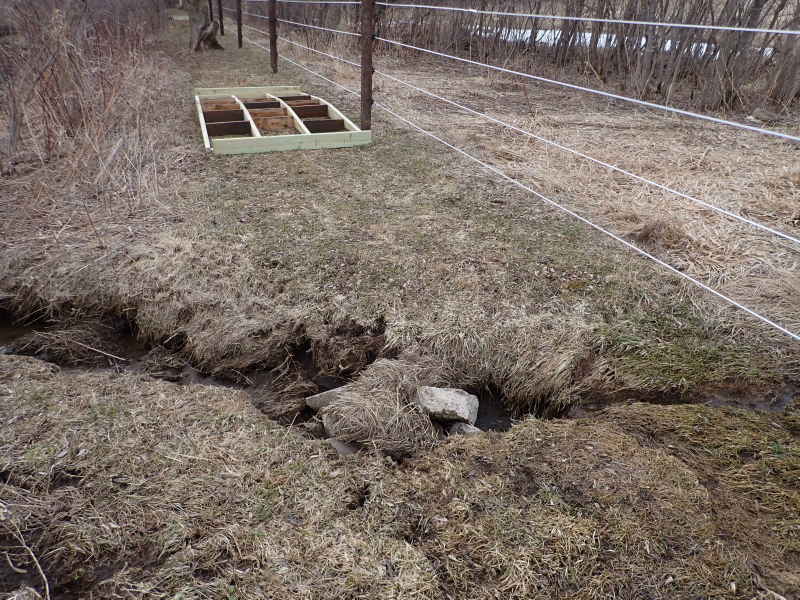
Because the bridge will end up being very heavy, I decided to build the frame right next to the washout I’m covering and then drag it into position.
 .
.
.
.
.
.
.
.
I was able to haul the boards down by the fence and begin to screw some of the cross-supports into position but quit when the time had passed for Delilah’s dinner. I’ll leave the finishing until next weekend.
Trying to screw the pieces together square and true proved challenging on the uneven ground. I want to give that the time and attention necessary to get everything precisely the way I want it. Then I plan to move it into position before screwing down the floorboards.
I’m not sure I’d be able to lift it if I waited until it was completely built. I mean, not without someone with a strong back to help me.
.
.
Pandemic Loneliness
It is hard to predict what the situation will be 10-days from today but based on comparison with geographic locations where the coronavirus outbreak is that far ahead of here, it seems that people who don’t feel sick now may have symptoms by then. That really does make it feel strange to carry on with life as usual.
Sure, the odds go down if you only expose yourself to a handful of people every day, but what good does that limitation do if one of those people have the virus and don’t know it? So, the safest bet is to stay home entirely. All by myself.
It feels a little apocalyptic.
I’m going to build a bridge.
While Cyndie is hunkered down with her parents in Florida, I’m alone to pick eggs and walk the dog. Between tending to animals, I’m going to try solo construction and use leftover deck lumber to make a bridge over the eroding drainage swale. It will take some ingenuity to manipulate 16-foot boards into the chop saw all on my own, but I think I can figure something out.
The muddy effort we put in to re-establish the concerted flow of the drainage swale across our land appears to have paid off.
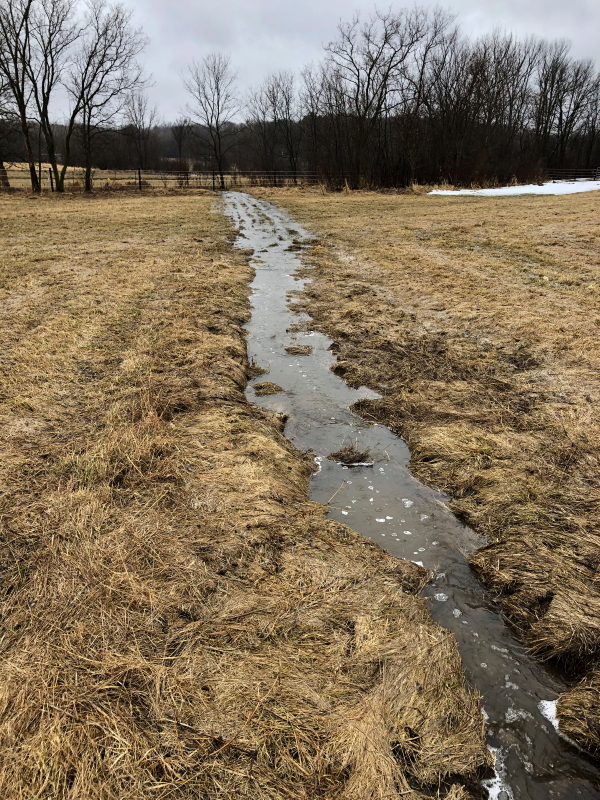
That provided motivation to get on with this bridge project sooner than later. Actually, I have a little extra time before the primary need arrives. During the growing season, I cut the grass along the strip just beyond the pasture fence to maintain a walking path, and the erosion blocked my ability to drive the lawn tractor beyond that point. The bridge is a solution to that barrier.
I won’t need to mow for a few weeks yet. Look at how little in the way of green growth there is to be found in our current landscape.
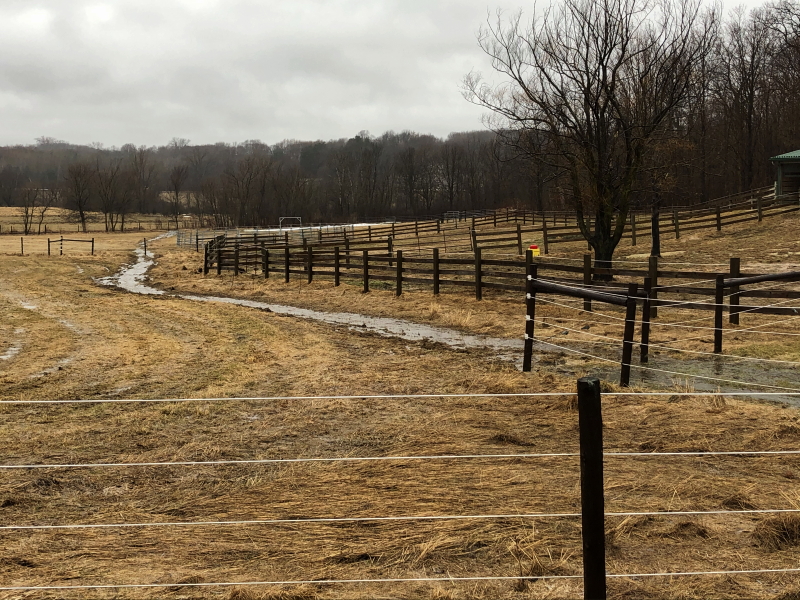
That will change real soon.
A lot like the looming intensity of a certain virus outbreak underway.
I wonder what our landscape will look like in 10-days.
.
.
Makin’ Mud
When the snow disappeared from the ground in our hayfield, the ruts from the tractor that had picked up the round bails during winter became clearly visible. Those tire tracks weren’t a concern for me until I could see the drainage swale water was following them instead of flowing straight in the direction we want.
Then I had an “aha moment.”
If the water was following tire tracks, I just needed to make some new tracks.
I decided to try using the ATV. Knowing it wasn’t as heavy as a big tractor, I accepted the chance it might not make the impressions I wanted, but it was safer than bringing out the diesel and getting it stuck in the mud. The surface is already too soft to be in the field with the big tractor.
With the plow blade still on the front, I added cement pavers to the basket on the back for added weight and headed into the field. Back and forth I drove, working to re-establish the track we want the water to follow.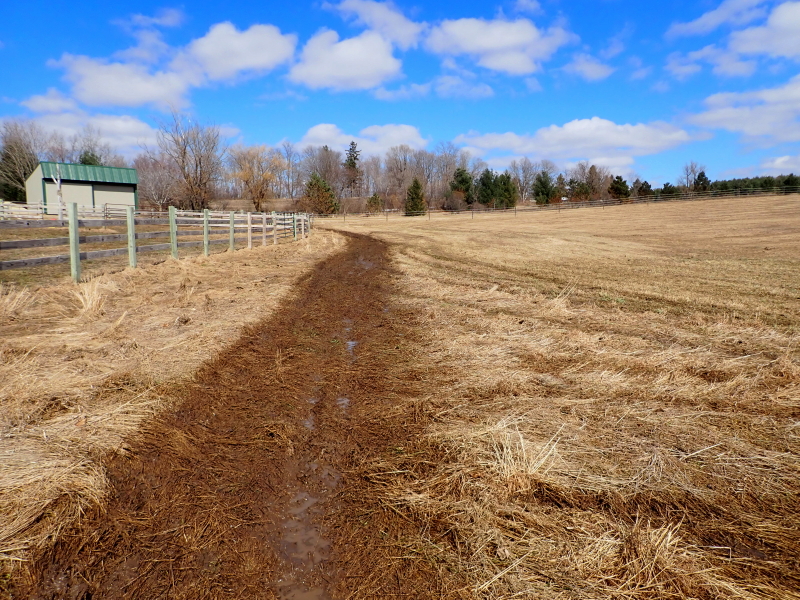
The ATV, plow blade, and I got splattered with mud, even though the path was grass-covered, but I think I succeeded in creating a new preferred route to the curving ruts left by the hay bale tractor.
Now we just wait for the next dose of precipitation to see it work.
.
.
Few Views
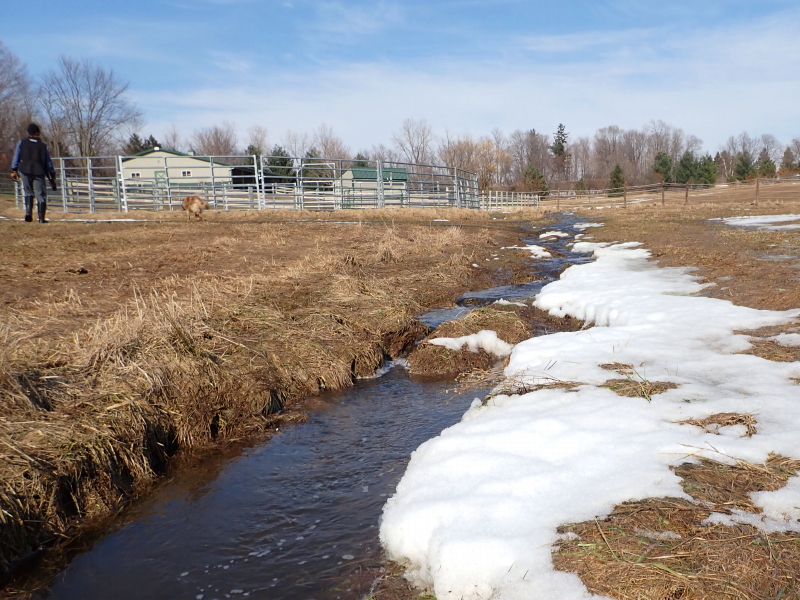
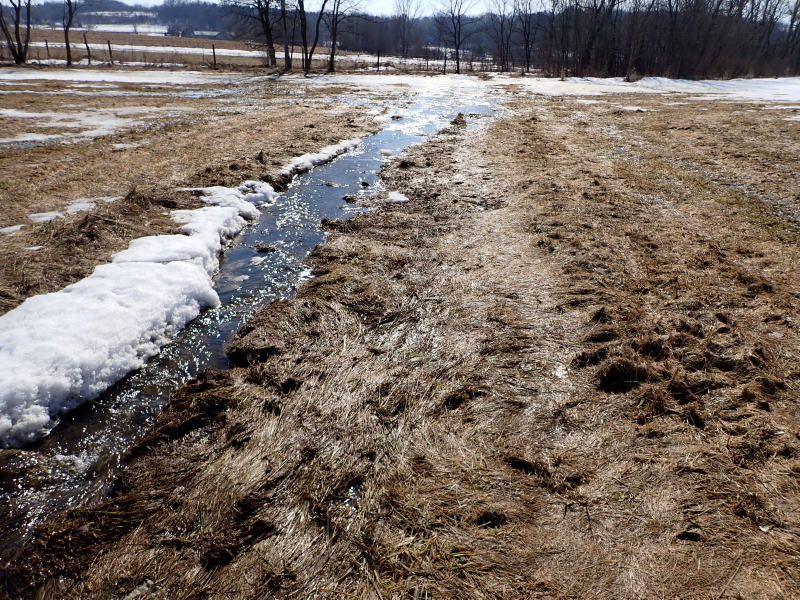
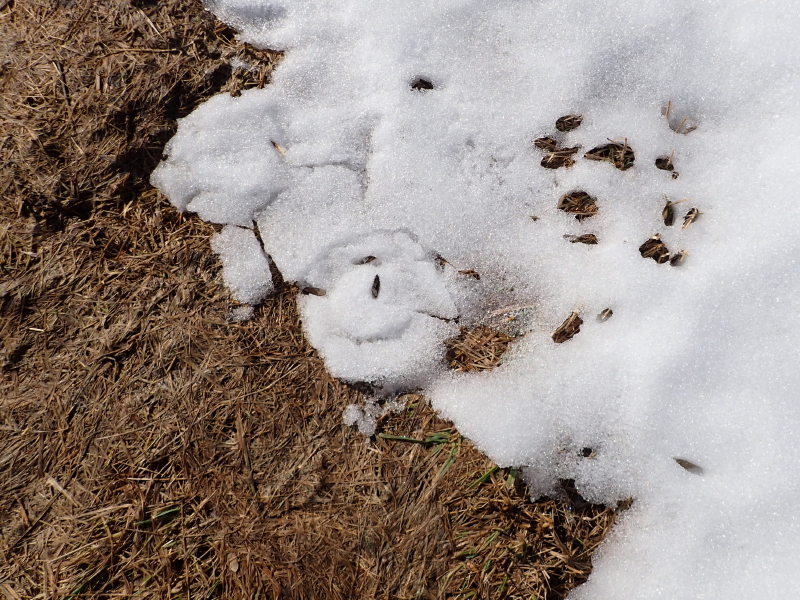
Here are some more views captured during our walk last weekend in the bright sunshine while the snow was melting fast and the water was flowing freely…
 .
.
.
.
.
.
.
.
.
.
Runoff’s Flowin’
The impact of 50°(F) March temperatures was obvious yesterday and not unexpected. Our drainage swales were flowing with zeal in stark contrast to just 24 hours prior.
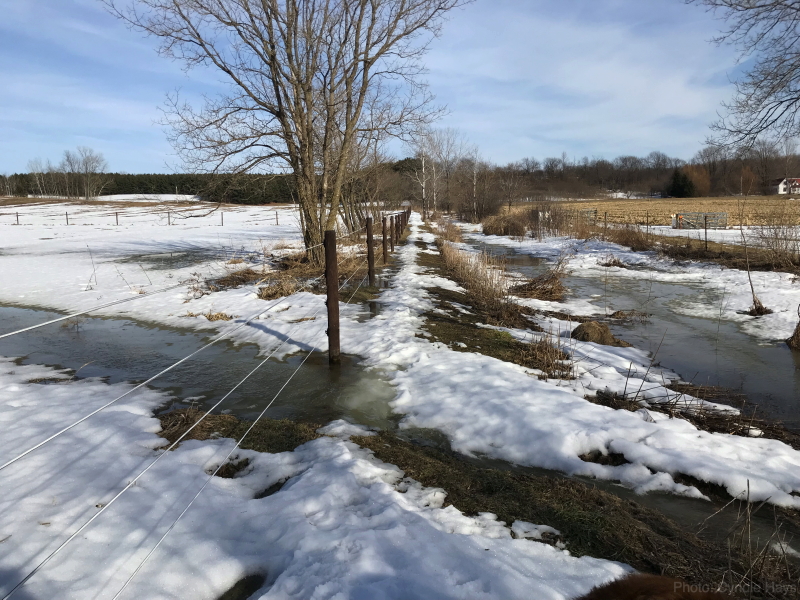
Where it doesn’t flow away, it puddles up and can even hide just below a cover of old snow.
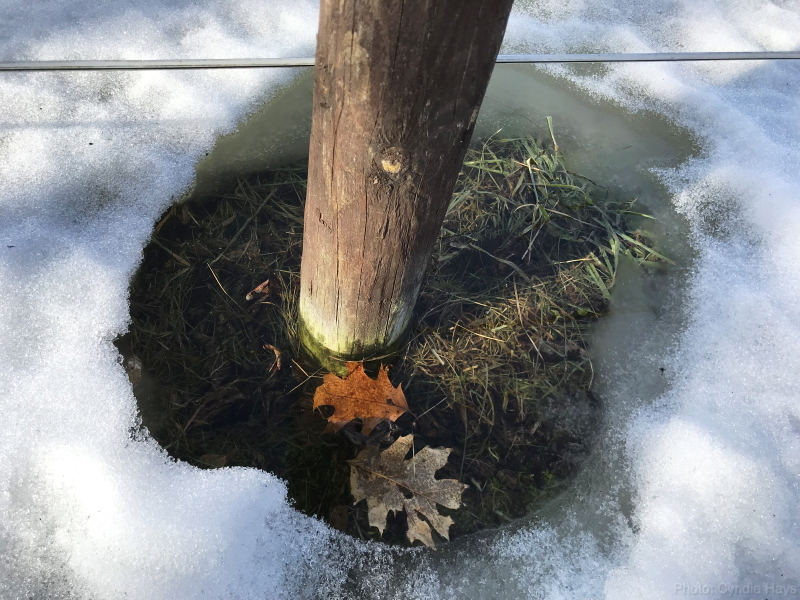
I thought stepping in deep snow-cone snow was risky, but it’s nothing compared to plopping a boot into a puddle of melted snow that rises over the top.
Green growth and leaf buds can’t be far behind!
.
.
Early Worms
The saying goes, the early bird gets the worm. The ground has barely thawed, but the chickens made a mad dash out of the coop this morning to scour the sloppy paddock for something. Are the worms already out and about?
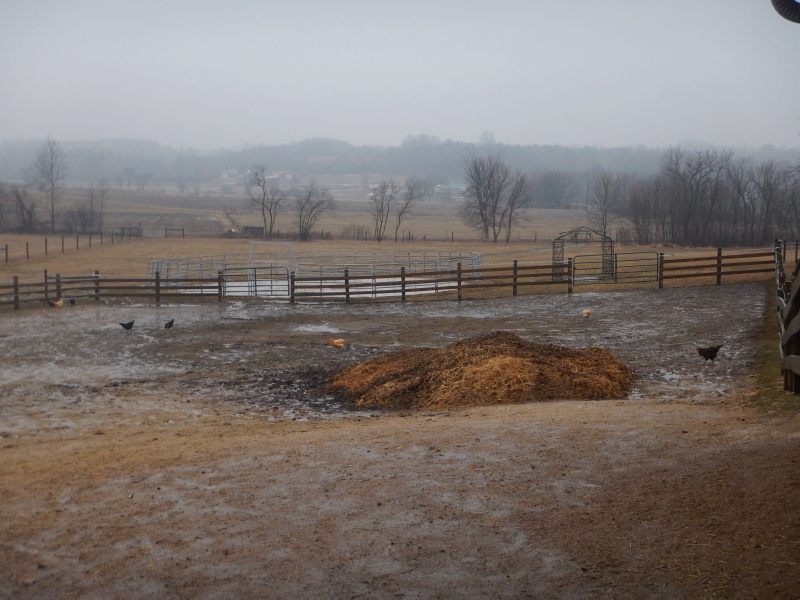
I peeked out from under the overhang to see how wet it was because the sound of the rain on the metal roof of the barn made it sound like it was pouring.
The land is already saturated by the spring thaw, so, even though this April shower slowly moving across our region has been gentle, it has triggered some substantial flow in all the drainage swales. Water, water everywhere.
It always causes me to think about the people down stream, on the rivers being fed by countless other drainage tributaries. Sorry, you guys.
Maybe all the water will carry some worms for your chickens to find.
.
.
Flowing Water
Our drainage swales are finally flowing!
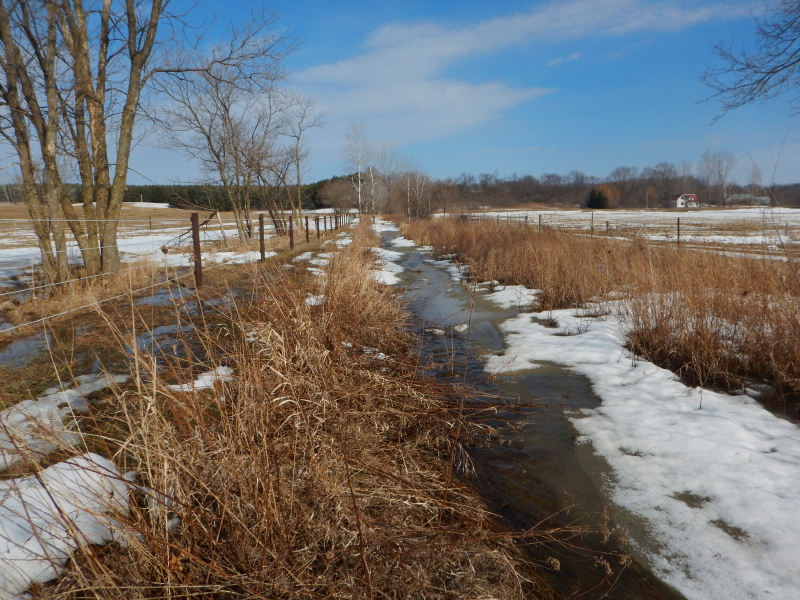
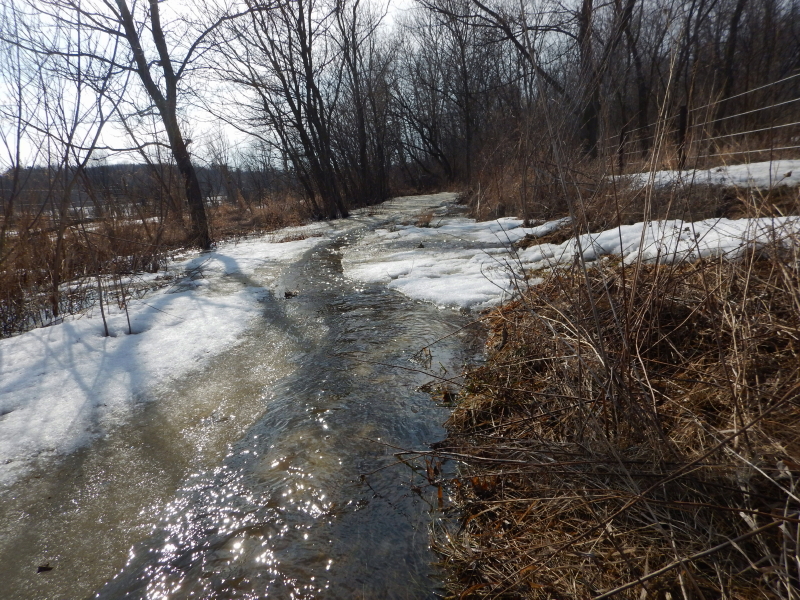 .
.
.
.
.
.
.
.
The largest ditch along our southern border was a babbling brook yesterday.
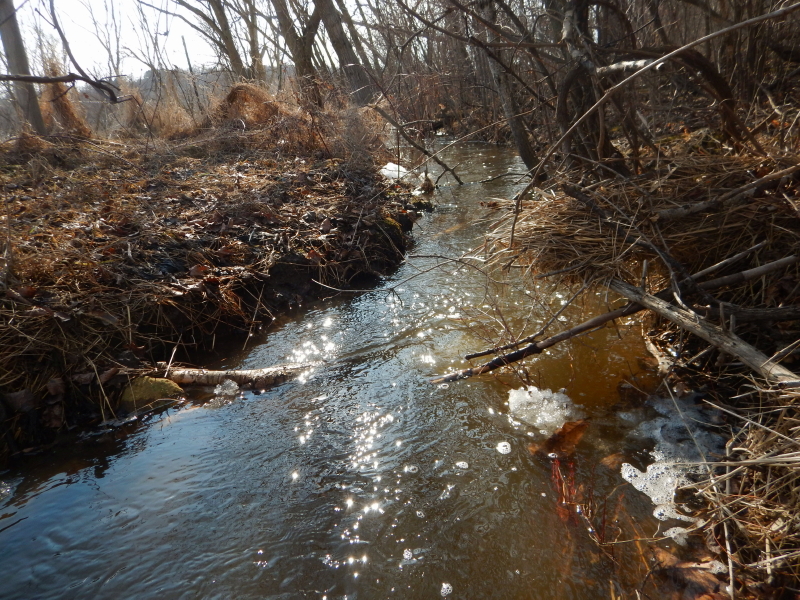
Eventually, the ditch narrows and meanders away from our property, wandering its way through our neighbor’s cow pasture.
The snow is leaving, and it will travel to rivers that travel to the Mississippi that flows to the Gulf of Mexico.
B’ bye.
.
.
Triple Fenced
The heat and humidity have broken and it finally feels a little more like September now. We were expecting the transition to involve a lot more rain than showed up yesterday. The line of precipitation slowly moving west is doing so at an angle that is sliding from the southwest to the northeast and for some reason, most of the rain moved around, rather than over our region.
Ironically, now I am wishing we would actually receive a heavy dose of rain, because last Friday we put a lot of energy into shoring up the silt fence at the property line adjacent to our neighbor’s corn field. In fact, we turned it into a bit of a terrace with three-tiered layers of silt fence.
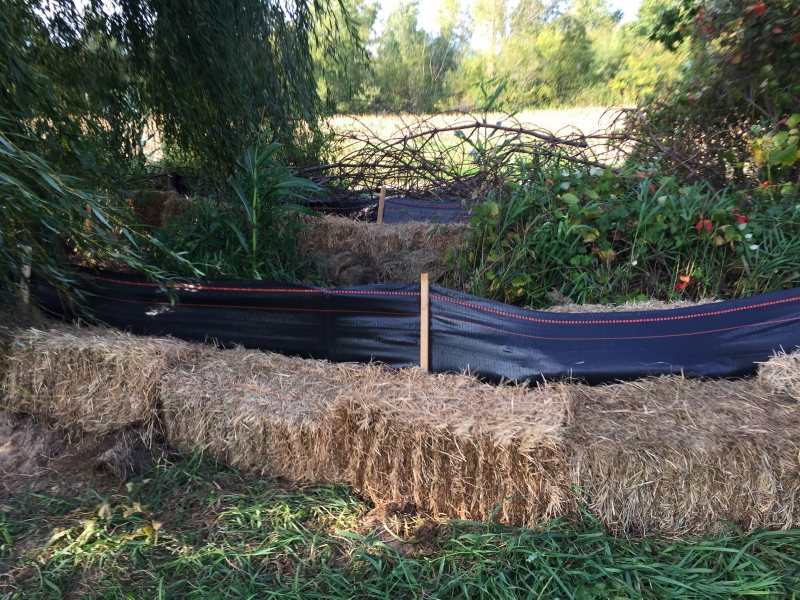
The first two are short sections to slow the flow before it reaches our long fence. Between the top two sections there is the skeleton frame for a berm, in the form of piled dead pine trees. The soil runoff will accumulate around the branches and hold them in place. Eventually, weeds and grasses will grow through the branches and that forms a nice natural barrier that will hold soil in place but allow water to flow.
We have added support to the fabric fence by using old hay bales that we can’t feed to the horses because they have gotten moldy.
If I am able, I hope to trek out there in the middle of heavy rain to observe the action as it happens. At the very least, I now know that we need to check it after every big rainfall and remove excess soil if it accumulates.
I don’t know why I originally assumed the soil fence wouldn’t need regular maintenance, but after the soil conservation consultant pointed it out so very matter-of-factly, digging out accumulation makes total sense to me now.
If our enhancements work to mitigate the mud overflow messing up that area, we will be one step closer to being able to enjoy a good cloudburst when it happens. There still remains a problem in the paddocks, where a terrace or silt fence is not an option.
We plan to do some digging to create a couple of better defined routes directing runoff straight to the drainage swale beyond the wood fence, hoping to reduce the amount of flow traveling to one spot with energy that washes away our precious lime screenings and creates a deep canyon of a rill.
It’s fine if a little flow goes that way, but it is currently a problem because most all of the flow is combining to rush sideways along the fence, instead of straight under it out of the paddock.
The trick in the paddocks is, our solution needs to be horse-proof. Their heavy hooves have a way of disrupting all of the simple spade-width channels I’ve created in the past, causing runoff to flow every which way, and ultimately not where we really want it to go.
The next version we have in mind will be scaled up. Maybe I should triple-size it.
.
.
Periodic Maintenance
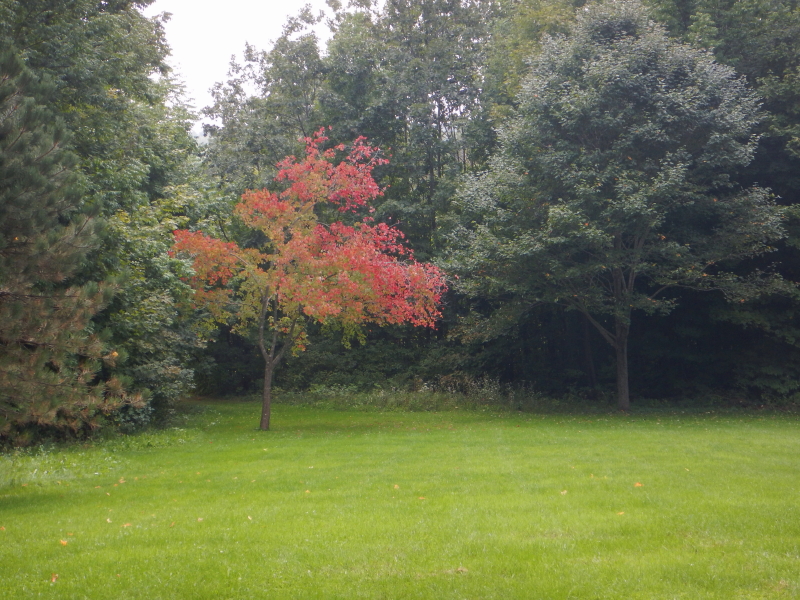 That tree in our back yard which leads the way in changing colors is cranking it up to full blaze now that we have arrived within the month of September. This image doesn’t to justice to the view, because our sunlight was muted by the smoke of wild fires in Canada and the western U.S. most of the day yesterday.
I spent time in the morning consulting with a specialist from our county soil conservation office as he surveyed the situation where the neighbor’s tilled corn field is overflowing my silt fence. According to him, we have done all the right things for drainage on our property, adding that compared to other sites he reviews, our problems are not very significant.
My perfectionism sees it otherwise.
He did basically fault the neighbor, of whom I gathered he didn’t hold a high opinion. The best fix to hold the soil would be for the neighbor to plant hay in that field, instead of corn. I don’t have any idea if that is something I might be able to influence, but I will suggest it at the first opportunity.
On my end, I learned that the silt fence does require maintenance to remove material when it starts to fill, because he said it is obviously functioning as intended.
I will do that, but I will also add another short section of silt fence above it and then start building a berm of branches between the two, eventually creating a thicket of wild growing weeds and trees.
Since it is so late in the growing season, such a barrier will take a year to become the filter I envision, but just having the skeleton of tree limbs in place before winter will provide an additional place for the silt to build up and start a foundation for a natural barrier.
Looking at the drainage swale below our paddocks and across the pastures, the advice was to periodically reshape the high spots by digging those out as well. Funny me. I had it in my head that there was a one-time solution where I could shape the swale properly and then never deal with it again.
Why should it be any different from the periodic maintenance required on everything else?
Lawns need to be mowed, septic tanks need pumping, engines need oil changes, rugs need vacuuming, animals need feeding, relationships need tending. There aren’t many things that can be ignored indefinitely.
Land needs management. I guess I won’t argue with that logic.
Though, given that, seems to me that days need more hours.
.
.
.
.
.
.
.
.
.
.
.
.
.
Shaping Up
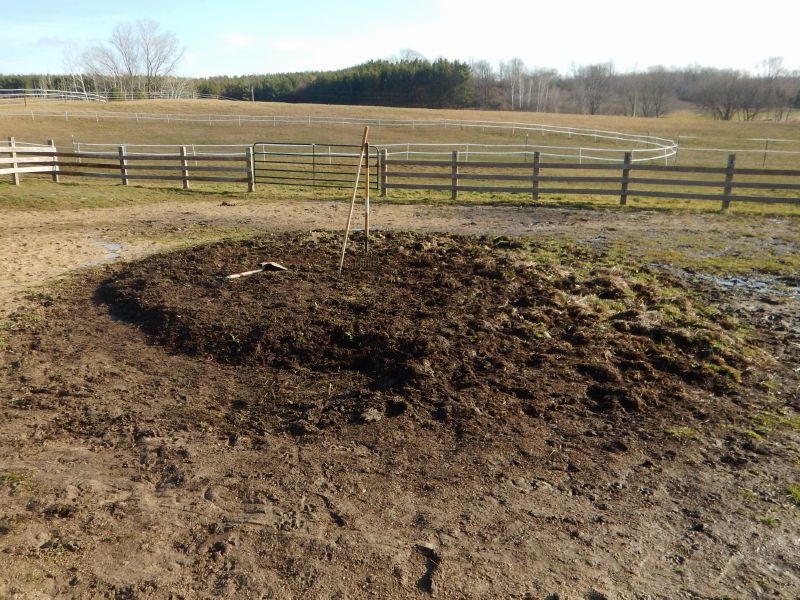
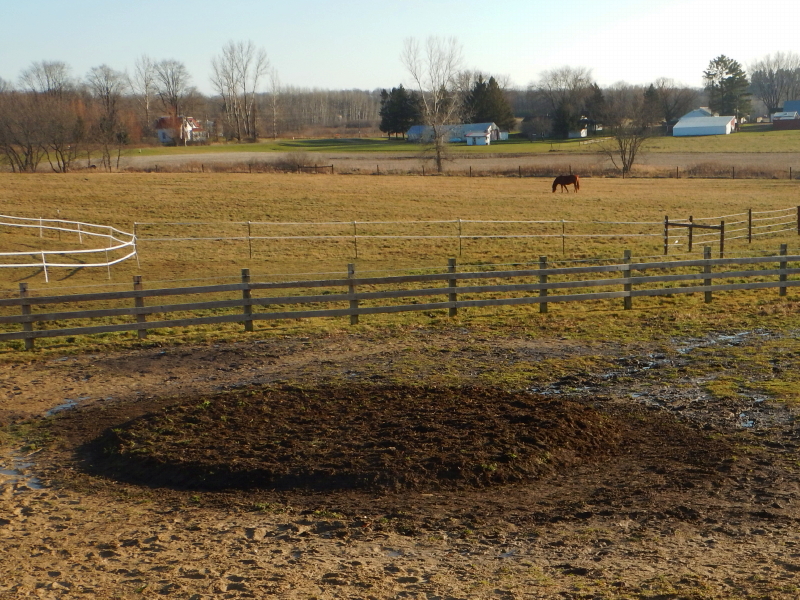
It has snowed and then melted again, so the ground here is well saturated, but not frozen. It was time to tend to the raised circle in the paddock before the earth becomes hard as rock. It’s been a year since I last shaped it and the definition was fading to the point it wasn’t really performing as a raised perch above the wet.
 .
.
.
.
.
.
.
.
Try as I might, I am not able to pack it firm enough to support the weight of the horses, but if I keep reshaping the circle as they stomp around on it, eventually it will become what I envision. It worked in another spot that we created when the excavator was here digging out our drainage swale.
That flat mound is visible in the corner of fence in the picture above on the left. Since it was made from slabs of turf scraped from the swale, there was a lot of grass in it that seems to have added a lot of stability. The circle I am creating in the middle has a lot of layers of hay which the horses’ hooves punch through with ease. It becomes a pock-marked uneven surface.
On the plus side, residue from the hay includes plenty of grass seed that wants to grow and will help firm up the surface over time. If I keep tending to it, I’ll get what I’m after. In the end, it’ll seem like it’s always been that way.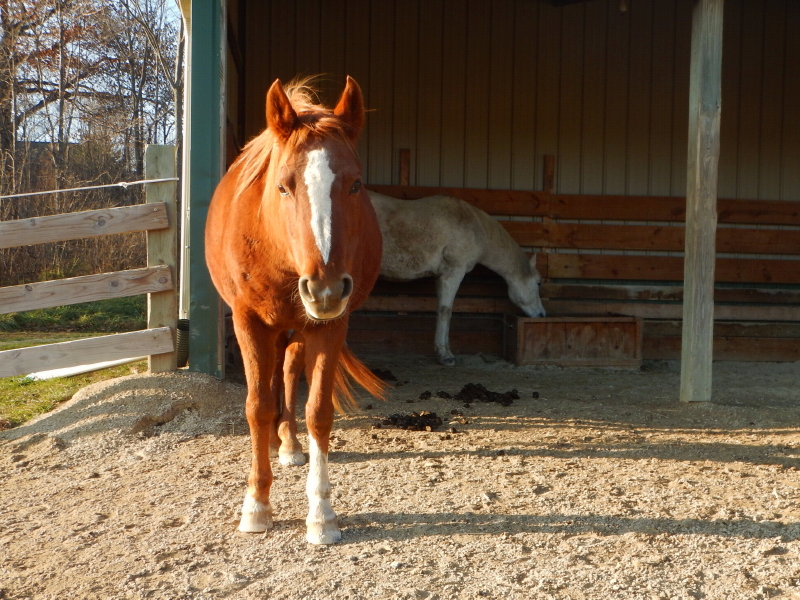
Good thing I’m a patient person.
Dezirea supervised my progress while Legacy grazed from the slow-feeder behind her. I get the feeling the horses recognize what I’m trying to create, and they approve.
When I came out from taking a lunch break halfway through the project, I found Cayenne standing beside the circle on the ground I had just raked flat.
It was as if she wanted to be close to what I was doing, but didn’t want to mess it up by stomping on it too soon. I appreciated her discretion, but in no time, the results of my reshaping will be hard to perceive amid the multitude of hoof prints.
Watching the horses all day long, you get the impression that they don’t really move very much. They don’t appear to cover much ground in a day. However, if you survey the ground over time, it becomes evident that there isn’t a spot where they haven’t been at one time or another.
In the long run, they are definitely shaping the ground of their confines.
.
.
.
.
.
.
.
.
.
.
.
.