Posts Tagged ‘DNR Forester’
Red Marks
For months now we have been walking past trees in our woods that are marked for removal with a red spot. It was more subtle when the forest was lush and green. Now that there aren’t any leaves on the trees, those red marks are impossible to miss.

When our local DNR agent responded to our invitation to walk our woods, we learned our most valuable trees are the oaks, and that they will be kept healthiest if we remove competition growing directly beneath their canopy. I mentioned it would be a challenge for me to identify what is good and what is bad.
You know how much of an aversion I have to cutting down live trees.
He was quick to volunteer to return later and mark trees for removal. Most of them are relatively small diameter and will be easy to bring down. Cyndie and I decided yesterday was a good time to start on the project.
Heck, I can’t drive the tractor anywhere yet, so we may as well create piles of branches to be chipped at a later date.
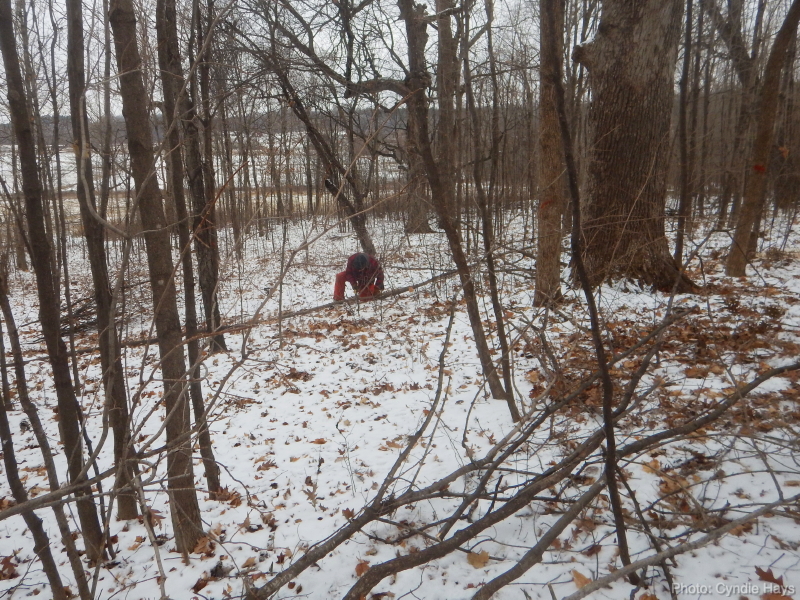 About those red marks… When you get a chainsaw in your hands, suddenly trees with red dots show up at every turn. Maybe that is because I just chose to start with the trees right below the driveway. Some of our biggest oaks are right there (hence the thick carpet of leaves that land on the yard) and that meant a lot of trees to be culled all the way around each of the large oak trunks.
I took some solace in being able to see visible evidence of just the problem our DNR forester described. Oak trees stop feeding lower limbs when other growth begins to encroach from below. That can lead to a lopsided or top-heavy oak.
When we pulled down the smaller trees, it was easy to see the number of bottom oak branches that had already been left for dead.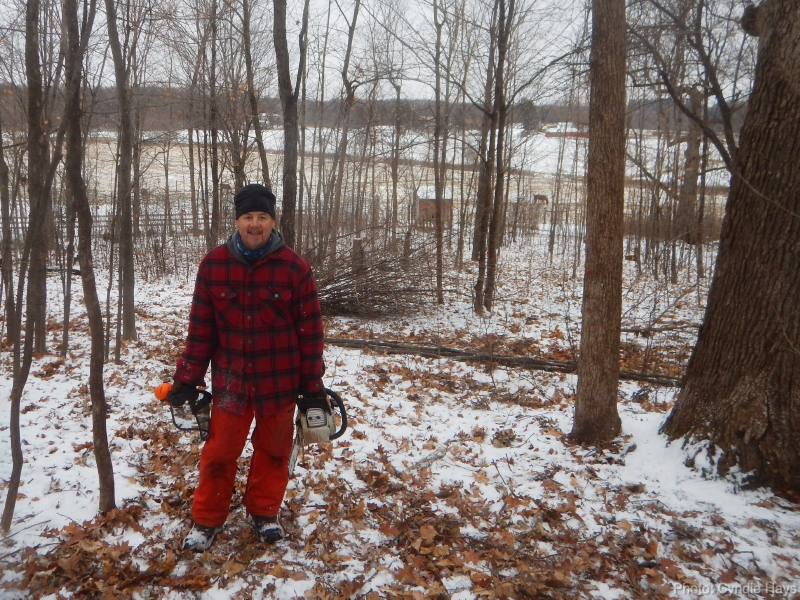
Unfortunately, we grew weary after just a couple of hours of cutting up and piling branches of the easiest trees felled. Several substantial sized red-marked trees remain. That will be a project for another day.
I may just move on further into the woods where I know there are a lot of small (easy) red-marked trees, before returning to take down the larger diameter encroachers by the driveway.
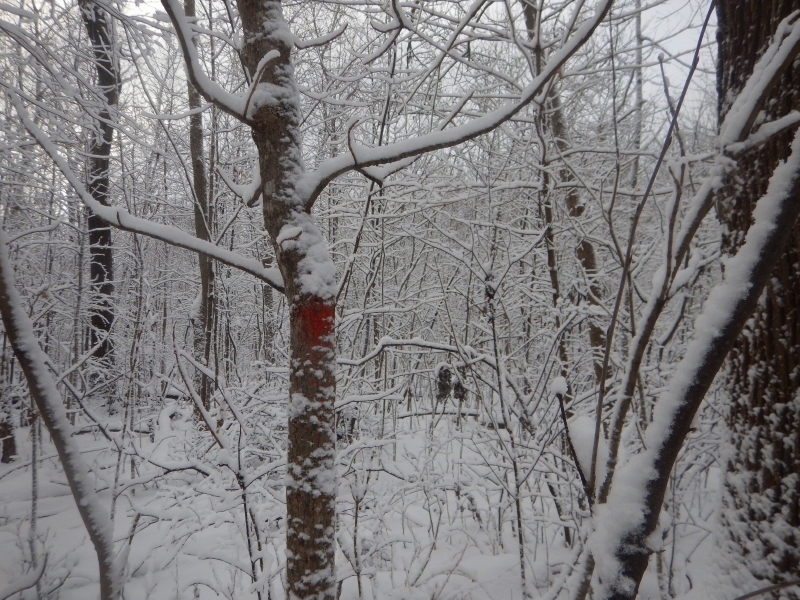
That project will be delayed a little bit now, though, as the more immediate pressing need is for plowing and shoveling snow. We received a decent amount of sticky flakes yesterday afternoon and overnight.
So much for easily spotting those red marked trees…
.
.
Pinnate Leaves
Back when our regional DNR Forester paid us a visit, he pointed out how many ash trees we have. I had been mistaking many of them for butternut trees, but closer inspection, and a noticeable lack of nuts, changed my perspective.
As a result, now my first impression of our trees with pinnate leaves is that they are likely ash.
While we were sitting with the chickens on the edge of our driveway the other day, I gazed skyward and became aware of a large umbrella of the pinnate leaves looming over us. Mentioning it out loud to Cyndie, I assessed it as a big ash that we didn’t even know was in that spot.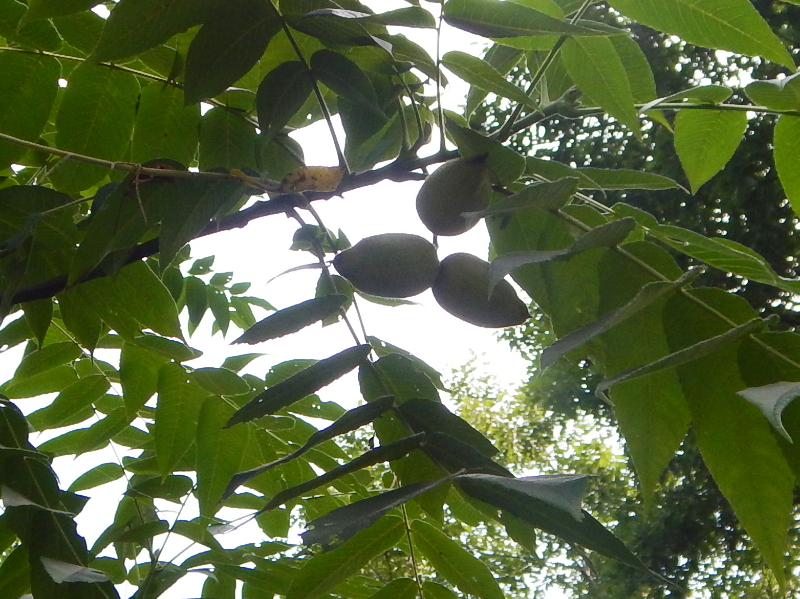
Until I saw the nuts.
Oh! So, it’s back to a butternut again.
From the class we look last winter, I was quickly able to detect one of the simplest identifying differences: the petioles or leaflets of the compound leaf.
The ash tree has about 7 leaflets arranged in opposing orientation along the stem.
On this butternut, I counted repeated occasions of 13 leaflets, and they are arranged in alternate orientation along the stem. Combined with the obvious groupings of nuts, there was little question about what kind of tree this was.
I’m a bit surprised by the significance of the canopy of leaves on this tree because the butternut canker disease is stunting the progress, or outright killing most of the butternut trees in the area. It is possible this tree has an inherent resistance to the fungus.
That would be great luck. Offspring from this tree could lead to additional trees with resistance. Invert the pyramid, I say!
On another note, I received a reply from our Forester about my findings on root girdling on the red pines. He found the report interesting and surmised the trees weren’t planted properly. He still concluded with, “Your trees may have still actually been killed by Diplodia.”
Another fungus. What’s up around here?
I blame climate change.
.
.
Wondering If
While trimming the remaining grass around all the pine trees over the weekend, three things triggered a new hypothesis about our ongoing loss of red pines. I’m wondering if it might have something to do with girdling from the trees being root bound.
I did some searching to see if being root bound might contribute to the way so many of our red pines are coming out of the ground at about a 45° angle before eventually turning to grow straight up, but didn’t find any hint of that connection.

 .
.
.
.
.
.
.
.
.
Then, while writing to describe my latest discoveries to our regional DNR Forester, it struck me that the eighteen inches of heavy, wet snow that fell in May of 2013 tipped many of our trees, but not all of them. In fact, mainly the red pines leaned over. If they were planted without proper attention to the roots, well, a root bound tree would have a hard time standing straight under that kind of load in the wet ground.
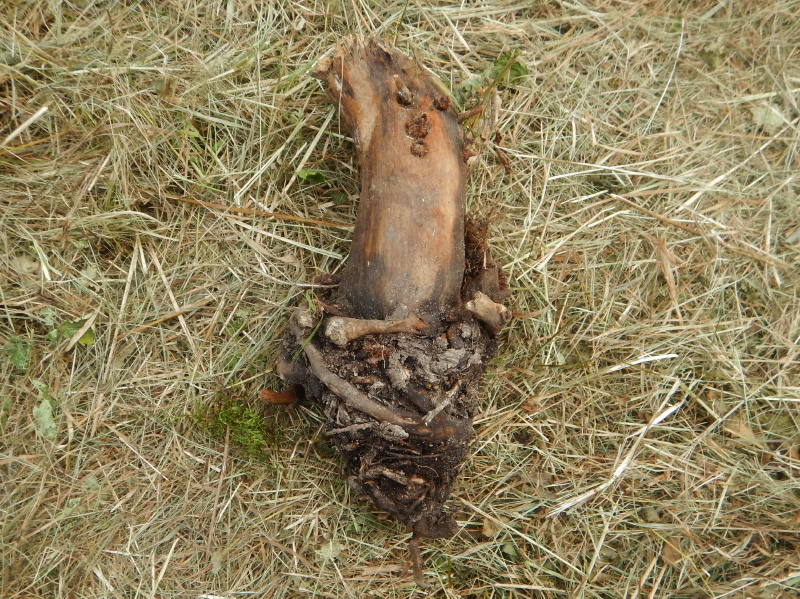
While laboring to walk through the cut growth with the power trimmer on my shoulder, I stumbled over an old stump of a long-dead tree. I was curious about an obvious circular root growth, but just tossed it to the side.
Later, while trimming beneath pine branches, I caught a brief glimpse of a girdling root on one tree which triggered a memory of long ago, when we lost a tree in Eden Prairie to root girdling. It led me to go back and reclaim that old stump for a picture, finally thinking I might be on to something.
 .
.
.
.
.
.
.
.
.
It occurred to me that I should also take a picture of the girdling root I had just spotted on that live tree. I retraced my path to find it again, but to no avail.
I was hot, tired, sweaty, and covered with weeds and grass shrapnel. I didn’t have the energy or mental acuity to execute an intelligent search. I am confident it is out there somewhere, unless maybe it was just an optical illusion that my mind used to help guide me further along this theory I was concocting. I’ll allow for a possibility it was all in my head.
If I receive a response from our Forester that lends credence to my thinking, I’ll undertake a more organized research expedition through that grove of pines again.
I realized, in afterthought, that my tired searching was mainly focused on looking at the leaning red pines, in support of my hypothesis. Maybe the root I noticed had yet to cause a problem, and was on one of the trees that still looked just fine.
It all definitely has me wondering. Did these red pines have already compromised root systems when they were all planted? There are several stumps still in the back yard from trees I cut off at ground level after they died. I could always exhume those remains to collect a little more evidence.
Put that on the “someday” list. For now, I’m going to wait to see if our DNR Forester thinks my latest findings could possibly explain our red pines slowly dying, year after year.
.
.
New Information
Sixty years ago today, before I was even born, the best thing that could ever happen for me took place. With eternal gratitude to Fred and Marie Friswold, today, June 4th, I boast to the world that it is Cyndie’s birthday!
Happy Birthday, my love!
After a jam-packed weekend of social events and more, we begin this week with new information and new energy.
First, after a scheduled appointment for our vet to visit and give the horses their spring shots, we came up with a plan for how we will proceed into the summer grazing season. Both Cayenne and Hunter are showing signs of good health with their sensitive laminitic front hooves. The diet of reduced portions has their weight under control, and more importantly, it has been achieved with minimal evidence of angst from the horses.
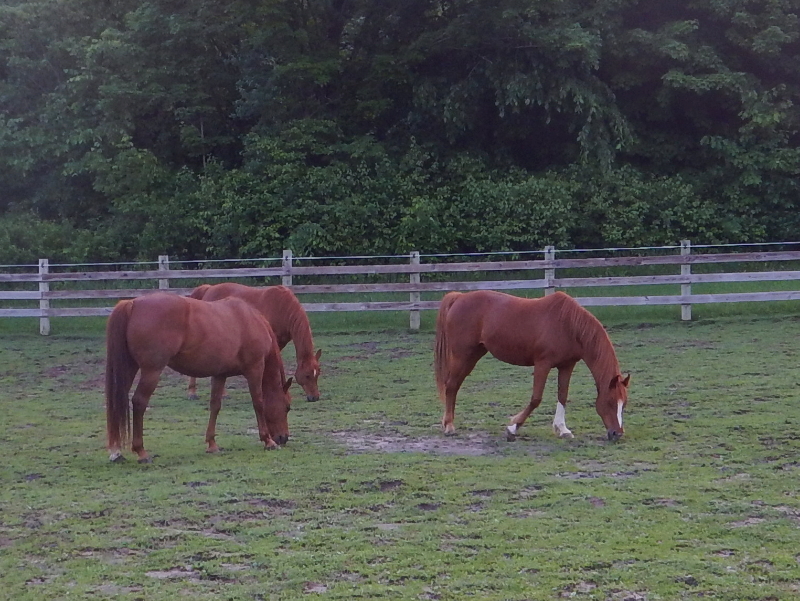 Going forward, we are going to work on getting them used to wearing muzzles to slow down their pasture grazing. We will then feed them dry hay in the morning to fill them up and give them muzzled access to a previously mowed (shorter grass = smaller bites of cake) pasture in the afternoons. They will be confined to the dry paddocks overnight, with no added hay available until the next morning.
Most important for us will be the attitude the horses have about their situation. If they are okay with it, that will be the definition of acceptability. If they balk over any of it, we will work to adjust accordingly. Our goal is to keep their weight down, yet give them some time to enjoy the freedom to move about in the open pasture and “graze” as close to normal as possible.
The next big thing that we learned came as a result of a visit from our local DNR Forester yesterday. My key takeaway from that consultation was the value of cutting trees beneath the canopy of mature trees we favor. Growth that reaches up to encroach on the lower branches of the favored tree should be removed.
He asserted that the primary focus is on providing the most sunlight to encourage growth, but protecting lower branches from competition will also help keep the mature trees healthy.
My first inclination is never to cut down any tree, but our Forester convinced me that cutting some will enhance others. I need to get more comfortable pruning entire trees, in the way I am comfortable pruning a few branches to shape a single tree.
He suggested clear cutting some areas, like stands of aspen, to open up sunlight and entice energized bursts of new growth to expand the grove. It seems so counter-intuitive. I want more trees, not less. Apparently, a little loss now, produces bigger gains later. In his mind, it doesn’t take that long.

Time is a relative thing. I’m not feeling that patient.
I was surprised to learn that he felt our highest priority should be to work on removing invasive garlic mustard. I did a quick Google search and the response was rich with states battling the troublesome intruder. Our Forester said we should pull the plants, bag them in plastic garbage bags and throw them in the trash.
Among the many other battles we are already waging, like vines, common buckthorn, and poison ivy, we now will move garlic mustard to the top priority.
Oh, joy.
.
.


 Relative Something