Posts Tagged ‘controlling invasives’
Fourteenth November
We are in our fourteenth November on these twenty acres and marveling over the thought that we have been tending these fields and forests for that long. Thinking back to when we first arrived, one particular vivid memory stays fresh in my mind. The very first time I ventured off-trail in our woods, I came upon the fresh, blood-red skeleton of an 8-point buck in a circle of hair and paw prints.
We had heard the excited yips of a pack of coyotes during the night a week before that, but didn’t realize how close to our house they were or what the ruckus actually meant. We’ve heard similar howling packs over the years since, sometimes triggered by an emergency vehicle siren, but haven’t come upon any similarly obvious evidence on our land like that carcass.
A stray bone is not uncommon, though.
 Cyndie recently trained me in recognizing the invasive garlic mustard plant she has worked for years to disrupt, and we spent some time during an afternoon last week pulling sprouts in the areas off-trail that are less obvious. I found it a little overwhelming because it seems to be everywhere. We did what we could until my ability to cope was exhausted.
I can see why she just makes it a habit to pull whatever catches her eye when on our walks. She stuffs her pockets with plastic shopping bags to always have a way to bag and dispose of what she pulls up, an essential step in eradicating the highly destructive invasive.
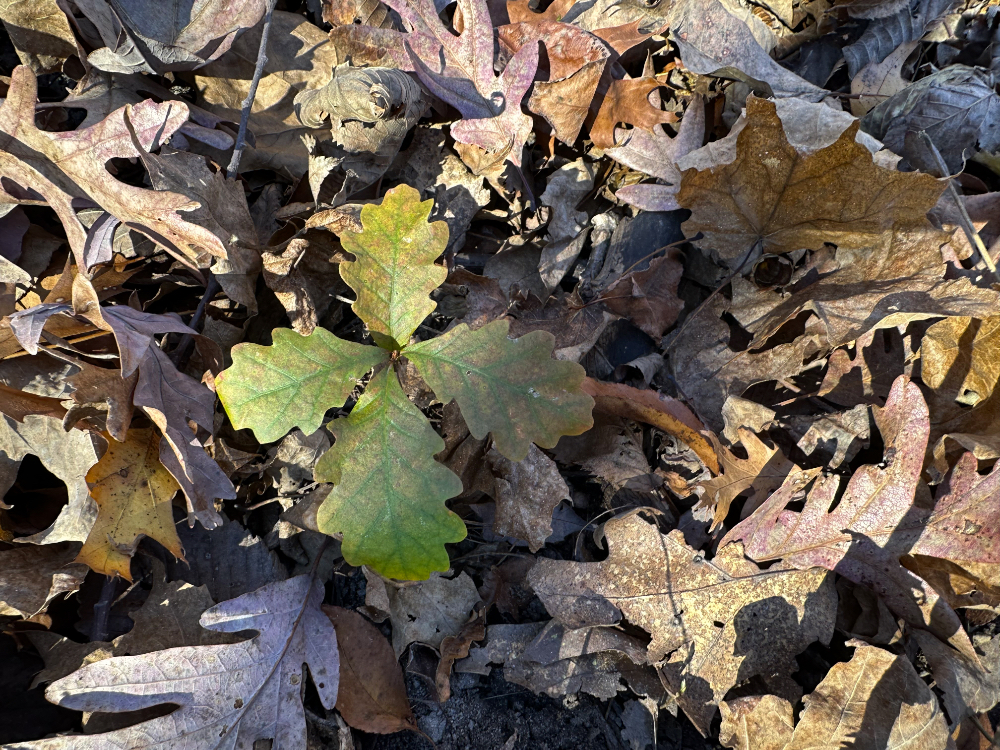
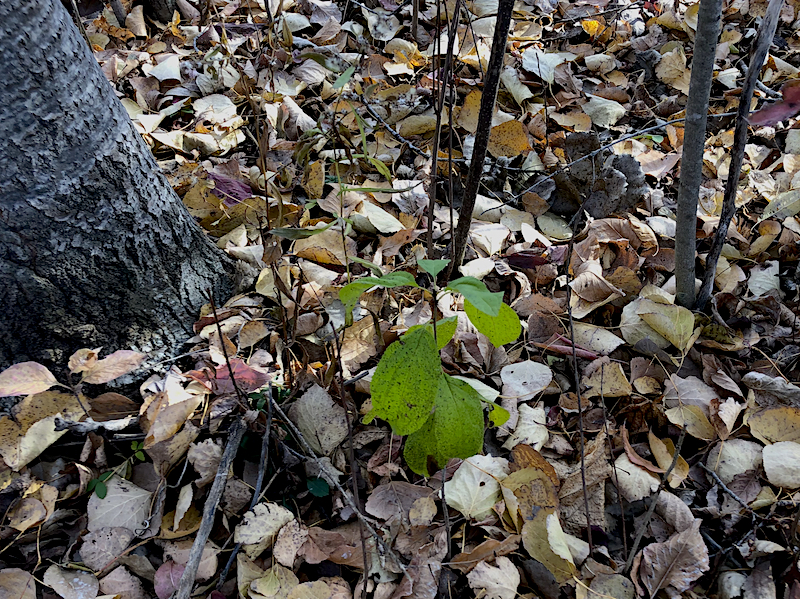
There was a tiny oak sprout that caught my attention, barely tall enough to stand above the dead leaf blanket covering the ground in November. The leaves were so perfect. Apparently, too young to keep up with all the bigger trees that have the fall routine figured out.
 It looks like today’s precipitation is sliding to our south, which is both good and bad. It’s nice that the horses will get a break from needing to deal with wetness in these cold temperatures. Their natural winter coats are coming in nicely, but their shaggy look quickly flattens out in the rain or wet snow.
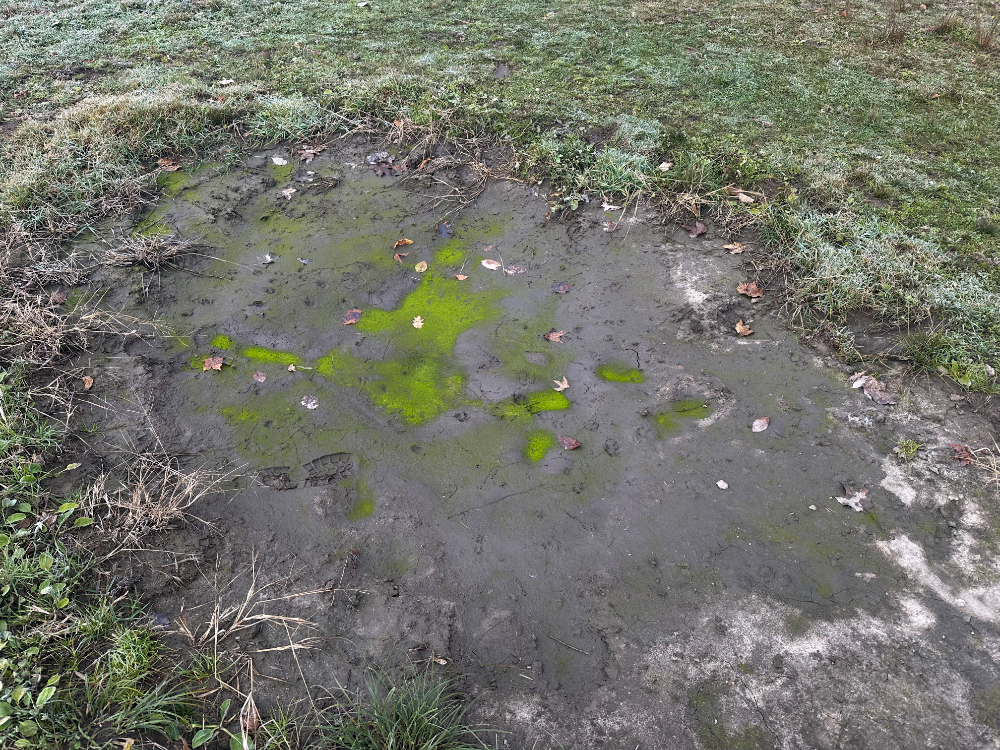
The bad part of missing out on some rain or snow is that Paddock Lake is dry and will make for lousy skating this year. The residual growth was almost fluorescent green in the low spots.
My footprint was a result of retrieving the horses’ Jolly Ball that had rolled into the middle of the muddy remains of the “lake.” It’s always interesting to find the ball has been relocated from the spots where I place it, handle up, in hopes of enticing them to play.
We rarely have the privilege of catching them in the act. Occasionally, the ball disappears from the paddock. When it happened one time when the hay field grass was tall, we didn’t find it until the hay mower had sliced into it.
Fourteen Novembers of wonder and joy.
.
.
Lethal Precision
My goal of policing our land for signs of the invasive scourge, common buckthorn, is in full swing this time of year. Yesterday, I headed back to an area by the road where I had already made a first pass through a few days ago. I was aware of several spots well into the thicket where sprouts of buckthorn remained.
Soon, I found myself on my hands and knees, doing battle against a tangle of branches to reach the swaths of still-green leaves. Some are very short and get gobbled up into fistfuls as I pull them from the dirt.
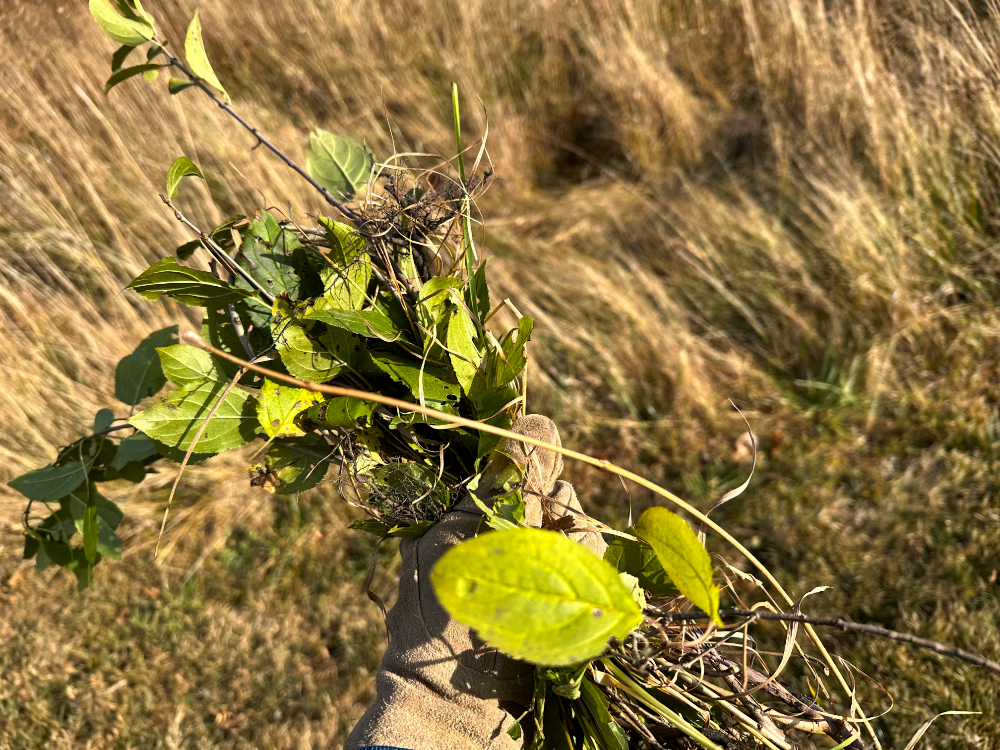
Taller shoots that I’m able to yank up by the roots get treated like trophies and as such, I hang them upside down in the branches of other trees to display the awesome dominance we have over the invader.
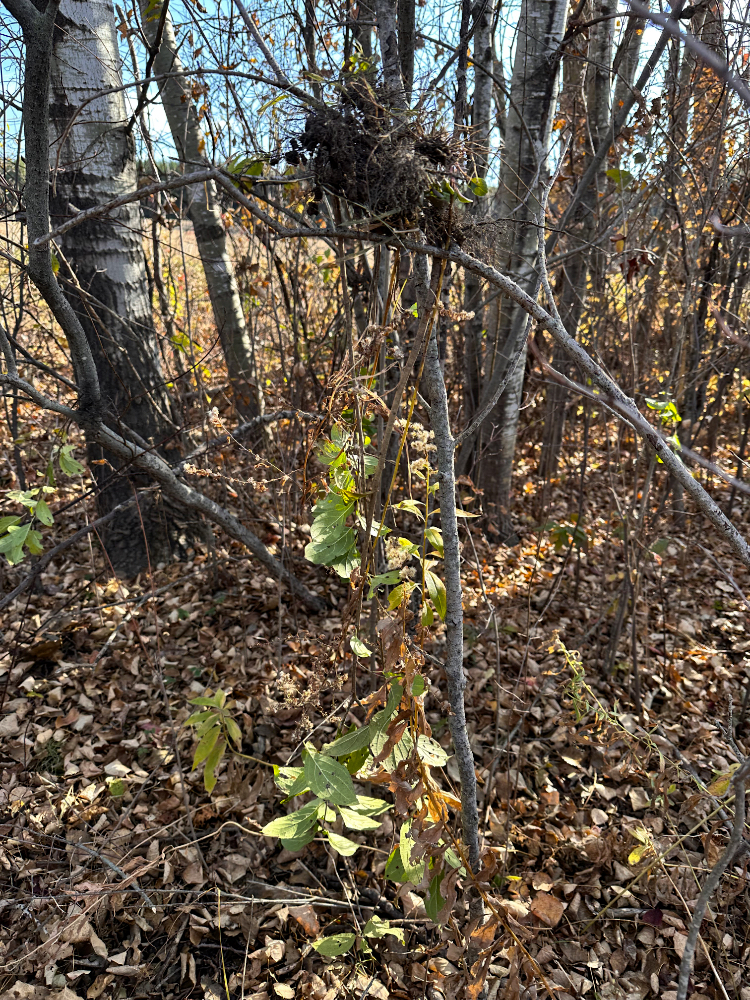
Actually, hanging them like that started as a way to ensure that the roots dried out and make it easy to see the unwelcome leaves had already been dealt with. If I just drop them on the ground, the green of the leaves continues to catch my eyes for a few days, making me think more attention is needed when it’s not.
I thought this effort would become easier every year, but I’m finding that hasn’t been the case. I don’t have to deal with large trees anymore, but the new little sprouts show up in new and different places every year, many of them deep in brambles and hard-to-reach places.
Basically, anywhere that birds like to perch since they are spreading seeds after eating the berries. They definitely like sitting in the protective confines of thick tangles of branches.
Keeping our land from being overtaken by this invasive nuisance is worth the effort based on the way our property looks compared to properties around us where we’ve never seen any effort made to address it. The buckthorn on surrounding land only gets thicker each year, while our property will become progressively more impressive in comparison.
I say more impressive because, in addition to removing buckthorn, we are also nursing along every volunteer oak, maple, poplar, cedar, elm, butternut, hickory, and several versions of pines that we find with equal precision.
.
.
Madness Method
It is the season for easy sighting of the invasive Common Buckthorn which we regularly seek out for elimination from our woods. The leaves of Buckthorn hold a deep green color longer than most other undergrowth in the fall. Now is the time when I can spot what was previously obscured by other summer growth in the woods and venture off-trail to cut back any progress made by the pernicious invader since last year.
The small sprouts that pop up from seeds dropped by birds are easy to pull by hand. New sprouts that emerge out of a root structure that was already in existence don’t pull as well. If I bring a shovel with me on these missions, a lot of those can be dug up. Anything that has made it to “tree” size presents a bigger challenge.
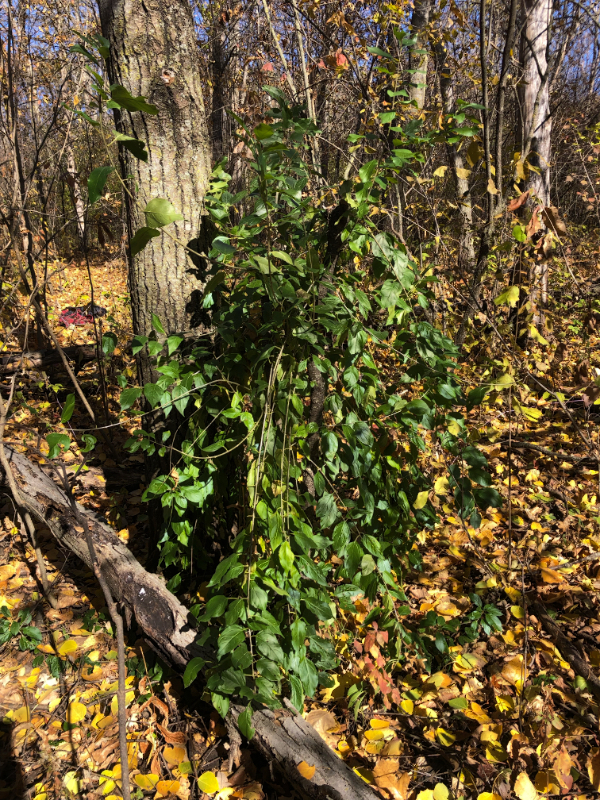
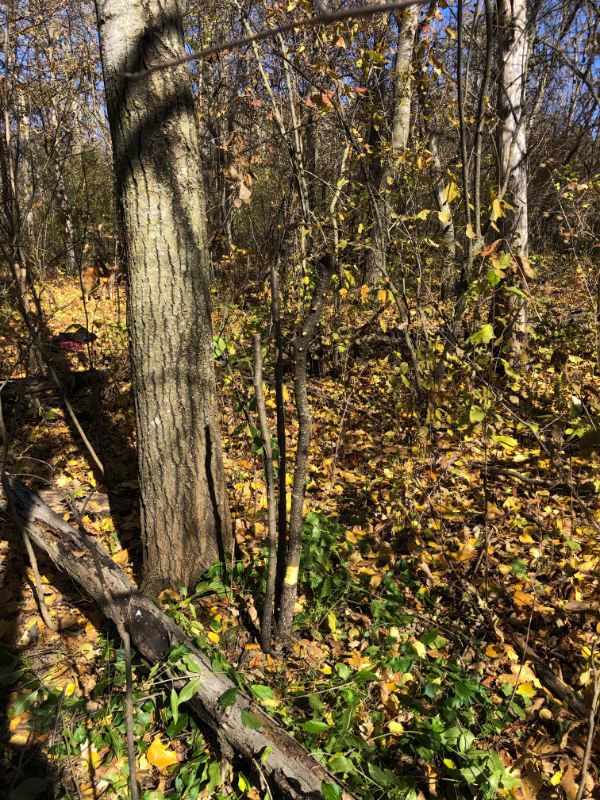
I have decided on a process that I call my method of madness, partly as a result of a handsaw being all I was carrying way back when I first started cutting Buckthorn on our property. I cut off the trees at a height of 3 or 4 feet so the stump will be noticeable the next time I pass by, knowing there will be subsequent growth since I don’t apply an herbicide to the cut.
This process wouldn’t be practical if I wasn’t constantly walking through these woods and following up each year on the re-sprouting stumps. After a while, new sprouts will stop showing up. Here are before and after images of one example of my madness:
 .
.
.
.
.
.
.
.
.
.
.
This year I have also removed a section of bark on some of the stumps to see if that will prevent new sprouts above the break.
I found an interesting video from the University of Minnesota Extension that reveals how Buckthorn has become a winter haven for soybean aphids. An added incentive for farmers to pay attention to the invasive growing beside their crop fields.
.
Boggles my mind that people figure out stuff like this. Who noticed the aphids were going to the Buckthorn and laying eggs that survive the winter?
Seems like madness to me.
.
.
Compare Contrasts
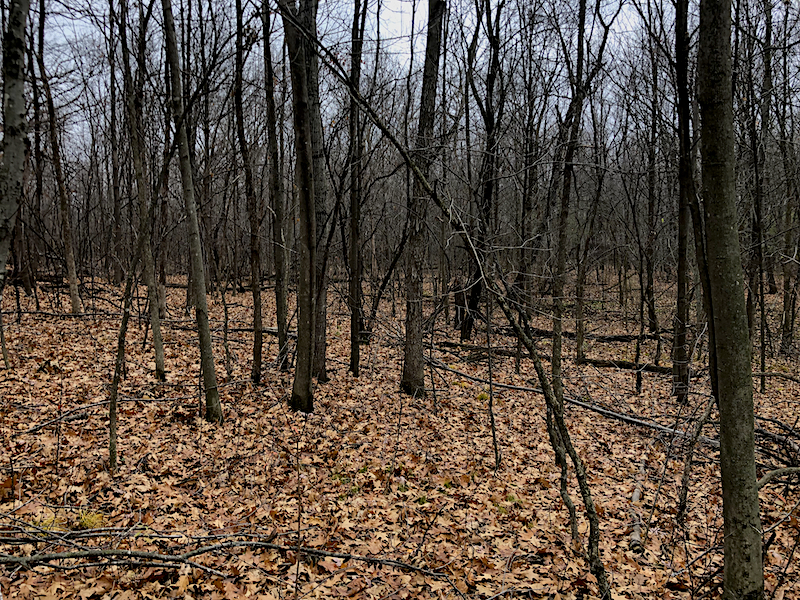
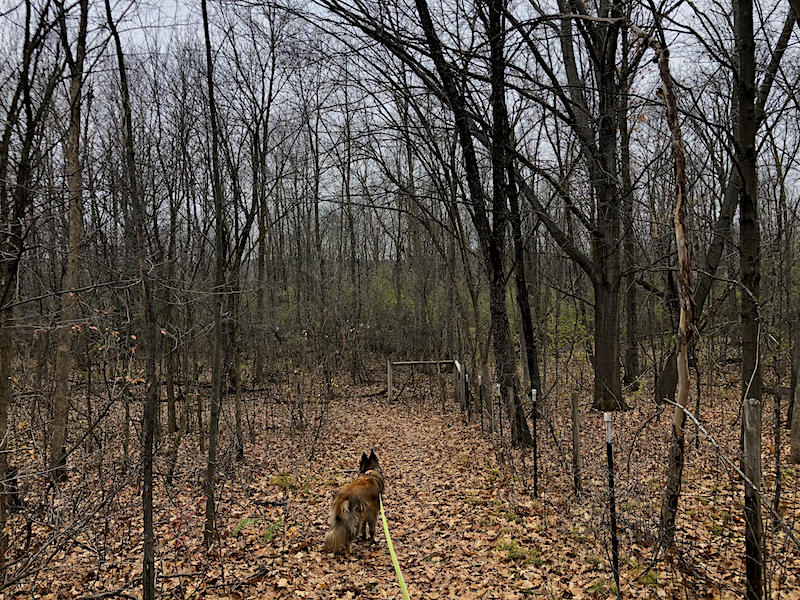
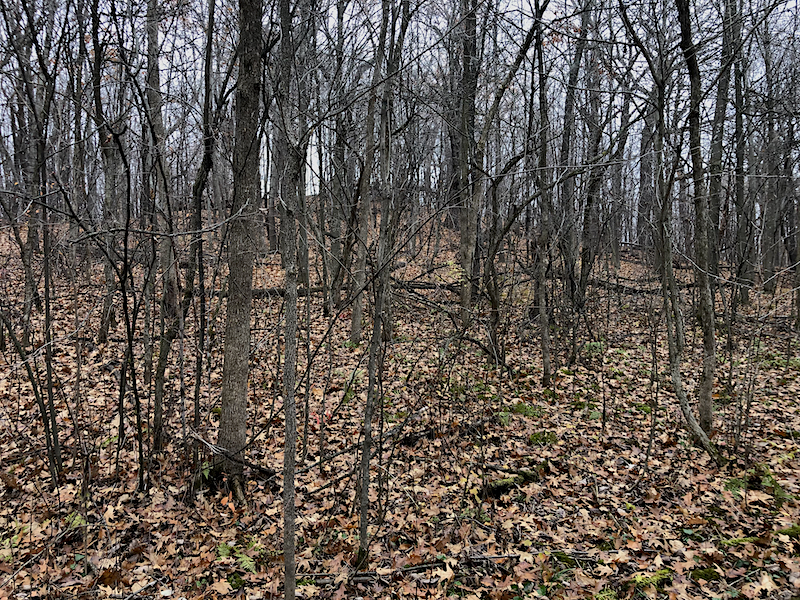
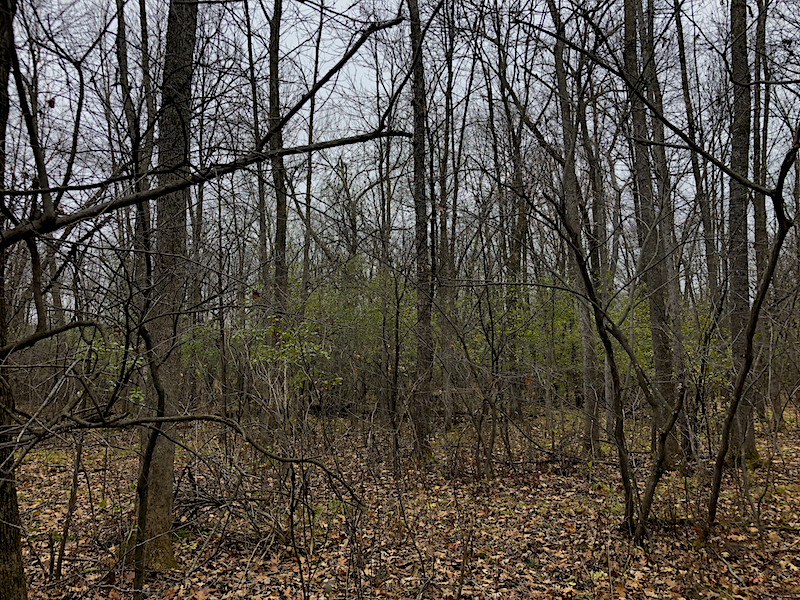
I have mixed feelings about the comparison of our woods to our neighbor’s when it comes to the obviousness of difference in controlling the invasive Common Buckthorn. Do you notice the contrast in the images below?
 .
.
.
.
.
.
.
.
.
 .
.
.
.
.
.
.
.
.
That line of green leaves on the low trees visible in the images on the right is increasingly dominating the understory beyond our fencelines.
It is pleasing to be able to clearly see the progress I have achieved in my vigilance to remove the buckthorn every year. At the same time, it is unsettling to watch the progress of the invasion playing out on the land surrounding ours.
Meanwhile, remember how happy I was to boast of stocking up on woodchips?
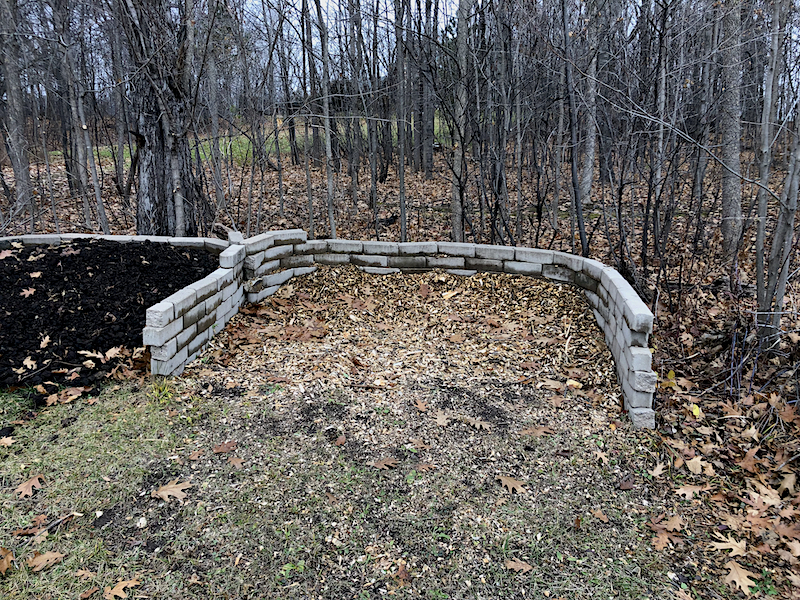
Cyndie has already succeeded in decimating the store of chips, distributing them far and wide for mulch around small trees and plants in the labyrinth and beyond.
We are on the brink of no longer being able to see most of the downed branches available for chipping with the arrival of snow season.
Yesterday, the driveway was still too warm to be covered by the first measurable amount to fall, but the leaves weren’t.
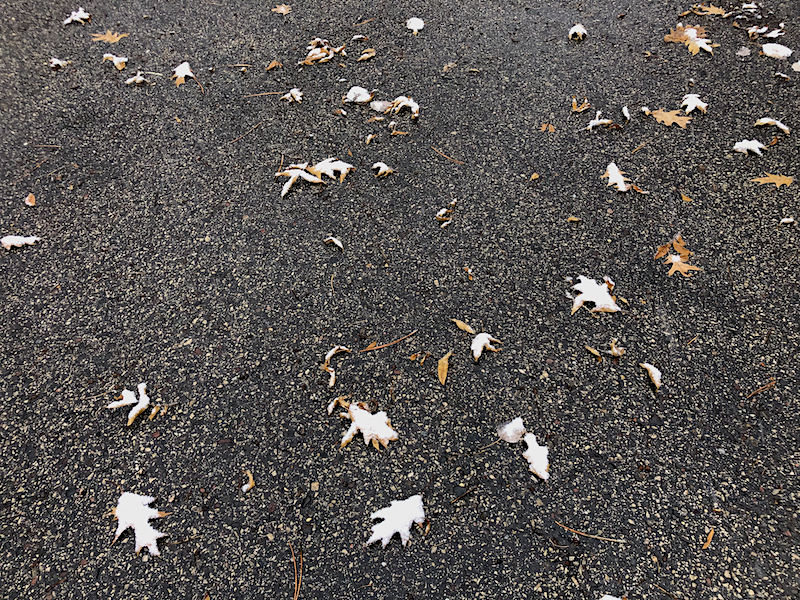
Our landscape turned white overnight last night. Animal tracks are clearly revealed this morning. I didn’t go out yet, but Cyndie said there were no bear footprints on the trails she and Delilah walked. Plenty of deer and an occasional bunny rabbit, though.
I’m going to be comparing our new surroundings today to the contrasting snowless world I walked less than 24 hours ago in my wanderings around the grounds.
.
.
Pernicious Invasive
It never stops. The unending intrusion of Common Buckthorn spreading anywhere that birds perch requires equally persistent vigilance to thwart. While I have given our largest segment of woods the most consistent annual attention, the small grove near the road dominated by poplar trees seems to have slipped my notice last year.
There were a couple of inch-plus diameter trunks that I had cut in the past but forgot to watch the next year. They had sprouted twice the new growth since I’d made that cut. Oops.
When I come upon tree-sized specimens, I often cut the trunk off a few feet above ground to leave the stump visible. The next season, many new sprouts will erupt from around the cut and my plan is to simply break those off enough times the root system finally stops trying and dies. Sometimes I forget to follow up.
In addition to the big ones, there were a frustrating number of little sprouts scattered all throughout the small segment of trees.
Luckily, those little ones are easy to pull out, roots and all, by hand. I just need to spot them and navigate the tangle of undergrowth to reach each one. And even when you think you’ve pulled the last, there’s always one more that I somehow missed.
At least I’ve given this challenge enough attention that it’s manageable at this point and the progress is noticeable. The surrounding woods of my neighbor’s property are filled with many tree-sized sections that haven’t been tended to in all the years we’ve lived here.
The difference is obvious and significant.
Speaking of that property to our north that was supposedly auctioned off on the courthouse steps in July, another neighbor recently mentioned a possibility that the sale never went through for some undetermined reason. Saturday afternoon the guy was mowing the weeds on the field that had been left fallow all summer, supporting the likely assumption of continued ownership.
The more things change, the more they seem to stay the same.
.
.
Buckthorn Season
In addition to looking for antlered bucks in the woods this time of year, I am also hunting for buckthorn. Common buckthorn is an invasive tree that I strive to control on our property. In the fall, buckthorn holds its deep green leaves longer than most other growth in our forests, making it easier to spot.
It’s not foolproof though, because I always seem to find a large enough tree that reveals I must have missed it the year before. I think the main reason for this is buckthorn is not the only growth that still has leaves after the majority of the forest turns brown and barren. There is at least one other bush that confuses my hunt.
 The main difference I have found is the relative color of green, as can be seen in the picture I took yesterday while Delilah and I were forging our way off-trail to dispatch every invasive we could find. The batch of leaves on the left are a buckthorn I just cut down that must have been missed the year before. The noticeably lighter green leaves on the right are the primary bush that complicates my identifying the unwelcome buckthorn.
When I look into the trees on my neighbor’s unmanaged land, there is an obvious spread of green growth, but ours holds just a fraction of that, only a few of which are the deep green buckthorn.
With this year’s quick jump to Arctic cold and several doses of early snow, the buckthorn hunting season has been shortened. Luckily, I had already done a first-pass through to address the sprouts of growth that are small enough to easily pull by hand before the ground started to freeze.
At that time, I didn’t have my hand saw with me, so I took a mental note of the larger trees I wanted to come back to cut down. When I set out to do that yesterday, I almost failed to find that tree shown in this picture. I needed to get to a place where just the right angle of view made it stand out.
Delilah loves that we need to roam into the middle of the areas we rarely visit, as she is able to find all sorts of disgusting things left behind by the wild forest animals that romp around on our land.
I’m satisfied with the progress this year and ready to consider the hunt complete. There was less growth than previous years, so our efforts are definitely paying off. The view into the adjacent property confirms it.
Our woods look distinctly more managed and that makes trekking through them for year-round forest bathing that much more rewarding.
Huzzah!
.
.


 Relative Something