Posts Tagged ‘Common Buckthorn’
Eradication Season
 It’s that time of year again. The invasive Common Buckthorn becomes much more exposed in early November, when the leaves of the desirable trees have just dropped to the ground. The deep green buckthorn leaves hang around long enough to make them easy to find.
I have taken a crack at this every fall since we arrived here, and I still get surprised to discover some really tall trees in our woods that have obviously been missed.
Yesterday, Cyndie offered to do most of the strenuous work if I took Delilah and walked the woods with her, pointing out which green leaves to eradicate. It’s not a perfect science, because there is one other bush that holds leaves this late, and its leaves are just barely less green than the buckthorn.
The challenge is compounded by Cyndie’s insatiable urge to wield the pruner with reckless abandon.
As persistent as the buckthorn invader can be at taking over the understory of our oak and maple forests, I take satisfaction in the comparison between our property and the neighbor’s. I have seen no effort to clear their property, and the results just become more obvious every year.

 .
.
.
.
.
.
.
.
.
Those views above are from one spot on our trail. On the left, looking into the neighbor’s land, and on the right, ours.
I would say, our efforts are proving worthy.
.
.
That Time
It’s that time again. Now is the time of year when it is very easy to see the common buckthorn leaves in the woods, because they stay green longer than our other trees. Buckthorn is a non-native invasive tree that makes a great hedge, but given free rein, can block out all others here and take over the landscape.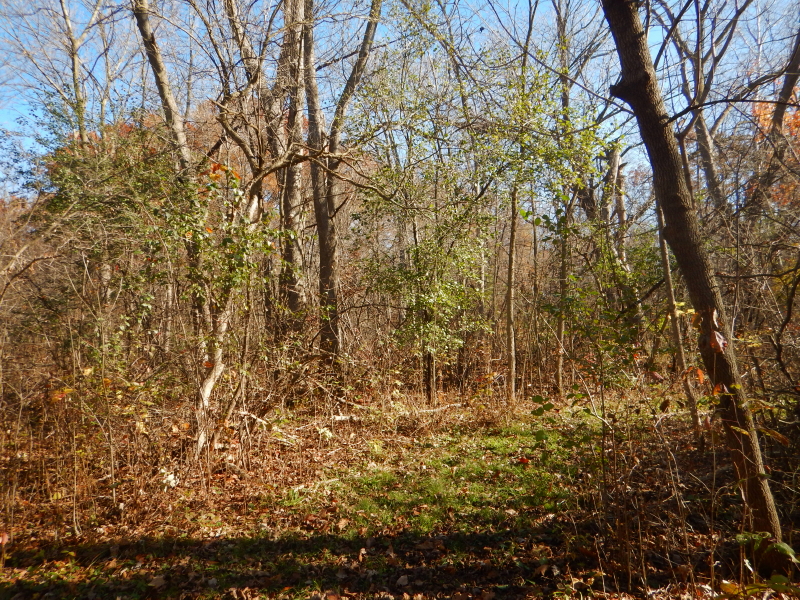
I let the buckthorn get out of hand on our previous tiny lot in the suburbs, so I have first-hand experience on what can happen, and what it takes to eradicate it. Now we have a LOT more property to police, which makes it a difficult thing to control, but I still want to put effort toward keeping it at bay.
There are still a few other plants that also have their leaves, so it isn’t as simple as pulling up or cutting down anything that is still green. Most of them are relatively easy to recognize as something other than buckthorn, but there is one in our woods with leaves that look surprisingly close to those of the buckthorn.
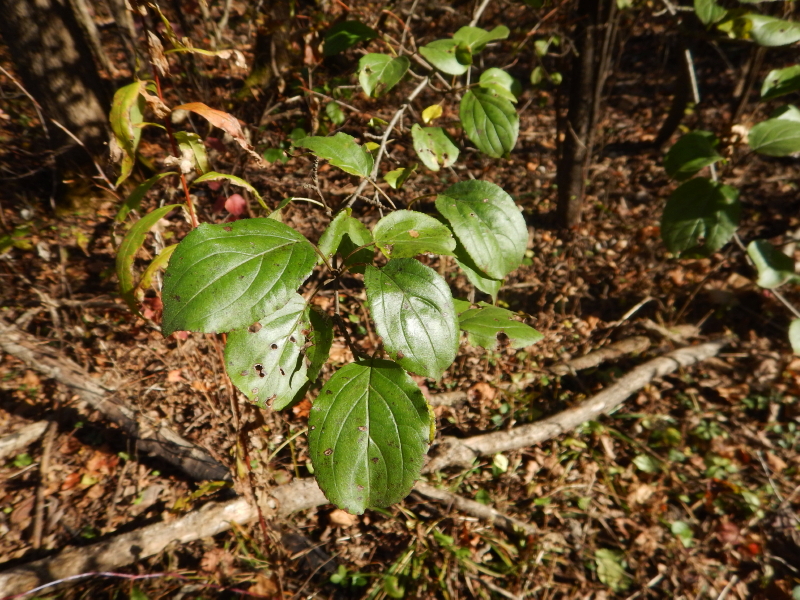 Usually, if I’m not absolutely sure, I just skip over it for the time being. Once you know what buckthorn leaves look like, it is pretty clear when you come upon them.
The saplings are rather easy to just pull out of the ground, and the area where I was working was very wet, so that gave me even more inspiration to try pulling most of what I found.
Some were just too big, obviously ones I hadn’t properly dealt with a year ago to have grown so large. Those I had to cut down with a saw.
The pulling is just so much quicker and more rewarding. I knock the dirt off the roots and dangle them over some nearby branches to wither and dry. Delilah loves to help with the root pulling. She claws away at the dirt and then grabs the roots in her teeth and pulls.
Sometimes we end up pulling against each other.
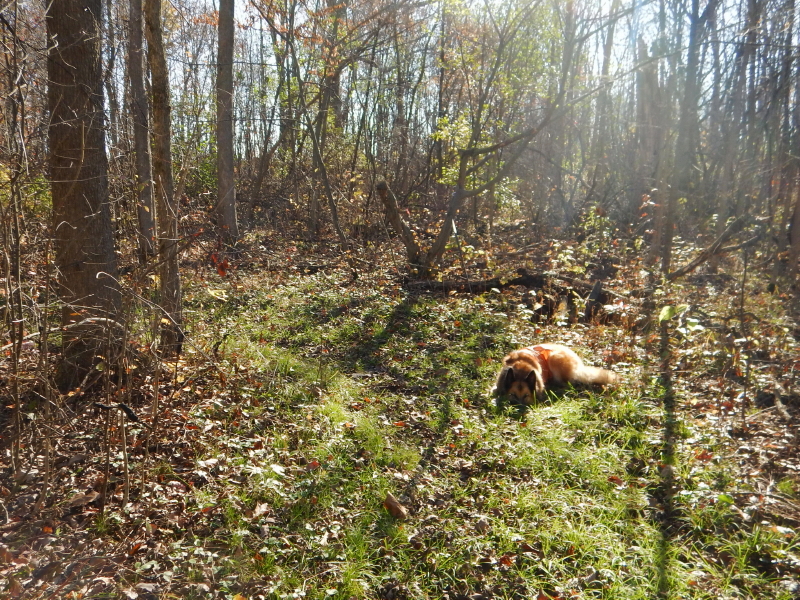 It is a serious full-body workout to pull the bigger ones. It ends up becoming a challenge for me to see if I can dislodge the next size larger trees by gripping them with my legs bent and then trying to stand up. I need my legs to do the bulk of the work, not my back.
At one point when I felt my legs tiring of the effort, I looked over to see how Delilah was holding up. She was sound asleep in a nap.
Yeah, it is really an exhausting exercise.
.
.
.
.
.
.
.
.
.
.
.
Thorny Challenge
 Today, Cyndie’s and my forearms look like we have been through a shredder. On Sunday, we decided to try tackling the chore of locating the old fence posts along the front half of our northern border, and then cutting out the old barbed wire. That section is a complete tangle of junk trees and vines that have been left untended for a very long time. Any area like that is bound to include that scourge, Common Buckthorn, and ours is no exception.
Cyndie had a thorn puncture her head, which we made sure to wash thoroughly and apply an antiseptic cream to, after my experience of having a puncture wound become infected, earlier in the year.
I said, “Ow!” so many times that Cyndie finally stopped inquiring as to what happened. The last one did require an explanation though, since it led to my taking a break to clean and bandage the wound. Regardless how careful I tried to be, one of the rusty barbs finally bit me, and it was deep enough to bleed a fair amount. Luckily, after washing the scrape, I found that the portion doing the bleeding was just a small section at one end that had broken through the skin.
I probably let my guard down about the barbed wire, after suffering so many stabs from the barbs of berry bushes and the thorns of trees in all the bramble. I think the thorns on the bushes were more lethal than the fence wire. Heck, they were probably the original inspiration for the idea of barbed wire.
One of the reasons we were doing battle with the tangled mess, instead of just clear-cutting it to get at the old fence, is that we want to keep as much growth as possible to maintain the visual barrier that already exists. The dilemma which that presents for me is to decide whether I allow the Buckthorn to remain or not. I seem to recall that it was originally brought to the U.S. for use as a hedge, and so I would be using it for its strengths in this location, if I keep it. But the problem with Buckthorn is that it out-competes native plants and can totally take over. I prefer a more natural diversity of native plants, if possible.
I may go for a compromise of trying to have both. I just need to be active in tending the growth in that area. When left to neglect, like happened over the years, trees grow through the fence, and send runners in all sorts of crazy angles, searching for the best sunlight. Buckthorn leafs out early in spring and holds its leaves late into the fall, creating shade that helps it to steal the light from other plants.
By the end of our effort of battling the nasty thicket, we had just a small distance completed. On the positive side, we found all 4 strands of wire, and all the old rusty posts for the distance we worked. I know the fence posts will disappear for a portion of the remaining run, and expect the wire will have gotten buried at those places where there is no bramble. At least we will be able to dig for the wires without getting stabbed all over our bodies!


 Relative Something