Posts Tagged ‘brush cutter’
Sunrise Ride
Watching 13 stages of the Tour de France provided ample inspiration for me on a beautiful morning bike ride over the hills and past the cornfields of my neighborhood in the driftless region of Wisconsin.
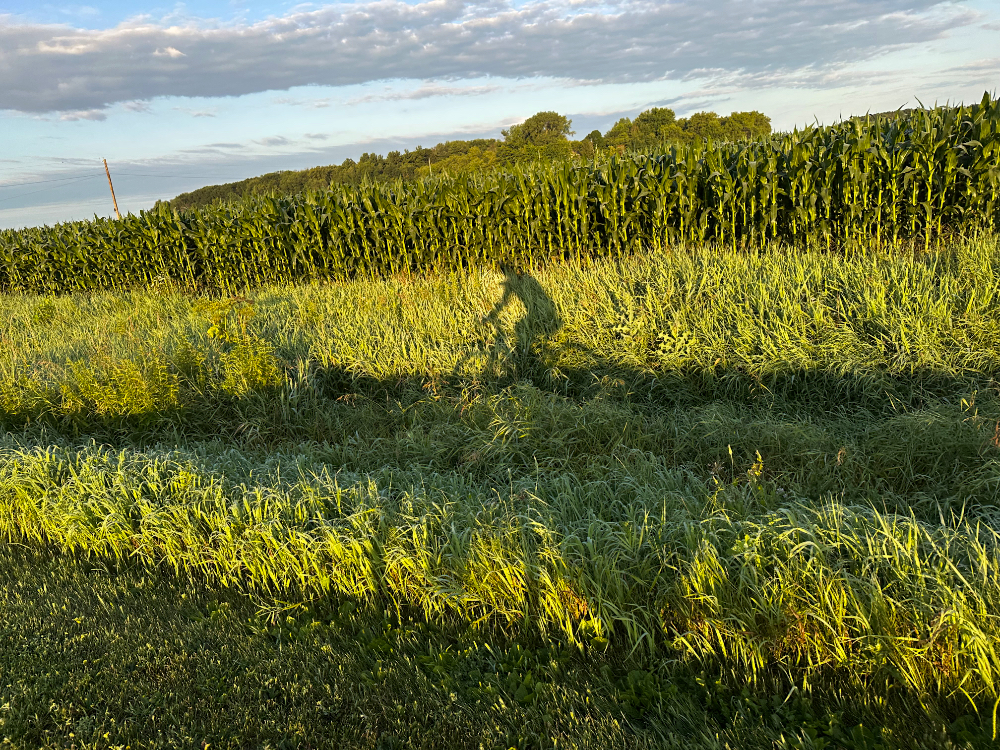
The low angle of the sun created shadows that proved irresistible for me to pull out my phone while riding, which I am VERY reluctant to do. The odds of my dropping it are extremely high, but I got away with it this time.
I was probably feeling a little cockier than usual because I had chosen to ride in the opposite direction of one of my usual routes, which put me immediately into several big climbs, and I found myself pulling it off without feeling noticeably abused. Maybe all the miles I trod back and forth on our hilly property are keeping my cycling abilities fit.
Since I had failed to test my bike since I picked it up from the shop almost a month ago, I was also energized to find my pedaling was as quiet as ever. It would have been a massive disappointment had it been otherwise.
By riding first thing in the morning, so that I could get back to feed the horses at their usual hour, I still had the whole day open to take on whatever chore I wanted. The one that seemed to offer the greatest return for the effort involved cranking up the diesel New Holland with the brush cutter to knock down the uncut areas along the edges and corners of the hay field that the hay mower couldn’t negotiate.
 That is an exercise that takes only a few minutes, but it serves as a precursor to moving into the back pasture to trim the weeds before they go to seed, which takes more than three hours.
After giving my legs an early workout, the extended tractor time may appear to be a more forgiving endeavor, but hour upon hour of pushing the clutch pedal, then the brake pedal, while spinning the steering wheel around and back on every turn, was almost as exhausting as conquering Pierce County hills on my bike.
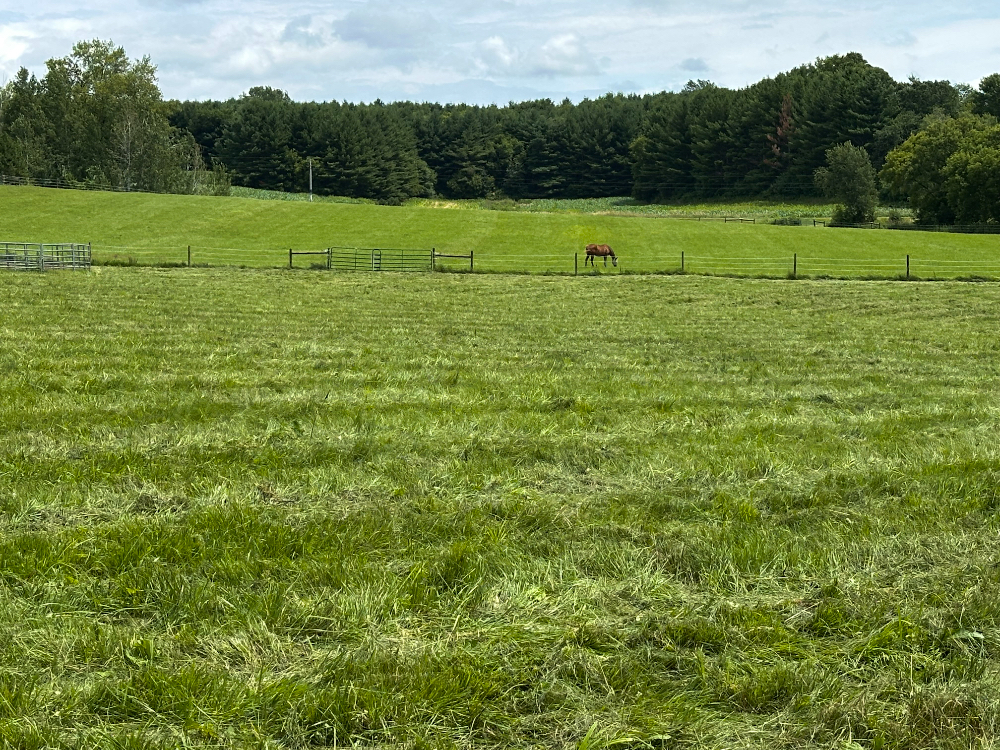
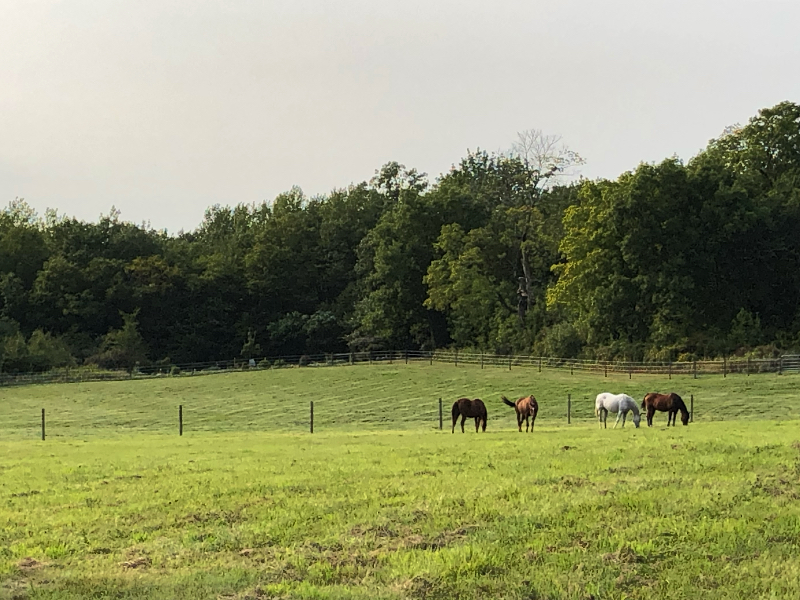
I had closed the gates to keep the horses out of the back pasture, but they were free to graze in the recently mowed hay field. I always love seeing them out on the grass instead of standing in a stupor under the overhang, which tends to be their preference much of the time. That’s Mia all by herself in the image.
This morning, I’m riding bikes vicariously through the pros racing Stage 14 of the Tour. They are a great inspiration.
.
.
Long Days
Catching up on daily tasks after more than a week away is a small price to pay for the extended time I was able to relax at the lake, but that doesn’t mean catching up is easy. I’m not saying that it’s hard, but it does tend to require long days when I’m also attempting to watch daily Tour de France races in the morning.
Things will calm down when Cyndie gets home, but there will also then be the added responsibility of caring for Asher when they return. For now, I’m benefiting from our decision to keep him at the lake with Cyndie because none of my time needs to be assigned to his needs.
I successfully created a steaming pile from the week’s-worth of dumped manure our horse sitter collected.

It’s cooking perfectly after just one day of shaping the mess into a composting mound.
After mowing around the barn with the zero-turn lawn tractor, I took care of the labyrinth with the push mower. Then, I cleaned the waterer in the paddocks and fed the horses. Next came the exercise of moving hay bales from the shed into the barn.
Normally, that would have been enough to send me in for a shower, which would allow for dinner at a reasonable hour. Yesterday was not normal, so I got out the diesel tractor and cut the weeds in the paddock with the brush cutter. While I had that tractor out, I also knocked down the portion of growth along the inside of the hay field fence that gets missed when the hay gets cut and baled.
I have wanted that done since the field was cut almost a month ago. Even though that pushed my dinner an hour and a half later than I prefer, the accomplishment was worth it. It becomes one less thing I will need to do today.
That gives me time to watch more bike racing this morning! Yay!
One time-consuming task I am neglecting is berry picking.
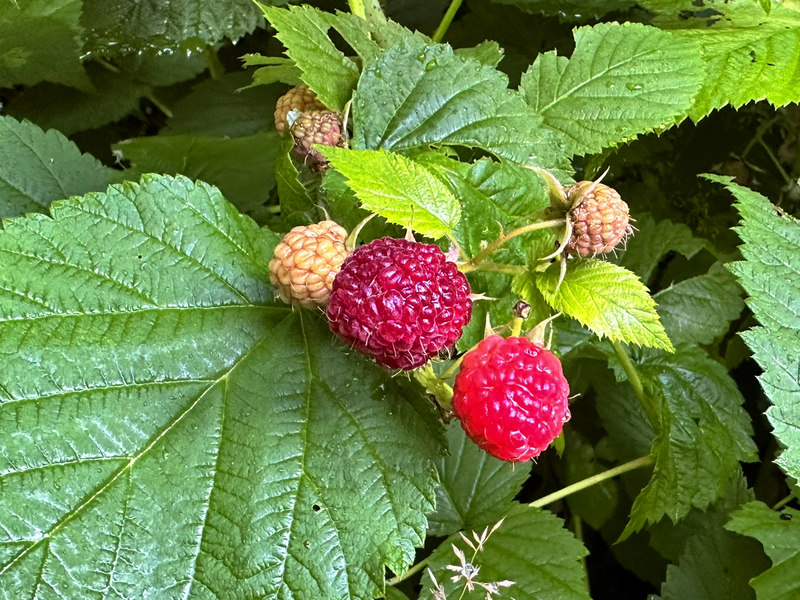
I’m hoping they will survive on the vine for a few more days so Cyndie can tackle that project. When I finish cutting all the grass (weeds), I need to complete the trimming of fence lines and then use the hedge cutter to knock back the growth leaning in along our pathways.
While mowing the labyrinth, I noticed the hedge trimmer is needed on the outer circle path where the jungle-like growth from the woods is encroaching on the air space.
It’s no surprise that managing all the growth around here makes for long days. Good thing the place looks gorgeous when I’m all caught up on the mowing and trimming. That makes it all well worth it.
.
.
June Fourth
What makes June Fourth so special? It’s Cyndie’s birthday!! We are not old or anything, compared to everyone older than us, but when you qualify for Medicare in the U.S., it suddenly feels like you are older than ever. Well, older than you’ve ever been before.
It feels wrong to be doing anything other than celebrating my lovely wife today but there are weeds to be cut, you know. We are meeting Cyndie’s mom and our kids for brunch, but after that, it’s back to the battle against allowing weeds to go to seed.
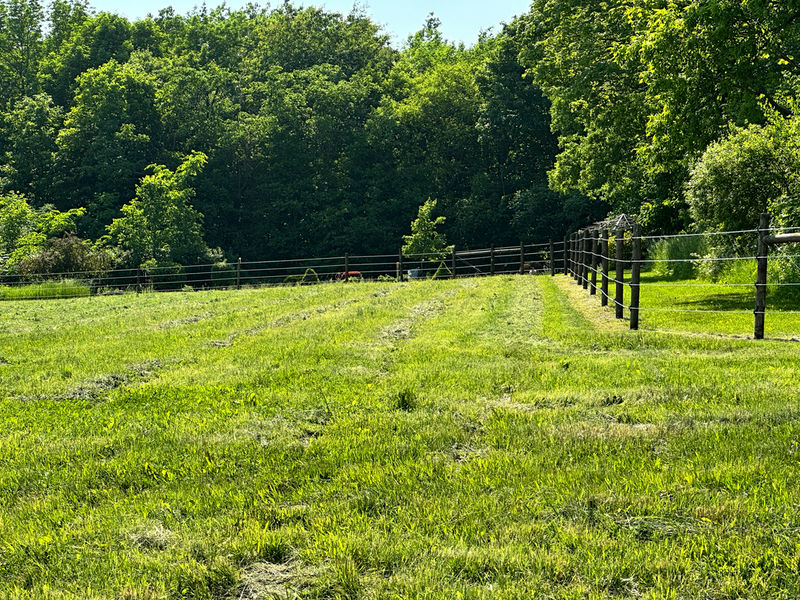
I don’t know how many versions of this photo I have posted over the last ten years, but it’s a view that truly captures my experience for hours on end.
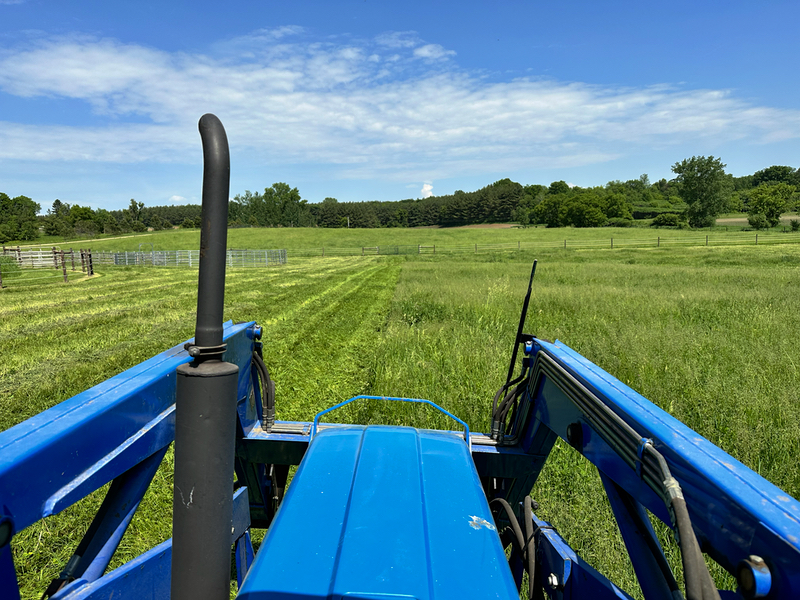
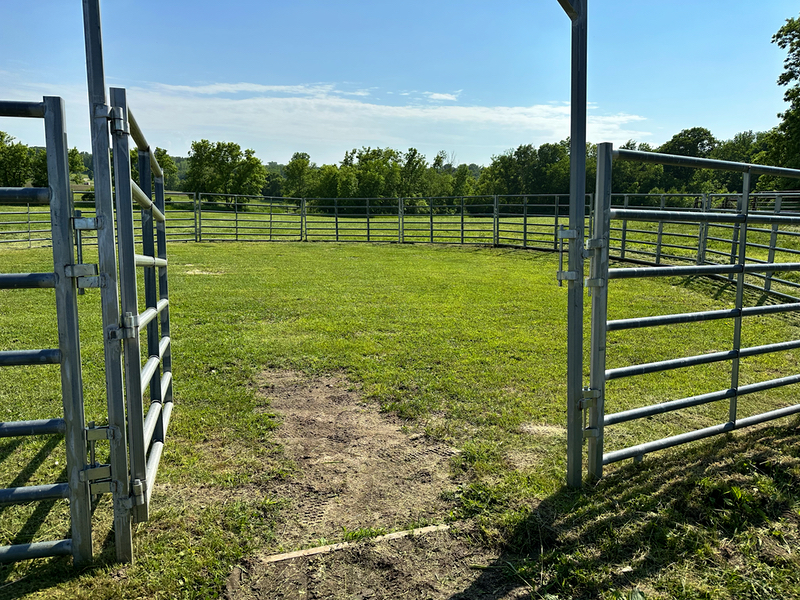
I worked the string trimmer along the fence line, around the round pen, and along the deep washouts of the drainage swale. I used the Greenworks riding mower to knock down weeds in the round pen and along the inside of the fence line. Finally, I pulled the brush cutter behind the diesel tractor to cut the back pasture. Among the multiple weeds battling for dominance against grasses in the field, thistle is the one we are keeping at bay by mowing.
 .
.
.
.
.
.
.
.
.
In the background of the photo with the cleanly trimmed fence line, you can spot the little maple tree that is in the center of the labyrinth.
This morning we opened the gate to the back pasture, giving the horses access to all that cut grass. They took little notice after finishing the feed in their pans and lolled around near the fans under the overhang. It’s not uncomfortably hot yet this early in the day, but the humidity is noticeable and those big-body mares know the heat will build faster by the minute.
I expect we’ll find them out there soon enough. They have a good sense about the opening of gates around their confines.
.
.
Rock Up
When I was mowing the back pasture a couple of days ago, I was startled by what almost sounded like a gunshot when the brush cutter struck I rock that I didn’t know was there. In pure reaction mode, my foot hits the clutch as my right-hand grabs the lever to lift the mower.
I hopped down off the tractor and checked everything over, then walked off to grab a step-in stake to mark the hazard. With the blades looking no worse for the wear, I resumed the pasture cutting and finished without further interruption.
Yesterday, I grabbed a shovel and a pry bar to bring the troublemaker up out of the ground, not yet knowing if it would even be possible. All that was visible was the freshly nicked tip of a proverbial iceberg. What could be lurking beneath the surface might be so large it would require a backhoe to dig out.
Luckily, that wasn’t the case and I was able to employ my solo technique of bringing large rocks up to the surface where I can scoop them up in the loader for relocation.
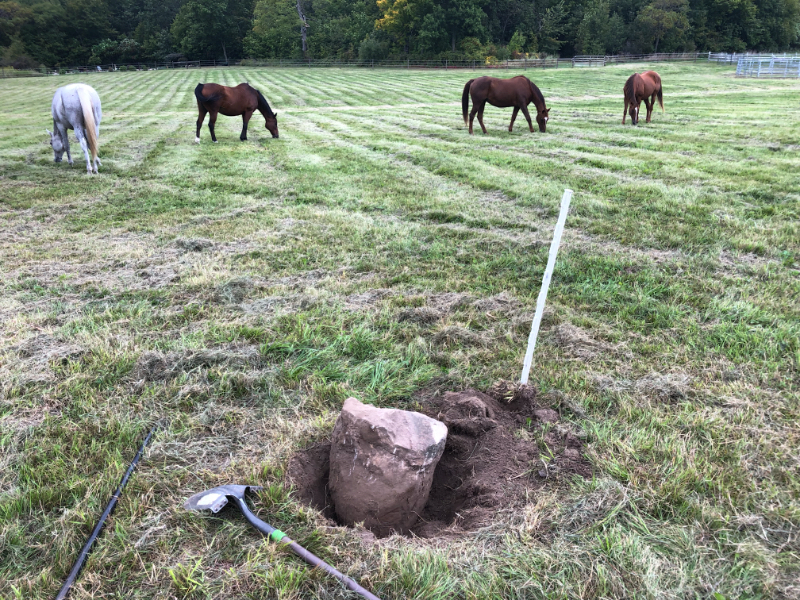
While the horses grazed nearby, I began probing to find the edges of the rock. Relieved that the borders seemed reasonable, I began shoveling scoopfuls around the perimeter until I got deep enough to use the pry bar to get some movement of the rock.
It’s a slow but completely effective process of tipping the rock enough to shove dirt under it. At first, it seems ineffective but after enough iterations, the progress speeds up. Alternating back and forth on opposite sides of the rock, I pry it up and shove the dirt previously removed to fill the small gaps that open up.
If I had a time-lapse recording it would look like the rock “rocks” back and forth, gaining a little height each time.

The white portion is what the brush cutter chipped off. The darker portion around it is the area that was above the surface. The rest was the mystery encased in dirt.
It looks suspiciously shaped as if it had been formed at some time for a particular purpose but I have no idea why it was buried out in the middle of an open field if that was the case.
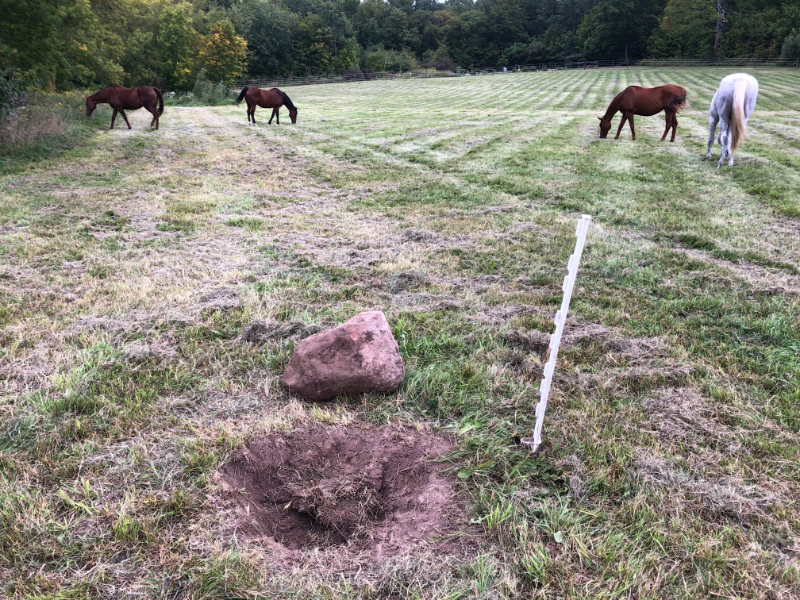
Now I am left with a significant void on the surface of the pasture. Before I come out to retrieve the rock with the loader bucket on the tractor I will need to fill the bucket with some replacement soil. Now, where will I find some natural fill around this place?
.
.
Cutting Pasture
It feels like I have been cutting grass non-stop for days. I used to think that growth slowed to a crawl after August but I saw a chart at the State Fair this year that indicated grass growth in September can be compared to what happens in June. There is a slump in July and August when grass might even go dormant before reenergizing in September.
It used to confuse me that September was a recommended time to seed new grass but now I can understand why that is.
Our land is still overly dry but we have had just enough rainfall between dry spells that the greenery looks pretty lush and the grass seems as happy as can be. The reason it feels like I’ve been doing a lot of mowing is that I have been playing with our new electric push mower, and I cut grass in the labyrinth, then used the brush cutter pulled by the diesel tractor to mow the hay field, and yesterday, the back pasture.
In addition, I have been cutting beneath the fence lines with the power trimmer. On top of that, I knocked off the second phase of a twice-a-year mowing of the drainage ditch along our southern property line.
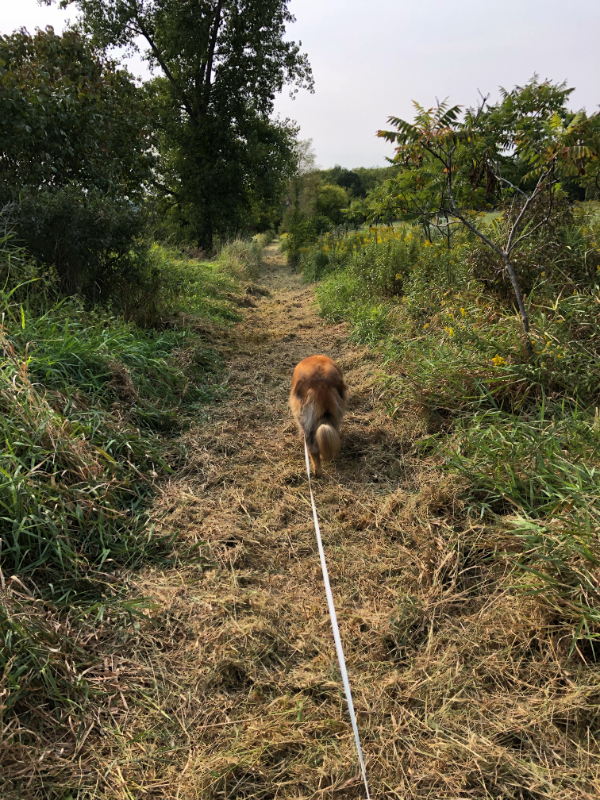
When it’s dry, the mowed ditch becomes an alternate trail for Delilah to explore. In that image, she has her nose to the ground exploring any animal trails hidden beneath the mass of cuttings. The months of growth in the ditch were four to five feet tall and it is a blind cut on the first pass. My foot is poised to hit the clutch to interrupt the power to the mower if anything that wasn’t supposed to be mowed is encountered.
I back up the full length with the brush cutter tipped up a bit and then lower it for the return trip in the forward direction toward where I started. It isn’t a straightforward simple cut because there are washouts where fast-moving water has eroded the soil and they meander back and forth so the tractor wheels occasionally drop down or the mower bottoms out as travel progresses.
So, it is a blind cut on a completely unpredictable terrain. It is a great relief when that task has been fully accomplished.
It is also extremely satisfying to have both big fields mowed. If you’ll recall, it isn’t so much the grass that we need to cut as much as the weeds we want to prevent from going to seed. Cyndie and I don’t want to use toxic chemicals so mowing is our chosen method of control. We also pull a lot of weeds but that is similar to trying to empty a lake of its water by removing a spoonful at a time. Although, it is very satisfying, psychologically, to yank a weed out by its roots.
The horses took great interest in my activity in the back pasture and gave me the impression they wished I would hurry up and finish so they could get back on it.
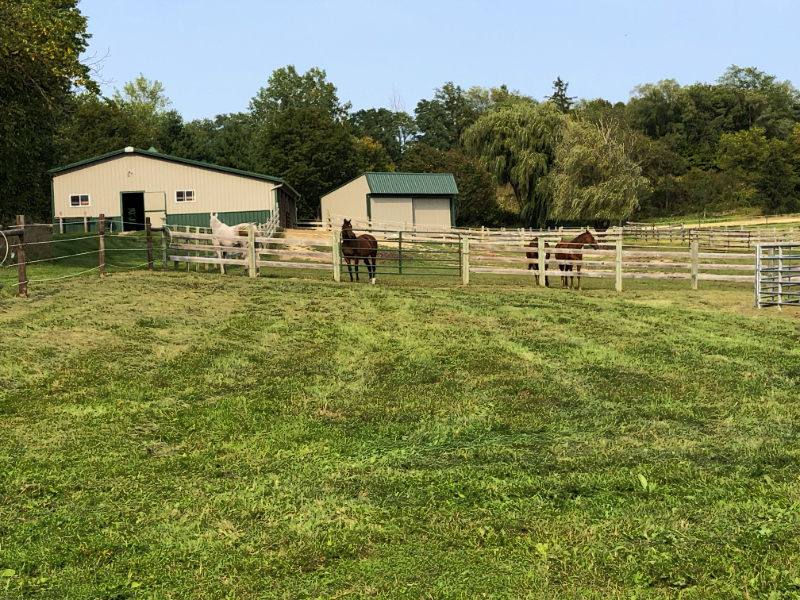
I’ll keep the gates closed for a couple of days to dry out the cuttings and give the grass a little time to sprout new growth before giving them access again. Meanwhile, they have the entire already-mowed hay field at their disposal.
.
.
Weed Control
We had two primary goals in mind when we plotted a strategy for what we would focus our efforts on yesterday. The first was something I hoped wouldn’t take a lot of time to accomplish. There were two tipped trees with upper branches hung up in surrounding trees. Using knowledge gained by watching the tree professionals who worked for us last spring bring down similar “widow-makers,” I readied our chainsaw and headed into the woods.
With my mind focused solely on the task at hand, I failed to take any pictures of the leaning trees or the keen aftermath of my success in bringing them down. The big poplar near the road took a lot more time than I anticipated. After five successive cuts ultimately eliminating the lower trunk that had been leaning at a 45° angle, the remaining upper portion of branches stood vertical and was still tangled in the branches of surrounding trees.
I needed to go back to the shop to get our pole chainsaw to finish the job. By the time we finished cutting trees, the day was more than half over.
The second goal was to get the hay field mowed, a job that I knew would take more hours than I really wanted to give to the task.
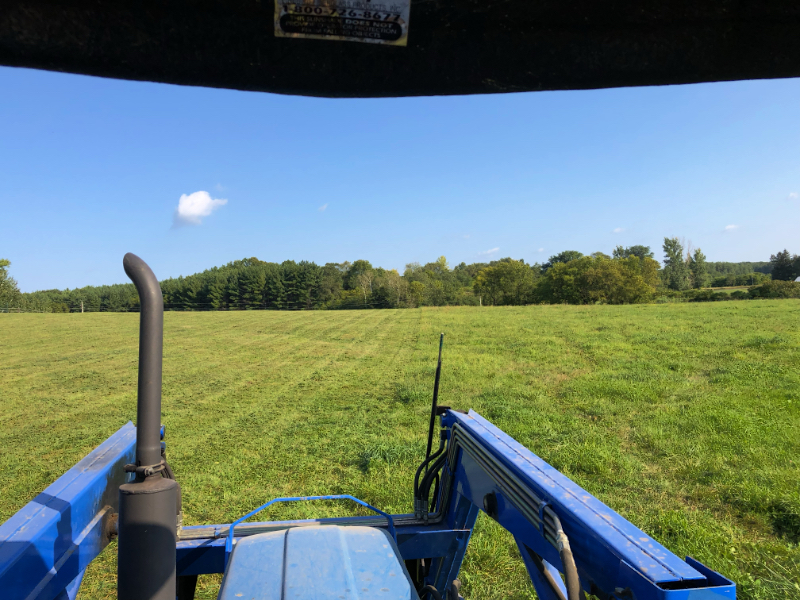
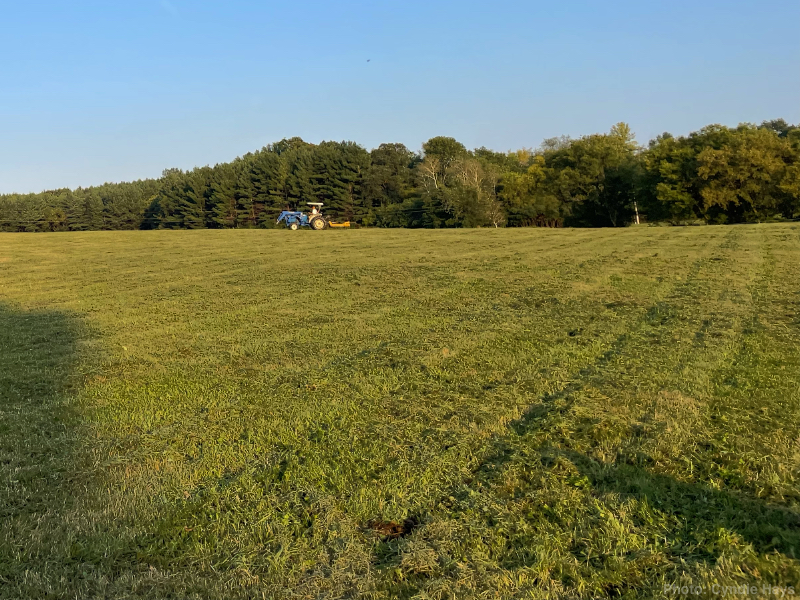
The growth wasn’t excessively tall but there were plenty of weeds maturing and we didn’t want them going to seed. I finally finished around 7:00 p.m. after almost 5 hours out on the tractor. At one point, feeling like it was taking too long, I tried running in a higher gear to speed up progress. The bouncing and jostling were a bit too much and the high gear made backing up hard to manage. All I could do was plod along at a steady pace in the lower gear and keep making passes until the entire field was finally cut.
 .
.
.
.
.
.
.
.
.
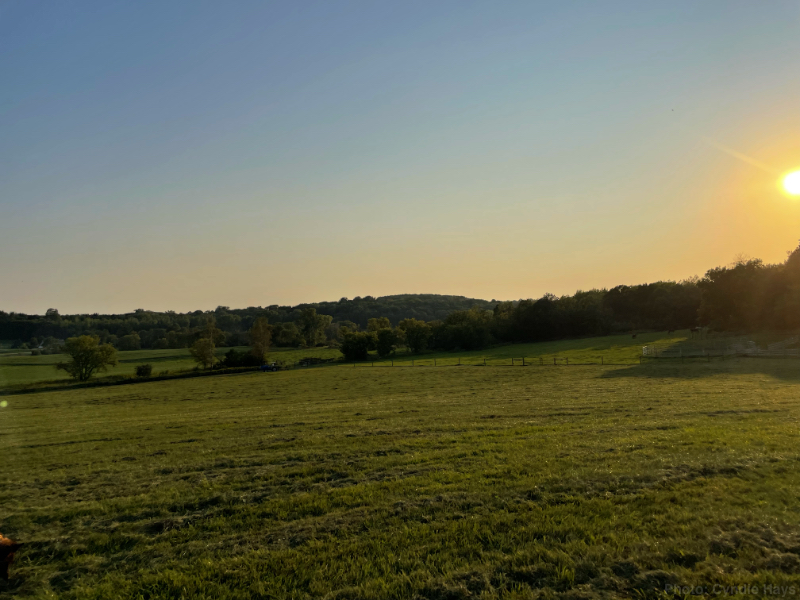
Cyndie took pictures as I headed toward the gate upon finishing. For a relatively small field, it sure is bigger than it seems.
The horses were relegated to the unmowed back pasture for the day. They are doing a fair job of grazing the good grass in that pasture but there are enough unwanted weeds in that field that it will need to be mowed soon as well.

In a day or two, they will be allowed back on the grass in the hay field. Then I will spend the better part of a day mowing the back pasture.
As much as I dread doing the mowing, the fields sure look great with all the weeds knocked down. For now, in our minds, mowing is our preferred method over chemical applications for reducing weeds that are toxic to horses. It may not be as effective, but mowing doesn’t leave a weed killer residue in our soil.
I can live with giving two afternoons of my precious time to bouncing along on the diesel tractor a couple of times a summer.
It’s easier than chainsawing widow-makers!
.
.
Concrete Lifted
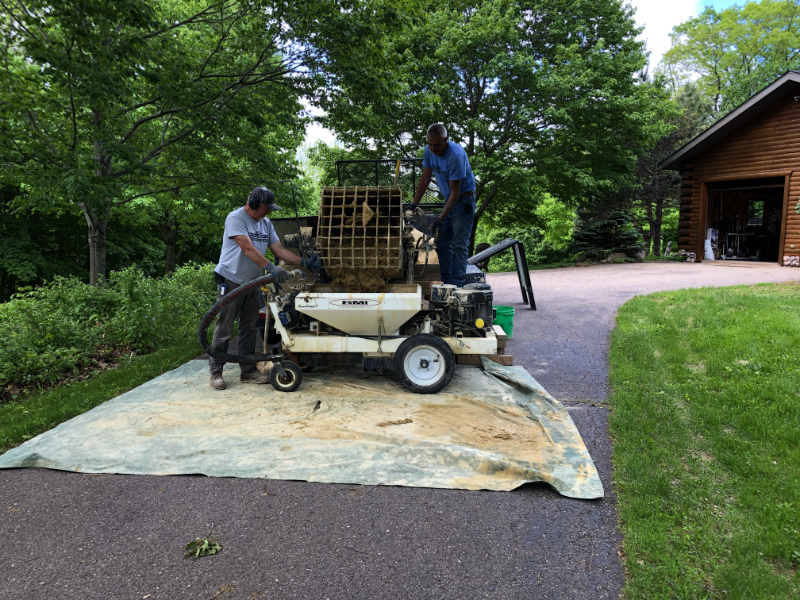
I successfully avoided titling this post, “Apron Lifted” but that is what happened yesterday in front of our garage. We have a plan of fixing our driveway this summer and in preparation for that, the first thing that needed to be completed was to solve the sunken concrete apron in front of our garage.
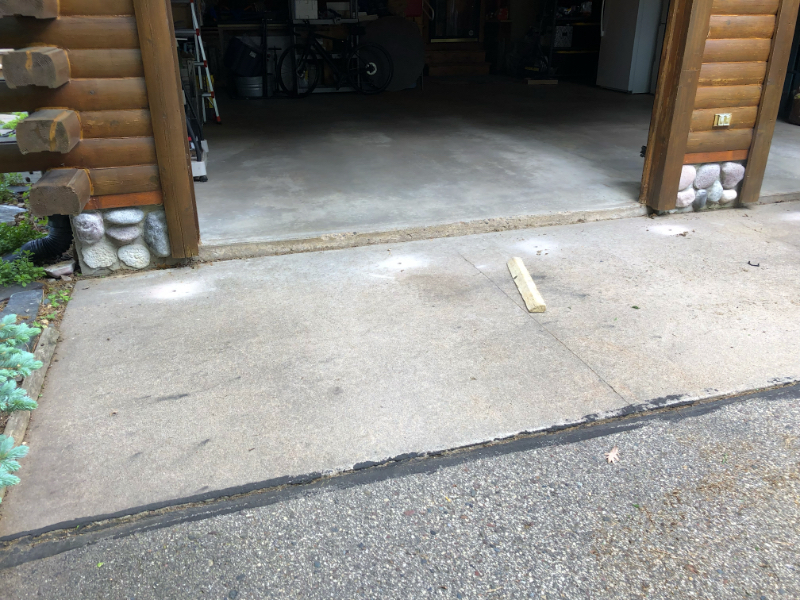
On my side of the garage, the apron has fallen almost three inches. We were warned by the company doing the work to be careful moving our cars back into the garage because the old habit of revving the accelerator to get over the bump will no longer be necessary.
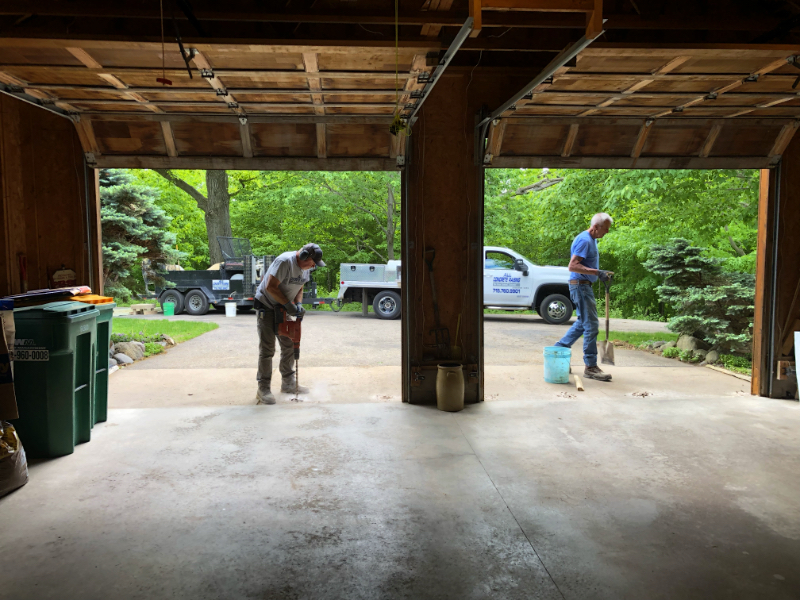
 .
.
.
.
.
.
.
.
.
The company we chose uses polymeric sand to seal the gap between the apron and the main garage slab. This was my first exposure to the material and leaves me intrigued to consider using it in other applications in the future.
The rest of the day for us was almost as productive as it was for the rapid and efficient concrete lifting crew. (They were in and out within about one hour.) I got some power trimming done down by the road at our driveway entrance, we received a visit from the farrier to trim the horses’ hooves, and I pulled out the diesel tractor to mow the back pasture.
It took me longer than one hour but I’m focused on how smoothly the whole mowing project went, all the way from getting the tractor out for the first time in months, finding the ground wasn’t too wet and soft for the weight of the big machine, and finally, finishing all the cutting without incident.
I’m always nervous about operating the heavy equipment around our fences. It will be much easier to wield the power trimmer to clean up the last remains of tall grass that is growing underneath the fence, especially after I remember to turn off the electric jolt pulsing down the wires.
I don’t know why it is so hard for me to remember to shut that off in advance.
When I was all done mowing the back pasture I discovered a bumper crop of dandelion seeds had piled up on the brush cutter behind me.
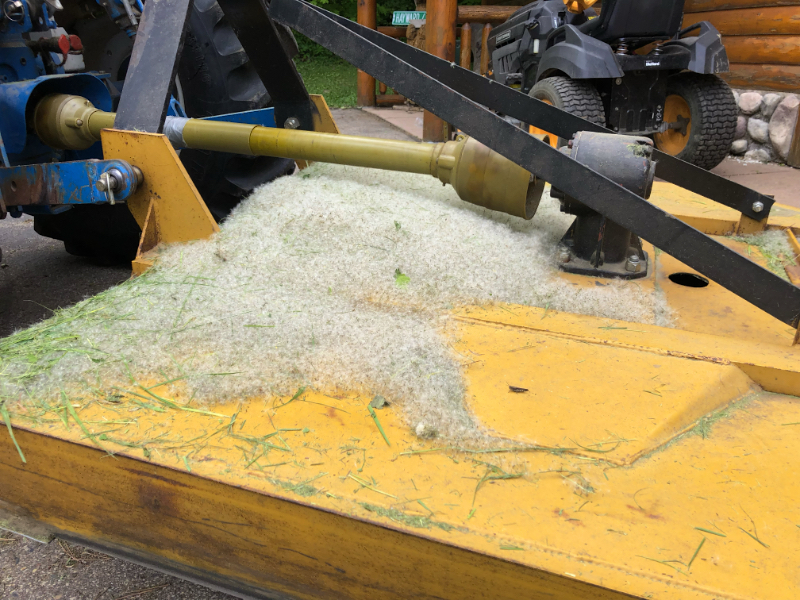
Better they landed there, I guess than out on the ground. Not that there wasn’t an equal amount blowing around every which way around me as I mowed.
.
.
Midday Sprint
I did recently swear off mowing grass in November but this is different. This isn’t lawn grass I was mowing yesterday with the garden tractor. On an uncharacteristically warm November day, I brought out the big diesel and pulled the brush cutter across the back pasture to cut down a problematic invasion of Canadian thistle.
We were aware of the toxicity risks for horses, yet it was Cyndie’s recent Master Gardener classes that pointed out how the thistle will spread and degrade the quality of grazing pastures if left unchecked.
But, honestly, it still felt a little too much like mowing grass.
My presence on the big machine riled the horses into a bit of sprinting that Cyndie captured on video.
.
.
I had closed gates to isolate the pasture I was going to mow and that was the first step in raising the curiosity of the horses. When I showed up on the big tractor and started cutting, it was unclear if they were upset to see their grazing options disappearing before their eyes or just worked up over the strange-looking noisy contraption rolling along.
They started racing in and out of the paddocks from the front hayfield.
It is beautiful to watch them sprint in the manner they were bred and raised to do, knowing it is their choice to run and they are free to stop whenever they wish.
Soon after their little spurt of racing, they wandered out into the hayfield and stood for a little nap while the tractor droned on. When I finished in the back pasture, Cyndie opened the gate to the hayfield and I rolled out there to mow the strip along the paddock fences where we had planted acorns. The horses didn’t move a muscle at that point.
They quickly get over the initial alarm about me showing up on machines with engines.
Using the knowledge Cyndie is gaining from her Master Gardener classes, we have a new plan to transplant some yearling oaks next spring and protect them from animals and crowding from surrounding growth for the first few years. Yesterday, she scouted and marked the candidates we hope to use when the winter snow disappears from the ground.
I mowed the grass short and Cyndie dug holes in advance to mark the spots. That alleyway will end up getting a more permanent barrier to keep horses away while future paddock shade is being developed.
Beware the work deemed necessary when you start learning the wealth of valuable details included in Master Gardener lessons.
It will be much more marathon than occasional sprints.
.
.
More Clearing
On Saturday, we worked on the north side of our property. Yesterday, we directed our attention to the south. It has been several years since I properly worked to clear the drainage ditch that runs along most of the southern border of our property.
The first winter we were here I saw how the accumulated snow piled up against the neglected growth of brush and small trees in the drainage path. It acted as a dam and caused water to overflow the ditch during the spring melt. I remedied that for the next season by cutting out the trees and mowing the length of the ditch.
Lucky for us, the overflow poured into the neighbor’s field that year, not ours. He never said anything about it, but I’m sure he is happy seeing the attention I have given toward keeping the ditch clear since then.
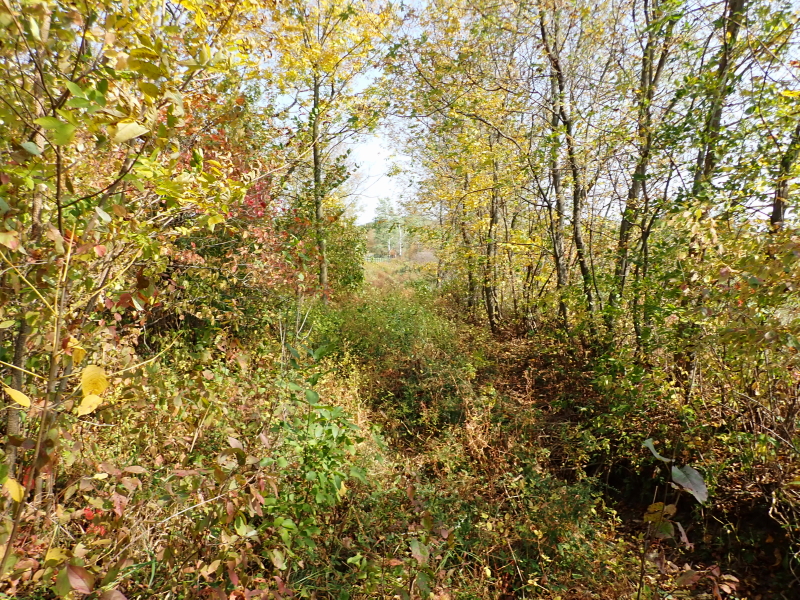
I was complacent last year and skipped doing any cutting, so the random volunteer trees were able to establish themselves a little more significantly than I’d prefer.
 .
.
.
.
.
.
.
.
.
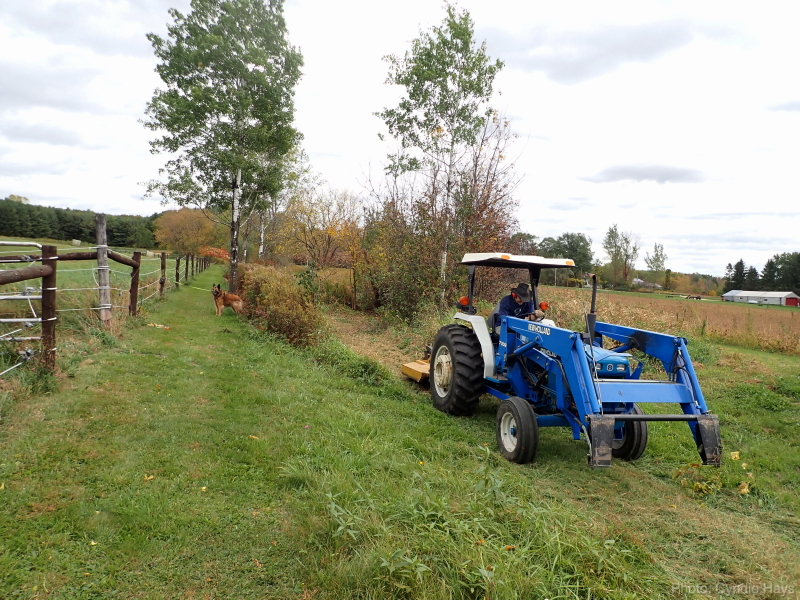
After first clearing each end of the ditch with the power trimmer, the rest was a cinch with the brush cutter on the diesel tractor. Well, that is, after pruning some branches that interfered with the upper portions of the tractor. Once we trimmed those, I just backed my way the length of the ditch and returned.
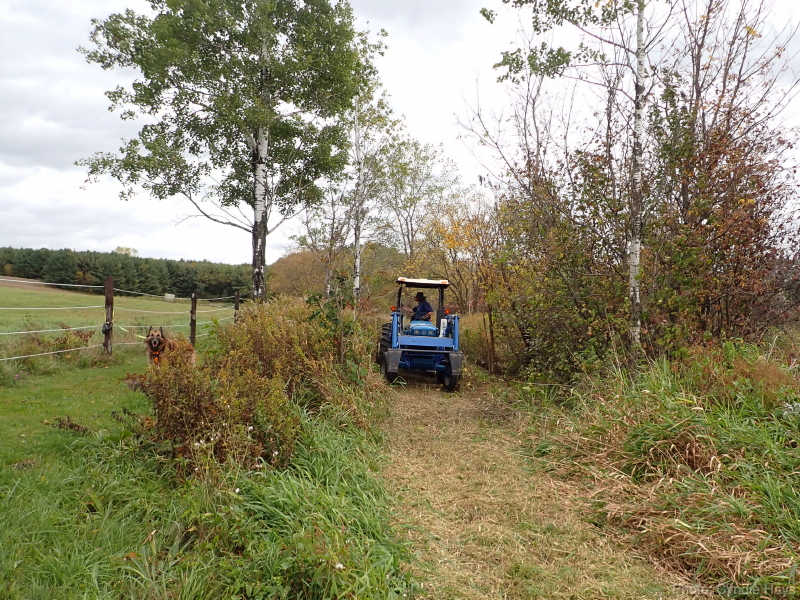 .
.
.
.
.
.
.
.
.
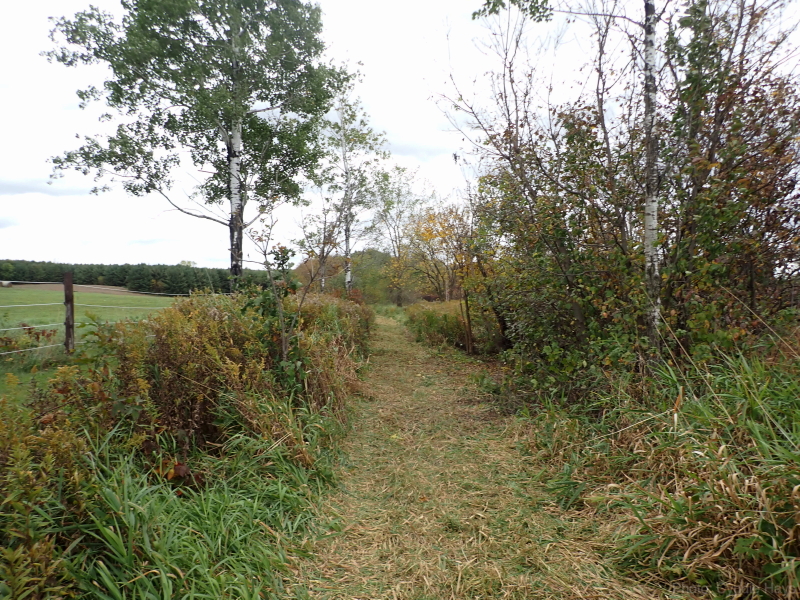
Voilà.
Let the water flow.
.
.
Paddocks Reclaimed
Mission accomplished on Sunday in my effort to reclaim the paddocks from the unchecked growth of grasses and weeds, some of which had risen to over a meter tall since the beginning of this year’s growing season.

 .
.
.
.
.
.
.
.
.
I got in there with the big diesel tractor pulling the brush cutter and successfully avoided destroying any fences while maneuvering in the confined spaces.
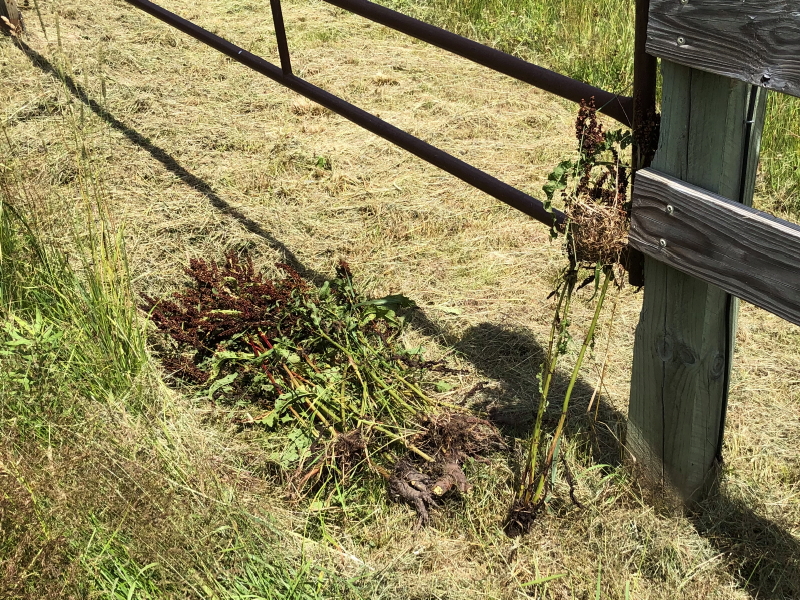
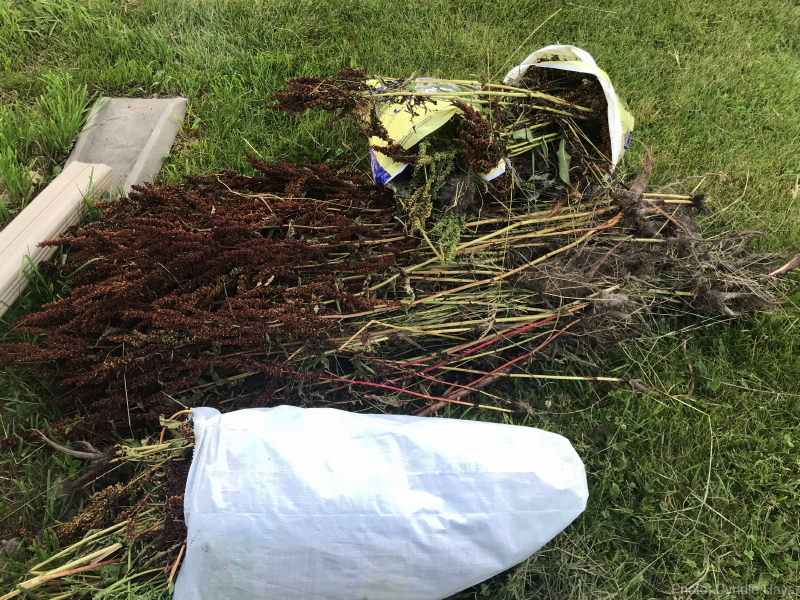 Before the cutting started in earnest, Cyndie and I made a pass through, digging up “sour dock” weeds (that’s the local name for Rumex Crispus or some variation thereof) in hope of reducing their propagation.
We used to get sour dock mixed in bales of hay we bought for our horses and they were not fond of it. Ever since, we’ve framed it as an undesirable weed, despite evidence there are some medicinal and edible features to it.
Then it was off to the mowing races.
It’s always a little unnerving to be mowing blindly over such thick and tall growth, not knowing if I might run over a misplaced tool or any variety of wild critters that may have made themselves a home there. As it was, while walking through the higher-than-my-waist jungle of growth I figured I was wandering in a snake pit, much to my discomfort.
Luckily, no snakes were encountered over the entire duration of this project. A lot of toads and a couple of field mice were about the extent of sightings.
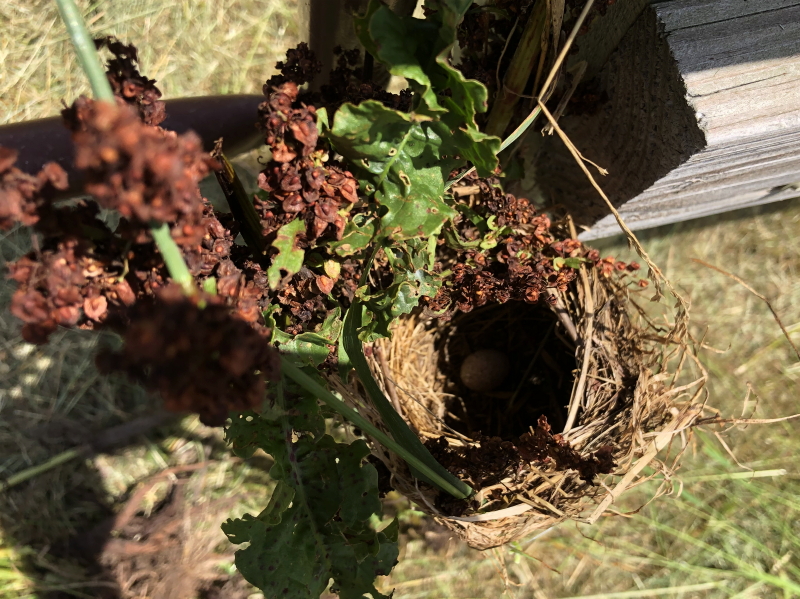
At one point in my hunt for stalks of sour dock hiding among the tall grasses, I came upon a bird’s nest with a lone egg in it. With a total absence of any upset flyers winging their way overhead, I concluded this poor egg had been abandoned.
 .
.
.
.
.
.
.
.
.
Now there is a blanket of cuttings covering the ground in the paddocks. That’s enough for hundreds of nests.
I noticed the three hens wandering around in there right after I finished mowing, picking at the wealth of opportunity, but I don’t think they will make a dent in cleaning up all the deadfall.
We’ll simply leave it to dry up and break down where it lays.
Maybe that covering will slow new growth so I won’t have to mow it more than one more time by the end of the summer. I don’t enjoy operating the diesel tractor so close to fences, especially inside the corners.
The paddocks almost look like we have horses again!
That’s so much better an impression than the neglect all that wild growth has been emanating.
.
.


 Relative Something