Posts Tagged ‘stacking firewood’
Moving Hay
When we moved to the country twelve and a half years ago, there was a lot that I didn’t have a clue how to do. After a career in manufacturing, you’d think I would have a better perspective on inventory management, but I struggled a little bit in figuring out how to manage turning over our firewood and bales of hay.
“First in; first out” (FIFO) is a classic method of using the oldest inventory first. That can be a trick to do when stacking your wood or hay in storage. The oldest ends up at the bottom of the pile.
For our firewood, I quickly changed from stacking it horizontally across the width of the shed to short rows, back to front. I just use the rows up from right to left and stack new wood behind them as space opens up.
That method doesn’t work for our hay. Since the bales arrive in large numbers all at once, we fill up the hay shed, and the last bales stacked become the first bales used. The routine I’ve settled on requires that we use up almost all of the last delivery before ordering more, which gets a little nerve-wracking since we don’t have complete control over when the next delivery can happen or how fast the horses will be burning through bales any given week.
When we do get close and the delivery is scheduled, I then hustle to move the last of the old bales out of the way in the shed and stage them in the barn. That is what I worked on yesterday, moving the last 21 bales from the hay shed to the barn.
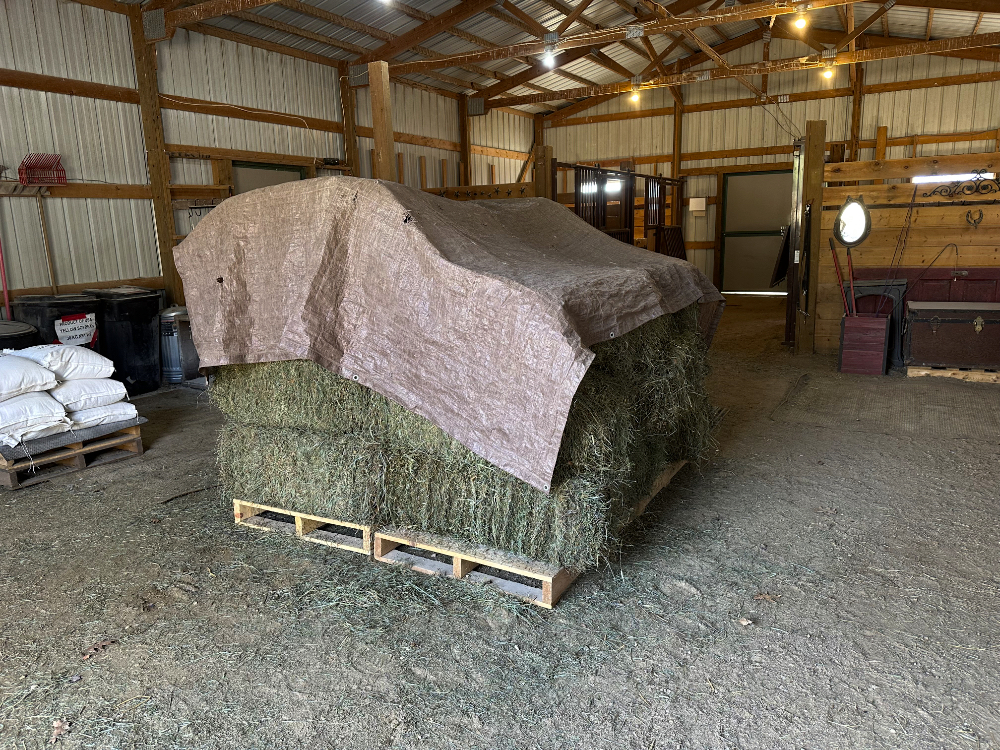
The chance to meet our new handler, Jeremy from This Old Horse, ended up getting postponed yesterday afternoon. However, while I was hauling hay bales, I received a call from a contractor who wanted to come out this afternoon to talk about helping me put up a shade sail. I anticipate it will be a challenge to get a firm quote since there are so many unknowns at this point, but at a minimum, I hope to gauge a level of interest, knowledge, and ability for the project as I imagine it.
I’m expecting new hay to be delivered on Sunday, and if all goes as planned, I hope to meet Jeremy at the same time. It would be great to have another person to help toss bales into the shed for stacking.
It feels like a lot is happening here while Cyndie is in Florida. Of course, yesterday morning, before she left, Cyndie baked oatmeal raisin cookies for me to give the folks stopping by.
The more I give away, the fewer there will be for me to resist eating. Now, that’s inventory management.
.
.
Drying Firewood
For the record, drying firewood shrinks. I have yet to devise a stacking system that stays upright for a full year of shrinking. First, it starts to lean, and then it pushes against an adjacent stack. Eventually, they tend to topple over into a scrambled pile of split logs. I have resigned myself to simply climbing in there to pile firewood back into an orderly stack, regardless the odds it would probably just tip over again later.
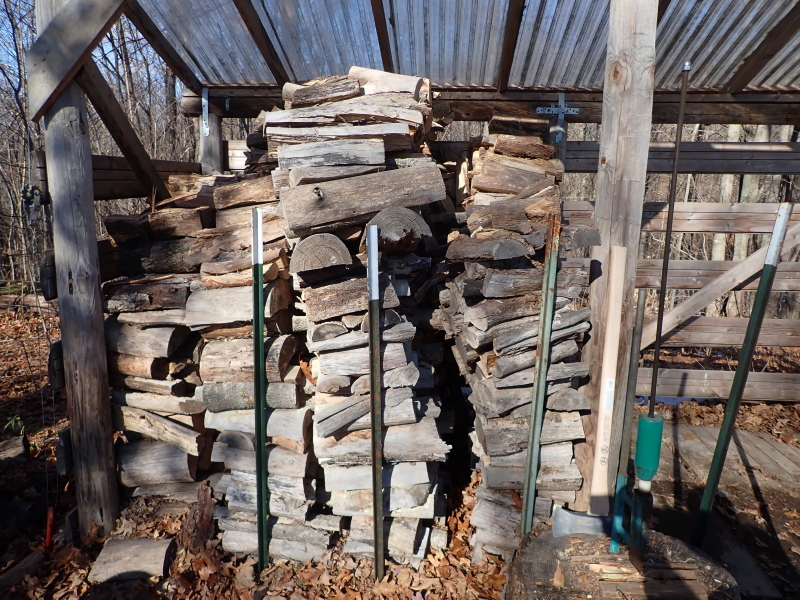
I used to strive to push the stacks back into balance before they tipped over, but now I accept they are going to lean. My odds of causing it to tip over the other direction by pushing it upright are high enough I have forced myself to get over being annoyed with how it looks and just leave it be.
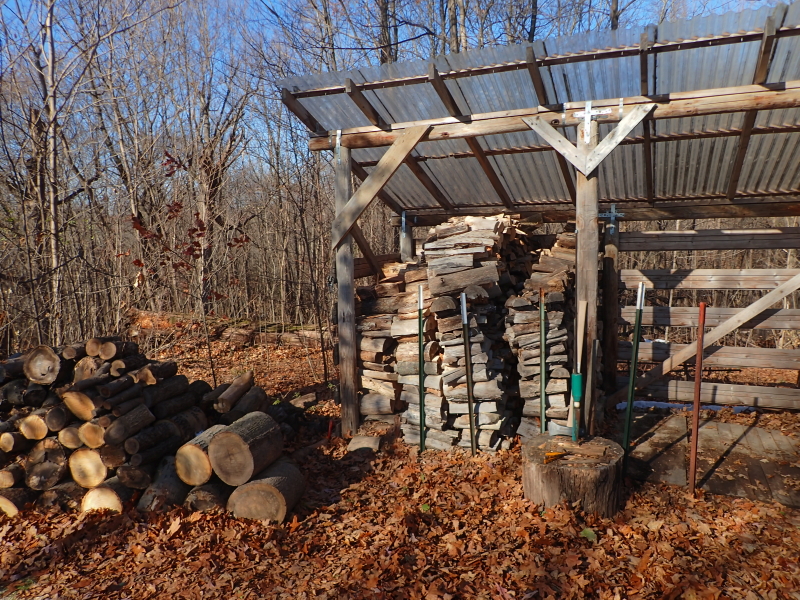 Yesterday, we moved half of a stack of the oldest logs onto the wood rack on our deck for premium proximity to the fireplace. It’s interesting to be handling wood that I stacked two years ago. In that amount of time, some impressive rodent nests get built, probably chipmunks. It would be reasonable to assume the critter activity in the stacks contributes to destabilization.
As I am splitting logs to refill the right side of the woodshed, it occurs to me that I could just toss them all into a big pile and forego the tippy stacks.
Why is that such a difficult decision for me?
- I believe it wastes less space to stack the wood tightly.
- I can better gauge how much firewood there is when it is stacked.
- I can easily tell how long each stack has been drying.
- Stacks appeal to my sense of order.
At the same time, I know from past experience how much we use per winter season, so the volume of a pile filling one half of the woodshed would give us two years. I could stuff a jumbled pile to fill the space to a greater extent than I achieve with individual stacks.
Since I already started a new stack on the right side of the shed yesterday, I’m now thinking about doing a bit of both. I could put down a base layer of individual stacks to cover the space on the right half and then switch to just tossing split pieces on top of those short stacks.
If only I can convince myself to follow through with such a random-looking storage choice.
It would be something of a “can’t beat ’em, join ’em” solution of intentionally tumbled drying firewood.
.
.
Happy Splitting
With additional flurries making their way across our region overnight, I didn’t waste time yesterday cleaning up the random inch or two of snow that had accumulated over the previous week. That will be today’s project.
Instead, I made my way back to the wood shed to put in some quality time splitting firewood.
Hoping to keep me from wandering off to some other more enticing opportunity, in case the splitting didn’t turn out to be rewarding enough, I decided to build a fire.
It helped to create an inviting atmosphere and an occasional distraction which enticed me stay on the task for most of the day. Working alone, my momentum wasn’t very consistent, so the day-long effort only produced a fraction of a day’s result, but it proved to be mentally rewarding.
Any progress is good progress.
Throughout the process of trying to make piles of logs disappear, it occurred to me how our focus changes depending upon what we are trying to achieve. When cutting limbs and branches of a fallen tree, the goal is to get the wood into manageable pieces, working at whatever angle is available. The focus is on not getting the saw pinched or having a limb fall on you.
When my focus shifts to splitting, I want logs with a flat, square cut that will stand nicely on the base of my splitter. It would be great if I had avoided leaving a joint right in the middle of the piece, too. When splitting, I quickly discover the cutting involved a very different focus.
The same thing happens when I’m plowing snow. In the winter, the goal is to get the snow removed from the driving surfaces. Sure a few rocks might get pushed into the grass. It just isn’t enough of a priority to matter that much.
In the summer, when we are trying to rake all the rocks out of the grass to facilitate mowing, the focus is very different. Suddenly I care a lot more about that detail.
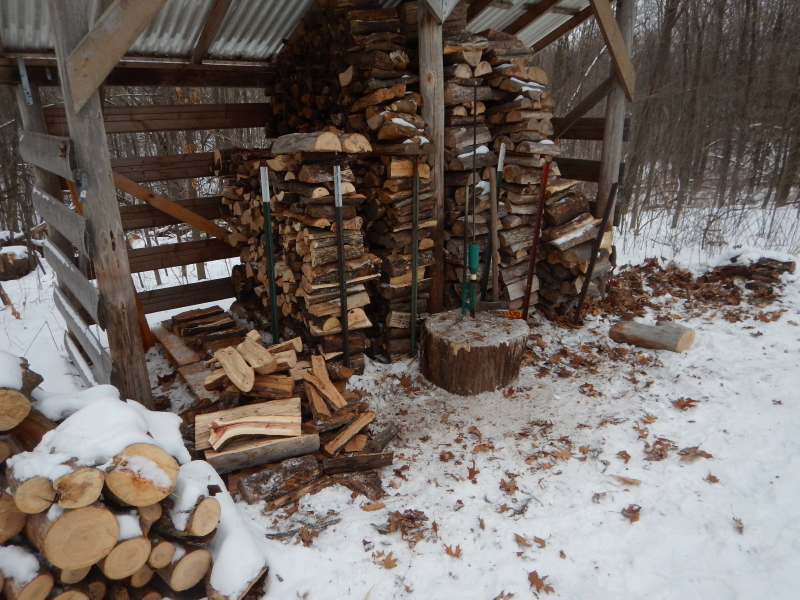 Similarly, when I am stacking wood in the wood shed, I just want to fill it to the top, grabbing whatever odd pieces are in reach and plopping them on the row. As the wood dries, it shrinks. The stack shifts. The wind blows. The stack leans. Eventually, the stack topples over into a messy jumble.
As I am re-stacking the firewood, I always question why I couldn’t take the time to split the logs cleanly so I could stack the pile sturdy enough to hold up.
Pay for it now, or pay for it later.
I wonder what I’m neglecting to appropriately pay for today, that will show up demanding collection later. Gosh, it’s almost like a life lesson.
.
.
New Parts
I decided to practice a little preventative maintenance on my log splitter and ordered spare parts before they completely failed. I had noticed that the nylon impact bushing was beginning to deform and one of the washers on the bottom spacer had already fractured.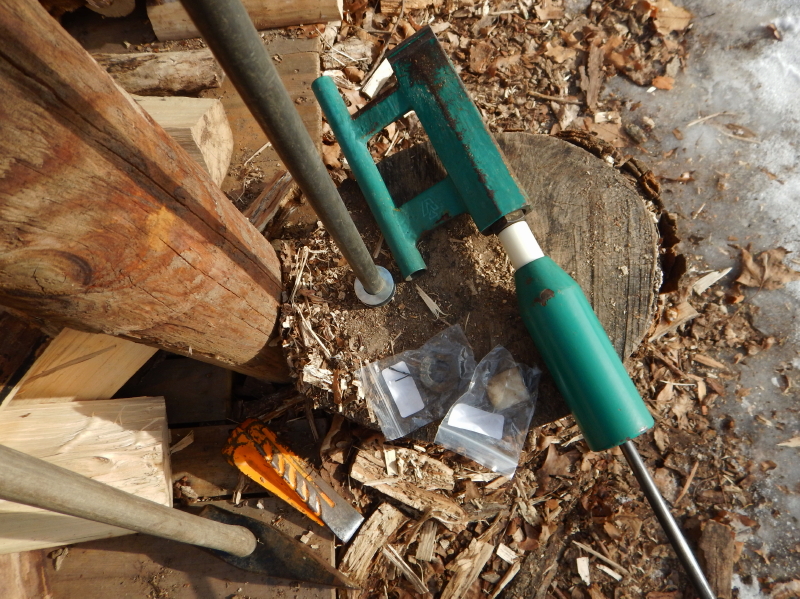
In a quick search, I found that both of these parts were readily available to extend the life of the product, so I made the buy. In this picture, I’ve already installed the new parts and bagged the old ones, which I’ll store in the off-hand chance of future unexpected failure.
I saw in the review comments for the parts that some folks had the impact bushing fracture. It has helped me to be more aware of how my use of the splitter stresses these parts. I am less driven to pound away on a log that is obviously not giving in to the idea of my wanting it to split.
The temperature was just about to climb above freezing when I started yesterday and the frozen wood was snapping apart with minimum effort. I was thinking I should get Cyndie to record a video to demonstrate how slick this tool is. I’m glad I didn’t, because no sooner than having that thought did my luck swing and the wood changed to stringier oak. I also came to a few Y-shaped pieces. These reveal the amazing strength at that junction which allows branches to support such incredible amounts of weight in big old trees.
You need to pick your angles carefully to convince the wood to separate at the junctions where branches Y off.
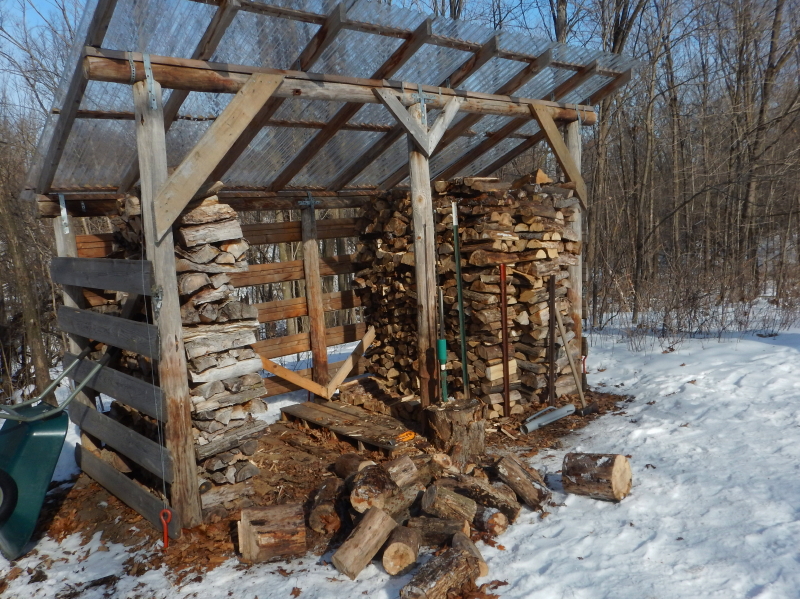
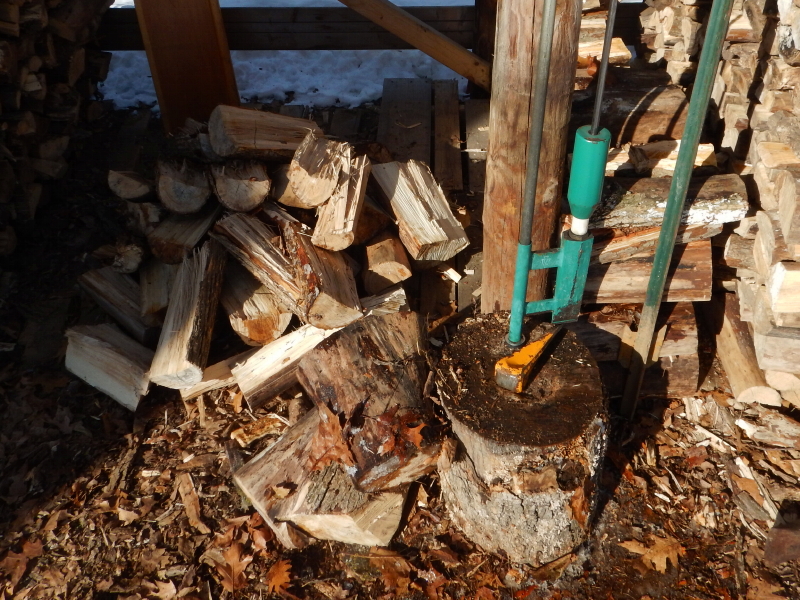
When a log is particularly resistant to the intrusion of the Smart Splitter wedge, I employ the added incentive of the orange twisting wedge and some pounding with the traditional splitting maul. It makes for a lot more effort, but I surprise myself by the eventual success I’ve been able to achieve in the face of some pieces that look like they would require the power of a machine.
 .
.
.
.
.
.
.
.
.
I had a nice session of progress, saving a couple of the bigger challenges for later, since my energy had declined as morning turned to afternoon and it was time for some lunch. Later, on my way to another task, I stopped to muscle the last two challenges.
I have incentive to get our current piles of wood split and stacked in the shed. This coming Thursday and Friday is our appointment for the tree trimmers to come cut high branches from our old trees. I’ve instructed them to focus solely on dropping branches that are out of my reach.
I will cut and split, or shred with the chipper, all the wood that comes to the ground so they don’t end up wasting any precious time (or our limited funds) on something I can do later. I think that cleanup project has the capacity to become an ongoing chore that will last me for the rest of the year.
.
.
.
.
.
.
.
.
.
.
.
.
.


 Relative Something