Posts Tagged ‘runoff’
Wintery Spring
After what seemed like an almost summery winter, we are now experiencing a very wintery spring. Did I mention the meteorologists were referring to this storm as a long-duration event? It rained hard almost the whole night before turning to snow again yesterday morning.
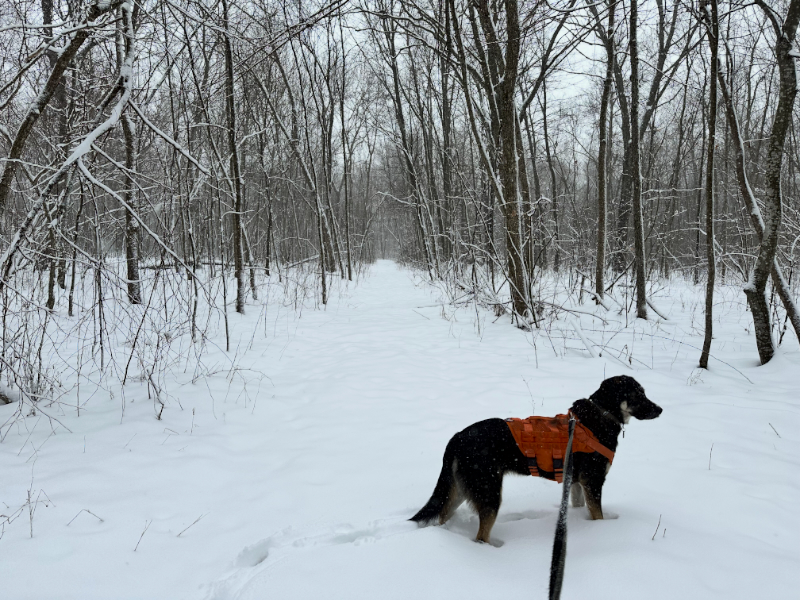
Now on top of the inch or two of standing water that was covered by about 7 inches of saturated snow, we were receiving oodles of new, dryer snow. It made for some really laborious trudging while accompanying Asher on one of his daily rounds.
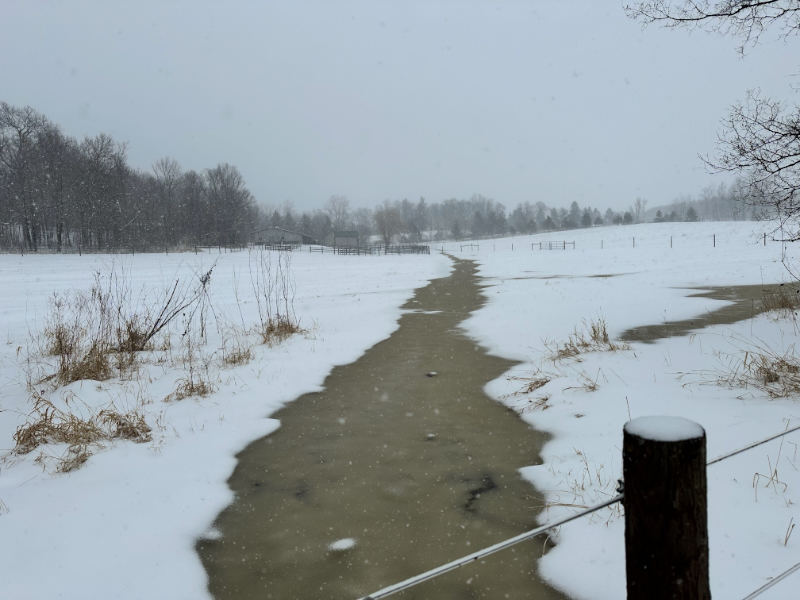
The drainage swale that cuts across our back pasture was clearly visible as the rainwater made its way from the fields to enter the creeks that run to the rivers that eventually make their way to the mighty Mississippi for the journey to the Gulf of Mexico. It’s all downhill from here.

When I took these pictures, I was standing on the footbridge I built that allows for ease of travel across the spot where our swale meets the ditch along the south border of our property. That ditch was filled with more flowing water than I have seen in a very long time.

It is dry 98% of the time. It channels runoff during spring melts and occasional flash-flooding rain storms.
As Asher and I reached the far corner of our property on the trail we call the North Loop, a bald eagle swooped up out of the field as if we’d disturbed it from some activity. The very top of the tallest pine tree in our neighbor’s front yard became the eagles’ perch.

If there was a carcass the beautiful bird had been involved with, I didn’t want Asher to find it so we trudged onward to finish the property border walk and get back to the safe confines of the house. The conditions outside were teetering uncomfortably close to the category of being unfit for man or beast.
I’m looking forward to the end of this long-overdue smattering of winter so we can return to some much more spring-like conditions. We’ve certainly got a good head start on “April showers.”
.
.
Home Happy
I’m still thoroughly enjoying being home again but last night’s dinner of grilled pork chops left over from one of our fantastic meals up at the lake gave me a moment of hesitation as I mentally revisited the greatness of those days.
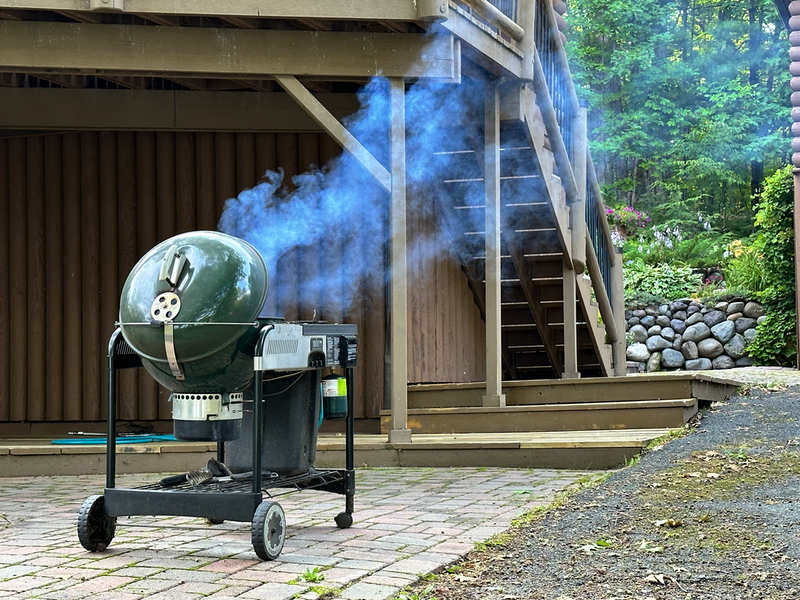
It’s a rough comparison since my day yesterday was spent sweating over pulling weeds, running the power trimmer, and mowing grass in the tropical heat wave of the hottest July on record. Who wouldn’t prefer to be back up at the lake?
Well, I’m pretty happy being able to sleep in our usual bed with the conveniences of a bedside table. I really like our shower. I’m spoiled by how much room there is, allowing for soaping up just beyond the spray of water. My regular routine of charging my phone and laptop works best with my home setup.
I like having the manure compost under daily control. Once every week or week and a half is just too much work all at once to get piles cooking efficiently again. Getting grass mowed before it gets too long is also a preference.
 .
.
.
.
.
.
.
.
.
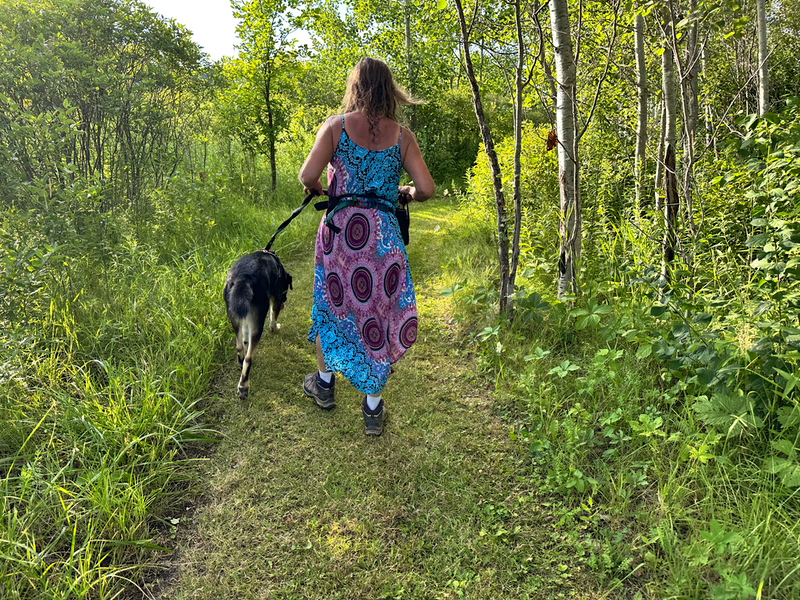
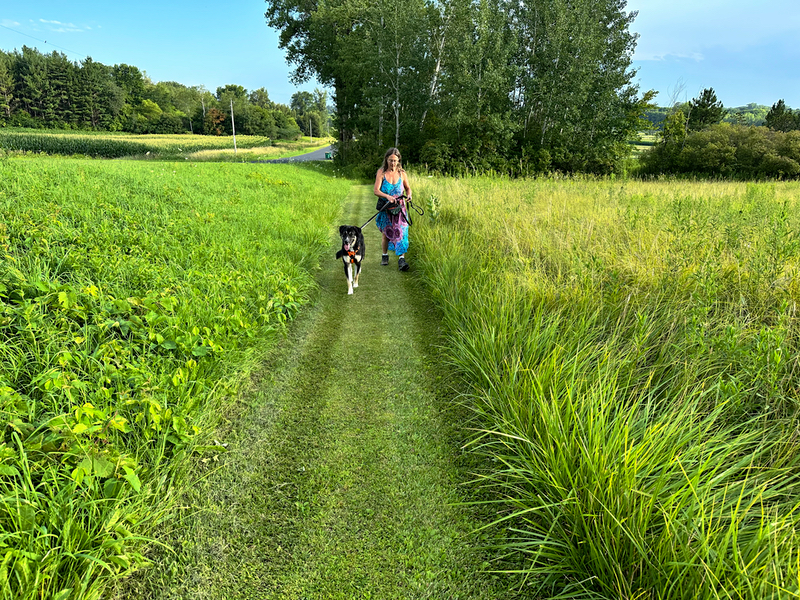
After dinner, we walked the trash and recycle bins down to the road with Asher at our sides, making it back with time to spare before the first wave of thunderstorms arrived overhead. That weather came in with an ominous-looking cloud line and a dramatic burst of tree-bending wind.
The brief duration of the heavy downpour was a bit anti-climatic when that ended up being all that happened.
Not that I was looking for weather trouble. Quite the contrary. We already have the makings of a small canyon in the paddocks where draining rainfall has washed away the lime screenings into the main drainage swale. The battle against gravity and moving water is never ending in my quest to best manage runoff.
I’m afraid it’s time to extricate the back blade from the depths of the shop garage for attaching to the diesel tractor to scrape gravel back “upstream.” I was relatively successful the last time I tried doing that but the exercise remains on the fringe of skills I have acquired on the big tractor. It always feels like I am on the verge of making things a lot worse instead of better.
Regardless, we are home and that is making me as happy as it always does.
.
.
Snow Coming
I’m usually grateful to have advanced notice of coming weather, but sometimes I don’t like knowing we are about to receive large amounts of heavy, wet snow in April.
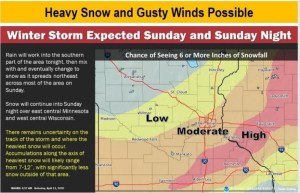
The snow is predicted to come in a narrow band, so it could shift a little, but we are located perilously close to the highest risk of seeing 6 or more inches of snowfall. Look to the right of the letter “e” in the word Moderate, just above Red Wing. Oh, joy.
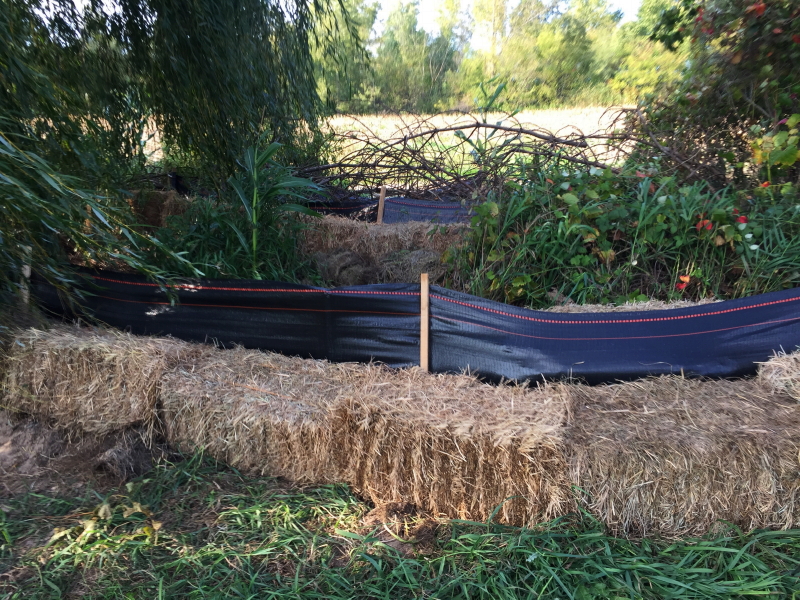
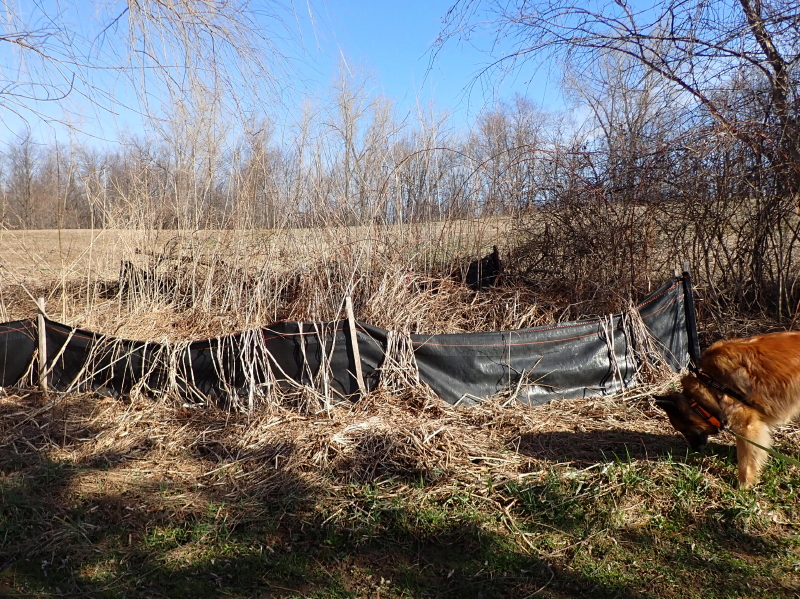
I spent yesterday tinkering with the slowly developing berm we are constructing at the edge of our property where the neighboring cultivated farm field drains onto our land. It’s been 2-and-a-half years since we installed the latest version of erosion fencing and much of that has filled with so much topsoil the fabric is laying almost flat in some places.
Granted, the following photos were taken at different seasons, late summer vs. early spring, but the difference is rather striking.
 .
.
.
.
.
.
.
.
.
The bales obviously disintegrate. Progress that may not be evident can be found in the number of volunteer plants that have taken root and naturally help to hold soil in place. The thing is, though, that helps to hold our soil from eroding, but we still get large flows of the neighbor’s topsoil washing over our property.
If I can get the berm established enough to pool his runoff, it will serve as a natural replacement for the Polypropylene fabric and, most important to my sensibilities, be a less unsightly barrier.
I have found the use of gnarly dead branches that are too big for my chipper makes for great starter material in establishing a natural barrier. The highly fertilized runoff tends to fuel thick growth of tall grasses that ultimately create a tangled wall of live plants weaving through dead wood.
Looks like I’ll have a fresh opportunity Monday to see how my latest upgrade to the barrier yesterday will impact the drainage of many inches of melting snow.
Wouldn’t you know it, I changed the tires on the ATV yesterday to swap out the aggressive treaded winter tires for plowing snow, with the smoother treads of summer tires that are kinder to our land.
I could be in for a complex day tomorrow of clearing heavy, wet snow that will be a big problem for a day or two, and then melt. Then we can get on with spring, which is on the verge of swiftly getting sprung.
.
.
Makin’ Mud
When the snow disappeared from the ground in our hayfield, the ruts from the tractor that had picked up the round bails during winter became clearly visible. Those tire tracks weren’t a concern for me until I could see the drainage swale water was following them instead of flowing straight in the direction we want.
Then I had an “aha moment.”
If the water was following tire tracks, I just needed to make some new tracks.
I decided to try using the ATV. Knowing it wasn’t as heavy as a big tractor, I accepted the chance it might not make the impressions I wanted, but it was safer than bringing out the diesel and getting it stuck in the mud. The surface is already too soft to be in the field with the big tractor.
With the plow blade still on the front, I added cement pavers to the basket on the back for added weight and headed into the field. Back and forth I drove, working to re-establish the track we want the water to follow.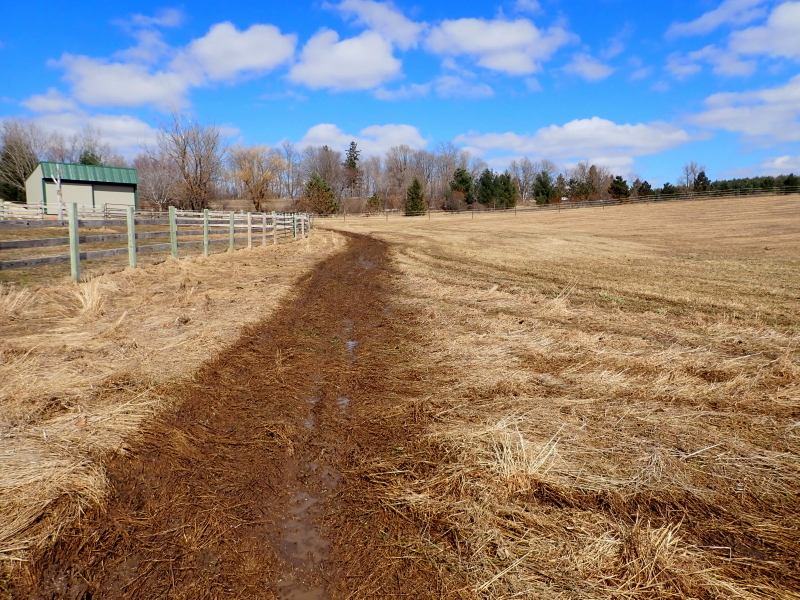
The ATV, plow blade, and I got splattered with mud, even though the path was grass-covered, but I think I succeeded in creating a new preferred route to the curving ruts left by the hay bale tractor.
Now we just wait for the next dose of precipitation to see it work.
.
.
Serious Soaking
First, I want to share an image that I received from Cyndie yesterday morning after she read my post. Exhibit A:
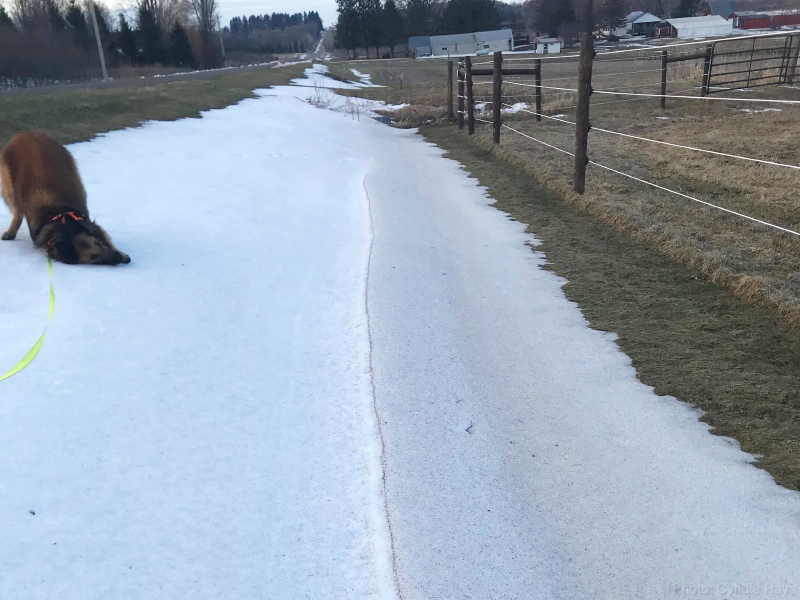
She had forgotten to send it earlier, but my description of how Delilah loves rubbing her snout in the snow reminded her.
Just as I predicted, there is very little snow left now. It was very gloomy all day, and rained throughout, but being mostly chained to my desk, I didn’t really notice how much rain actually fell. All I had to go on for what was happening across the state line at home, was the weather radar.
My main concern was over how the thunder might be upsetting Delilah. I wasn’t sure about what hours she might have the company of Anna, our animal sitter who helps out between classes at University of Wisconsin – River Falls. It’s hard to pinpoint the minutes of big thunder claps booming.
I did find the telltale evidence of a throw rug at the deck door pushed up into a pile, indicative of her usual tizzy of “shouting” down the big bully who is threatening us with all that rumbling noise.
From her location and behavior when I walked in the door, I’m guessing she tired of the stormy weather and took refuge in the one place without windows. She didn’t get up until after I walked in –an uncharacteristic behavior– from the rug in a short hallway between bathroom and bedrooms, where she had obviously been sleeping.
The situation at home turned out to be an anti-climax to the alarming sights I witnessed on my drive after passing through River Falls. The whole way from work was wet, but closer to home there must have been an extreme downpour.
Just south of River Falls, I spotted the first epic flooding, where it was pouring over a side road, making it impassable. A short distance later, I noticed a car turning around on an adjoining County road. As my car moved past the intersection, I saw that a highway crew was trying to deal with a missing lane of asphalt that had washed away.
Five miles from home, I cross what is usually a little meandering stream, but the outlines of the banks were completely indistinguishable beneath what was now a giant flowing lake.
The water flowing in ditches looked like raging rivers. I worried about what I might find at home.
Luckily, although there was an abnormal about of water wherever I looked, the damage was minimal.
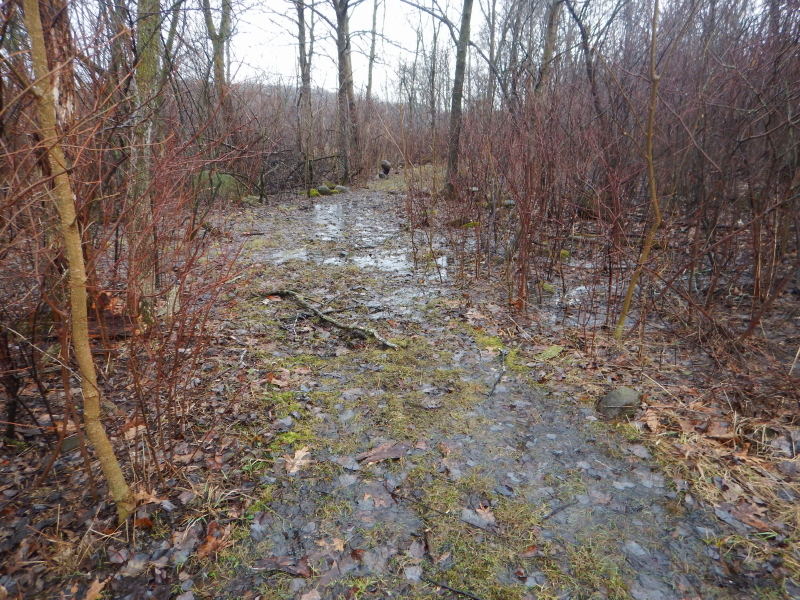

We now have a pretty significant washout on the path around the back pasture. I’m afraid I will need to resort to a bridge over that gully now, if I want to keep mowing that route with the lawn tractor.
It used to be a slight depression that I could drop into and drive up out of, to keep mowing without interruption. Any attempt to repair the gulf with fill, so I could continue to drive over it, would just get washed away with the next heavy rain.
That spot is calling for a load of field rocks, which then leads me to the plan of needing a bridge for the lawn mower.
Our land is in a constant state of change. I think the rate of change is accelerating due to a certain alteration of the global climate.
It’s intimidating.
.
.
Not Surprising
I received another weather warning on my phone last night. This time, it wasn’t about another round of plowable snow, but it comes as no surprise that they’ve issued a flood watch for our county. So, it’s out of the frying pan snow machine and into the fire hip waders for us this week.
Oh, joy.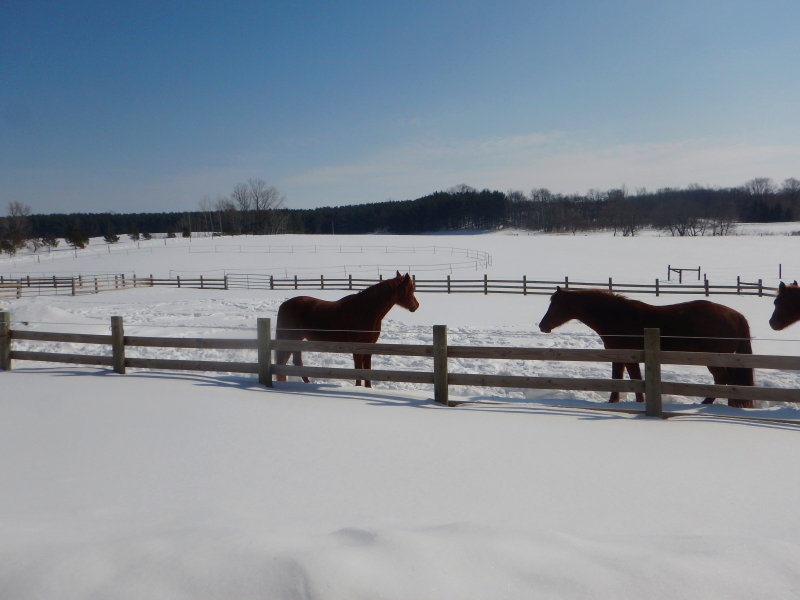
We’ve got so much snow that our 3-board fence looks short enough in some spots that the horses could high-step their way over it. I think the only thing dissuading them from trying is the deepness of the snow on the other side.
We are due to get significant rain tomorrow and Thursday, without anywhere for it to soak in. There are bound to be a number of new rivers and lakes formed in the days ahead.
We’ll probably have the horses in the barn while it is raining, and the chickens will be given the option of venturing out at their own peril, but I’m not confident either of their structures will stay dry.
At least the coop is on stilts. The wood is shrunk from the dry winter air, so there are some gaps in places, I suspect, but it swells up nicely when it gets wet, so that just leaves drips from a few leaky screws in the roof panels.
The barn, on the other hand, is already suffering from areas that were once standing water that subsequently froze and rendered the two big sliding doors inoperable. More water on top of the old ice will not only make that situation worse, it will inevitably start flowing toward the lower ground available inside.
Thank goodness our house is at the top of a hill.
It is not surprising that they chose this spot on which to build.
.
.
Flowing Water
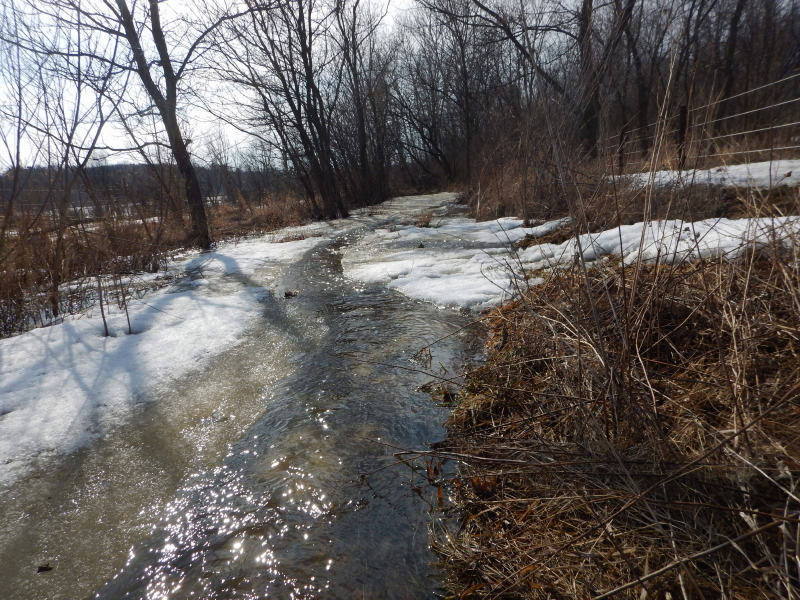
Our drainage swales are finally flowing!

 .
.
.
.
.
.
.
.
.
The largest ditch along our southern border was a babbling brook yesterday.
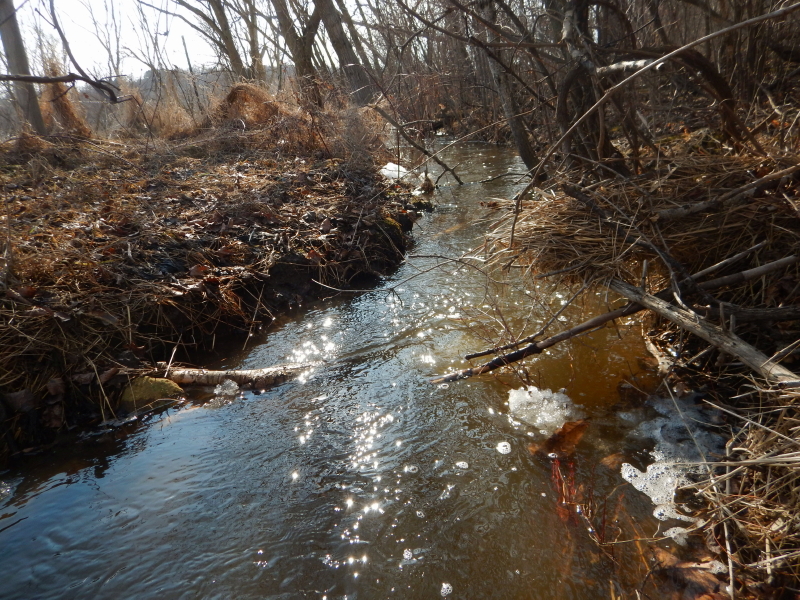
Eventually, the ditch narrows and meanders away from our property, wandering its way through our neighbor’s cow pasture.
The snow is leaving, and it will travel to rivers that travel to the Mississippi that flows to the Gulf of Mexico.
B’ bye.
.
.
First Version
Over the weekend, I completed a first version of the stick-fence backdrop for Cyndie’s perennial garden. The most significant accomplishment was that the thing didn’t completely collapse while I was working on it. It feels as if the whole construct is like a layout of dominoes that will fail in a spectacular cascade when any particular weak point happens to give out.
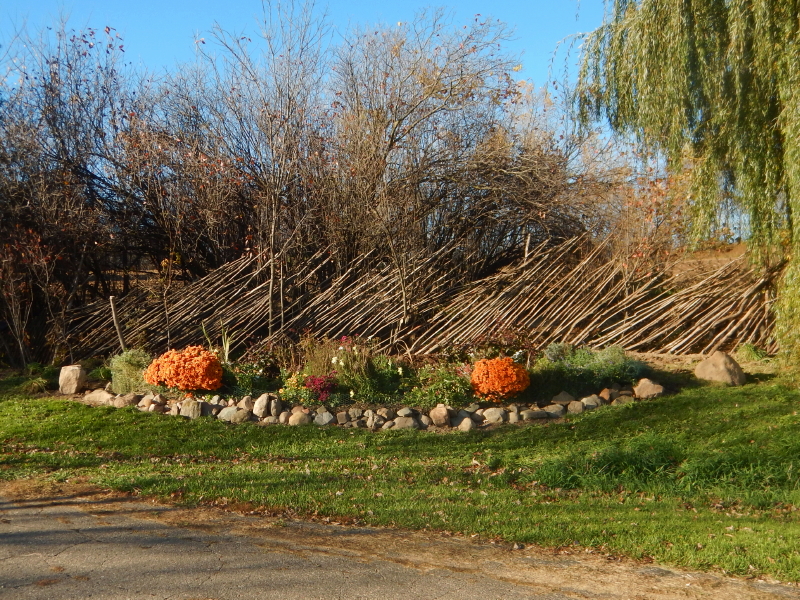
That leaves me a little timid about going back and trying to remedy some of the hollow spots that were a result of my trying to utilize existing trees for support every few yards. They complicated the simple weave I was otherwise employing.
Part if me wants the random imperfections, and part of me wants to see more consistent lines. I think the imperfections will win out, because that will allow me to do nothing more with it, accepting it as is.
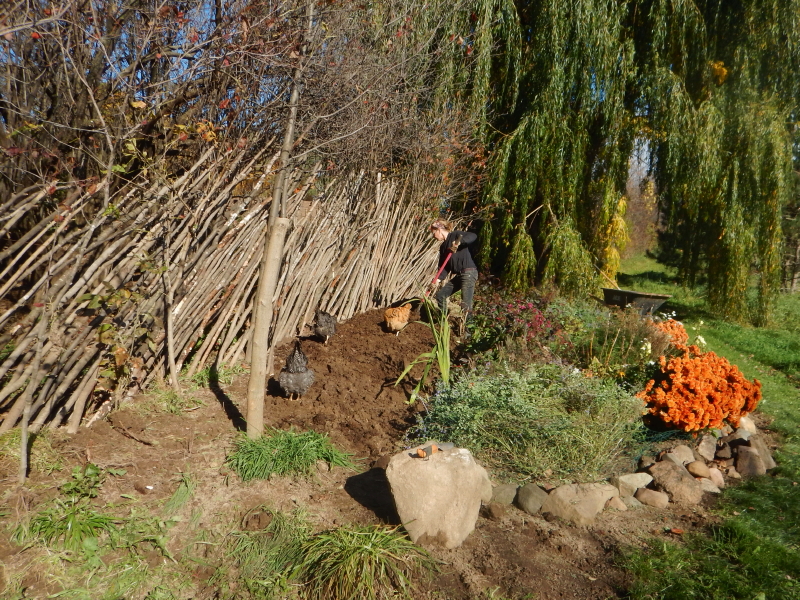 Sounds like it will get a workout in the wind today, with gusts possible in the 40mph range. That should be a worthy test of the weak points.
With this phase done, Cyndie was able to begin redistributing the plants that have been smooshed up against each other all summer after the big mudslide from the neighbor’s cornfield last spring.
She made me laugh yesterday when she dug up a huge mass of something that looked like a tall grass and then wondered aloud about whether it was a “weed” or something she intentionally planted a couple of years ago.
We are into the second version of the garden now, while I am hoping a second version of the backdrop fence won’t be required for a very long time.
.
.
Triple Fenced
The heat and humidity have broken and it finally feels a little more like September now. We were expecting the transition to involve a lot more rain than showed up yesterday. The line of precipitation slowly moving west is doing so at an angle that is sliding from the southwest to the northeast and for some reason, most of the rain moved around, rather than over our region.
Ironically, now I am wishing we would actually receive a heavy dose of rain, because last Friday we put a lot of energy into shoring up the silt fence at the property line adjacent to our neighbor’s corn field. In fact, we turned it into a bit of a terrace with three-tiered layers of silt fence.
The first two are short sections to slow the flow before it reaches our long fence. Between the top two sections there is the skeleton frame for a berm, in the form of piled dead pine trees. The soil runoff will accumulate around the branches and hold them in place. Eventually, weeds and grasses will grow through the branches and that forms a nice natural barrier that will hold soil in place but allow water to flow.
We have added support to the fabric fence by using old hay bales that we can’t feed to the horses because they have gotten moldy.
If I am able, I hope to trek out there in the middle of heavy rain to observe the action as it happens. At the very least, I now know that we need to check it after every big rainfall and remove excess soil if it accumulates.
I don’t know why I originally assumed the soil fence wouldn’t need regular maintenance, but after the soil conservation consultant pointed it out so very matter-of-factly, digging out accumulation makes total sense to me now.
If our enhancements work to mitigate the mud overflow messing up that area, we will be one step closer to being able to enjoy a good cloudburst when it happens. There still remains a problem in the paddocks, where a terrace or silt fence is not an option.
We plan to do some digging to create a couple of better defined routes directing runoff straight to the drainage swale beyond the wood fence, hoping to reduce the amount of flow traveling to one spot with energy that washes away our precious lime screenings and creates a deep canyon of a rill.
It’s fine if a little flow goes that way, but it is currently a problem because most all of the flow is combining to rush sideways along the fence, instead of straight under it out of the paddock.
The trick in the paddocks is, our solution needs to be horse-proof. Their heavy hooves have a way of disrupting all of the simple spade-width channels I’ve created in the past, causing runoff to flow every which way, and ultimately not where we really want it to go.
The next version we have in mind will be scaled up. Maybe I should triple-size it.
.
.
Making Peace
It is getting to a point where I think I just need to make peace with the fact that water runoff on our property will carve its own path no matter what feeble attempts I make to direct it.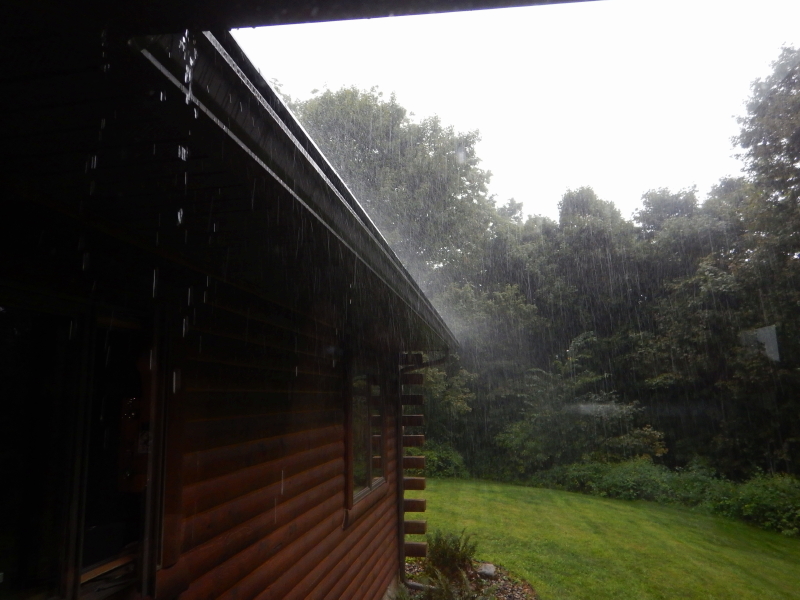
We received another short-but-robust deluge from the rain gods yesterday afternoon, which generated eroding runoff flow digging ever deeper into all the existing rills and washouts that had already evolved from the last few downpours this summer.
While standing on one of the spots inside the small paddock where our insufficient attempts to establish a direct route to the drainage swale had long ago spectacularly failed, I tried to envision what a successful solution might look like.
I picture a much more assertive effort along the lines of what you would see done to create a drainage ditch along a roadway. If we dig an unmistakable ditch, we could dump the material we scoop out of it to fill the washouts we’d rather not have.
The big challenge with a serious excavation is getting planted grass to sprout and hopefully hold soil in place before rainfall gets a chance to wash it all away. If money were no object, maybe we could line the ditch with enough river rock to form a creek bed.
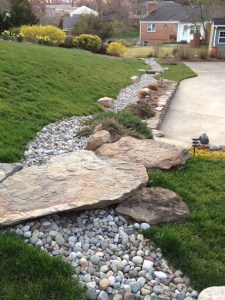 Aw, heck, why stop there? Let’s just line it with a rubber pond skin first, and then pour on the rock. Wouldn’t that make a sharp-looking dry creek that’s always ready for a flash flood. It’s called Rainscaping.
There are a lot of images out there depicting some incredibly artistic solutions along these lines. Fifty dry creek ideas right here! But there is one thing missing from all photos I saw: weeds.
If we tried any of those solutions, in a very short time, you wouldn’t be able to see the beautiful rocks through the 3-foot tall weeds that would happily take root.
Maybe there’s a happy medium in there somewhere. I’m thinking I need grass to grow to hold soil in place, or rocks. How about grass and rocks?
It would be a hassle to mow, though.
Back to reality. The rocks to cover the distances I need would be an awful strenuous effort to accomplish, in addition to the cost of having them delivered. Grass seed is something I can afford and plant easily myself.
It doesn’t cost anything to dream. I like picturing the possibilities. In the mean time, I am stuck looking at the ongoing and frustrating erosion that has had the better of me for the last five years.
I want to work on making my peace with that.
.
.
.
.
.
.
.
.
.
.
.
.


 Relative Something