Posts Tagged ‘repair’
Pickling Around
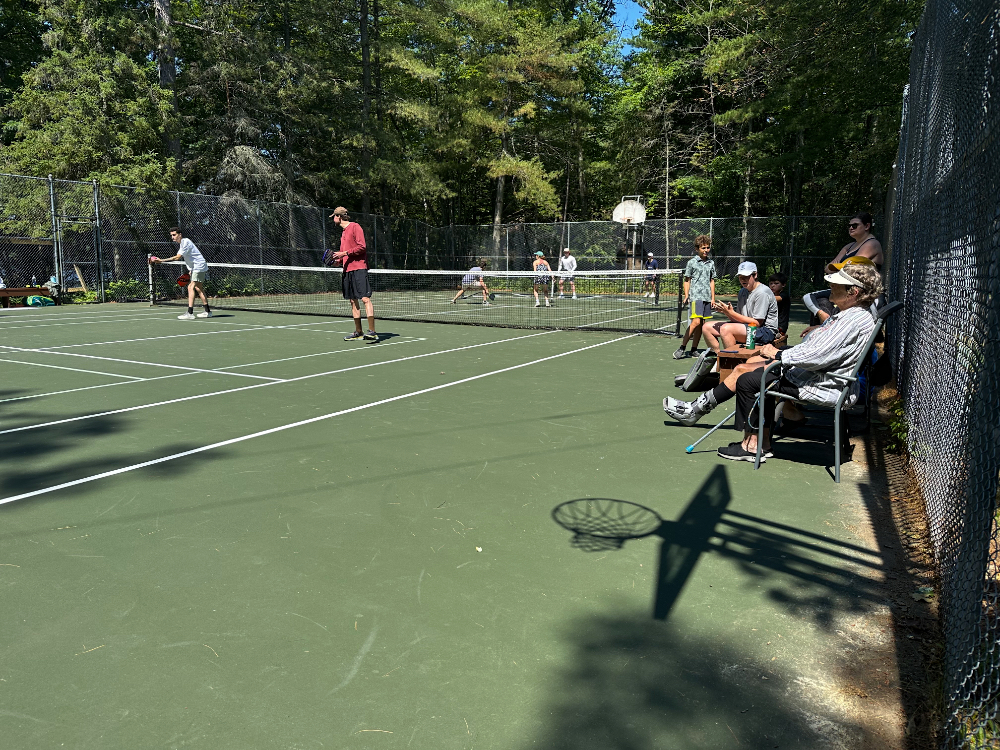
Opting to remain at rest since my body was already at rest when yesterday’s post-4th-of-July pickleball tournament was held, I wandered down to observe as a spectator after the competition was already underway.

They achieved a good number of participants who did an impressive job of keeping games close, providing plenty of entertainment for the gathered crowd, made up mostly of other players waiting for their next game.
After I’d witnessed at least one game by most of the teams, I made my way back to the house by way of the beach, where I paused to hang for a bit while Cyndie, Elysa, and Ande were floating on or soaking in the lake. After so many days away from home, I’m finally getting the hang of doing nothing without needing to convince myself I can get away with it.
In fact, it feels a little daunting to contemplate revving my energy up again to tackle all the projects that will be awaiting me back at Wintervale. We expect to be on the road before noon today for the drive south to Pierce County, where we will find the hay field has been cut and baled, and the lawn grass about two weeks tall.
Yesterday afternoon, I took on a challenge I’ve been skipping over for a long time. I keep an old floor pump for inflating bike tires up at the lake place, ever since I bought a nicer one to replace it at home. The thing is, the old one leaks air on every stroke. One of the reasons I haven’t dealt with it is that I couldn’t easily deduce where the problem was, nor how to get the lower pieces apart to get a look at what was wrong.
Finally, yesterday I was prepared to give it a go. First off, I did some research to see if I could find an exploded view or service information on this old model. I could not. I surfed through a few YouTube videos, but didn’t find any answers there. I did find some replacement parts that looked identical to my model, but nothing that revealed how it came apart.
I tried pulling with increasing force, but wasn’t making any progress. Then, I had a lightbulb moment of insight. One of the replacement parts I had seen included a hose. I searched for that image again and zoomed in. The end of the tubing had a threaded fitting on it. That was the secret. I needed to find a pliers because the rubber boot over the mating part did not budge against my finger strength. Knowing it should turn allowed me to grab it using pliers with much more confidence.
It came loose easily. All the subsequent connections unthreaded with ease as well. The broken gasket at the bottom junction became glaringly obvious.
I felt pride in having used my mechanical sense and a good dose of patience to work out the problem without breaking something in the process. It just took a little pickling around with the parts before I eventually reached the desired result.
I’m taking the ripped gasket home with me to see if I can find a suitable replacement. If not, it will be time to make one myself, probably by cutting up a discarded inner tube. Wish me luck.
.
.
Returning Again
This saga continues… The replacement rainfly that I was so excited about receiving from The North Face warranty department last year needs to be returned for the same reason I sent back the original rainfly. The seam sealing tape is coming loose.
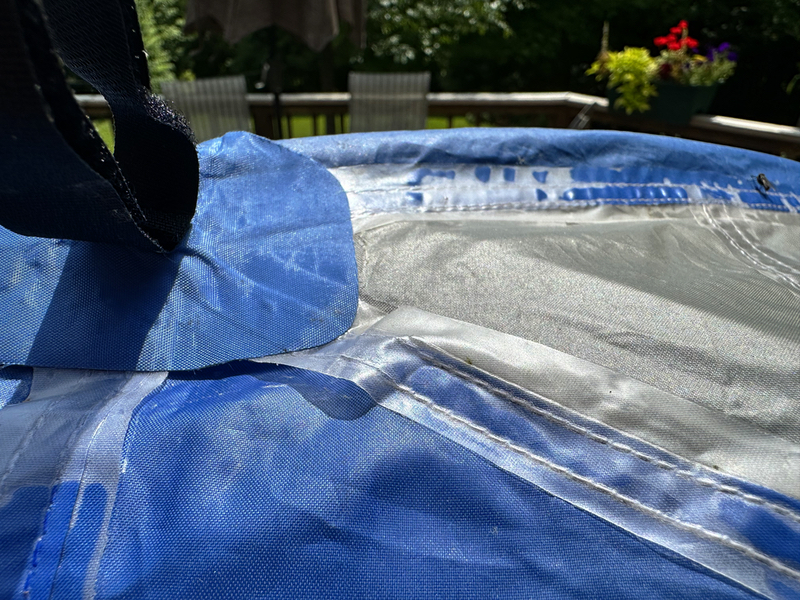
I used the rainfly for just one week while on the Tour of Minnesota trip in June and discovered a few drips as proof that it leaks.
Not wanting to deal with shipping the rainfly back to face unknown odds of their ability to solve the problem, I pulled it out of storage yesterday to assess how bad the delamination really is. Would it be possible to buy some sealer and brush it on the seams myself?
It didn’t take long to decide I wasn’t up for the challenge. There are just too many places where the original tape has lost contact with the fabric. Also, I’m not certain which version of a seam sealer would match the fabric. Urethane or silicone?
The label on the rainfly says- Fly: 100% Polyester, Canopy: 100% Nylon. Huh? Canopy? I have no idea how to interpret this information.
I sent an email to The North Face warranty department seeking advice, even though it was after hours there. What did I have to lose?
That company impressed me once again. I received a reply 14 minutes later, at 6:12 p.m. from their Customer Care Team. They reminded me that items must be returned for assessment and provided a label for shipping.
I don’t know if they will be able to help me or not since my tent is obsolete, but I’m impressed enough with The North Face to give them another try. It’s my guess that the replacement rainfly they sent me was on a shelf somewhere for nearly as long as I’ve owned this tent. Even though it hadn’t been subject to harsh weather, time alone was tough enough on the materials they use to degrade the adhesive of the sealing tape.
Since the tent is obsolete, I doubt they have any fresh versions of this rainfly laying around in their warehouse. And since they didn’t see fit to reapply seam sealant to the original rainfly I returned, I am suspicious about the likelihood of them deciding to do so on this one.
I’ll give them another chance, just in case I’m wrong. It buys me more time to kick and scream against solving my problems by simply purchasing a new tent that was manufactured in this century.
.
.
Ghost Leaves
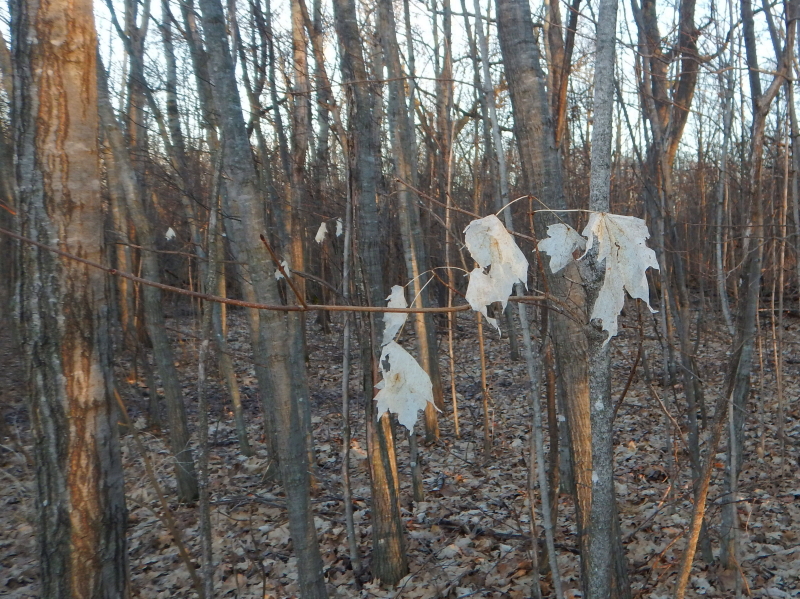
On a walk through the woods with Delilah yesterday morning, my attention was grabbed by some disintegrating leaves that never fell from the tree. They looked like ghosts of leaves.
 .
.
.
.
.
.
.
.
.
Why did they not fall to the ground?
Especially in the face of some wind gusts that were strong enough to break loose a roof panel on our wood shed. Yesterday, there was dead calm in the morning, so I took advantage of the perfect weather to work on replacing the busted section.
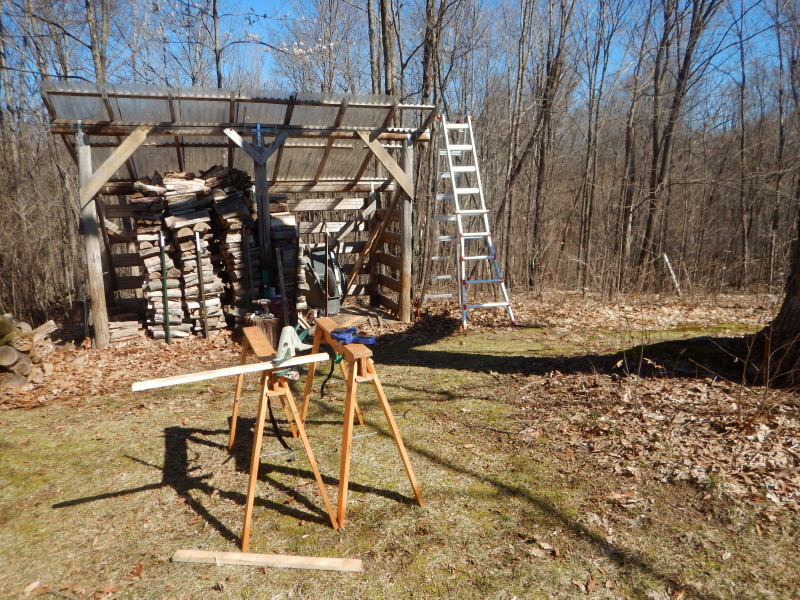
Learning from experience, I added some cross supports that will better hold the overhanging side from flexing, should future winds blow from that same direction.
That simple structure, built to store split logs while they dry for a year, has provided multiple lessons from failure.
When it blew over in a storm, I figured out a way to secure it to the ground by stringing some old fence wire over the cross beams and running it through the eye of earth anchor augers in three strategic locations.
With the help of my friend, Mike Wilkus, who came to my rescue when re-assembling the shed after it had overturned, I learned how to improve the diagonal bracing to stabilize the overall structure.
It leaves me wondering what the next failure will be that might teach me yet another lesson in the great world of being an amateur builder.
.
.
Fortuitous Failure
The plan was to get one load of gravel, one load of sand for the round pen, and two loads of lime screenings —one to spread around in the paddock, and one to keep as backup to fill washouts as they occur. In order to receive all these deliveries in the time while weather is good for doing so, we plotted out the order and location for dumping the piles.
The primary concern was to avoid having the heavy truck drive into the paddock, because the previous time we allowed that, it led to problems from the extreme compression straining buried electric fence wires between gate posts. I was also concerned about collapsing the buried drain tube we had installed from the barn gutter downspout.
The truck driver always seems more than willing to drive anywhere, leaving the responsibility on us to restrain the choices in protection of property. He long ago demonstrated complete disdain for the well-being of our asphalt driveway.
By my figuring, if we got gravel first and spread it out before the next delivery, the truck could drive on the new gravel and dump the lime screenings at the entrance of the paddock. I would spread them inside the paddock. The sand could then get dumped beside the barn, where I could move it by loader scoops, driving over the new lime screenings through the paddock to the round pen.
That would be a lot of tractor hours, but it was worth it to me to protect the paddock from the heavy truck.
Then Cyndie received word that they currently had no stock of lime screenings. The driver delivered gravel on Thursday with a plan to bring the sand on Friday morning. I had a short window of time after work on Thursday to spread the gravel, so he could drop the pile of sand the following morning in the spot where we wanted it.
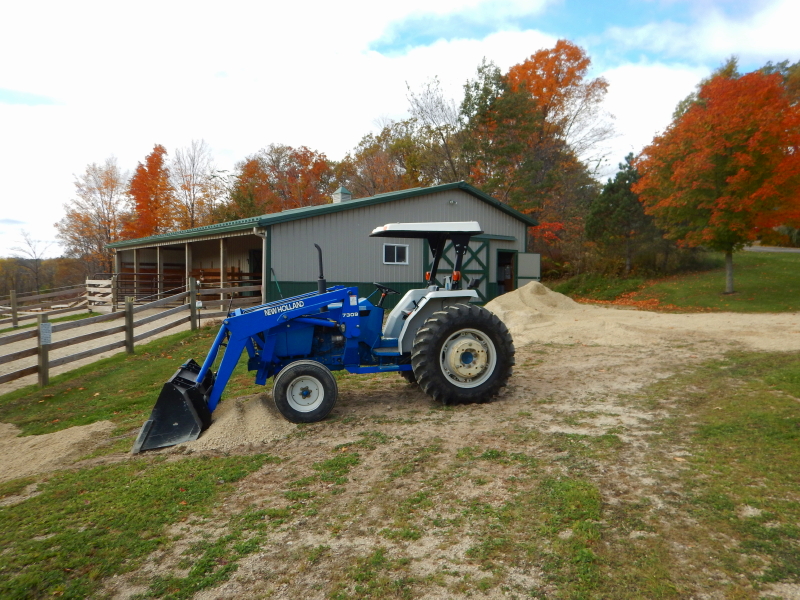 In the middle of that task, as I tried to back up in order to spread the scoop of gravel I just dropped, the tractor lurched forward. I shifted again. This time it wouldn’t go backward, or forward. Tractor fail!
That wasn’t in my plan.
I struggled to remove a cover plate to see the mechanism of the gear shift lever. That didn’t help much, because even though I could then see it, I didn’t actually understand what I was looking at.
The options rattled through my mind. Call my very knowledgeable neighbor? It was getting late. Call the implement dealer? That would have to wait until morning. What about the sand delivery? Where would I put that?
Well, this failure caused me to rethink the possibilities and opened up a new willingness to have the truck drive through the hay-field. He would only need to pass through gates in which there was enough turf to limit the compression that happens from the weight of the load.
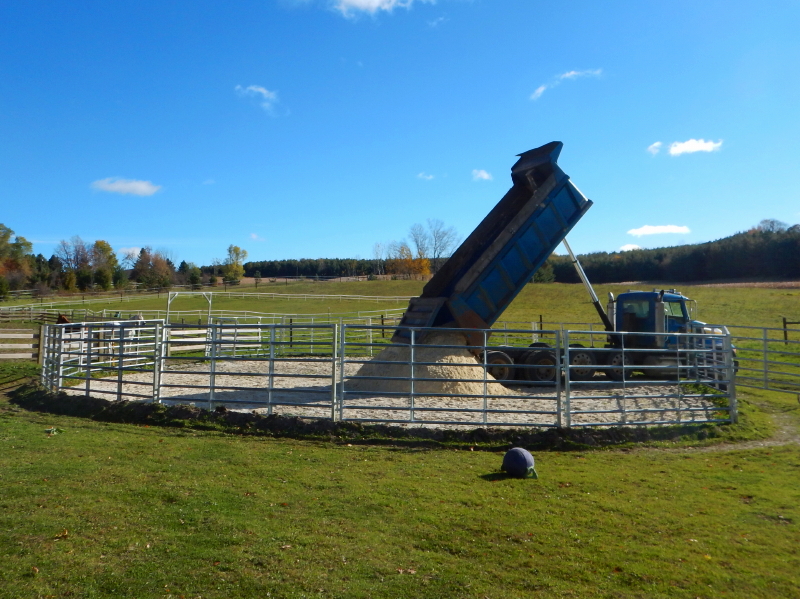 In the end, I have a new appreciation for the inconvenience of that shifting failure, because it has saved me a lot of work. The dump truck placed the sand in the center of the round pen. The hay-field held up well under the load, but the driveway has some new wrinkles where he made the turn on and off it.
The service man from the implement dealer made short work of the tractor repair by afternoon, replacing a pin and snap ring at the base of the shift lever, and I finished spreading the gravel.
That shifting failure is one I will remember fondly for the better outcome that came as a result.
There may be a life lesson available in all this.
Ya think?!
.
.
.
.
.
.
.
.
.
.
.


 Relative Something