Posts Tagged ‘pine trees’
Wondering If
While trimming the remaining grass around all the pine trees over the weekend, three things triggered a new hypothesis about our ongoing loss of red pines. I’m wondering if it might have something to do with girdling from the trees being root bound.
I did some searching to see if being root bound might contribute to the way so many of our red pines are coming out of the ground at about a 45° angle before eventually turning to grow straight up, but didn’t find any hint of that connection.

 .
.
.
.
.
.
.
.
.
Then, while writing to describe my latest discoveries to our regional DNR Forester, it struck me that the eighteen inches of heavy, wet snow that fell in May of 2013 tipped many of our trees, but not all of them. In fact, mainly the red pines leaned over. If they were planted without proper attention to the roots, well, a root bound tree would have a hard time standing straight under that kind of load in the wet ground.
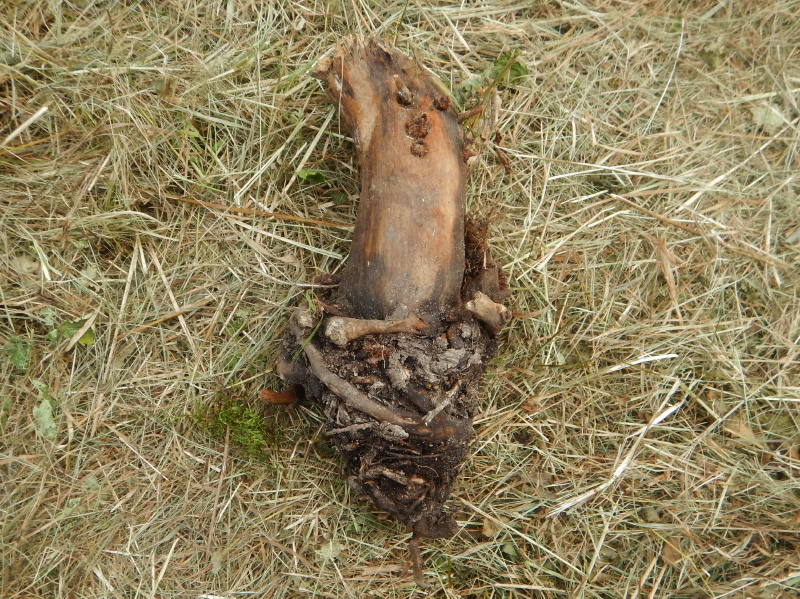
While laboring to walk through the cut growth with the power trimmer on my shoulder, I stumbled over an old stump of a long-dead tree. I was curious about an obvious circular root growth, but just tossed it to the side.
Later, while trimming beneath pine branches, I caught a brief glimpse of a girdling root on one tree which triggered a memory of long ago, when we lost a tree in Eden Prairie to root girdling. It led me to go back and reclaim that old stump for a picture, finally thinking I might be on to something.
 .
.
.
.
.
.
.
.
.
It occurred to me that I should also take a picture of the girdling root I had just spotted on that live tree. I retraced my path to find it again, but to no avail.
I was hot, tired, sweaty, and covered with weeds and grass shrapnel. I didn’t have the energy or mental acuity to execute an intelligent search. I am confident it is out there somewhere, unless maybe it was just an optical illusion that my mind used to help guide me further along this theory I was concocting. I’ll allow for a possibility it was all in my head.
If I receive a response from our Forester that lends credence to my thinking, I’ll undertake a more organized research expedition through that grove of pines again.
I realized, in afterthought, that my tired searching was mainly focused on looking at the leaning red pines, in support of my hypothesis. Maybe the root I noticed had yet to cause a problem, and was on one of the trees that still looked just fine.
It all definitely has me wondering. Did these red pines have already compromised root systems when they were all planted? There are several stumps still in the back yard from trees I cut off at ground level after they died. I could always exhume those remains to collect a little more evidence.
Put that on the “someday” list. For now, I’m going to wait to see if our DNR Forester thinks my latest findings could possibly explain our red pines slowly dying, year after year.
.
.
Prickly Problem
Historically, I have been much less inclined than Cyndie to worry about identifying and controlling all the multitudes of potentially problematic invasive plants that loom as threats to our fields and forest. My main beef was with the Common Buckthorn tree. Cyndie had discussions with an agent from the county extension office who pointed out many other troublesome plants, first hand, on a visit to our property.
I quickly got on board against one other invader when Queen Anne’s Lace grew to dominate our hay-field. A review of the Wisconsin DNR invasive species photo gallery provides a whopping 118 examples of potential problems. I find it too much to bear.
Cyndie is able to focus on battling dandelions in our lawn, where I see the effort futile. This translates to most other plant invasions as well, so when she would verbalize concern about the dozens of other threats appearing around every turn, I would tend to glaze over and save my focus for challenges already known.
In the fall, when all the leaves have dropped, except for the Common Buckthorn, I kick into a high gear of eradication. In the spring, when the leaves haven’t sprouted yet, except for the prickly bushes that drive Cyndie nuts, she wants to do the same.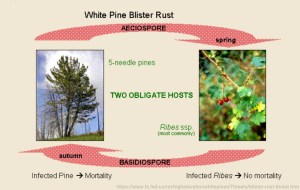
I wasn’t so inspired, until she spent time to identify the thorny pest. When she came upon the Prickly Currant, one detail got my attention. It plays the role of host for a blister rust that kills pine trees.
Well, why didn’t you tell me that in the first place?
Now I care as much as her about not wanting these painfully prickly nuisances growing everywhere.
 Once I started looking for them, it became clear the bush is thriving on our land. It is very easy to spot this time of year, as the leaves are some of the first to appear. Luckily, I discovered they are relatively easy to pull out of the ground.
It grows a lot like the raspberry bushes, with the long sprouts drooping over to the ground and taking root in a new spot. Since the stems are so thorny –worse than the raspberries– it makes for a very annoying hazard when walking off the trail, like one might do when hunting to pick berries.
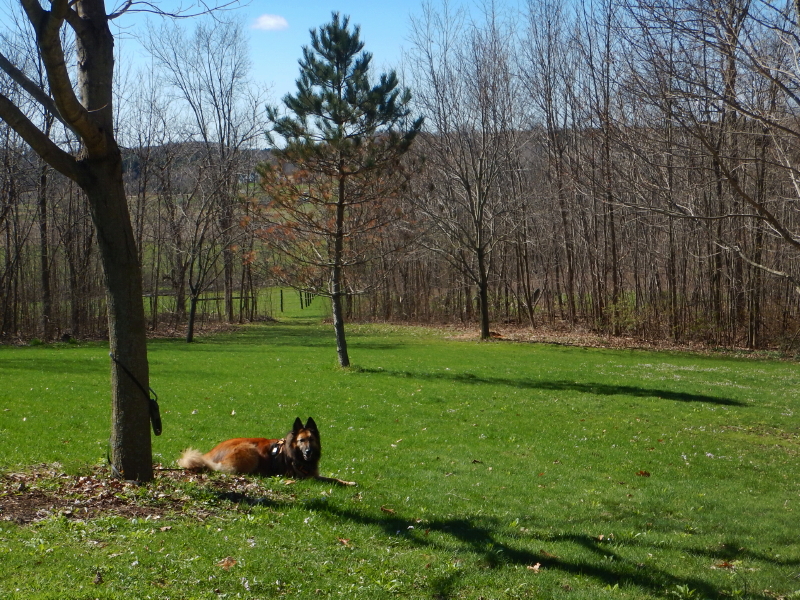
We spent much of yesterday pulling and digging to extricate a surprising number of these stabbing hazards along the edges of our back yard, where there used to be about ten more lovely pine trees, back when we bought this place.
Now there are only two on the back hill, and they aren’t looking very good.
 I never imagined how much knowledge and effort would be involved in being a good steward to manage what grows on the land. I figured nature would take its course and come to a healthy balance. Unfortunately, one plant’s ‘healthy’ can often lead to another’s demise.
To protect the plants you desire, a little lethal effort is sometimes going to be required.
I am enjoying renewed respect for Cyndie’s capacity to comprehend and react to all these details which too often overload my mental resources..
Now it’s time for me to go fret over getting all our grass mowed.
.
.
.
.
.
.
.
.
.
.
.
Preventive Medicine
We have now received three diagnoses for what has possibly been killing our pine trees over the three years that we have lived here.
The first guy thought it might be related to spider mites. He offered to treat all our trees with over $1000 worth of insecticide.
The second guy became very alarmed over the visible damage from sap suckers. I am grateful that the second guy was at least thorough enough to have also taken needle samples back for further analysis and consultation with other experts.
We are feeling most confident with the follow-up diagnosis he came up with of a fungus. Given that we are not interested in applying toxins in hopes of treating our remaining trees, I have responded to advice from the arborist to give our remaining healthy trees plenty of food and water for the best chance going forward.
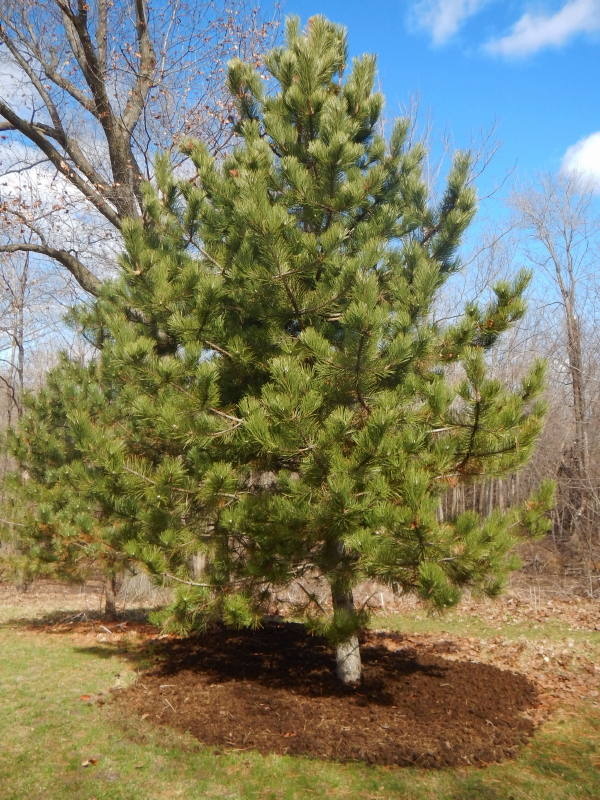 When he suggested giving them a good bedding, I pointed out that I have plenty of composting horse manure.
“That would be great for bedding.” he said.
Done.
Well, one done. Many to go.
.
.
.
.
.
.
.
.
.
.
.
.
.
.
.
Losing Trees
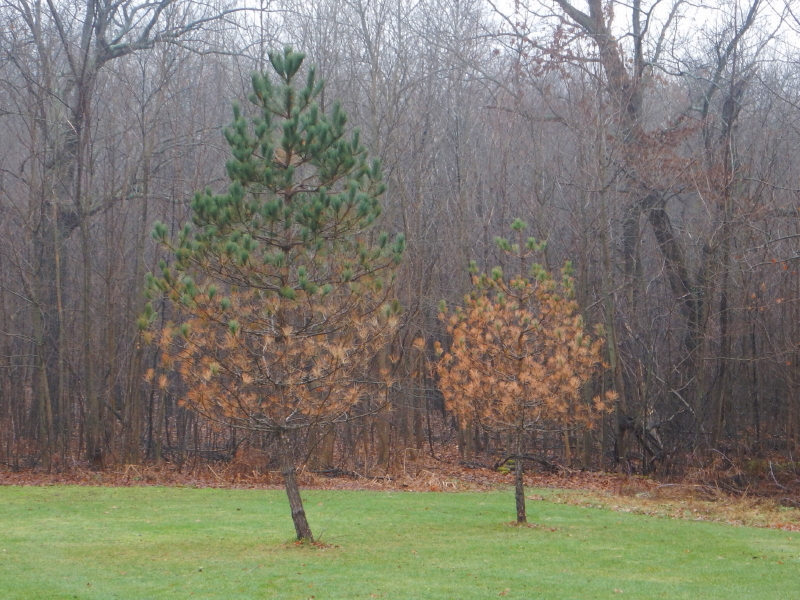 It’s so incredibly sad to be losing more pine trees. Our pine trees have slowly, but very consistently every year since we bought this place, been dying off.
Looking back, I believe it probably started before we arrived. One of the first things I noticed after we moved in was a small, dead pine in our front yard. It had just endured a very dry autumn, so I left it stand over the winter, in case it showed any sign of new life the following spring.
It didn’t.
I cut it down and accepted the loss as a single unfortunate occasion. However, the next year there were more.
 Several trees began showing signs of stress and I figured they were suffering from another very dry summer and autumn. I tried watering them to aid their ability to withstand the rigors of the approaching winter. Little did I know, it would be very extreme winter.
I wasn’t surprised when the trees weren’t able to survive that double whammy.
It was always 1 or 2 trees in a bunch, while others, often the larger ones around them, seemed unaffected. I would cut down the dead trees and assume that was that.
Each time, the decline of the trees happened so slowly that I wasn’t forming an opinion there was more to be concerned about. I had researched the symptoms, and came to believe (probably due to a confirmation bias) it was weather related. Knowing I wasn’t going to control the weather, I resorted to sadly accepting the loss without feeling there was anything more to be done.
When we spotted it happening again this year, on the few remaining trees in all of the several locations of previous losses, we called for an analysis by a professional. I had hoped that one look would reveal to an arborist some known predicament indigenous to this region.
Unfortunately, he arrived in the middle of a pouring rain. Cyndie was home at the time, and walked with him, trying to hold an umbrella that kept folding inside out in the wind. Not conducive to making close inspection or pondering possibilities.
What he did offer was the disconcerting news that no matter what the problem is, possible treatments wouldn’t start until next spring. He left us with the impression he would return later, in better weather, and take a closer look. One of Cyndie’s to-do tasks today is to call the tree company and inquire, because we haven’t heard anything for weeks.
Maybe when he said better weather, he meant next spring.
.
.
.
.
.
.
.
.
.
.
Burdensome Weather
Our weather has been chilly and wet for a few days now, enough that it is beginning to feel like a burden to face it. I suppose the fact that the temperature is dropping below the freezing point and the wind is picking up to gale force gusts, may be contributing to the desire to batten down the hatches and snuggle indoors under a thick blanket.
Today the precipitation is more likely to be in the form of snow than rain. This is a harsh reality after having been coddled for so many days of autumn with temperatures more akin to the comforts of mid-summer.
On top of that, our chimney liner has not been replaced yet, so we haven’t been able to have any fires in the fireplace. Takes away one of our favorite tools to offset the chill. A little warm air flowing from the furnace vent just doesn’t satisfy in the way a crackling fire can.
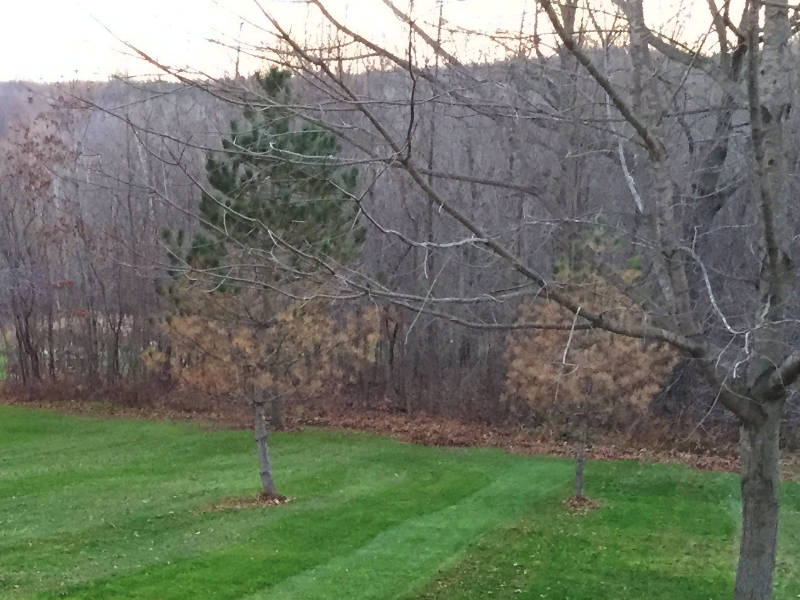 Yesterday, Cyndie got a local tree service to send someone out to assess what might be continuing to attack our long-needle pine trees. I raced home through the poor visibility of endless road-spray, a half hour early, in hopes of being here for the visit.
I just missed him.
Cyndie said it was a rather abbreviated visit due to the unfavorable conditions, and that he planned to return another day when he could more readily investigate what critters might be killing the pines.
At least he got a chance to orient himself with our specific areas of concern. In addition to the ailing pines, we are seeking advice on recommended pruning needs of several of the largest oak and maple trees. I don’t expect the assessment to render a very affordable quote, but seeing the cost of professional tree service will help us plan our next move in tending to the precious resource that is the trees on our land.
It is a burden that we are honored to be in a position to bear.
.
.
.
.
.
.
.
.
.
.
Creatively Repurposed
We lost 8 long-needle pines in the last couple of years due to a combination of dry summers that sandwiched one long and very harsh winter. It was pretty obvious last fall that they were beyond recovery, but I just didn’t have the heart to take them down until this spring.
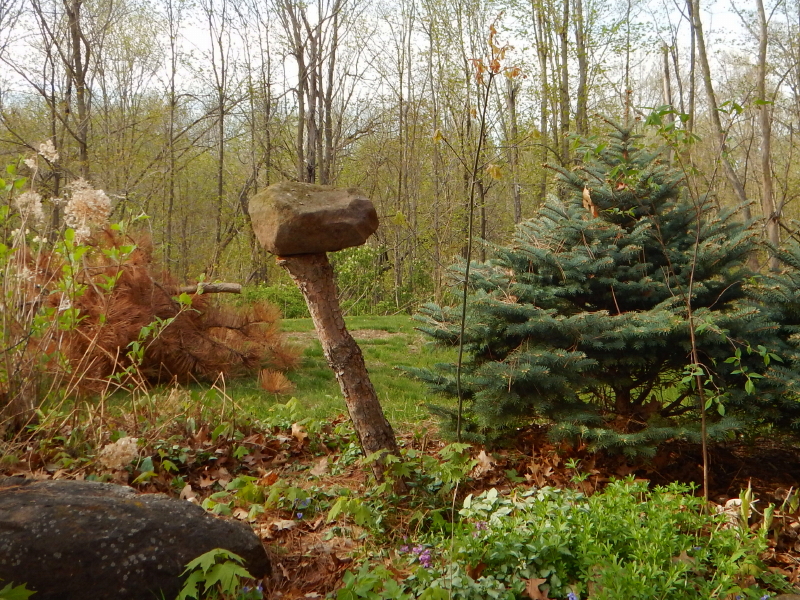
When the time came to finally face that chore, I decided to see if I couldn’t find some creative way to honor the memory of the pines. It just didn’t feel right to cut them all off at the ground. Of course, I have some history with this ploy of not cutting a tree to the ground and then using the remaining stump for something new.
At our home in Eden Prairie, I saved the 2-3 inch diameter trunks of a cluster of 3 choke cherry trees that had sprouted in an unwelcome spot of our yard, and then balanced rocks on them to create an interesting visual display. I liked the results enough to resurrect the concept again. In this instance, however, I have one item that will be more functional than a rock. It’s a birdhouse (Thank you, Mel & Greg!).
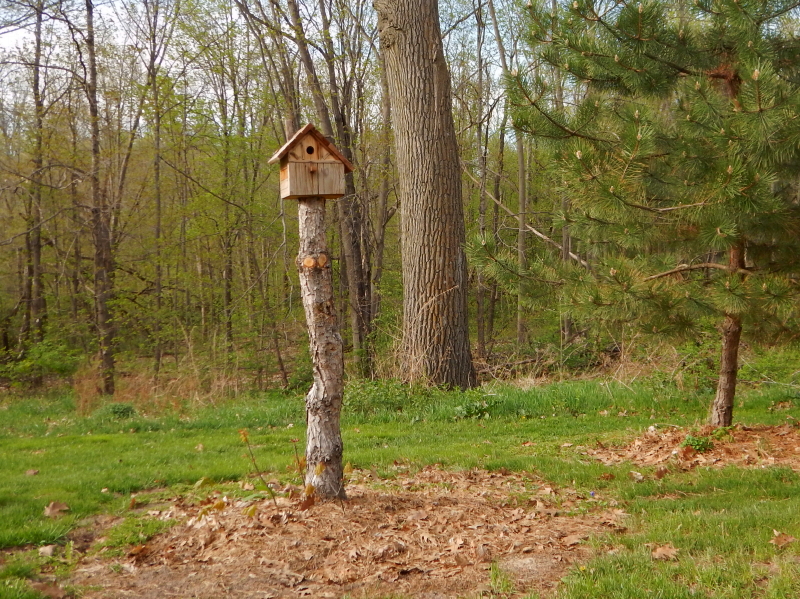 We have some really nice rocks here, so putting a few up on tree stumps is irresistible to me. While I was cutting down this tree which was leaning significantly, I discovered a twiggy young oak tree growing beside it. If that oak survives the abuse that some critter has enacted on the bark of its skinny little trunk, someday it may tower over the end of our house beside our bedroom in the spot where this pine was unable to survive.
 .
.
.
.
.
.
.
.
.
.
.
Pine Love
I am deftly skilled at passing the same scenery day after day without really noticing details that are plainly visible. Last time I was mowing the grass around our home, the sorry condition of a few of our pine trees suddenly caught my full attention. I hate to think of how long I have been missing signs they were not making the best recovery from the harsh winter.
When spring finally arrived, I was greatly surprised to see almost every pine tree that turned brown during the winter ended up sprouting new growth, indicating signs of life. I had figured many of them were goners. As time passed, I failed to monitor their progress closely enough to spot the few who were having trouble keeping the new growth flourishing. I hope I haven’t missed a possibility of successfully nursing them back to health.
 Yesterday, I took action to give the saddest looking trees some loving. Basically, they received a dose of horse manure fertilizer and a thorough soaking of water. We are hoping to be able to give all the evergreen trees around our house a regular watering through the fall this year to do everything we can toward reducing the stress they have endured for the last couple of years. It is hard on evergreens to enter winter without a good water reserve.
I did read that it is good to pause the watering in early fall, until deciduous trees drop their leaves, to allow trees to enter a transitional phase. After leaves have fallen, it is recommended to give all trees a deep watering until the ground freezes. Those evergreens will be losing moisture through their needles throughout the dryness of winter.
Meanwhile, despite total neglect, unwanted trees around our place, like box elder and common buckthorn, flourish and multiply. It’s just not fair.
.
.
.
.
.
.
.
.
.
.
Latest News
Lest anyone be oblivious to the special significance of this day, let me make it known that June 4th happens to be Cyndie’s birthday! I can’t think of anything more appropriate to give her this year than a new riding saddle. It’s a complicated purchase, so I already told her my idea and she will begin the process of getting the horses measured to see if it will be possible to get one saddle that will fit more than one of our horses.
She has received a few tips on recommended retailers, so we will be visiting a couple of them as soon as we have the measurements. Looks like I better stop dragging my feet about getting the trails in order around here. There are still downed trees in two places obstructing our main perimeter trail through the woods. Just as important, I need to increase the height of clearance throughout all the trails, to make it safe for someone traveling on horseback.
Cyndie reported that the vet said we can start increasing the time we allow the horses to graze freely by a half-hour every other day, up to a max of about 5 hours per day. That’s great news. The horses received good reviews and were given whatever shots were due this time of year. In about a week they will have their feet checked and hooves trimmed by our farrier, neighbor George Walker.
Speaking of George, I stopped by to check on him on my way home from work yesterday, and discovered he was out cutting hay using three of his horses to pull a rig with a sickle bar mower. What a beautiful sight. I pulled over and he gave the horses a break while we chatted about things like the weather, his hay-field, if it was going to rain, how much hay he should cut in case it was going to rain, and whether or not it might rain.
Obviously, the biggest trick to cutting and baling hay is finding enough consecutive dry days to pull it off during the months of May and June when things are growing the fastest.
After that visit, I headed home to do some cutting of my own: I mowed our lawn. The grass was so thick, it looked like I had created windrows for baling!
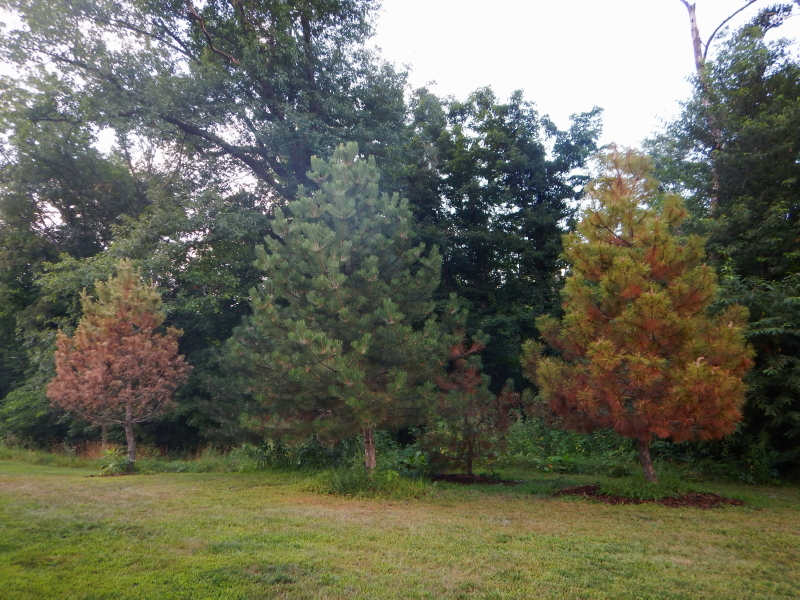
If you can decipher it in this picture, the pine trees that suffered so much from dryness last fall, followed by the extremely harsh winter, are sprouting new growth, except for one. The one on the left that looks the most rust-colored is the one that tipped over last year. It didn’t survive. Next time I have the chainsaw out down there, he will get cut down.
We are looking forward to seeing the new growth pop open soon, to bring the trees a healthier glow. As you can tell by the image, everything else around them is bursting with green life.
.
.
.
.
.
.
.
.
Will They?
 One of our current spring dramas is whether our pine trees will recover from the stress they have endured from our dry fall that was followed by the most extreme winter we’ve had in 35 years. I’ve not consulted with an arborist yet, but our trees are definitely browning from the bottom up and the inside out. This doesn’t match the descriptions I find of how winter injury or pine wilt symptoms appear. Whatever it is that is causing the problem, it’s not affecting every single pine, but it is widespread throughout our property and not confined to one spot. We are hoping for the best, but I’m inclined to believe the prognosis is not good. The die-back on many of them is over half the tree.
That isn’t our only drama this spring. We are also anxious to learn whether the maple tree we transplanted to the labyrinth last fall survived the obvious shock it endured from its being uprooted and relocated. If we witness signs of life from that tree in the days ahead, my spirit will soar and we will have much cause for celebration.
There is also concern for the number of plants Cyndie worked so hard to get established in the rest of the labyrinth. This winter was hard on everything, so even if the plants survived the onslaught of snow and long periods of extreme cold, they will now face risks from animals that are trying to eat anything and everything available to recover from their own season-long deprivation. I don’t intend to erect a 10-foot-high fence around the garden to keep deer away, but I fear that is about what it would take to dissuade them from bellying up to our conveniently situated buffet down there.
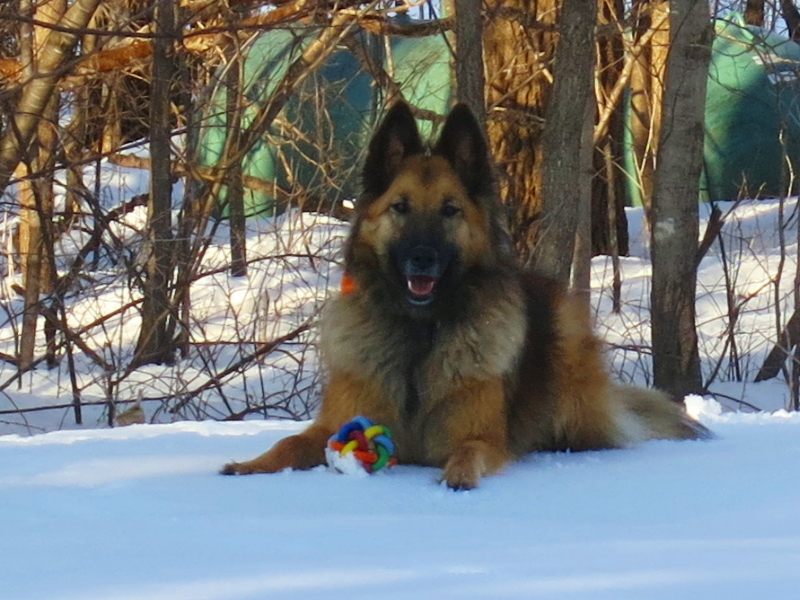 We could ask Delilah to patrol the area for us, as she would be thrilled at an invitation to chase deer, but she would likely wreak her own havoc on plants, as she demonstrates amazing reckless disregard for all living things in her excitement to chase and dig.
One last drama we came face to face with yesterday is the question of whether we will be able to continue allowing Delilah to be both an indoor and an outdoor pet. This is the first spring that she has lived with us, so we haven’t previously needed to deal with managing both spring mud and a dog before.
When we step in the door, we can simply remove our muddy boots. I wish it were that simple for her. Yesterday, a day when the temperature was below freezing, but the sunshine was still melting exposed ground, she got legs and belly covered with mud and manure-cicles. When we came inside, Delilah was rubbed down with a towel in a cursory attempt to dry her off. Later, when we had time, she would get bathed to remove the residual grime.
So much for waiting. Soon we were seeing dark spots all over the floor. The mud and manure frozen to her underside, and which toweling did not remove, was now melting at a rapid pace. Everywhere she walked in our house was becoming a bio-hazard site. Poor dog was unceremoniously evicted and sent to her kennel outside do be dealt with later.
If I thought it stood a chance of working, I’d look into mud boots for her. I wonder if she’d let me wrap her torso with stretch-wrap to keep her belly fur dry.
.
.
.
.
.
.
.
.
Walking Partner
The best thing I can do for my back is go for a walk, so as soon as I got home from work yesterday, I headed out with Delilah for a little stroll around the property. She is very entertaining to walk with this time of year. The snow is deep enough that she struggles mightily to make progress through areas of undisturbed accumulation, quickly resorting to leaping like a deer to pounce over, instead of plowing through it.
She is happy to follow the trails left by the deer, or where someone has previously walked, sprinting to get way ahead of me, and then turning to see if I’m still coming. She shows intense interest in the scents lingering in the footprints left by the deer, and spends protracted moments in olfactory detection. If I somehow manage to catch up and pass her, she bolts to close the gap and then leaps into the deep snow for several pounces to get around me before reclaiming the trail.
We came upon the pine tree that we picked up off the ground a few times last spring, and discovered it is showing signs of not having survived. It is one of several that aren’t looking so good, and has me thinking we should be planning to do some tree planting come spring so that we add more than we lose every year. We are already behind, because a similar pine on the front side of the house died last winter and had to be cut down.
While I was taking pictures of the tree, Delilah got in some small-game hunting beneath the snow.
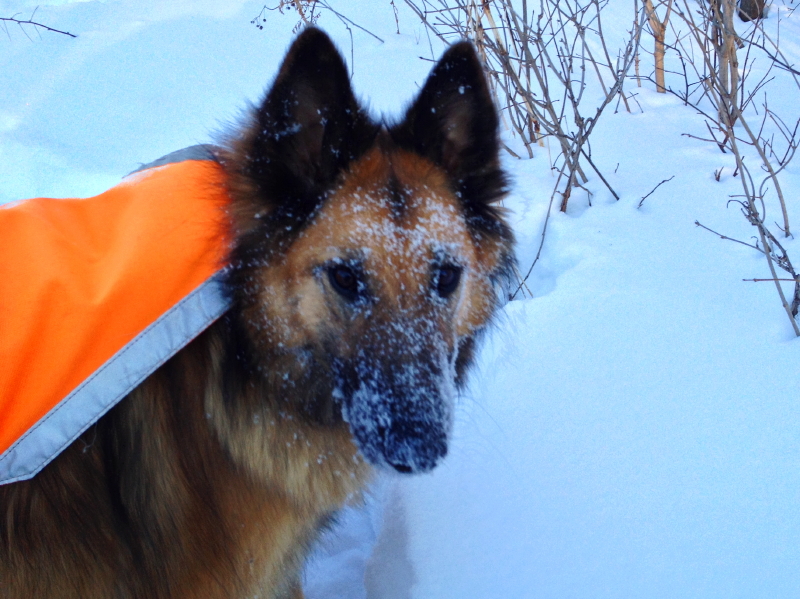
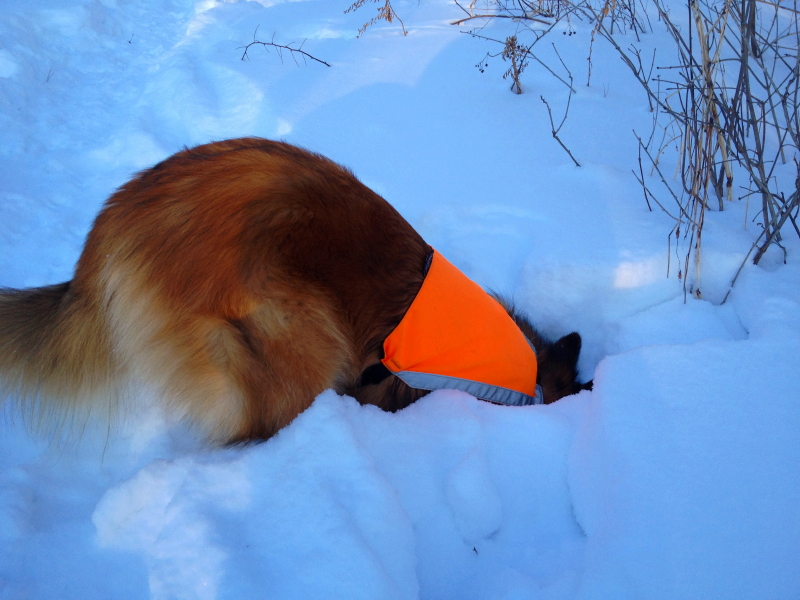 She didn’t come up with anything except a face full of snow, which I attempted to capture before she shook it all off. I didn’t get much cooperation from her in terms of posing for photographs, but I think this does it justice.
 .
.
.
.
.
.
.
.
.
I was lucky that the deep snow tired her out enough that she reached her fill of being outside at about the same time I was reaching my tolerance limit for walking. On this day, the deep snow and my ailing back ended up balancing our walking partnership perfectly.
.
.
.
.
.
.
.


 Relative Something