Posts Tagged ‘optimal hydration’
Long Term
Thinking long-term has become a key component guiding my choices in pursuing a rewarding, healthy lifestyle. In line with my desire to invert pyramids of dysfunction, I look at unhealthy practices and consider the results of not just ending bad habits but replacing them with something helpful.

Specifically, I like to pay attention to the types of behavior that are known to contribute to problems over time. An unhealthy diet is pretty straightforward in this regard. Eating a serving of anything that is obviously unhealthy won’t kill a person but if they did that for years, negative outcomes result.
Seems logical to avoid a prolonged habit of eating poorly. So, take it a step further and replace unhealthy food with nutrition-dense food as a long-term habit.
A person who eats poorly doesn’t check the next day to see if they are less well. In the same way, a person who eats healthy food shouldn’t expect to become healthy in a day. Many people check their weight every day as a monitor of their health. Cyndie and I don’t own a scale. My weight gets checked whenever I have reason to visit the doctor.
My day-to-day weight fluctuations don’t concern me. In the same way, I don’t check my retirement account value every day. It’s the long-term trends that indicate how I’m doing against my goals.
Most people know that it’s good to avoid dehydration, but it is common for people to allow their hydration to regularly fluctuate. I tend to think it is more helpful to my body to consistently function at a healthy level of hydration. What’s the worst that could happen if I’m wrong ten years down the road?
You might think my kidneys would get worn out but my practice is beneficial to them in preventing stone-forming crystals from sticking together. One bout of kidney stones was enough for me. That pain was off my scale.
When I’m well-hydrated, I feel more confident about stretching my muscles. Do you stretch every day? Does your dog or cat stretch almost every time they get up after a long lie down? It’s fun watching the horses do cat-like stretches.
I’ve learned to be patient and allow my body time to process a thorough stretch. It always strikes me as surprising that each time I prepare to stretch, I discover that my body has returned to the same limits of movement as the day before.
When I lay flat on my back and bend at the waist to lift my legs with my knees locked and bring my feet as far as possible toward my face, the stopping point is always the same and surprisingly limited. Then I do a hamstring stretching routine. After I have stretched, I revisit that first exercise of lifting my legs with knees locked and my back flat against the floor to see how much closer my feet come toward my head. The change is dramatic.
What do you imagine the long-term impact might be of regularly stretching for the rest of a person’s life versus not stretching?
.
.
Two Articles
If you wait long enough, things tend to come around again. I’m not just talking about music and fashion, either. An unending onslaught of studies, some more scientific than others, seem to appear with regularity in headlines for bringing ever-changing perspectives to the forefront.
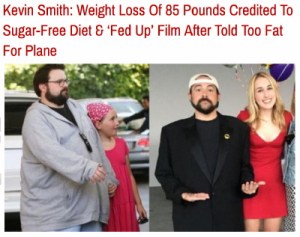 I spotted a bit of celebrity talk on my news feed yesterday, but what caught my attention about it was the reference to ‘sugar-free’ and the film, “Fed Up.” In this case, it supported exactly what I am currently experiencing and it felt very affirming. Filmmaker Kevin Smith has dropped significant weight after experiencing the same insights I did upon watching the documentary about how sugar is contributing to today’s health woes.
The old targets of scorn in the American diet were at one time fat and cholesterol, and maybe that will come back into the limelight again before the end of time, but my present battle is with sugar. It used to be that I shouldn’t eat eggs. I am so happy to have eggs safely back on my menu these days.
Years ago, sugar was considered a bit of an extravagance, but then it became something added to almost every processed food, and our national palate adjusted to the point of expecting sweetness in everything.
I plan to ride the reduced sugar band wagon for as long as I can hold out, figuring the next wave of food information will come along well after I have made peace with my addiction.
The second article that showed up for me yesterday hit on a subject near and dear to me for decades of athletic endeavors. I am a big proponent of optimal hydration, but like everything, there is a critical balance that should be maintained. Yes, I’ve heard the scary threats that you can die from drinking too much water. That has never been a concern for me. However, I have long adhered to the advice that waiting until you notice feeling thirsty puts you behind the curve of maintaining optimal hydration.
I also tend to use the clarity of my urine output as a gauge of desired hydration. Both beliefs are now being challenged by an article on Critical Journal of Sport Medicine.
“In all cases, blanket statements that can be found on the internet such as “don’t wait until you feel thirsty” make little sense for the majority of casual athletes” – Preventing Deaths Due to Exercise-Associated Hyponatremia: The 2015 Consensus Guidelines, Mitchell H. Rosner, MD
At this point, what I intend to take from my limited understanding of the clinical verbiage and specific qualifiers for the science the article intends to express, is that I will try not to be overly confident going forward, about my level of understanding of optimal hydration. I plan to continue to rely on my intuition and the results I experience with regard to what is right for me.
Your mileage may vary.
But back to the sugar thing, I invite you to spend a day tracking how much you REALLY consume in a 24-hour period, then see if it seems right to you. I may not comprehend all the clinical details, but my intuition tells me there is definitely something problematic with the current American high-sugar diet.
.
.
.
.
.
.
.
.
.
.


 Relative Something