Posts Tagged ‘manure’
Measured Freedom
I spotted a recent invitation to connect with an old acquaintance on the career oriented networking site, Linked In, and in a moment of spontaneous whimsy, decided to update my profile to reflect my recent employment change to full-time ranch manager. Who knows? One of my connections there might someday be seeking advice about manure management or moving from suburbia to the agricultural countryside.
As manager, I have decided I should begin establishing and documenting our ranch policies. First off, all visitors arriving from West African countries, Spain, or Dallas, TX, will need to have their temperature measured before entering the property. Also, as a proactive measure, anyone even thinking of visiting the countries of West Africa will be checked for a fever.
Forgive me if that seems insensitive, but my coping method for dangerous or intense situations often involves attempts at humor. That runs the risk of offending if someone reading happens to be directly affected or involved. No offense intended.
Maybe that is why I find myself making so many wisecracks about manure. You see, the title of “Ranch Manager” is just a nice way of labeling the job of manure collector. Sure, I also take care of the dog and cat, manage the maintenance of our fleet of machines, tend to the grounds keeping and forest management, and am the general contractor for all improvement projects, but those activities all happen while I am at the same time scooping up manure.
 Yesterday, true to my word, I kept Delilah confined to a leash the entire time I was working on projects. She got one break for exercise when I unleashed her to chase flying discs. When I was working, I always knew where she was. I would describe her reaction to being leashed as, contrite.
I’m pretty confident she understands what is going on. Countless times she has demonstrated a memory for something from a day before. If she was remembering her little escapades from Tuesday, and wanting to return to those adventures, being confined to the distance of her leash was a clear manifestation of having her freedom revoked.
I think both she and I are looking forward to the day we get back to practicing her appropriate measure of free run.
.
.
.
.
.
.
.
.
.
.
New Fence
How many times will I say this? We have another new fence! Yesterday, they hung the wires on the posts creating the fence that surrounds our back grazing pasture. I discovered it is a case of “be careful what you wish for” because we have been wanting this fence for about a year, and now that I stand beside it, I feel a bit of a shock to have my ability to freely traverse that field impeded. What was I thinking!? (*start singing “Don’t Fence Me In*)
Honestly, it is going to be a special feature that will allow us to simply open a gate to give the horses somewhere to go when the paddocks become too muddy. In addition, it will grant them convenient access to what will be our primary grazing pasture. Also, it looks incredibly slick. I’m almost a bit embarrassed about how good it looks. I guess I’ve grown too accustomed to the look of the t-post temporary fences we have had to rely on prior to this.
I stood in the middle of the south run and took pictures in both directions, east and west, and have merged the results into one image. It is a bit of an optically disorienting look, making it seem as though there is a corner in the middle, but I like how it provides an equal view at the two opposite directions.
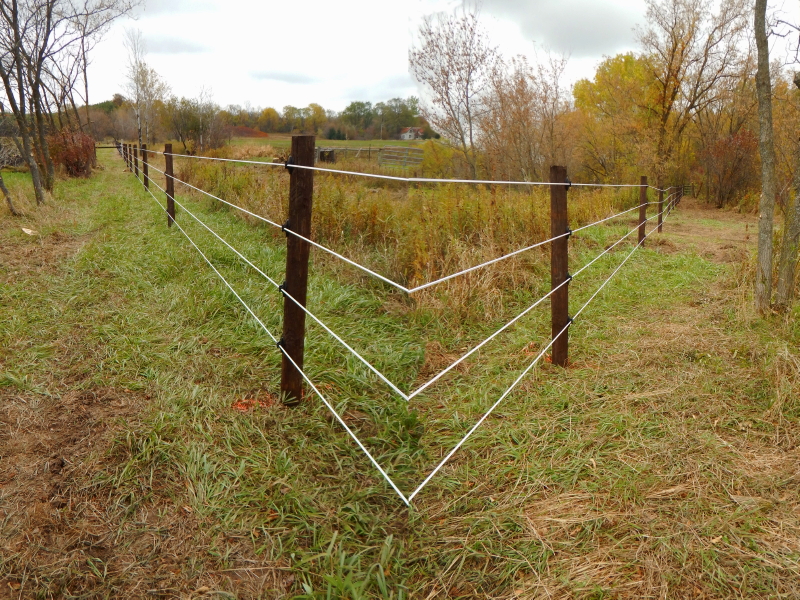 Today they will finish the installation by burying a wire beneath the gate openings to complete the electric circuit, and then they will hang the gates. We are recycling gates that were left here by the previous owners.
Our horses will be so happy!
I will be happy, too, but with the horses having so much access to pasture now, I will need to become more intentional in my efforts to get out and redistribute the manure drops they leave lying around. In the paddocks, we remove them, but in the pastures, I can get away with just breaking them apart with a rake or a good swift kick. I just need to get out there and do it.
This is one of the reasons that keeping some chickens remains on our radar. We have been told that they automatically spread out the piles by scratching for larva. You get a 2-for-1, because they help control the fly population while breaking up the manure droppings.
See how that works? I go from talking about a new fence, to getting chickens. I have come a long way from that life in the suburbs, don’t you know.
.
.
.
.
.
.
.
.
.
.
It’s Beautiful
It was Saturday, and Cyndie was home, so I wanted to take advantage of having a potential assistant. Despite my wishes, there are some tasks that demand attention, particularly when it is essential they be completed before another task is able to occur. During the week, while the landscaper and fence crews were working, my attention needed to be on their activities, and I postponed chores like mowing the lawn and managing the manure pile.
The landscaper is done and the fencers are off for the weekend, so Saturday was a chance for me to catch up, regardless of the fact the tasks were the ones I try to save for when I have no one around to help. I absolutely needed to rotate the composting manure piles to create space for dumping the fresh daily collections. Production never stops, and I was running out of places to put it.
It worked out well that Cyndie chose to spend time with the horses, doing some grooming and then exercising them in the round pen, before turning them out into the hay-field to graze. Our activities kept us within sight of each other, so it felt like were working together, despite our different tasks.
It also worked out nicely for me that Cyndie had scheduled an afternoon fall-color drive with a friend, so I could get after the over-due mowing while she was gone.
Well in sight of the middle of October, and I am wondering if this is the last time I will need to mow for the season. I set the mower to cut the grass short and am hoping that will be it. I’m conflicted between wanting the new grass I planted in the drainage swale to grow and the lawn grass to stop growing.
The place looks great with the fresh, close-cut green grass complimented by the colorful leaves of fall. We are in the midst of a series of warm, sunny autumn days with cool nights. I want to be sure to give this pleasant weather as much attention as the wet and cold days usually get.
It would be nice if I stopped and took a few pictures to capture the beauty, I suppose. Maybe I was just working too hard yesterday, but I neglected to pull the camera out even once, even though I had it in my pocket all day. You’ll just have to trust me. It’s really beautiful here right now.
.
.
.
.
.
.
.
.
.
.
Prototype Blend
Between the thundering copious downpours yesterday —which by this morning have dropped a 24-hour accumulated total of 5 inches of rain on us— I began production of our first prototype mix of custom horse-manure-fertilized growing soil. It was an extension of my working on the rock pile we received from a neighboring farm field last spring.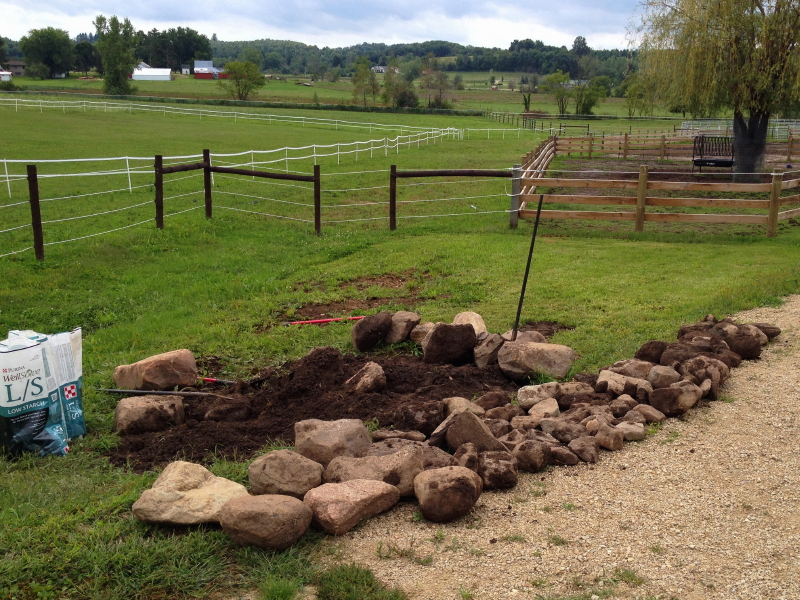
That dump-truck-load of field rocks included a significant amount of dirt that surrounded and buried a lot of the stone. Slowly, but surely, this summer I have been prying out rocks and moving them down near our Rowcliffe Labyrinth Garden. As I am getting closer to the bottom of that pile, it is becoming more dirt than rocks. I decided to shovel that rich field-dirt into bags for future distribution, and in so doing realized the opportunity to mix in some composted manure to create our first dose of Wintervale old souls super soil.
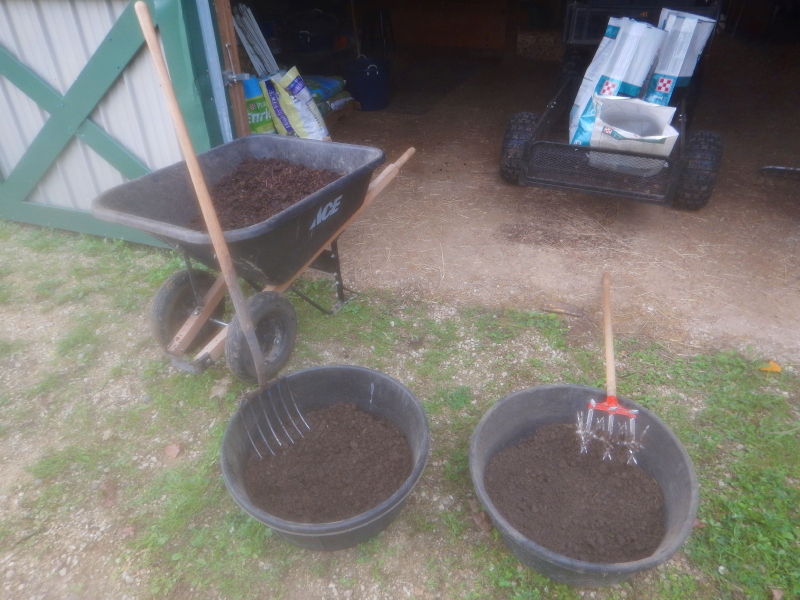 It’s kind of like harvesting our first crop! There is a different reward to mixing the composted manure with dirt, as opposed to just using it to fill low spots around our property.
This will be a long-term process, as I won’t really know how successful my concoction is until a season of growing passes and I can learn the results from growers who receive our initial distribution.
Not that I have any real doubts about the potential. I have seen how robust the volunteer growth was that sprouted out of this rock pile all summer, and I have ample evidence of the accelerated growth around all the places I have used composted manure for fill.
Together, I expect they will produce even greater results.
.
.
.
.
.
.
.
.
.
Fertilizer happens
In about a month we will reach the point of having had our 4 horses for one year. No matter how much reading and planning we could do for manure management, it is nothing like actually seeing and dealing with the real thing. For the uninitiated, a 1000 pound horse can produce around 50 lbs of manure a day. We now have an idea of what that is really like.
 The storage and distribution system I naively devised over time worked adequately for this first year, going from having none at all to a year’s-worth. Now we are approaching the point of starting the second year with a lot less open storage space. It is roughly half-filled with composting manure right now.
There are some refinements to my system of manure management that I hope to accomplish. My effort to thoroughly compost is forcing me to rethink my methods and may require some expansion of space to store ‘in-process’ manure. I like working small-scale, but the sheer volume produced might force my hand to take up the offer from neighbor George to use his manure spreader and my front loader to distribute a bulk amount all at once.
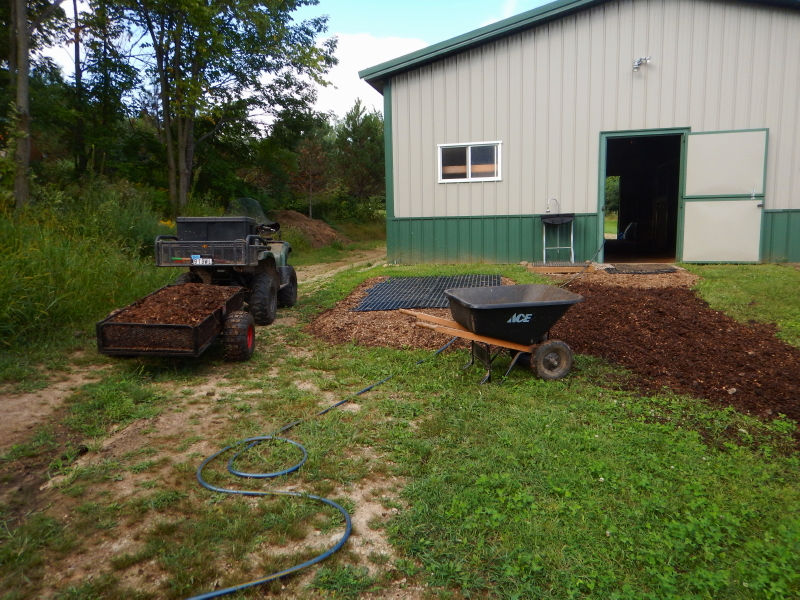 I continue to use the oldest, bottom level of partially composted material as clean fill in a variety of places around our property, but I’m guessing there might come a day when I run out of a need for that kind of use. Maybe by the time that happens I will have perfected a system that allows me to offer (sell?) bagged horse manure fertilizer to interested gardeners as a means of distribution.
The current challenge has been moving the pile around to provide access to that base level of compacted material I want to use. Yesterday, when I was doing so, it became obvious how quickly the composting dries out an inside layer. The pile always seems so wet to me that I haven’t been worrying about adding moisture, but the light bulb came on when I saw the dramatic difference as a result of trying to move the entire upper level to a new location. I got the hose out and watered the pile, and Delilah. She absolutely cannot resist chasing water from a hose.
Unfortunately, that meant she was trying to chase it through manure. Not a pretty picture.
Unsanitary Landfill
I laughed at myself yesterday, thinking about my unorthodox methods. When I lived in the suburbs, I would collect fallen leaves and spread them all around our lot as ground cover, while all my neighbors were collecting theirs and bagging them to be thrown away. Now I am using composting manure to fill low spots, without waiting for it to become dirt.
One area I am working on is just outside the back door of the barn. Last year when we were creating the paddocks, we had water piped from the barn to a Ritchie waterer for the horses. Excavators dug a very deep trench to get below the frost line, and it exited the barn by that door. I think we are going to be needing to add fill over that trench for a few years as the dirt they filled it with continues to settle.
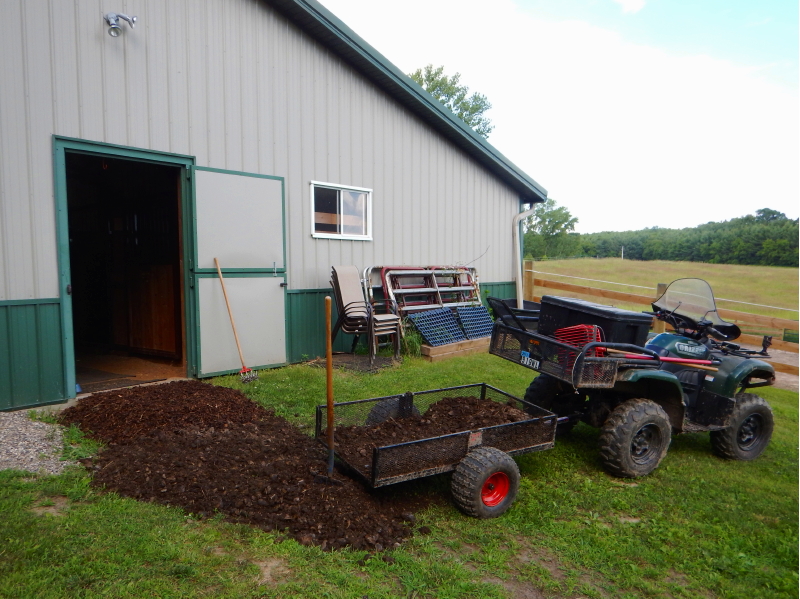 This spring, after the snow melted away, the ground had dropped down so much that the first step out of the back door had become a real doozy. I have slowly been filling that trench with the dirt and manure that was raked into piles in the paddock at the end of winter. I got the idea to use that for fill from the fact that the piles ended up being more dirt than manure. Still, I am putting poop on the yard as fill. How unsanitary is that?
The last few rain events interrupted the composting process on my main pile, by getting everything too wet. I’m using the oldest portion at the end of the pile anyway. It can dry out where I spread it to fill the depression caused by the trench.
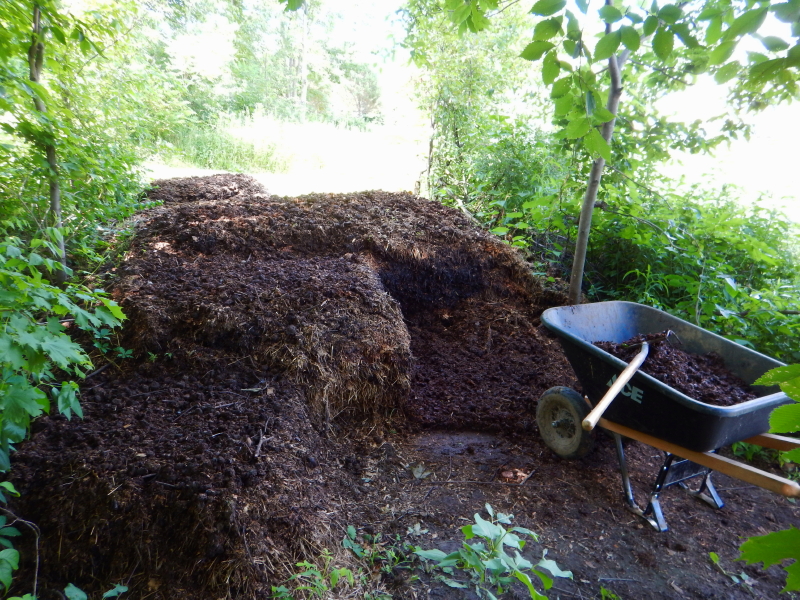 You might be able to discern how I have segmented the pile to create sections with differing stages of composting. I think it would work, if I had a roof over it to control the moisture.
Not gonna happen. Not for a while, anyway. I’ve still got a woodshed to rebuild before I embark on any other roof constructing projects.
.
.
.
.
.
.
.
.
.
.
Shitty Education
In the time since our horses arrived late last September, we have been stockpiling manure in one primary location. Based on information Cyndie gathered, we roughed out a spot that we guessed would be large enough. That was about as far as we went in terms of a plan of action for manure management.
In my naiveté, I thought we could start piling at the back of the clearing we designated, and just keep dumping new loads toward the front. If it timed out right, we could access the pile from the back to remove old composted manure for use as tree food and fertilizer for Cyndie’s plants. I planned to scoop the front of the pile with the loader on our tractor, to stir and aerate the material, moving the composting manure back and making new space for fresh loads to be dumped in front again.
The more informed method involves an area divided into 3 separate sections. This allows the first pile to become fully composted and ready for use, the middle one to be in process of breaking down, and the last one for dumping fresh manure.
My system didn’t work the way I imagined because our method of dumping full-wheelbarrows ended up filling the designated space all the way to the front in a very short amount of time. Instead of dumping somewhere beyond our designated space, I chose to go up. I created a ramp and we just kept adding fresh manure on top of the previous batches already beginning to break down.
That has led to a pile with layers in varying stages of decomposition. It is obvious our pile shrinks over time, depending on how much new manure is being added, but the two key elements to accelerating the breakdown are the optimal amount of air and moisture, and our pile hasn’t been getting the correct amount of either. Our location is not covered, so I figured we would suffer from too much wetness, but the process of decomposition uses up moisture and will cause dry spots that interrupt decomposition if not stirred.
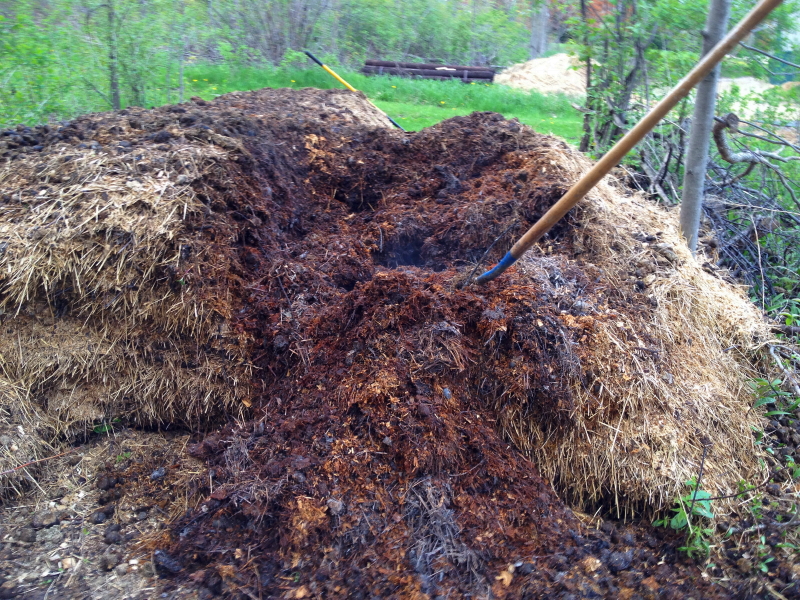 Yesterday afternoon, after I got home from the day-job, I cut deep into the back of our manure pile for the first time. I wanted to move some material from the pile that was already composting, down to the new location I created by the labyrinth. The impetus for that was our desire to give our newly transplanted tree at the center of the labyrinth a dose of horse manure fertilizer.
Even though the tree is showing signs of new buds along its trunk, there is no indication that the buds at the ends of the branches have any life in them whatsoever. It is really testing my patience.
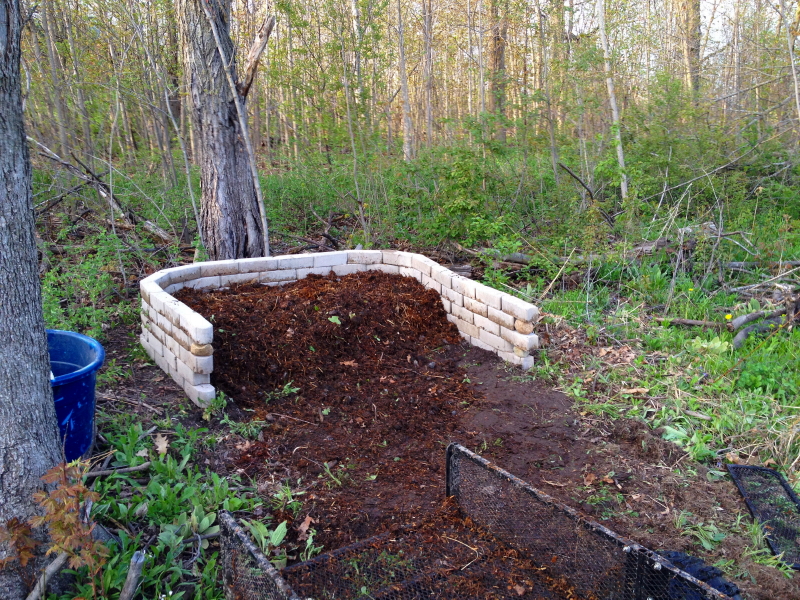 So, I was able to cut into the main manure pile and get educated about what is going on down below, and I got enough cinder blocks stacked to create the start of a satellite pile where I will be better able to control the rate of composting.
Best of all, it will be conveniently located near the garden of plants that help define the form of our labyrinth path.
.
.
.
.
.
.
.
.
Trailering Poop
We finally put our new ATV trailer to use for cleaning the paddocks. The ground seemed to dry up quite a bit yesterday, so we took advantage of the opportunity to drive inside the fences and made fair progress on removing more of the winter’s-worth of accumulation. We have been working in steps, cleaning small sections at a time as they become dry enough. Using the ATV in place of a wheelbarrow increases our capacity nicely, and while working to prove the concept, we knocked off a new portion in each of the two paddocks.
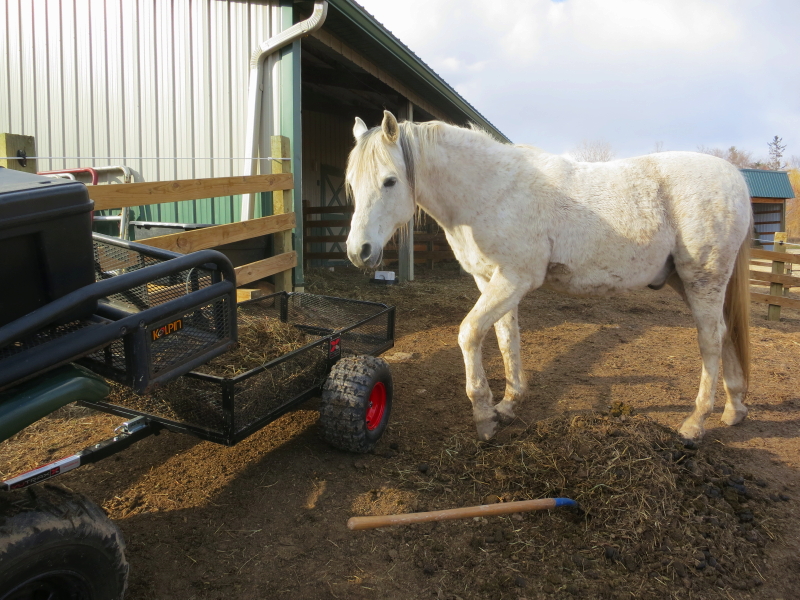 I am pleased with the horses comfort around motorized equipment. They are not intimidated in the least by the rumbling engines of the tractor or ATV. We left them roaming free inside the paddocks as Cyndie opened a gate for me to drive in. Here is a shot I took of Legacy as he stepped in close to check on the quality of my work.
We have yet to figure out the ideal method of unloading the trailer. The main location where we have been putting manure for compost has gotten rather tall, and isn’t currently situated so that I could drive up and over it. I have created a ramp within the pile that allows me to roll the wheelbarrow up and around for dumping, but that isn’t sized for the ATV trailer.
It was decided that we would expand our compost operation to multiple locations, placing more of the product in proximity to where it will likely be used. With the wheelbarrow, it didn’t make sense to go traipsing around the property to unload, but now with the ATV that is not a problem.
The first place we picked was across the driveway, up among the pine trees. There are enough trees there alone that we can probably spread the majority of our collection in that vicinity. We do want to provide a modest amount somewhere near the labyrinth garden, too, but Cyndie is concerned that it be far enough away so as not to disturb the pleasant ambiance we are trying to develop there. I think that can be achieved.
It feels good to be making gains on the cleanup of the paddocks as they begin to dry. Too bad today I am called away to the day-job and Wednesday is shaping up to be another winter storm. Poop trailering is on hold for a while again. It’s spring, two steps forward, one step back. We’ll get there, eventually.
.
.
.
.
.
.
.
.
Harsh Realities
In the last few days, we have come across a surprising number of animal parts that Delilah has collected from her explorations around our property. I think the melting snow might be revealing some carcasses that were preserved beneath all the white stuff this winter. At least, we hope that explains the dramatic increase in our exposure to the harsh reality of animal mortality lately, as opposed to the possibility that she has become that proficient of a predator.
Cyndie buys a lot of chew toys for our dog, but none of those come close to thrilling Delilah as much as something biological. Oftentimes, we are unable to recognize what she has in her mouth, but it is easy to tell from her behavior and body language that it isn’t one of the toys.
If we are lucky, we are unable to identify what it is. Somehow that is easier to stomach. I felt a bit nauseous yesterday as she chomped away on the very obvious body of a mouse. Then she comes inside and tries to lick our faces with her bad breath while we towel her dry and remove her blaze-orange vest.
Earlier that morning, Cyndie stepped in the house from feeding the horses and said, “I have a blog post title for you…”
“Headless Rabbit.”
I decided not. Cyndie described the unlikely scenario of lifting one of the horse’s feed pans which had been flipped upside down in the paddock, and discovering the carcass of a headless rabbit beneath. We can’t imagine how it ended up there. Maybe one of the horses came across the body and purposely covered it out of respect.
We also have a pile of feathers that Delilah has been working on, which I’m guessing came from one of the many wild turkeys roaming our land. In addition to the deer leg that has been a recent prize, she also is quite fond of chewing on a fair-sized piece of hide; both hoof and hide being something that a pack of coyotes might leave behind.
Another harsh reality we are facing this weekend, with temperatures soaring well-above freezing, is the mud and manure mess we have been anticipating in the paddocks. When the ground here is saturated, it becomes so soft that you sink to the point of losing a boot in many places. That means we don’t dare try driving the tractor into the paddocks now to remove the abundant accumulation of manure. It would sink past the axles. This will be a nasty problem to endure while waiting for the soil to dry out.
It is our first spring with the horses, and this worst-case scenario has us biding our time until we can engineer a remedy, which will likely be a combination of altering landscape to improve drainage, and adding some sand/gravel to a few key areas to improve their footing.
All this “reality” certainly does help to accentuate how far we have come in our move from the refined environment of our previous life in the suburbs.
.
.
.
.
.
.
.
Will They?
 One of our current spring dramas is whether our pine trees will recover from the stress they have endured from our dry fall that was followed by the most extreme winter we’ve had in 35 years. I’ve not consulted with an arborist yet, but our trees are definitely browning from the bottom up and the inside out. This doesn’t match the descriptions I find of how winter injury or pine wilt symptoms appear. Whatever it is that is causing the problem, it’s not affecting every single pine, but it is widespread throughout our property and not confined to one spot. We are hoping for the best, but I’m inclined to believe the prognosis is not good. The die-back on many of them is over half the tree.
That isn’t our only drama this spring. We are also anxious to learn whether the maple tree we transplanted to the labyrinth last fall survived the obvious shock it endured from its being uprooted and relocated. If we witness signs of life from that tree in the days ahead, my spirit will soar and we will have much cause for celebration.
There is also concern for the number of plants Cyndie worked so hard to get established in the rest of the labyrinth. This winter was hard on everything, so even if the plants survived the onslaught of snow and long periods of extreme cold, they will now face risks from animals that are trying to eat anything and everything available to recover from their own season-long deprivation. I don’t intend to erect a 10-foot-high fence around the garden to keep deer away, but I fear that is about what it would take to dissuade them from bellying up to our conveniently situated buffet down there.
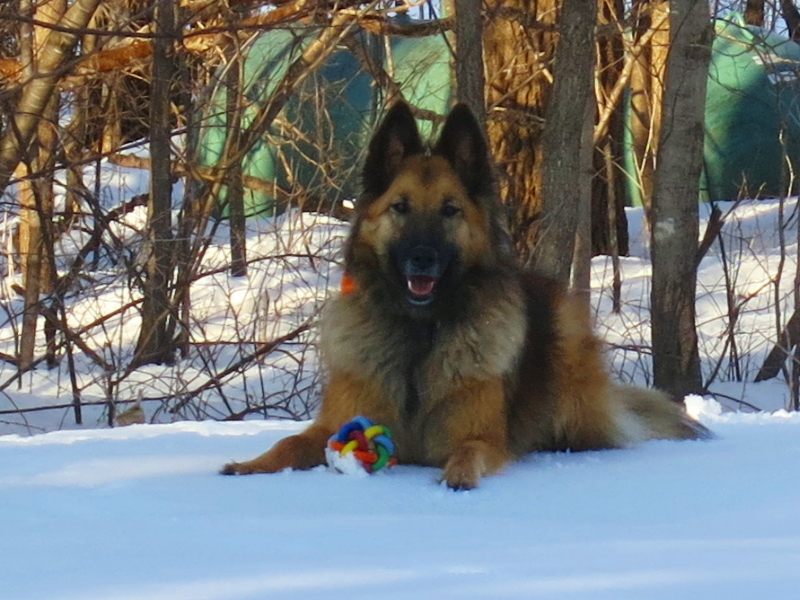 We could ask Delilah to patrol the area for us, as she would be thrilled at an invitation to chase deer, but she would likely wreak her own havoc on plants, as she demonstrates amazing reckless disregard for all living things in her excitement to chase and dig.
One last drama we came face to face with yesterday is the question of whether we will be able to continue allowing Delilah to be both an indoor and an outdoor pet. This is the first spring that she has lived with us, so we haven’t previously needed to deal with managing both spring mud and a dog before.
When we step in the door, we can simply remove our muddy boots. I wish it were that simple for her. Yesterday, a day when the temperature was below freezing, but the sunshine was still melting exposed ground, she got legs and belly covered with mud and manure-cicles. When we came inside, Delilah was rubbed down with a towel in a cursory attempt to dry her off. Later, when we had time, she would get bathed to remove the residual grime.
So much for waiting. Soon we were seeing dark spots all over the floor. The mud and manure frozen to her underside, and which toweling did not remove, was now melting at a rapid pace. Everywhere she walked in our house was becoming a bio-hazard site. Poor dog was unceremoniously evicted and sent to her kennel outside do be dealt with later.
If I thought it stood a chance of working, I’d look into mud boots for her. I wonder if she’d let me wrap her torso with stretch-wrap to keep her belly fur dry.
.
.
.
.
.
.
.
.


 Relative Something