Posts Tagged ‘manure management’
Measured Freedom
I spotted a recent invitation to connect with an old acquaintance on the career oriented networking site, Linked In, and in a moment of spontaneous whimsy, decided to update my profile to reflect my recent employment change to full-time ranch manager. Who knows? One of my connections there might someday be seeking advice about manure management or moving from suburbia to the agricultural countryside.
As manager, I have decided I should begin establishing and documenting our ranch policies. First off, all visitors arriving from West African countries, Spain, or Dallas, TX, will need to have their temperature measured before entering the property. Also, as a proactive measure, anyone even thinking of visiting the countries of West Africa will be checked for a fever.
Forgive me if that seems insensitive, but my coping method for dangerous or intense situations often involves attempts at humor. That runs the risk of offending if someone reading happens to be directly affected or involved. No offense intended.
Maybe that is why I find myself making so many wisecracks about manure. You see, the title of “Ranch Manager” is just a nice way of labeling the job of manure collector. Sure, I also take care of the dog and cat, manage the maintenance of our fleet of machines, tend to the grounds keeping and forest management, and am the general contractor for all improvement projects, but those activities all happen while I am at the same time scooping up manure.
 Yesterday, true to my word, I kept Delilah confined to a leash the entire time I was working on projects. She got one break for exercise when I unleashed her to chase flying discs. When I was working, I always knew where she was. I would describe her reaction to being leashed as, contrite.
I’m pretty confident she understands what is going on. Countless times she has demonstrated a memory for something from a day before. If she was remembering her little escapades from Tuesday, and wanting to return to those adventures, being confined to the distance of her leash was a clear manifestation of having her freedom revoked.
I think both she and I are looking forward to the day we get back to practicing her appropriate measure of free run.
.
.
.
.
.
.
.
.
.
.
It’s Beautiful
It was Saturday, and Cyndie was home, so I wanted to take advantage of having a potential assistant. Despite my wishes, there are some tasks that demand attention, particularly when it is essential they be completed before another task is able to occur. During the week, while the landscaper and fence crews were working, my attention needed to be on their activities, and I postponed chores like mowing the lawn and managing the manure pile.
The landscaper is done and the fencers are off for the weekend, so Saturday was a chance for me to catch up, regardless of the fact the tasks were the ones I try to save for when I have no one around to help. I absolutely needed to rotate the composting manure piles to create space for dumping the fresh daily collections. Production never stops, and I was running out of places to put it.
It worked out well that Cyndie chose to spend time with the horses, doing some grooming and then exercising them in the round pen, before turning them out into the hay-field to graze. Our activities kept us within sight of each other, so it felt like were working together, despite our different tasks.
It also worked out nicely for me that Cyndie had scheduled an afternoon fall-color drive with a friend, so I could get after the over-due mowing while she was gone.
Well in sight of the middle of October, and I am wondering if this is the last time I will need to mow for the season. I set the mower to cut the grass short and am hoping that will be it. I’m conflicted between wanting the new grass I planted in the drainage swale to grow and the lawn grass to stop growing.
The place looks great with the fresh, close-cut green grass complimented by the colorful leaves of fall. We are in the midst of a series of warm, sunny autumn days with cool nights. I want to be sure to give this pleasant weather as much attention as the wet and cold days usually get.
It would be nice if I stopped and took a few pictures to capture the beauty, I suppose. Maybe I was just working too hard yesterday, but I neglected to pull the camera out even once, even though I had it in my pocket all day. You’ll just have to trust me. It’s really beautiful here right now.
.
.
.
.
.
.
.
.
.
.
Fertilizer happens
In about a month we will reach the point of having had our 4 horses for one year. No matter how much reading and planning we could do for manure management, it is nothing like actually seeing and dealing with the real thing. For the uninitiated, a 1000 pound horse can produce around 50 lbs of manure a day. We now have an idea of what that is really like.
 The storage and distribution system I naively devised over time worked adequately for this first year, going from having none at all to a year’s-worth. Now we are approaching the point of starting the second year with a lot less open storage space. It is roughly half-filled with composting manure right now.
There are some refinements to my system of manure management that I hope to accomplish. My effort to thoroughly compost is forcing me to rethink my methods and may require some expansion of space to store ‘in-process’ manure. I like working small-scale, but the sheer volume produced might force my hand to take up the offer from neighbor George to use his manure spreader and my front loader to distribute a bulk amount all at once.
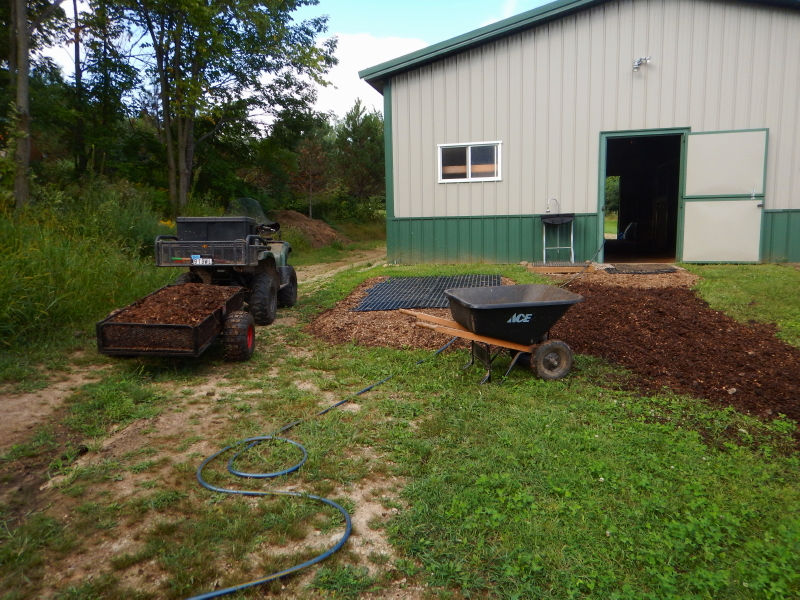 I continue to use the oldest, bottom level of partially composted material as clean fill in a variety of places around our property, but I’m guessing there might come a day when I run out of a need for that kind of use. Maybe by the time that happens I will have perfected a system that allows me to offer (sell?) bagged horse manure fertilizer to interested gardeners as a means of distribution.
The current challenge has been moving the pile around to provide access to that base level of compacted material I want to use. Yesterday, when I was doing so, it became obvious how quickly the composting dries out an inside layer. The pile always seems so wet to me that I haven’t been worrying about adding moisture, but the light bulb came on when I saw the dramatic difference as a result of trying to move the entire upper level to a new location. I got the hose out and watered the pile, and Delilah. She absolutely cannot resist chasing water from a hose.
Unfortunately, that meant she was trying to chase it through manure. Not a pretty picture.
Shitty Education
In the time since our horses arrived late last September, we have been stockpiling manure in one primary location. Based on information Cyndie gathered, we roughed out a spot that we guessed would be large enough. That was about as far as we went in terms of a plan of action for manure management.
In my naiveté, I thought we could start piling at the back of the clearing we designated, and just keep dumping new loads toward the front. If it timed out right, we could access the pile from the back to remove old composted manure for use as tree food and fertilizer for Cyndie’s plants. I planned to scoop the front of the pile with the loader on our tractor, to stir and aerate the material, moving the composting manure back and making new space for fresh loads to be dumped in front again.
The more informed method involves an area divided into 3 separate sections. This allows the first pile to become fully composted and ready for use, the middle one to be in process of breaking down, and the last one for dumping fresh manure.
My system didn’t work the way I imagined because our method of dumping full-wheelbarrows ended up filling the designated space all the way to the front in a very short amount of time. Instead of dumping somewhere beyond our designated space, I chose to go up. I created a ramp and we just kept adding fresh manure on top of the previous batches already beginning to break down.
That has led to a pile with layers in varying stages of decomposition. It is obvious our pile shrinks over time, depending on how much new manure is being added, but the two key elements to accelerating the breakdown are the optimal amount of air and moisture, and our pile hasn’t been getting the correct amount of either. Our location is not covered, so I figured we would suffer from too much wetness, but the process of decomposition uses up moisture and will cause dry spots that interrupt decomposition if not stirred.
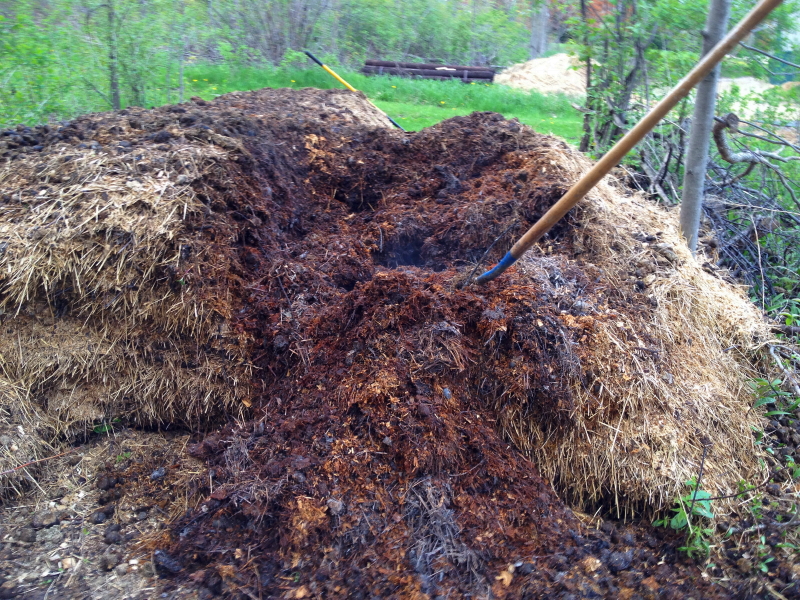 Yesterday afternoon, after I got home from the day-job, I cut deep into the back of our manure pile for the first time. I wanted to move some material from the pile that was already composting, down to the new location I created by the labyrinth. The impetus for that was our desire to give our newly transplanted tree at the center of the labyrinth a dose of horse manure fertilizer.
Even though the tree is showing signs of new buds along its trunk, there is no indication that the buds at the ends of the branches have any life in them whatsoever. It is really testing my patience.
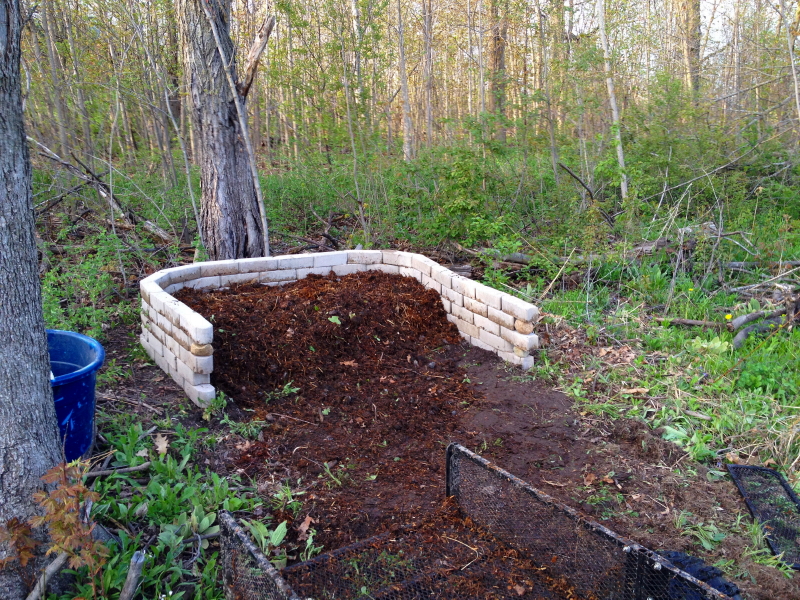 So, I was able to cut into the main manure pile and get educated about what is going on down below, and I got enough cinder blocks stacked to create the start of a satellite pile where I will be better able to control the rate of composting.
Best of all, it will be conveniently located near the garden of plants that help define the form of our labyrinth path.
.
.
.
.
.
.
.
.
Many Firsts
In our new world of country living on 20 acres with horses, cats, and a dog, 2 tractors, an ATV, a spare pickup truck, plus 3 outbuildings, we frequently find ourselves facing tasks with which we have no previous experience. Yesterday’s ‘first’ was using the diesel tractor to clean manure in the paddocks.
Our horses arrived at the end of September last year, so this has been our first winter with them. After the fall season in which we tried to clean the paddocks almost daily, the winter weather introduced a whole new challenge to our system. The snow covers and freezes the daily accumulations and we pretty much stopped trying to do any cleaning at all.
I asked our neighbor, George, how they deal with the situation at their farm. He stated matter of factly that they just wait until the snow melts and then scoop out the entire top layer of soil and manure. I fear ours will be a muddy mess that will keep our machines out of there until summer, so I was weary of how simple he made it sound.
Last week, while out shopping for hay nearby, we drove from the east on the county road that passes just south of our place. It was the very first time I have traveled that stretch of road since we moved here. We had yet to see the view of our place from that direction in the year-and-a-half we have been here.
While we were out on that trip, we noticed a farm where they piled the manure right inside their paddock. With all our snow finally melting, the months of manure are getting revealed in our paddocks, so I suggested we consider doing the same. The mess in our paddocks is big enough that I figured we would need to use the tractor, but I was unsure about whether I could successfully navigate the challenging terrain. The driveway was melting and would be a mud pit. The snow was still deep in some areas and the wheels of the tractor might not get me through. The ice could leave me spinning in place.
While surveying the situation, Cyndie spent precious time brushing out the shedding coat of each horse. I tried raking some manure by hand, and quickly learned it was still too frozen to be very effective with that mode. It would definitely take the power of the tractor to make any measurable progress.
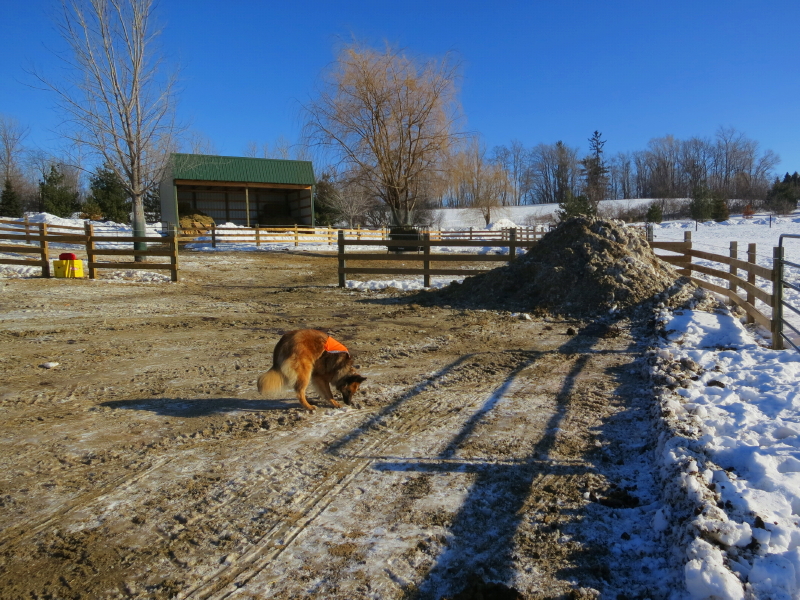 In hindsight, I think we picked the perfect day for this task because it was a day when the temperature stayed below freezing. The tractor was able to make good progress in scraping the top layer of accumulated manure, and in so doing removed a lot of snow. If we had tried this on a day when it was warmer it would have been a muddy mess.
We ended up with a giant pile in one corner, but that should shrink significantly when the snow portion melts away. I think we did pretty well with our first try at using the tractor to clean the paddock. It was, in fact, one of the primary reasons we anticipated needing that tractor in the first place.
.
.
.
.
.
.
.
Opportunity Aplenty
Here are some of the issues that are crowding my realm of possibilities this morning:
Our male cat, Mozyr, has fallen into the behavior of peeing on our bed. I’ve been told that once that gets started, it is unlikely to change. We must deal with this immediately. I hate that stench.
 We are getting more than enough urine smell from our manure pile. I had no idea what was involved with manure management, and I’m thinking now that the spot we selected seems undersized. I still feel like the location we selected is good, even though the smell sometimes wafts up toward the house, but I fear we may need to take out a few additional trees to expand the square footage.
Speaking of taking out trees, I now have all the equipment to do some serious lumberjacking and there is a dead tree on a corner of our property by the road. It is a chore that is overdue to have been started. Every day that goes by, the task feels more delinquent.
We spent time yesterday testing out the Grizzly ATV for assisting with cleaning up manure in the paddocks, with mixed results. The manure is frozen in multiple layers and much of it covered in snow. We tried both dragging the rake and pushing with the blade. Each seemed to make improvements, but manure that gets collected still needs to be scooped up and moved. That remains and laborious and lengthy endeavor.
I’m supposed to be clearing out our storage corner in the basement. In my search for a solution to the fractured triangular window beside the fireplace, I have connected with a local builder who stopped by to measure for the replacement. Over the phone I mentioned that we also were interested in having a storage room built in our basement. That seemed to go a long way toward enticing him to take on the window replacement. Now I need to get that space ready for the basement work to commence.
It is now nearing the middle of January and I never got around to preparing engines for winter storage. I understand that the primary reason engines fail to run well, or to even start, is leaving old gas in them over the off-season. I am my own worst enemy there. I have a hard time keeping my engines running properly, because I have a hard time getting myself to prepare them for the months of storage.
I took the mower deck off the little Craftsman garden tractor last fall, then flipped it over to be cleaned and to remove the blades for sharpening. It remains where I placed it, untouched.
I’ve got a half-built fence awaiting my attention down the hill from the house. The first snow of the season put that project on hold, but when it’s not bitterly cold, there is progress that could still be made there. I’m afraid the fence has gotten lost in the blur of other work that needs attention.
Meanwhile, we have plans for a Wintervale web site to market Cyndie’s services as a leadership trainer and to offer seminars and retreats here. The “under-construction” image is as far as we’ve gotten.
I’m sequential in nature, so I’d like to go back and get the first things done, so I can move on to the next few, but life doesn’t work like that. I’m back to playing “Whack-a-Mole” with whatever pops up in the moment.
Yesterday, since I had the Grizzly out, I ran it up and down the driveway to clear off the drifts that had developed over the week of historically cold temperatures. It was pleasing to so quickly and easily “whack” something from the list.
.
.
.
.
.
.
Too Fun
 It is a good thing that I chose the 8-cubic-foot sized wheelbarrow when I recently shopped for one with two wheels. Anything smaller and we would be making a lot more trips in and out of the paddocks to dump it, and anything larger and we wouldn’t be able to push it when it was full. I have been removing between 16 and 24 cubic feet of manure at a time, every few days, when I get around to tending to the task. When that wheelbarrow is full, it is very heavy to push.
Unfortunately, my grip is failing me, which doesn’t help when moving a heavy wheelbarrow, because the inflammation through my carpal tunnel (both left and right) is raging day and night lately. It seems that everything I do is an irritant, and my thumb and first two fingers go numb when typing on a keypad, when gripping a rake or shovel, scooping manure, moving the wheelbarrow, holding a steering wheel, gripping the wood splitter, or sleeping at night. It even bothered me while trying to hold a fork during dinner last night.
One would hope that the sleeping wouldn’t be a problem, because my doctor prescribed wrist braces to keep the hands in a neutral position all night, but 4 o’clock in the morning is a time when the pain and numbness seems to bother me the most.
It probably doesn’t help that I have started to frequently throw a ball for Delilah to find. My arm is killing me from repeated attempts to throw farther than I am realistically capable. But hope springs eternal, and I continue trying to throw that thing as hard as I can. It is just so irresistible to watch Delilah use her nose to hunt the ball down, returning so proud when she comes back to me with it clenched in her jaw.
It took her a while to get the hang of the game, but now she behaves as if she understands exactly what I am saying. If she didn’t see where I threw it, I tell her she needs to find it with her nose, and she will start traversing back and forth across the yard in front of me, nose to the ground, as fast as she possibly can. At first, I would just throw into the mowed grass, but I quickly increased the difficulty by throwing into the woods. It boggles my mind that she can find it in there, especially when she has lost track of what direction I threw toward. I will go back to splitting wood while she hunts, often expecting she will never find it, and then suddenly, she is at my feet, with that ball in her mouth, hoping I will throw it again.
It is a game that has become too much fun for both of us.
Final Preparations
I took advantage of being home on Monday and whittled away at the list of things we want done before the horses arrive. Cyndie had to work, so I was left to choosing tasks that I could accomplish alone. One of the big ones for me was to finish preparing the area we have set aside for manure management (just in case the 4 horses happen to produce any manure).
 We selected a site last fall, and did some initial clearing. At the time, it seemed like the perfect location, if only we could remove some stumps. We cut into the bigger of two that were right in front, to see if it might come out with minor effort. It didn’t. Elysa’s friend, Anne, volunteered to work on it, because cutting out a stump appealed to her. She made great progress at the time, cutting through all the roots around the perimeter, but the stump held fast.
Early in spring, when Cyndie initially began cleaning out the stalls in the barn, the old sawdust and wood chips got dumped behind and beside the stumps. We ended up ignoring the area for most of the summer, and it grew tall with weeds and some grass. Yesterday, I brought out the chainsaw and made all the stumps disappear, both front and rear (sorry, Anne). Now we are set to dump manure from the front side, and remove it from the back side.
It is another one of our visions realized.
 It will be easy to access the manure composting area off the new road that comes around the back side of the barn. Turning around from the view of the [future] manure pile, I took a picture of what the back side of the barn looks like.
We’ve got some spare gates remaining, which will likely get used in a next phase of fencing, whenever that occurs. Speaking of gates, my next project was getting chains installed to latch all the gates in the paddocks. That was definitely a priority to be done before the horses arrive.
When Cyndie got home, she helped to roll some big rocks into the bucket of the diesel tractor. The semi driver scouting our layout said he could back down toward the barn if the rocks weren’t there. We’d been meaning to move them ever since they were dropped on that spot at the start of our re-landscaping project, so we promised him they would be gone.
Now the rocks are back by the labyrinth.
In the evening, before we turned out the lights and closed up the barn, we turned on the electric fence to confirm everything was in working order, and then proclaimed the place ready for horses.
Today, I will mount some hardware to create tie-points where Cyndie wants them, to secure horses during saddling or other tasks. I will pick up some grain from the feed store. I will bring our collection of pallets down to the hay shed, to place under the bales of hay.
We are one day away from the planned arrival.


 Relative Something