Posts Tagged ‘landscaping’
Pushing Back
Cyndie put in a heroic effort yesterday to win back our river stone patio on the side of our house. The ground cover growth had overtaken the surface with such gusto that it looked like our property had been abandoned.
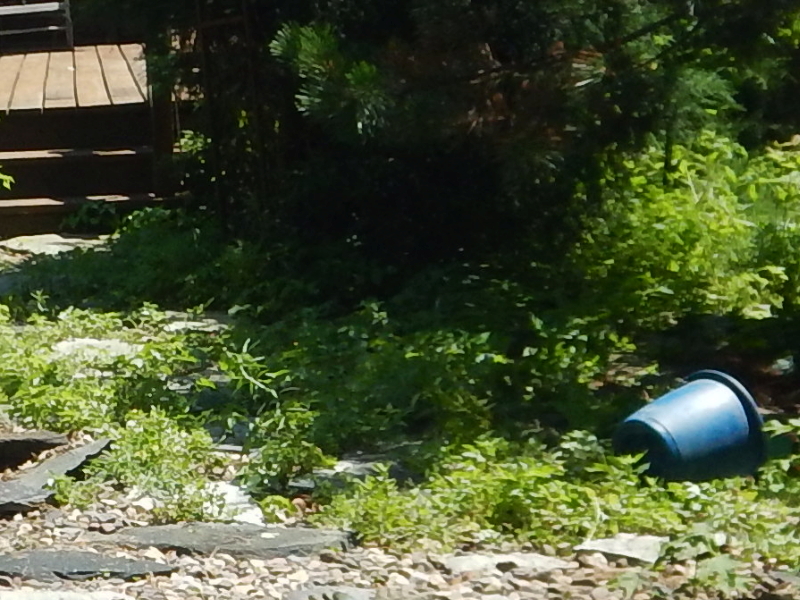
Our summer weather has been very friendly to growing plants this year, both the wanted and the unwanted.
I pulled in the driveway after work one day last week and came upon a curious row of garbage bags filled with plant remains. My first thought was, now what?
Earlier in the summer, after our visit from the regional DNR Forester who taught us about the importance of controlling the invasive garlic mustard, Cyndie did a super job of focussed eradication. He emphasized the requirement of bagging and discarding the plants that have been pulled from the ground, because if you leave them lay, they will simply put down roots and regenerate. So bag them, she did.
I was going to be shocked if this large new collection of bagged detritus lined up on our driveway was from a previously undiscovered patch of garlic mustard.
Upon my inquiry, Cyndie described thinking she was just going to pull out some wayward unwanted growth under the pine trees in our front yard. Turned out to be a massive woven web that went on and on and became a full-fledged landscaping project in its own right.
To be safe, based on what we learned about the garlic mustard, she decided to bag it, just in case.
Yesterday’s growth wasn’t so threatening, just prolific in an open area of river stones.
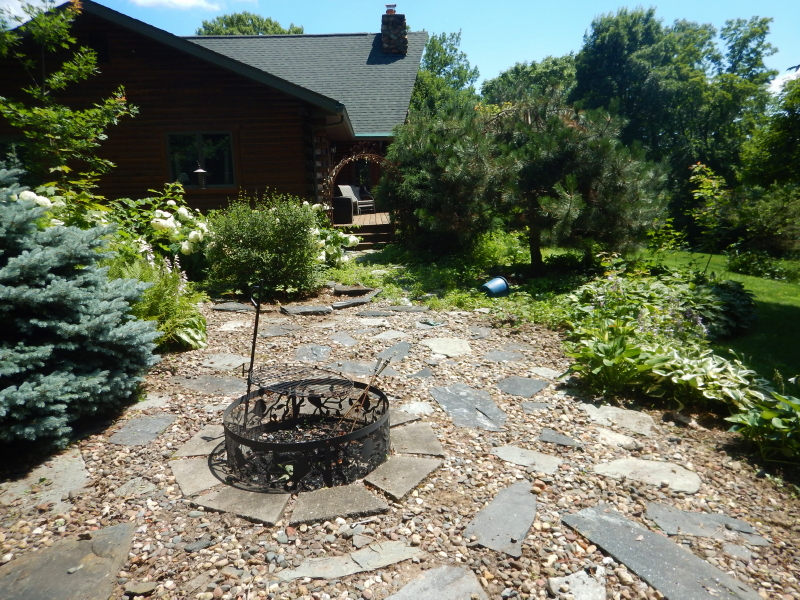
Luckily, the recent heavy rain (3-inches on Thursday) has softened the soil to ease the extraction of unwanted growth. Cyndie produced impressive results reclaiming our patio area in the high heat of a classic July day yesterday.
.
.
Spontaneous Transplantation
Last night presented one of those moments that would unfold without us having a clue where it would ultimately lead. Thankfully, due to Cyndie’s willingness to run with it, we took a step that was long overdue.
She transplanted some volunteer sprouts of oak and maple trees.
It started with her walking the dog and me doing some work in the shop. I had the door open and some music playing. Suddenly, Delilah popped in to say hello. Cyndie paused to trim some growth around the vicinity.
While pulling weeds, she discovered the saturated ground made it easy to pull out the new tree sprouts.
We’ve been talking about transplanting trees for weeks, but never really formulated a plan on where they would go when we finally take action. Since she now had a stack of multiple beauties fresh out of the ground, it presented an urgency to decide on a new location for them.
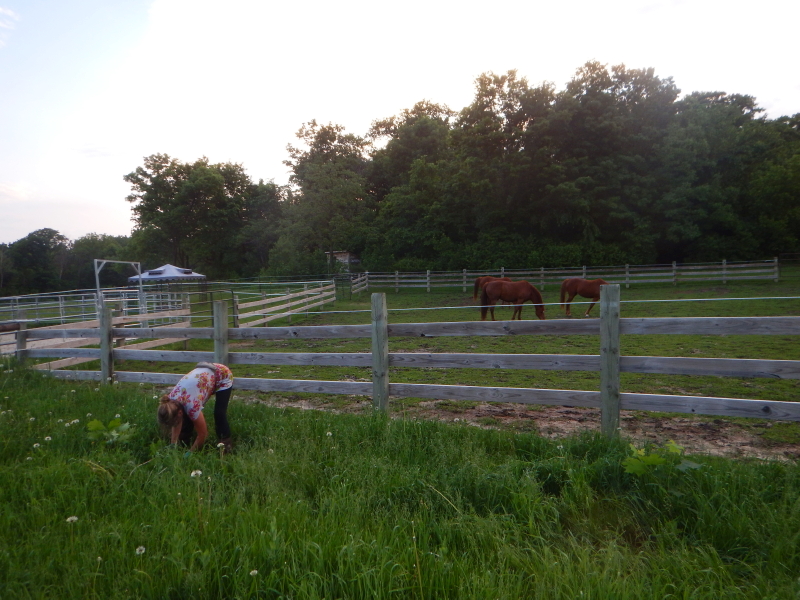
I honestly have no idea why I didn’t come up with this before, but it hit me in an instant that planting them just outside the paddock fence would someday offer a natural shade for the horses inside the fence.
 So, that’s what Cyndie did.
It will require some care to give these babies a fair chance at survival, but given the vast number of new sprouts showing up every spring, we will always have plenty of opportunities to try again, in case of any failures.
This is another thing that I would love to have done years ago, to have already taken advantage of that time for growth. The shade I’m looking forward to could be a decade away, to get the trees tall enough and filled out enough to cast a useful shadow.
It’s like our story about growing our own asparagus. People told us that it takes at least three years after planting to start harvesting stalks. For some silly reason, that information repeatedly caused us to not take action. Inexplicably, our response to something that required waiting a significant amount of time for results was to do nothing. Over and over again.
After three years, I mentioned that if we had just planted some when we first talked about the possibility, we could be harvesting already.
 Then Cyndie came across the brilliant idea of not planting from seed, but buying a 2-year-old plant and burying it in the ground.
We are learning to get out of our own way.
In this regard, the spontaneity becomes our secret weapon. We will always get more progress if we just do it, and not wait for the “perfect” plan. We need to not worry so much about the possibility of failure.
My old mode of thinking involved not wanting to work hard on planting trees if they are just going to die, but I’m getting over that now. Maybe the four tries to succeed in the center of our labyrinth have softened my resistance.
We transplanted this group yesterday without any planning or preparation.
I have no idea what the result will be, but at least we have taken the required first step, thanks to Cyndie’s adventurous spontaneous effort.
.
.
Nice Out
It seems like I have fallen into a heavy rotation of posts about the weather, or at least, heavier than what I’ve normally referenced since starting this blog so many years ago. Living in the country with acres to tend and animals to care for has a way of amplifying the significance of the weather, particularly when the conditions are extreme or out of the ordinary.
 As we enter the last week of April, finally having warm sunshine be the order of the day is unleashing a sense of urgency for getting into the outdoor spring chores. We started first thing in the morning yesterday, building a fire outside to burn combustibles from Friday’s garage clean-up that didn’t fit in our trash bin.
While we were out on that side of the house, we also moved all our outdoor furniture back on the deck, trimmed shrubs, and raked around the landscaping.
The afternoon was focused on the labyrinth. Cyndie did some plant pruning and raking, while I busied myself with reorienting and balancing rocks that had been felled by the long winter.
I was in the woods, digging up some additional rocks, I felt something on my eyebrow that I thought was debris that had kicked up, but when it didn’t just brush away with the back of my gloved hand, I paused. Removing my glove to better reach behind my sunglasses, my bare fingers were able to extricate a tiny tick. Most likely, a deer tick.
Happy spring!
At least it’s finally nice outside.
.
.
Occasional Rain
One of the things I was intrigued by during our week in Punta Cana was the occurrence of daily passing showers. It often happened without warning. Sometimes the drops appeared to be falling out of blue sky. Clouds frequently floated past, though very few actually dumped rain.
The ones that did, provided enough regular moisture, they have no need for a mechanical irrigation system.

The air never felt oppressively humid, but the difference from the dry winter air at home was definitely noticeable. I suppose the breeze off the ocean helps moderate the atmosphere.
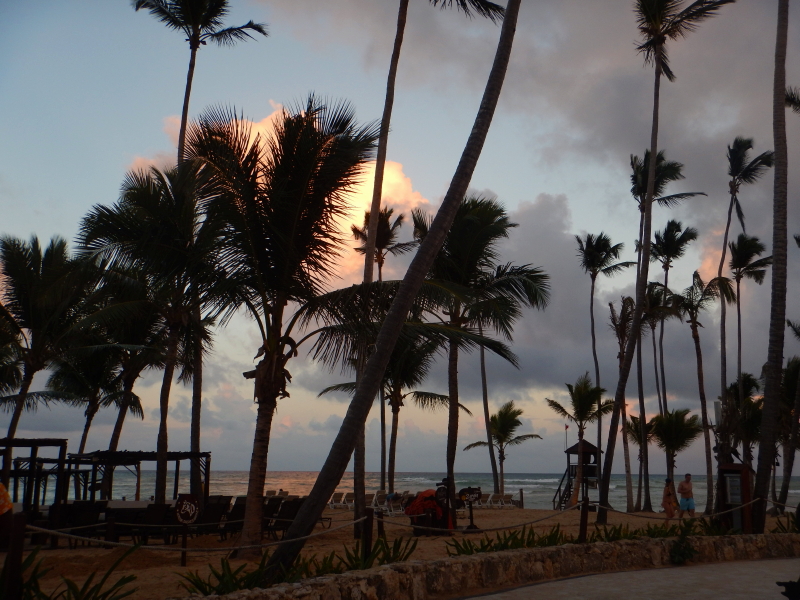
Several times, we walked to breakfast in beautiful morning sunshine, and while we were eating, the view outside would suddenly reveal a soaking shower. By the time we finished eating and stepped back outside, the sun was shining again and the walkways were already beginning to dry.
A couple of times we were poolside for the surprise showers. The shade umbrellas of palm tree leaves provided enough cover to keep our towels and stuff from getting soaked.
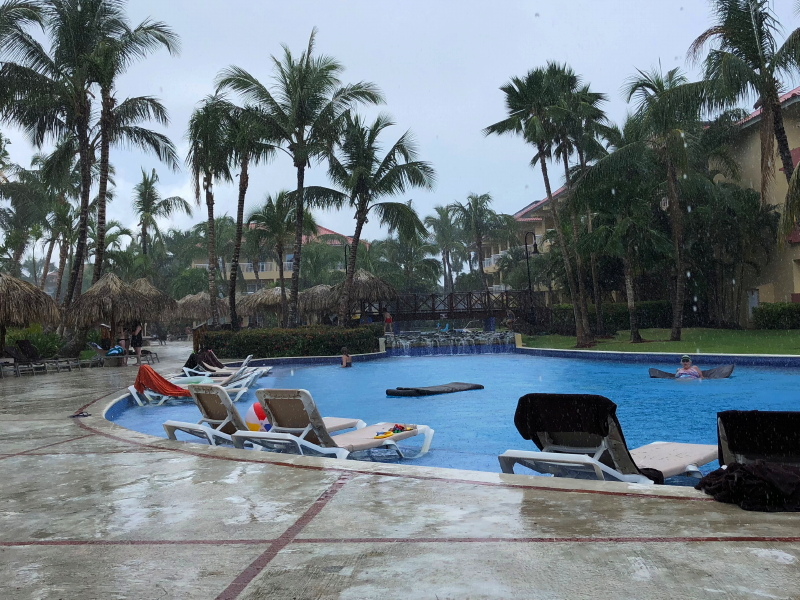
Towels on the recliners in the pool didn’t fare so well.
The frequent, brief soakings seemed like the perfect conditions for growing the lush landscape they maintained daily at the resort. I took note of the machete they used to trim their hedges, even though we don’t have any hedges to be trimmed at Wintervale. The tool produced a very clean line, in the hands of an experienced artisan.
When they closely cropped the grass areas, I felt right at home with the sound of the power trimmer that was identical to what we use along our fence lines and around the labyrinth.
I had to restrain myself from asking if I could help the landscaping crew for a day. Actually, I considered asking if any of them would consider coming to Wisconsin to work on our property, but the timing didn’t seem right.
With our temperatures down in the double-digits below-zero range, there just isn’t a lot of yard work happening around here for a while.
.
.
New Backdrop
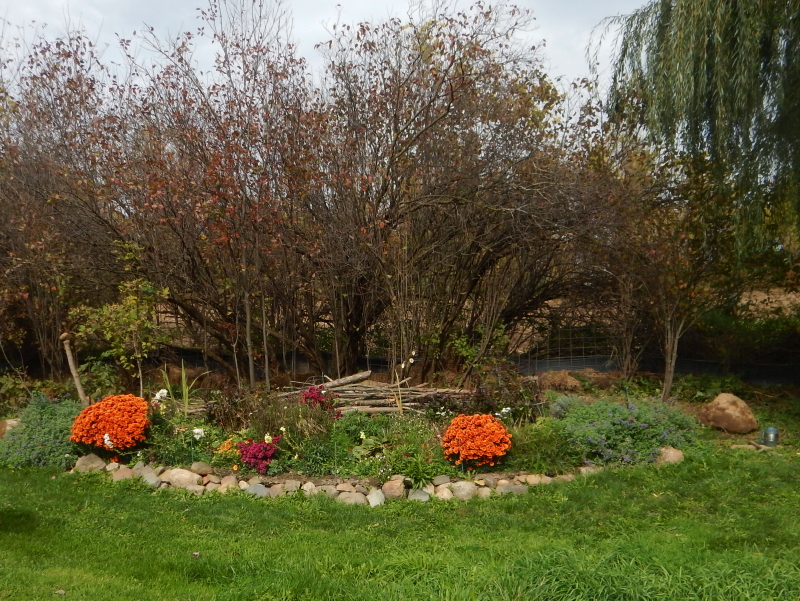
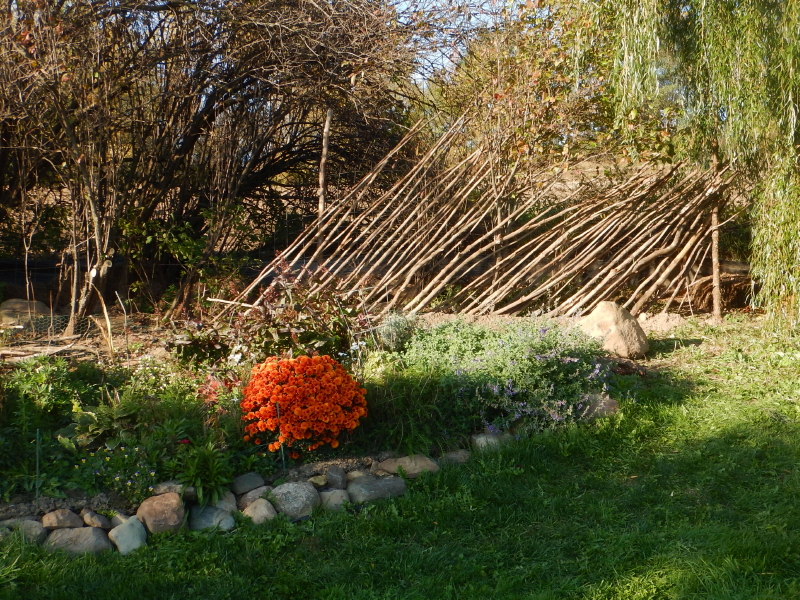
We are creating a new back drop for Cyndie’s wildflower perennial garden near the spot where soil from the neighbor’s cornfield has been pouring over our property line. This will obscure the sight of our less attractive silt fence and hay bale barrier installed to stem the flow of hyper-fertilized sandy topsoil that comes our way with every heavy rainfall event.
 .
.
.
.
.
.
.
.
.
We started collecting a wide variety of branches for the project last year, not exactly sure what the method would be, nor what the ideal branch would look like. Though the added character of misshapen gnarly pieces seemed like a good thing, I quickly discovered that the perfectionist in me was more strongly attracted to a precise diameter of very straight young trees.
I also figured out in rather short order, we are going to need to collect a lot more raw material to complete the project.
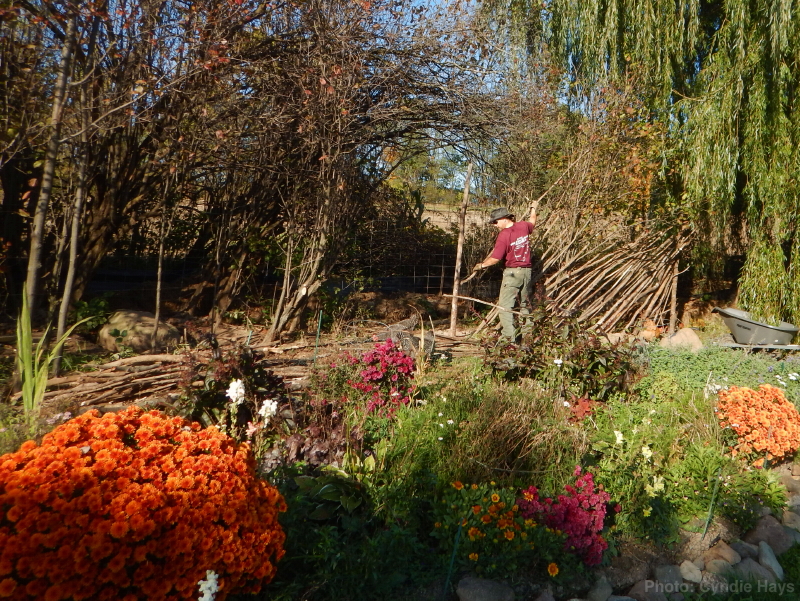 Off to a fair start, though, and have, at the very least, proved the concept. The vision I had involved a more dense positioning of branches than I am achieving, but given the material I am working with, the result is more open. In the end, I think this will work out well enough.
It’s certainly easier to accomplish.
For all the places around our land where we fight to squelch the growth of vines, I’m thinking we should try to encourage some to climb this. That would fill in the gaps nicely.
My favorite part of yesterday’s effort was actually the successful digging out and moving of a rock that was once again on the outer limits of my ability. With Cyndie’s assistance, we used a pry bar to tip it up and force dirt back underneath.
Alternating back and forth to opposite sides, this raises the rock up to the surface without leaving a hole in the ground. Once at the surface, using the pry bar, we can get it to roll into a desired new position. The rock is visible on the right, in front of the new fence, in the photos above.
I expect there will end up being an additional rock balanced on that one sometime in the future.
It’s a challenge to tip rocks up when they weigh more than me. There are limits to how much leverage advantage I can achieve. There was another rock uphill from this one that was over twice the size. I would have loved to raise that one to the surface, but I wasn’t strong enough to tip it more than a fraction.
Cyndie couldn’t push enough soil beneath it to make any appreciable progress. Given that our primary goal was to build the fence, we left the boulder for a future challenge, should we ever be so inclined.
.
.
Triple Fenced
The heat and humidity have broken and it finally feels a little more like September now. We were expecting the transition to involve a lot more rain than showed up yesterday. The line of precipitation slowly moving west is doing so at an angle that is sliding from the southwest to the northeast and for some reason, most of the rain moved around, rather than over our region.
Ironically, now I am wishing we would actually receive a heavy dose of rain, because last Friday we put a lot of energy into shoring up the silt fence at the property line adjacent to our neighbor’s corn field. In fact, we turned it into a bit of a terrace with three-tiered layers of silt fence.
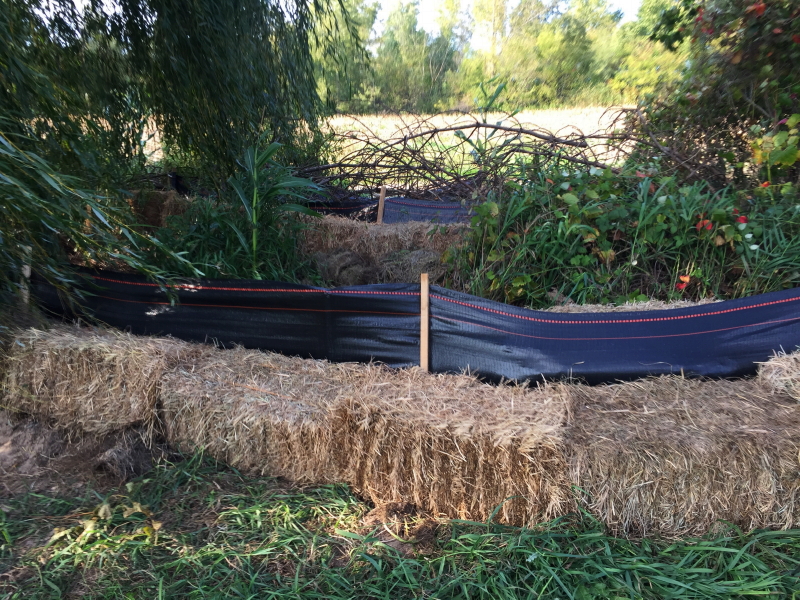
The first two are short sections to slow the flow before it reaches our long fence. Between the top two sections there is the skeleton frame for a berm, in the form of piled dead pine trees. The soil runoff will accumulate around the branches and hold them in place. Eventually, weeds and grasses will grow through the branches and that forms a nice natural barrier that will hold soil in place but allow water to flow.
We have added support to the fabric fence by using old hay bales that we can’t feed to the horses because they have gotten moldy.
If I am able, I hope to trek out there in the middle of heavy rain to observe the action as it happens. At the very least, I now know that we need to check it after every big rainfall and remove excess soil if it accumulates.
I don’t know why I originally assumed the soil fence wouldn’t need regular maintenance, but after the soil conservation consultant pointed it out so very matter-of-factly, digging out accumulation makes total sense to me now.
If our enhancements work to mitigate the mud overflow messing up that area, we will be one step closer to being able to enjoy a good cloudburst when it happens. There still remains a problem in the paddocks, where a terrace or silt fence is not an option.
We plan to do some digging to create a couple of better defined routes directing runoff straight to the drainage swale beyond the wood fence, hoping to reduce the amount of flow traveling to one spot with energy that washes away our precious lime screenings and creates a deep canyon of a rill.
It’s fine if a little flow goes that way, but it is currently a problem because most all of the flow is combining to rush sideways along the fence, instead of straight under it out of the paddock.
The trick in the paddocks is, our solution needs to be horse-proof. Their heavy hooves have a way of disrupting all of the simple spade-width channels I’ve created in the past, causing runoff to flow every which way, and ultimately not where we really want it to go.
The next version we have in mind will be scaled up. Maybe I should triple-size it.
.
.
Making Peace
It is getting to a point where I think I just need to make peace with the fact that water runoff on our property will carve its own path no matter what feeble attempts I make to direct it.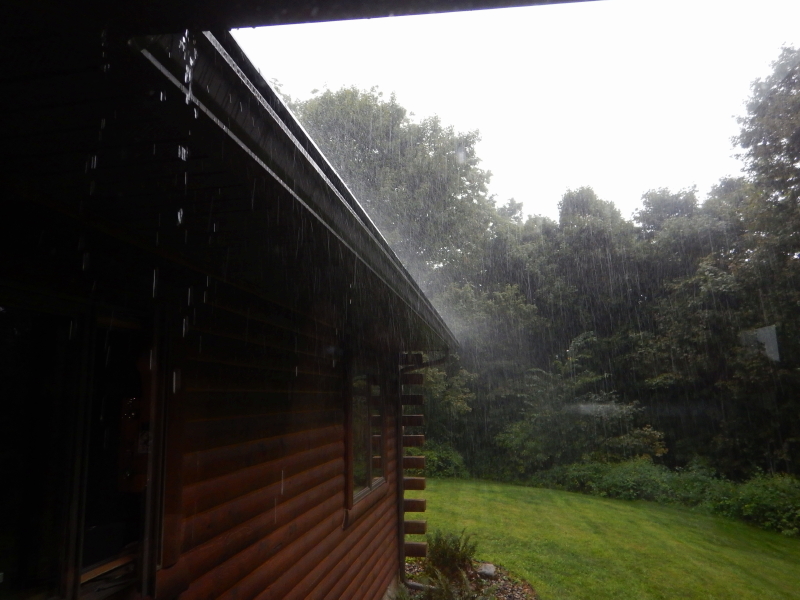
We received another short-but-robust deluge from the rain gods yesterday afternoon, which generated eroding runoff flow digging ever deeper into all the existing rills and washouts that had already evolved from the last few downpours this summer.
While standing on one of the spots inside the small paddock where our insufficient attempts to establish a direct route to the drainage swale had long ago spectacularly failed, I tried to envision what a successful solution might look like.
I picture a much more assertive effort along the lines of what you would see done to create a drainage ditch along a roadway. If we dig an unmistakable ditch, we could dump the material we scoop out of it to fill the washouts we’d rather not have.
The big challenge with a serious excavation is getting planted grass to sprout and hopefully hold soil in place before rainfall gets a chance to wash it all away. If money were no object, maybe we could line the ditch with enough river rock to form a creek bed.
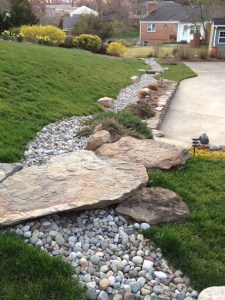 Aw, heck, why stop there? Let’s just line it with a rubber pond skin first, and then pour on the rock. Wouldn’t that make a sharp-looking dry creek that’s always ready for a flash flood. It’s called Rainscaping.
There are a lot of images out there depicting some incredibly artistic solutions along these lines. Fifty dry creek ideas right here! But there is one thing missing from all photos I saw: weeds.
If we tried any of those solutions, in a very short time, you wouldn’t be able to see the beautiful rocks through the 3-foot tall weeds that would happily take root.
Maybe there’s a happy medium in there somewhere. I’m thinking I need grass to grow to hold soil in place, or rocks. How about grass and rocks?
It would be a hassle to mow, though.
Back to reality. The rocks to cover the distances I need would be an awful strenuous effort to accomplish, in addition to the cost of having them delivered. Grass seed is something I can afford and plant easily myself.
It doesn’t cost anything to dream. I like picturing the possibilities. In the mean time, I am stuck looking at the ongoing and frustrating erosion that has had the better of me for the last five years.
I want to work on making my peace with that.
.
.
.
.
.
.
.
.
.
.
.
.
Nature Wins
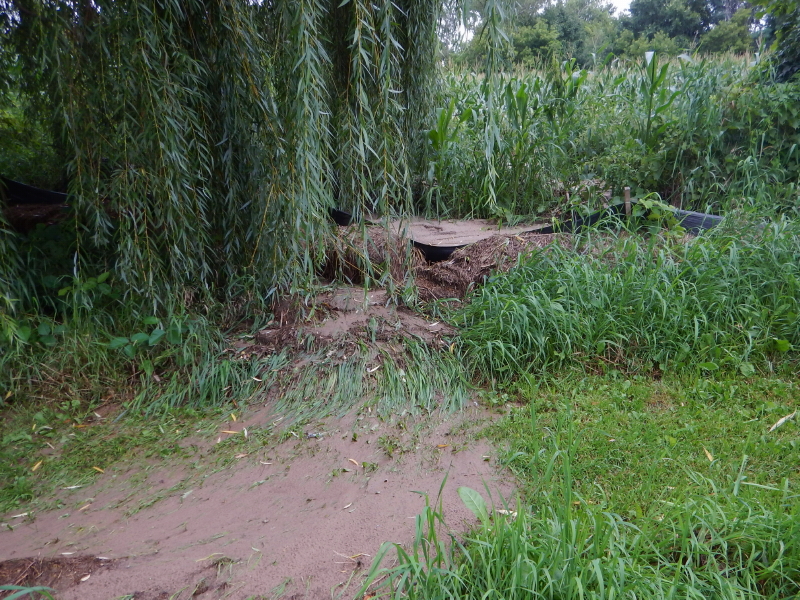 This round goes to Mother Nature.
I’ve heard tell that our warmer climate allows the atmosphere to hold more moisture. With a pattern of increasing frequency, our anecdotal evidence of the years we have lived here is that downpours are increasingly bringing multi-inch totals that overwhelm the old drainage paths.
Overnight Wednesday we received over 2 inches, bringing the 24-hour total to more than 5.5 inches.
When I combine our experience and the recorded data of measurable climbing global temperatures, I get the impression we are seeing the beginning of downpour trend that will, at best, keep happening at this level, or worse, continue to grow more extreme.
This presents a daunting challenge for devising a plan to improve our drainage paths to a point they will be able to handle ever-increasing volumes of massive flow in a manner that avoids major washouts, if that is even possible.
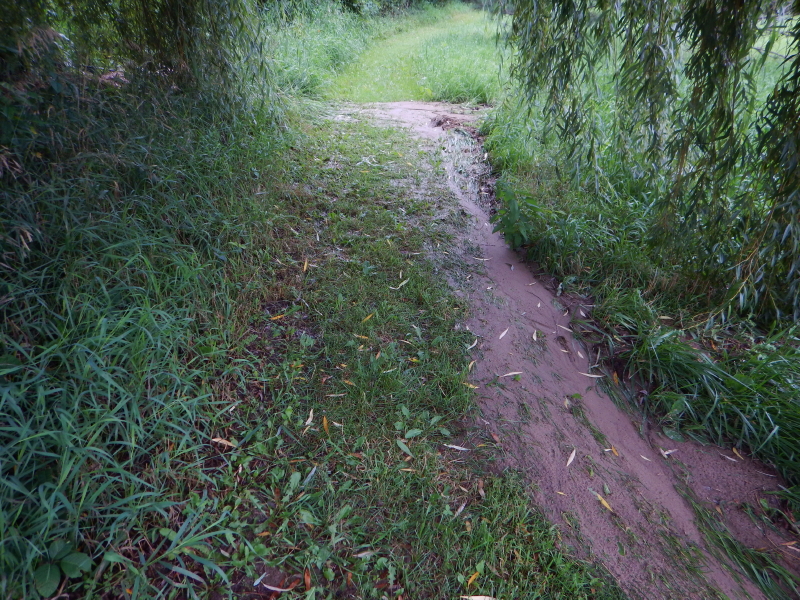 Our attempt to stem the tide of topsoil flowing from the neighbor’s cornfield came up short of successful after not very many storms. I don’t know if there is a more industrial version of a silt fence or we just need to pull out and re-install the one we have, above the new ground level.
Ideally, we would like to enlist the assistance of the neighbor-farmer to get him to not plow the portions of that field where the runoff flows and instead, create a grassed-waterway.
Recent efforts to contact him have thus far failed. I have a sense that his not having already maintained a protective waterway reveals a certain lack of interest in having one, so I’m imagining I may need to be prepared to offer a convincing sales pitch.
I suppose I could pull out the corn plants that washed down from his field and are now growing on our property, and bring them over to his house to see if he wants them back.
If it wasn’t so much work, I’d love to also bring him a load of the mud that poured out of his field and now covers the grass of our walking trail.
Since the rain will likely keep dumping on us, maybe his field will just empty out and that problem will go away. I can switch my attention to marketing the sale of a large amount of sifted soil that magically became ours when it crossed the property line.
.
.
.
.
.
.
.
.
.
.
.
.
.
.
Beyond Me
For me, building our chicken coop was a stretch. I’d never tried any construction project of that magnitude before, and I was choosing to work from found materials and without a blueprint. It was a small miracle it turned out as well as it did.
Now, Cyndie is telling me we need to modify it to have a divider that will allow us to introduce unfamiliar birds to the existing flock of three. Today, a functional version of her vision is completely beyond me. I have no idea how I will secure all the nooks and crannies with chicken wire to a point where two unfamiliar flocks of birds will co-exist for a while in that one coop.
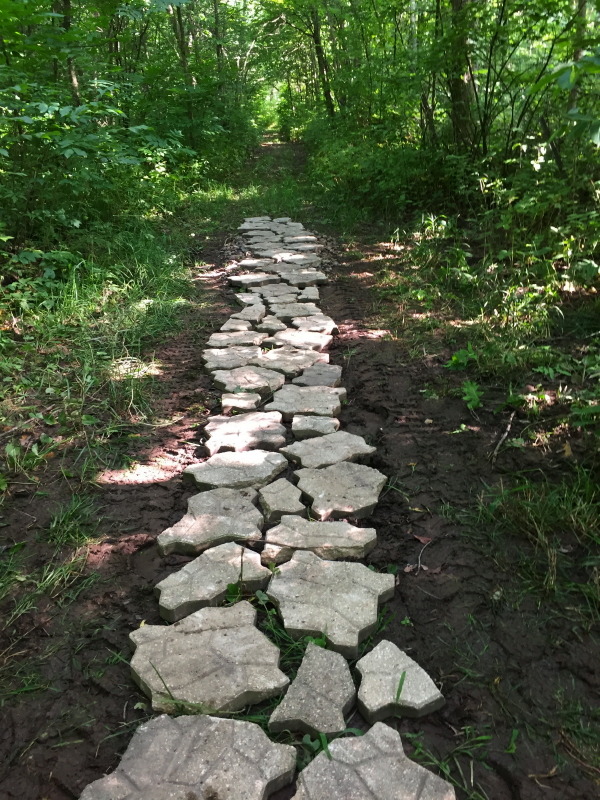
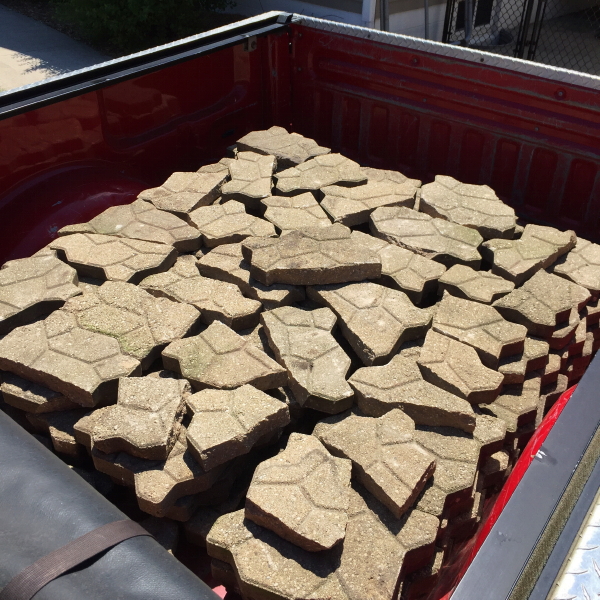 On to something I can do. Yesterday, I put the old F150 to work doing double duty. First, it was a road trip to the cities to pick up a load of unwanted used pavers from a staff member at the day-job. Drew was nice enough to offer them up for free if I would go to his place and make them disappear.
I had a plan to use them on one of the muddy spots on our trail through the woods. Before I could get to that step, I needed to reclaim a pile of rock that I had stumbled upon when creating a path to the new chicken coop last year. There was an old rusty box stove in the woods that I believe was used to boil syrup. It looked to be generations old, and the area around it had some old busted cinder blocks and a pile of landscape rocks.
Those rocks would serve nicely to fill a spot in the trail that tends to puddle, so before setting the new paver pieces in place, I wanted to transfer the rocks.
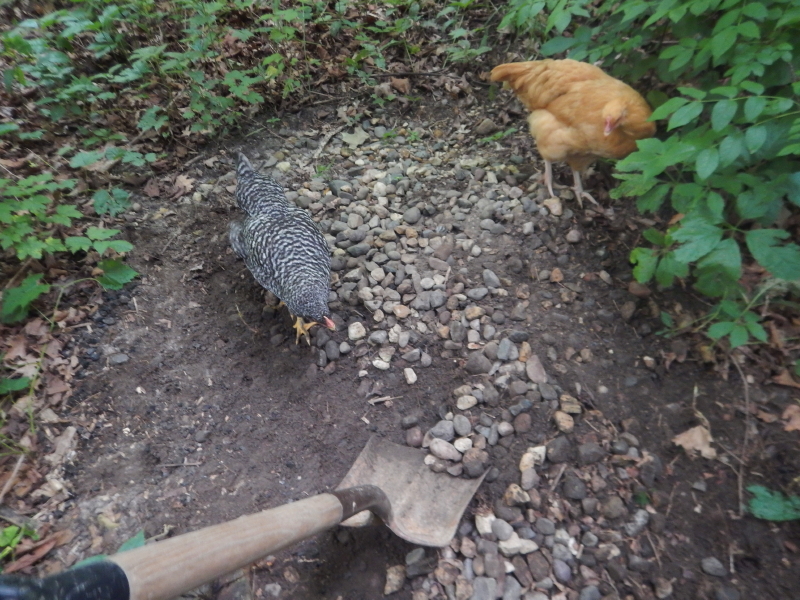 The chickens showed up to help, but were almost too eager to get after the creepy crawling creatures revealed when I scooped a shovel-full. They were more interference than they were helpers, but they sure are cute to have as company.
While the hours of the day vanished, one after the other, I hustled to get the pavers moved out of the truck. We had an appointment to pick up a load of hay around dinner time.
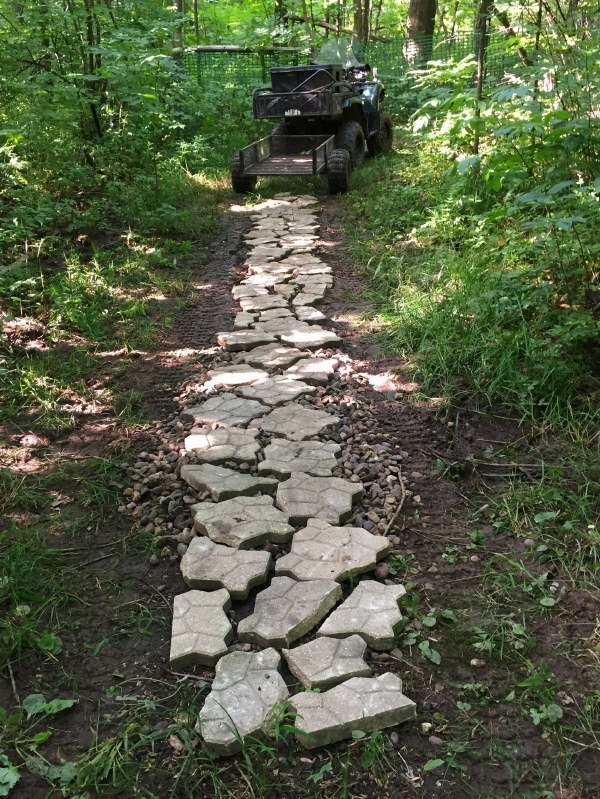
Hoping to minimize the handling, I wanted to transfer from the truck to the ATV trailer so I could deliver pavers directly to the path in the woods.
After a cursory two trips of distributing pavers, I had a good start on the trail, but needed to stack the rest up by the shop for use at a later time. The appointed hay hour was fast approaching.
Given this morning’s new assignment with the chicken coop, I am thoroughly enjoying the mental ease and physical feasibility of yesterday’s projects. New hay is stacked in the shed and pavers cover the muddy trail.
Next time it rains I’ll be excited to walk the enhanced surface of the trail at the bottom of the hill.
 .
.
.
.
.
.
.
.
.
.
.
.
.
.
.
.
.
.
.
.
.
.
Okay Already
I’ll tell. I’ll tell. Enough time has passed that she’s gotten over the shock and trauma and has been able to have a few good laugh-till-out-of-breath moments over her escapade on Saturday.
Cyndie stepped on a rake.
There. I said it. It’s true. Yep. A rake.
I’m pretty sure OSHA would not approve of the unsafe work practice of letting a rake lay on the ground with the tines all pointing at the sky, but she somehow let that happen. How many times can you do that and not suffer any consequences?
Doesn’t matter. All it takes is once…
I gotta clarify, though, this was no standard namby pamby garden rake. She was working with the dreaded level head bow rake. Yeah. Ouch.
It wasn’t a slow roll up to her noggin’ it was a lethal instant THWAP to the head.
Cyndie was under the willow tree at the time of the incident, and a gust of wind blew the wispy branches in her face. In her (probably somewhat out-of-balance) reaction, she planted a foot to catch herself and stomped on the business end of the rake.
The sound made by the handle smacking her skull was frightening. Then, that was followed by equally frightening sounds of her pained reaction.
Thank goodness that’s behind us now and we can laugh about it.
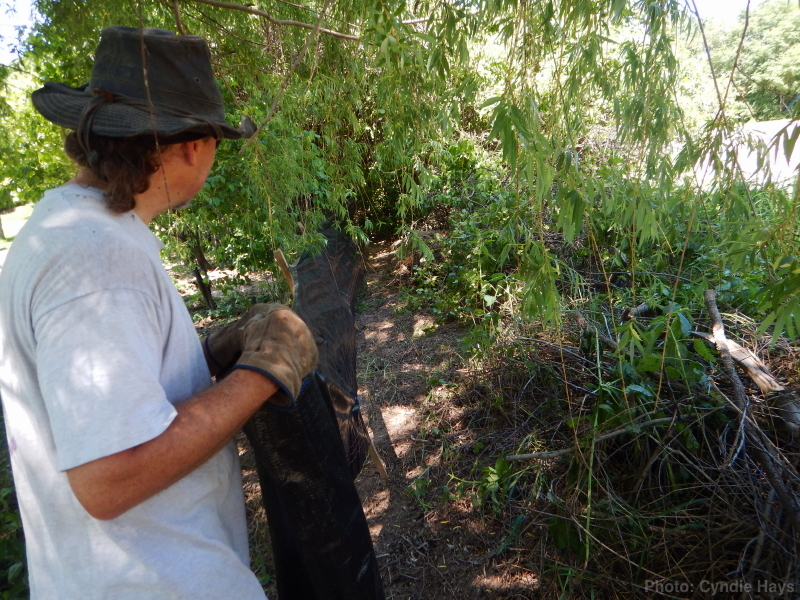
We celebrated her birthday yesterday by installing a silt fence uphill of her garden of flowering perennials which was inundated by the flash flood a few weeks ago. If the bizarre laws of “the way things go” plays out, now that we have this in place, it won’t rain again for months and months.
 .
.
.
.
.
.
.
.
.
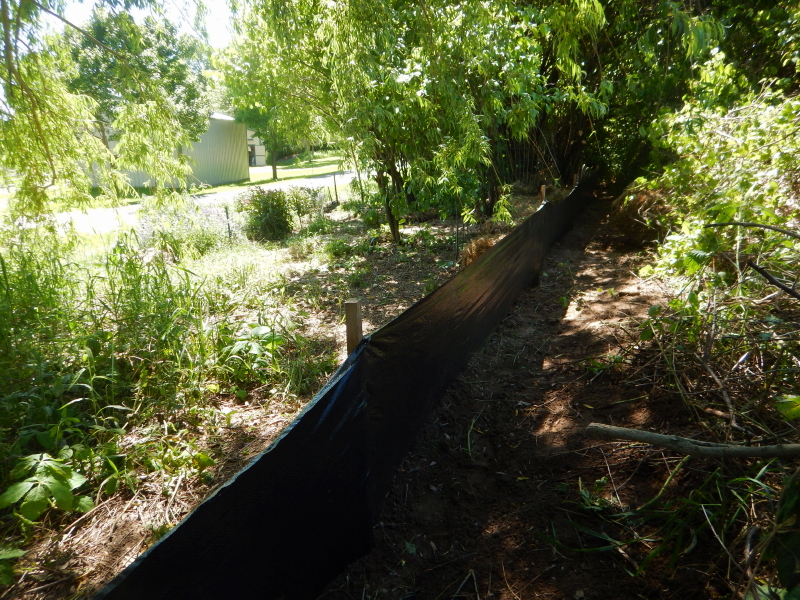
Just in case it does, and comes in one of those all too frequent 4-inch-at-a-time hundred-year events that happen multiple times a year now, we think we have a better chance of controlling the flood.
Time will tell.
Moral of the story, be careful out there. And always lay your rake with the tines down.
Yep, just like the cartoons. WHAM!
.
.
.
.
.
.
.
.
.
.
.
.


 Relative Something