Posts Tagged ‘Hunter’
New Affliction
What now? Last week, Cyndie alerted to what she thought was a cut wound above one of Hunter’s back hooves. She tried treating it by washing and applying an antiseptic and then we went away for the weekend. Upon our return, it appeared to be scabbing over, but it also seemed to be spreading.
An online search produced a pretty accurate match for mud fever. Not fun. She made an appointment with our vet to move up the annual fall visit to today so we can take care of this as quickly as possible.
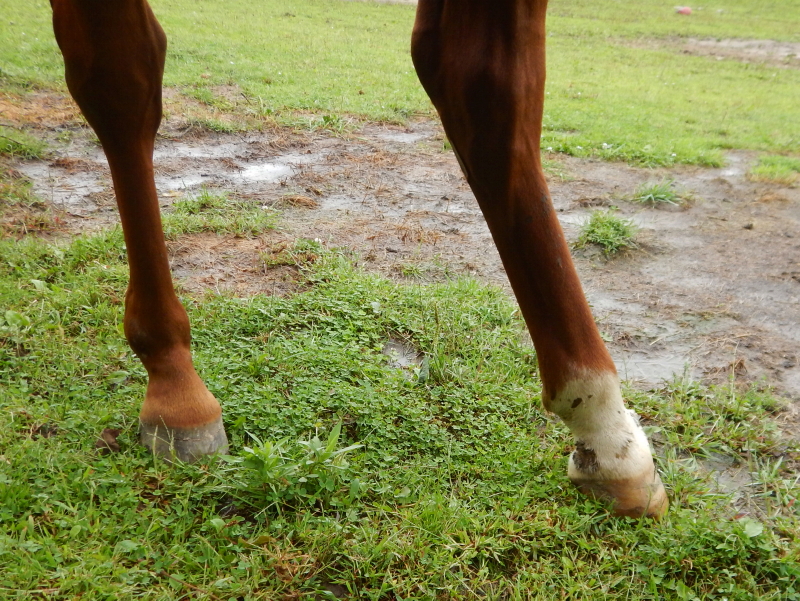 The poor guy appears to be favoring it quite a bit and it is visibly swollen. Cyndie thinks it is getting painful for him, as he won’t let her do anything with it now.
The vet will be able to sedate Hunter which will allow them to clean it up and treat the disease.
We assume the frequent rains and prolonged resulting wetness we have been enduring is a contributing factor. One response to that will be to keep him stabled in the barn. Oh joy.
But I will accept that outcome if it will cut this disease short. From what I have read about it, this pastern dermatitis is not something we want to mess with. It is contagious, difficult to treat, and can quickly become a very serious condition.
Send us some love and healing to Hunter!
.
.
.
.
.
.
.
.
.
Sharing Licks
.
 .
.
Cyndie caught this shot of Hunter and Cayenne sharing time on a mineral block that hangs on a rope around the fence post.
Sure, they are on the block at the same time, but it looks to me like Hunter (on the left) is being as careful as possible about respecting her space.
.
.
.
.
.
.
.
.
.
.
.
Bath Day
We’ve had a really fine few days of summer weather this weekend. Cyndie decided it would be a good day to give the horses a bath. I showed up in time to find Legacy luxuriating in front of the fan to dry.
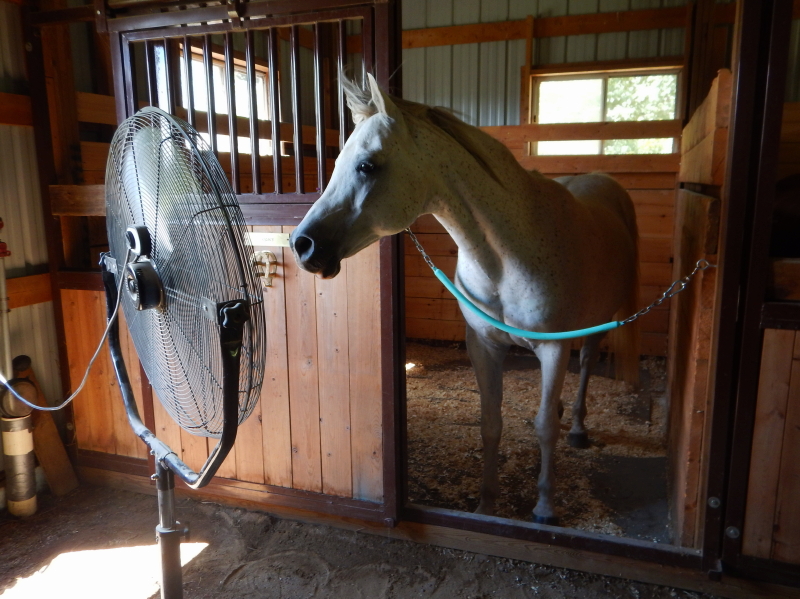 Looking out the door of the barn, I found Hunter in process.
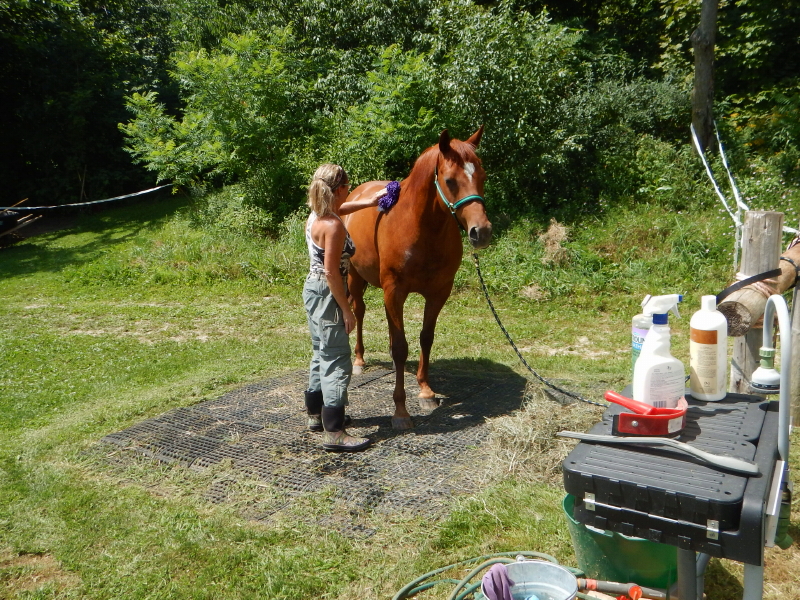 When Cyndie made her way back to the house after tending to all 4 horses, she reported that Cayenne was the surprise of the four, being the one to immediately roll in the dust when let back into the paddock.
 I would have put my money on Hunter.
.
.
.
.
.
.
.
.
.
.
Adding Oxygen
A sure sign of spring being in full swing is when we finally start dealing with the piles of manure that accumulate in the paddocks over winter. Yesterday, I dug into one of the two big ones.
 We generally build up the piles in the paddock and then ignore them. As a result, they don’t make stellar progress in breaking down. However, over time they do settle noticeably. Seeing them get flat is usually a trigger for me to take action to turn the pile.
Since the pile yesterday had been left untended for weeks, it made for a vivid example of the transition possible when putting in the effort to turn it over, reshape it and add air.
The micro organisms that do the composting will use up all available water and oxygen in the pile. If it isn’t replenished, the process stalls. In the case of this pile, the neglect had foiled things before all the moisture was removed, so it was still wet enough, but it needed some air get the process going again.
In the image you can see the old, dry, flattened portion on the right, and the freshly turned, taller pile I was turning it into on the left.
While I was working, Hunter sauntered over to visit. I acknowledged him, but didn’t stop what I was doing. He didn’t move as I maneuvered the pitch fork to toss the pile without hitting him, but only narrowly missing him. He kept inhaling loudly, absorbing the earthy smells emanating from the newly oxygenated mass.
I breathed heavily, right along with him as I worked. Soon, I noticed his eyes were getting droopy. He was just chilling near me as I toiled away.
It reminded me of the time, years ago, when I was just getting to know the horses. Hunter approached me while I was raking up the winter’s-worth of accumulated manure, and he laid down next to me. I was so shocked by his action that I called Cyndie to check on the situation. She seemed thrilled by his behavior and assured me that it was an indication he was entirely comfortable with my presence and I could simply continue to rake while he rested beside me.
It’s precious knowing he still likes to hang with me like that as I work.
.
.
.
.
.
.
.
.
.
.
Four Horses
With Cyndie home full-time this year and me working 4-days a week, I spend dramatically less time with the horses than I did last year. On Thursday, Cyndie asked me to feed the horses when I got home from work, because she wasn’t going to be home, and I found myself lingering with them afterward.
.
.
The young ones, Cayenne and Hunter, cooperated in some mutual grooming.
.
.
.
.
 .
.
.
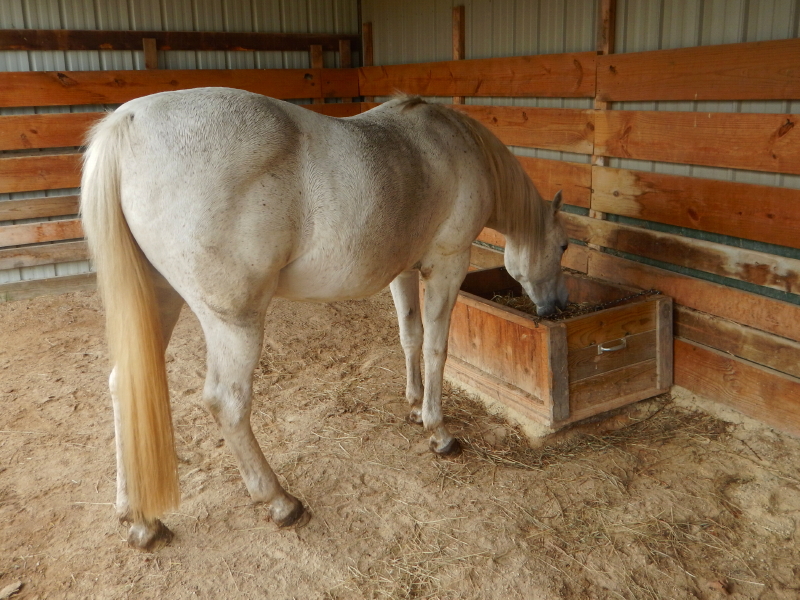
Legacy was test tasting a sample of the new hay Cyndie had brought home.
.
.
.
.
 .
.
.
Dezirea appeared to be standing watch. She is a very good lookout.
.
.
.
.
Yesterday, while I was working on distributing piles of compost to trees around the property, I looked up and spotted Dezirea laying down in the pasture. It was late in the afternoon, about the time they would be coming up to the barn for their evening feed, and it alarmed me to see her down at that hour of the day.
I hustled that direction and hollered to Cyndie, who had walked past the horses minutes earlier. I was curious how long Dezirea had been down. At the same time that I got Cyndie’s attention across the field, our hollering rousted Dezirea from her brief slumber. She stood up right away and quickly rendered my query to Cyndie, moot, although I still learned she hadn’t been down when Cyndie walked by earlier.
So, that was a really short nap.
Sorry, Dez, for so loudly disrupting your rest.
.
.
.
.
.
.
.
.
.
.
Teaching Manners
This weekend I was blessed to witness a brief moment of unmistakable horse-communication between three members of our herd, and Hunter had me laughing out loud. If ever there was an occasion to read human intent on animal behavior, this seemed spot-on.
We have a pile of manure in the paddock, leftover from winter, that is a few feet from the fence. Even though it creates a constricted space, the horses rarely let that interfere in their direction of travel. When I turned my attention to the horses, Hunter was intently straining to reach grass under the fence as far as his contorted neck would allow.
 Suddenly, Legacy decided to pull rank and move in on that same spot. Hunter obediently walked away on command, but as I watched, he circled around the pile of manure and paused to review the situation. It seemed as though he made a decision to press on the boundaries of herd leadership, …or maybe he just really wanted back on that grass under the fence. Hunter walked around Legacy and began grazing just uphill from him, about a foot away from the spot which moments ago had been his.
Legacy didn’t get ruffled by this apparent challenge. He simply made a clear gesture that he was claiming the whole area, and Hunter needed to go, again. The youngster’s reaction seemed pretty obvious to me. Hunter obliged and stepped away, but this time he lifted his tail and let loose with a perfectly orchestrated reverberating fart toward Legacy while leaving.
Even though I laughed at how perfectly it seemed to communicate how he probably felt about the situation, I assumed it could have been a coincidental occurrence, until I saw what Cayenne did in response.
She immediately came from the far side, stepping between that pile and Legacy so she could get on Hunter’s flank, using her energy to push him away, and not just a little bit. She stayed on him for an extended time, keeping him moving well beyond where he would have chosen to stop. I was struck by her persistence. In fact, Hunter finally had to lift his leg in a gesture of preparing to kick, in order to get her to finally back off.
It was all quite a show for me. Cyndie said it is the mares who teach foals and geldings manners and appropriate behavior. I got the impression she was saving Hunter from unknowingly picking a fight with the leader over something that wasn’t worthy. It was as if she saw the pointed flatulence as so disrespectful that she needed to convey he wouldn’t want to receive what the gesture might invite.
Each individual act I witnessed was interesting, but in concert, it was fascinating and thoroughly entertaining display of the equine educational system in action.
And who knew they could use their flatulence with such obvious intent?
.
.
.
.
.
.
.
.
.
.
Feels Like
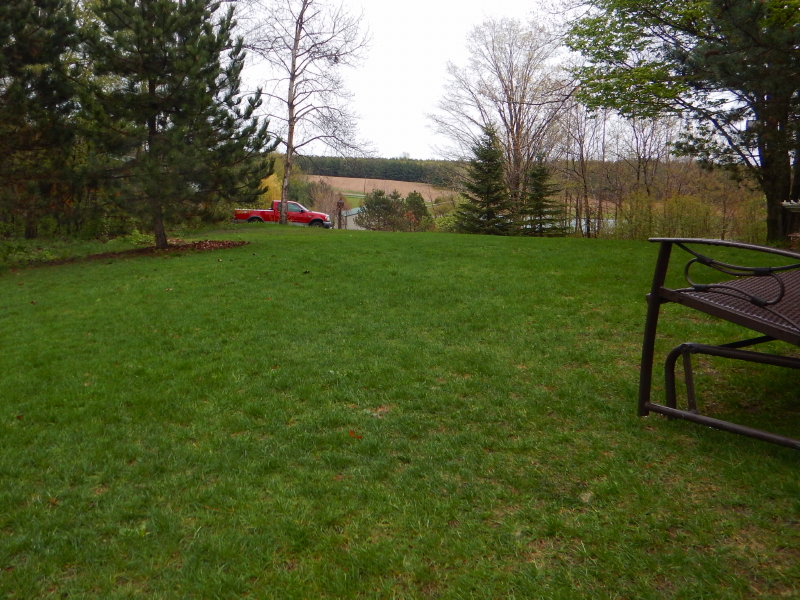
I don’t know if it is universal around the globe, but our weather reports include a “feels like” temperature along with the actual air temperature readings. Most people don’t need to be told what it feels like. We know when it feels like the gales of November even though the calendar indicates we are in the last week of April.

 .
.
.
.
.
.
.
.
.
There have been enough days of increased daylight, and a few early days of spring when the temperature climbed above normal, that plants and grasses have kicked off their growth. On Tuesday, when I got home from work, I mowed about 3/4s of our grass areas. It was so chilly outside that I needed a sweatshirt, but the growth of grass down by the road was enough that I didn’t want to wait.
I figured I would finish getting the remaining portions of yard cut when I got home yesterday, if it wasn’t raining. That didn’t turn out to be the case. There were a few random spatters on my windshield during the drive, and as I neared home, I could see the falling rain in the sky to the south.
 The cool temperatures and falling rain were enough reason to let the horses have a night indoors. Cyndie headed out into the chill to prepare their stalls. When she invited them inside, she described Legacy, the herd leader, started toward her and then paused.
She said it was as if he was uncertain whether he was getting an afternoon chance for grazing the new green grass out in the pasture, or was just being offered shelter from the elements.
The other three horses needed to halt their advance while he sorted this out. Cyndie said they weren’t being very patient about it, circling around in anticipation of continuing on to the barn, but also trying to respect Legacy’s not yet authorizing the choice.
Cyndie described Hunter eventually showing a look indicating he was done waiting. He and Cayenne came up to the gate to get inside. Responding to Hunter’s initiative, Cyndie let him come inside first. Once inside and alone, Hunter called out over being separated from his mates. Cyndie said that Legacy immediately responded with an acknowledging whinny.
She brought Legs next, followed by Dezirea, and then Cayenne.
Back in the house, we sat in front of the fire and listened to the ferocious sound of wind and rain, pleased that the horses weren’t stuck outside where they could find out what the weather actually felt like.
.
.
.
.
.
.
.
.
.
.
.
Real Life
Yesterday was a classically real life kind of day. There was some good, some bad, some tired and sad. We laughed and moped and tried to look at things from a balanced perspective. Things don’t always work out the way we think they should, but if that isn’t real life, I don’t know what is.
We’ve been watching Hunter for a few days, because I discovered his stall was uncharacteristically dry after a long overnight stay last weekend. When it happened another night, Cyndie decided to have the vet look at him, in case there was something amiss. Since our usual equine vet has moved to a different practice, we ended up getting the owner. Even though Cyndie expected the vet to arrive in the morning, he didn’t get here until late in the day.
Cyndie got the impression he wasn’t an equine specialist. I’m guessing he is probably an expert in dairy cows. Even though the visit sounded awkward, we feel like he was able to establish that Hunter is clear of any grave ailments. Our boy’s temperature was normal and the levels in his blood were all mid-range.
When I got home from work and was cleaning Hunter’s stall, it was obvious he had peed in there during the long wait for the vet to arrive. We also spotted him peeing out in the paddock, so he has proved to us that things are at least functioning.
It is quite possible that he just doesn’t like messing up his “bedroom.” We know a certain Ms. Barksalot who absolutely refuses to soil her kennel.
It is a little unsettling to have lost confidence in our vet of choice. I think we will be investigating other options for the future.
There was one particularly heartwarming scene that occurred with the horses yesterday. After the vet left, Cyndie let the other 3 horses out into the paddock, but kept Hunter inside while he recuperated from a sedative and pain-killer that he had received. She worked on cleaning the other stalls to give him some company while he lazily munched on some hay.
Outside, the other three were down in their favorite spot, grazing in the hay circle. I stepped out of the back of the barn to dump the wheelbarrow and Cyndie followed while telling me stories of the day. When Hunter suddenly found himself alone in the barn, he whinnied a little distress signal.
Instantly, Legacy answered the call with his own vocal response while running up the hill to the barn. There was something about the body language and immediacy of Legacy’s reaction that overflowed with the loving care of a passionate leader. It was a beautiful thing.
Cyndie went in and walked Hunter out to the paddock. She said Legacy met them right at the door and leaned over the fence to touch noses with Hunter in an extension of his caring, showing affection for the temporarily distressed herd member.
It was wet and cold outside, with more rain expected, but there were moments like that which felt almost like warm sunshine.
It was a lot like a real life kind of day.
.
.
.
.
.
.
.
.
.
.
Already Late
My least favorite day of the year is the day our society moves the clocks ahead one hour. That first day, this first day, I wake up already late for the day.
Time travels too fast for me on a regular basis. It becomes uncomfortably amplified when the clock is adjusted to steal an entire precious hour for which I can do nothing to account.
Yesterday I read that there is a myth that the adjusting of our clocks is something that helps farmers, but that the myth is not true and the majority of farmers actually dislike Daylight Saving Time. It is supposed to have something to do with saving energy, since Germany first did it for that purpose during World War I.
It appears it doesn’t actually save energy. The other thing it doesn’t do is save daylight.
It annoys me that real proponents are the retail industry, which profits when more people go out (drive vehicles and use gas) to do things (spend money for barbecues and recreation) in the evenings during the longer day-lit evenings.
The most ridiculous reason I read was that it moved daylight from the morning when people are asleep, to the evening when they are awake.
Just get up when the sun comes over the horizon if you have a problem with it! Who cares what time that is?
Our horses have the luxury of completely ignoring what time we set our clocks to. They do what they do, whenever they see fit to do it.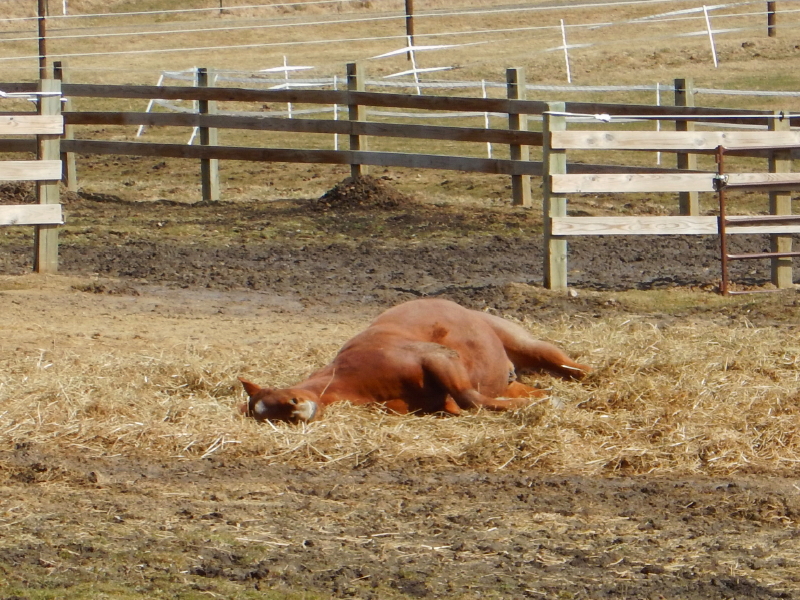
Yesterday, Hunter wanted to sleep deeply in the middle of the day. Once again, my first reaction is alarm. It is always shocking to discover the horses so entirely unconscious.
It was an uncharacteristically warm and sunny March day. The air was calm and the other horses were up by the barn, grazing on hay when we approached with Delilah. Not wanting to startle Hunter, we paused to take in the serene scene. Delilah laid down by the wood fence of the paddock and looked on.
Horses don’t stay down like that for long, so we waited to witness a behavior that would show us he was fine. The very first thing I did was zoom in my attention on evidence he was indeed breathing.
Not long after I started taking pictures, or maybe, because I started taking pictures, Hunter picked up his head and looked around at the world. Yep, still daylight out.
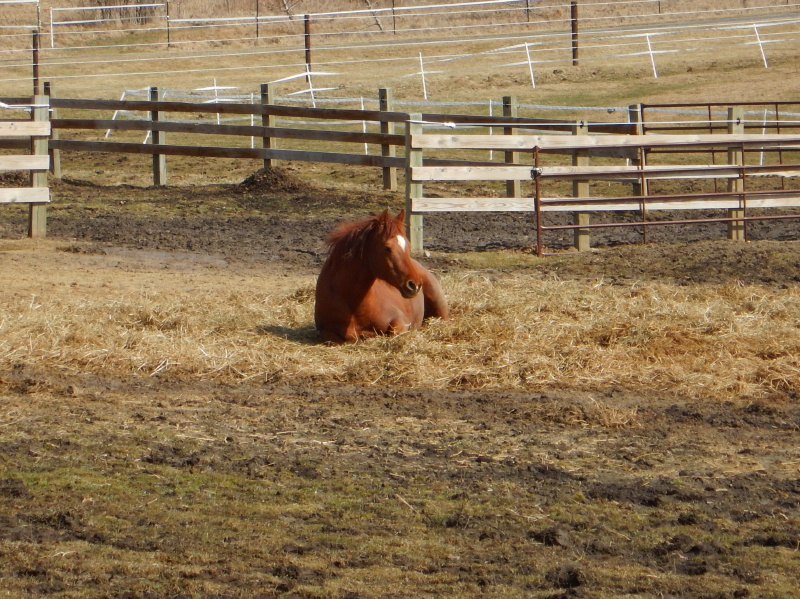
Moments later, he went right back down where he came from. I figured he probably wanted to finish a dream that had been interrupted.
He wasn’t late for anything.
.
.
.
.
.
.
.
.
.
.
.
Good Footing
It’s the time of year again when the thawing ground turns to mud, especially in areas where the horses walk. The first couple of years after we moved here were extremely wet in the spring, so we got a thorough lesson in worst case scenarios. The best thing that came from that was a recommendation for using limestone screenings in our paddocks.
I was unsure, at first. The searches for information we conducted tended toward extensive projects involving removal of all topsoil to some significant depth, and then installing expensive plastic grids and laying down thick layers of sand or crushed stone.
We opted for the least complicated idea, as a first test. We simply spread a thick layer of limestone screenings over the existing soil. The first time it rained, I figured we had made a big mistake. The lime screenings took on the water and became like thick, wet concrete. The horses sank right down in it. If it got below freezing overnight, the endless craters of their hoof prints would create an almost unnavigable landscape until the next thaw.
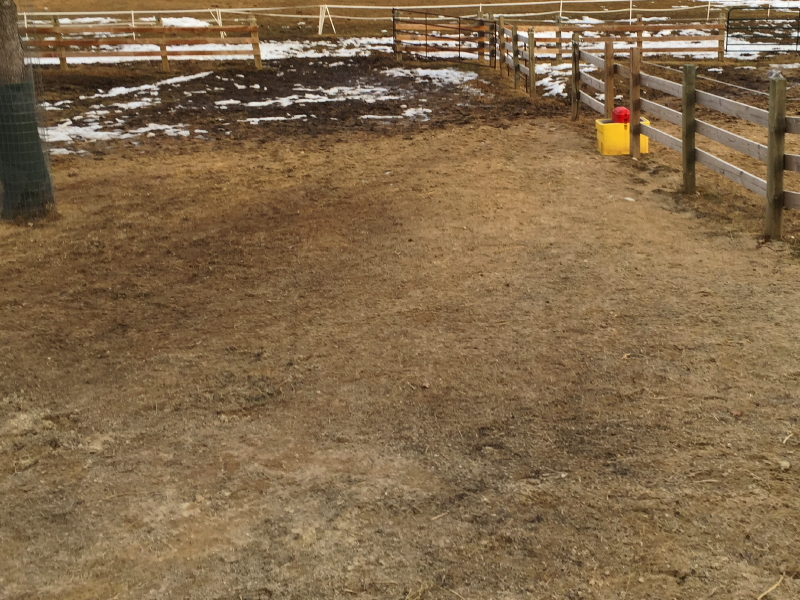
All it took was added time for the screenings to cycle through being packed down by the horses and baked by the sun, to set into a firm base that could support the horse’s weight. Other than the setbacks of losing a lot of material when heavy downpours created deep rills and washed screenings away, the overall result was proving to be worthy.
We simply ordered more limestone screenings and filled in the voids. So far this year, the surface is holding. Look at the dramatic difference from the areas we haven’t covered yet:
 .
.
.
.
.
.
.
.
.
We definitely need to order more, as we have yet to cover the critical heavy traffic areas around, and through, gate openings. The big challenge with bringing in more loads of screenings is the damage caused by the trucks delivering the heavy weight. We need to determine the right compromise of cost per benefit. A smaller truck would do less damage, but having smaller loads delivered drives up the cost a huge amount.
I find it hard to decide how to calculate the cost of damage that the full-sized truck does. Mostly, it costs me peace of mind, as it bums me out to break up more of the asphalt or get deep compressed ruts on our land. We figure the driveway is already a lost cause, so it becomes a matter of tolerating the additional damage until we take on the project of resurfacing it. Getting rid of the deep ruts hasn’t been a piece of cake, either, and who knows what damage it is doing to roots or my buried drain tubes.
For the most part, we plan to confine dump trucks to our driveway, and we will just have to move the delivered loads to any final destinations using our tractor.
Here’s a shot of Hunter showing how nice and dry the footing is on the well-set limestone screenings up near the barn. Niiiiice.
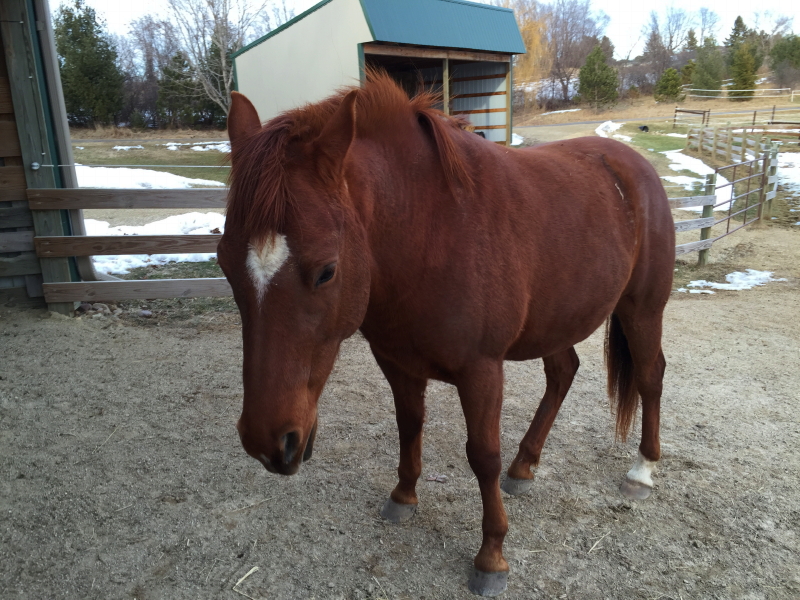 No complex process of soil removal and inorganic sub-surface installation. Just limestone screenings dumped on top of the existing surface and spread out to a depth of 6-8 inches. Oh, and time. About a year of horse traffic, hot sun interspersed with soaking rain, more limestone screenings to replace what runs off, more sun, and more packing. Walaah. Good footing.
.
.
.
.
.
.
.
.
.
.


 Relative Something