Posts Tagged ‘horse hay’
Wilting Winter
It doesn’t do any good to complain. I know that. That doesn’t seem to sway me from moping about the recent destruction of what started out to be a fabulous snow season this year. It melted big time, then refroze. Next, it warmed up again and rained, turning the snow on the ground into snowcone slush. Since that time, we’ve had some sleet mix and a dusting of flakes that covered the crusty frozen surface.
The snow cover is now a crunchy mess of greatly reduced value for most forms of recreation.

We received about a half-hour notice last night that somebody was coming to pick up the 85 bales of hay that the nutritionist frowned on feeding our rescued Thoroughbreds. Bad timing for me, since my back was teetering on the verge of a painful disc problem all day.
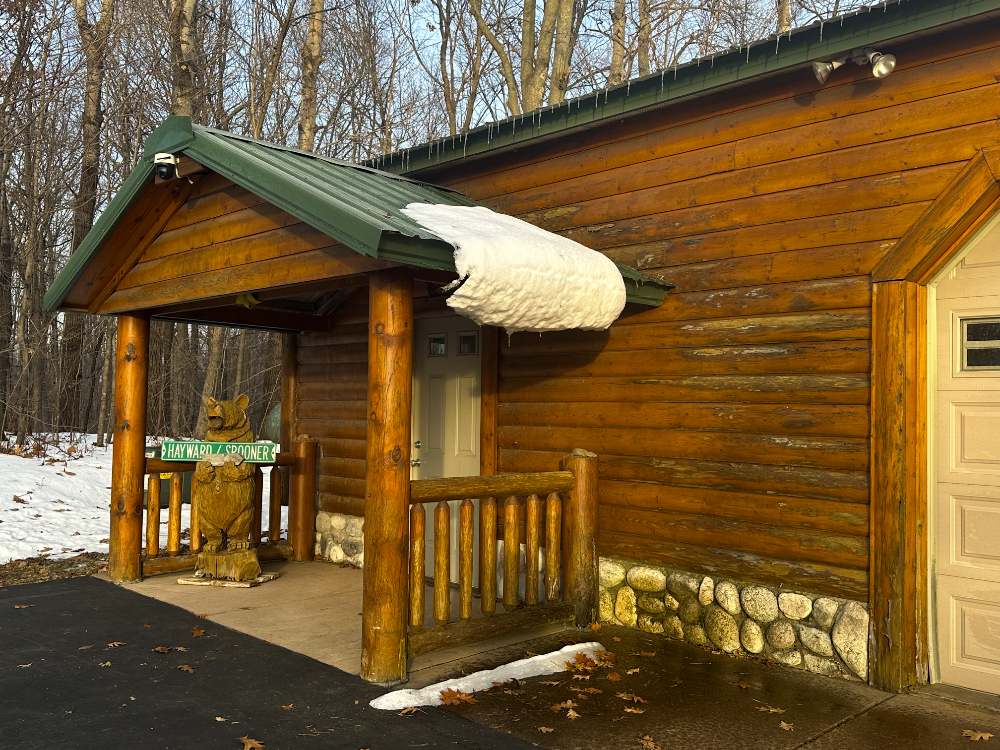
Somehow, both my degenerating spine and my bum shoulder survived tossing bales, and the shed is clear to receive a fresh batch from a different supplier next week. That put a crimp in our plan to sneak away to the lake place in Hayward for a few days after Christmas. We were given a date and a time when the hay would arrive, and that was that. We weren’t about to argue. Our response was, “Thank you very much.”
When someone tells you they can deliver hay, you do whatever it takes to make it convenient for them.
Well, while everyone was distracted by this and that in their lives, we have somehow arrived at the day before Christmas. Oh, you saw this coming? I should have been more aware. My online community was having an exchange of memories about the times the Santa myth unraveled for people.
I still remember the awe I felt when my dad told me, as I first appeared bleary-eyed one Christmas morning, that I just missed it. He said he had just heard the sound of reindeer hooves on our roof moments earlier. As time passed, I struggled to reconcile that powerful emotional “truth” I experienced with the logic that was debunking everything else about the Santa Claus ruse we were being sold.
My online friend shared the best description of the miracle of Santa. Sure, some of it is made up, but it’s based on this: it inspires people to experience the joys of giving gifts to others and making them happy, and it happens all over the world on the very same day.
That is something worth believing in for a lifetime.
“Happy Christmas to all, and to all a good night!”
.
.
Nuisance Amounts
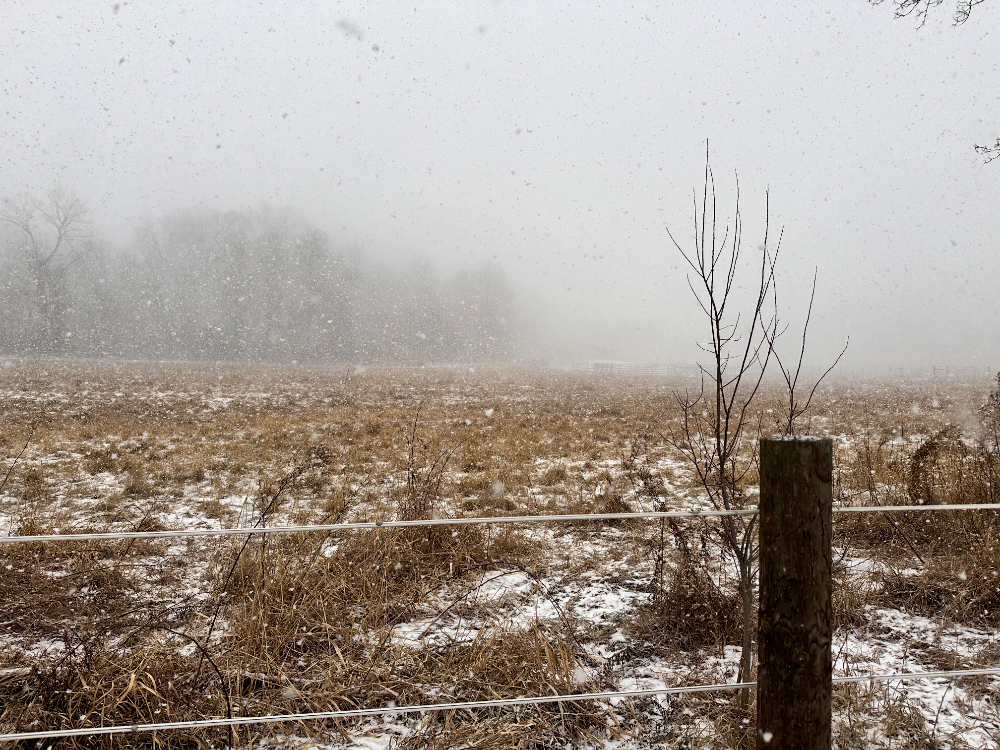
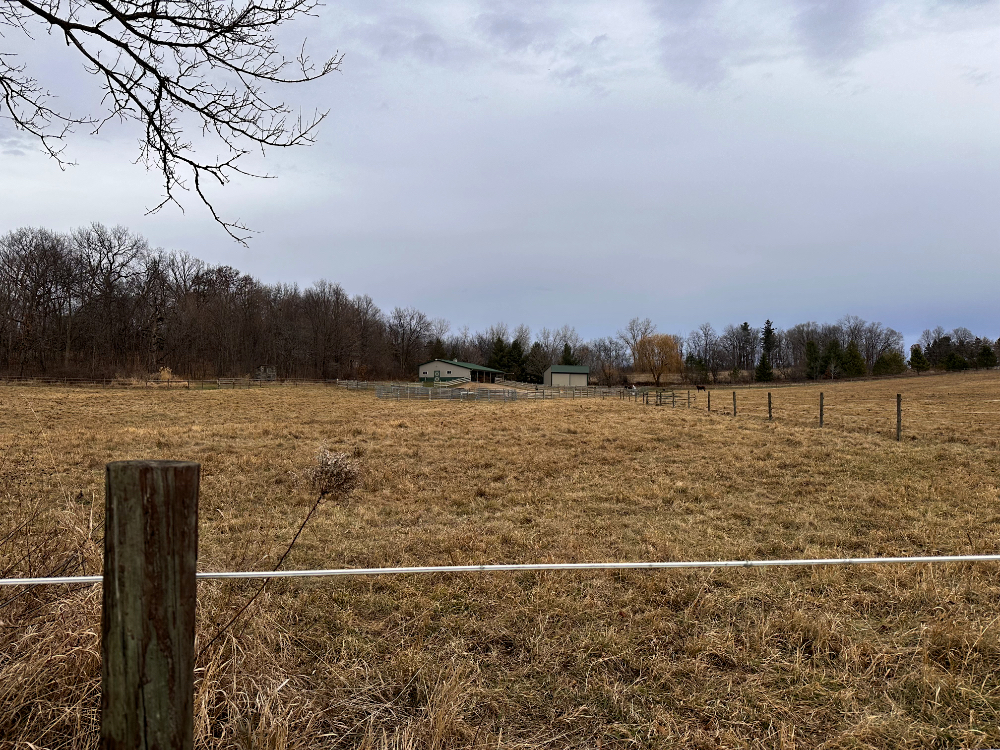
So far this winter (even though winter solstice is still nine days away), we have only been receiving what I call nuisance amounts of snowfall. It’s barely enough to justify shoveling, yet too much to leave on steps and walkways. Last week, when Asher and I got caught in that epic snow-burst, we couldn’t see the barn. In the end, so little snow accumulated that it was all gone two days later.
 .
.
.
.
.
.
.
.
.
Yesterday morning, I spent a few minutes clearing the driveway closest to the house with a shovel.
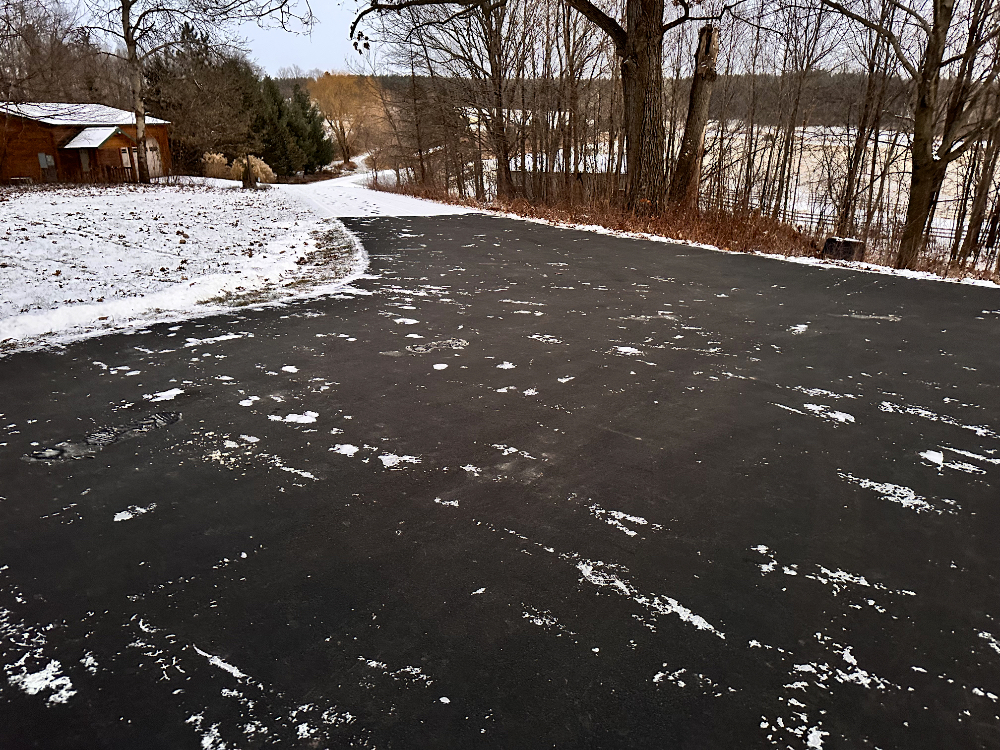
I like having the cleaner pavement, but that minimal covering of snow isn’t enough to deserve firing up the ATV to plow, and I’m not inclined to push the shovel the rest of the length of the driveway to the road. I saw the township plow go by on our road, so I carried a shovel when walking Asher. That big blade didn’t throw up enough snow to make any difference.
I shoveled what little there was anyway. So now the top and the bottom of our driveway are cleared, and the middle is just a series of tire tracks and footprints until we get enough sun to evaporate whatever snow remains.
Since the temperature was forecast to drop precipitously overnight, I made sure the horses had plenty of good hay to stoke their internal furnaces. They are decidedly picky about one of the batches of bales we’ve been trying to use up on them, and they regularly ignore any amount that we mix into the hay nets. I chose to dump some of those dregs out on the ground where we are building a hay path for traction in advance of future icy conditions. That way, I could fill the bag exclusively with hay they prefer.
What’s the first thing that happens?
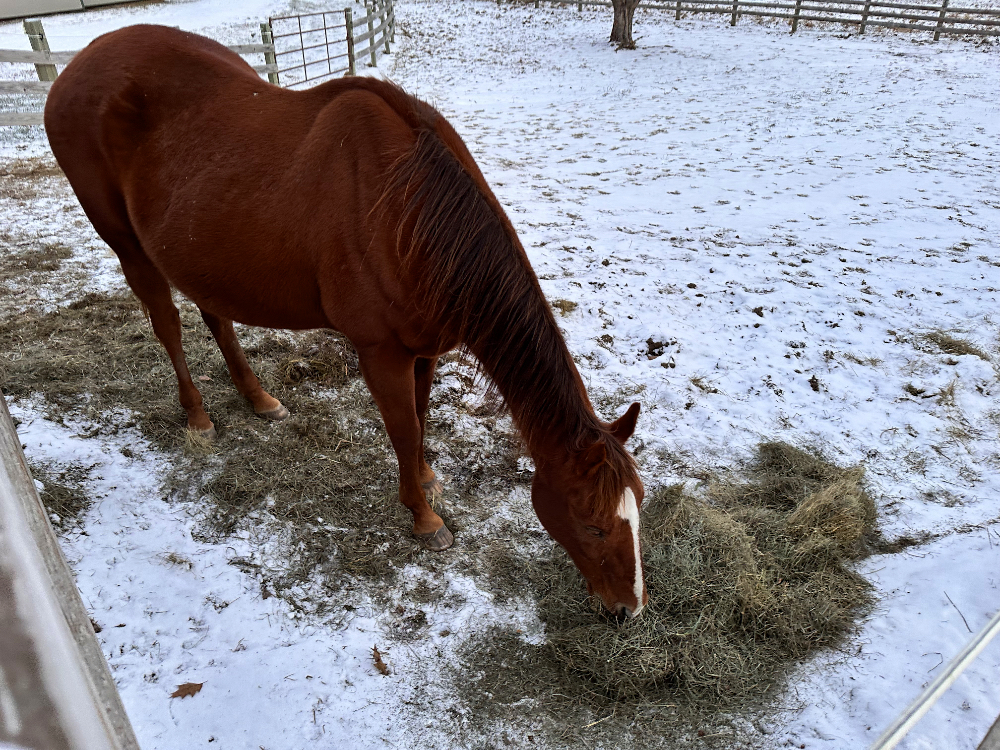
Mia comes over and starts eating the hay I dumped out.
I don’t blame her. Free of the netting, she can dive in and more easily scrounge out any desired nibbles mixed in with the stringy grasses she doesn’t like. She probably thinks of them as “nuisance amounts.”
.
.
Quality Hay
We received a delivery of new hay on Friday afternoon. Since we are caring for horses for the rescue organization “This Old Horse,” the hay was procured by one of their staff. I don’t believe we have ever received hay twice from the same source in the years we’ve had these horses.
Of the last two batches we’ve received, one was much better described as “straw,” and the other was primarily a hair-like grass blade of little substance. Each time, we believe it will be just fine, but the horses soon demonstrate whether they think it’s good hay or not.
Friday’s batch showed up in a hay wagon, not strapped to a flatbed trailer, and the farmer, Josh, radiated a feel-good energy that both Cyndie and I perceived. These were promising first impressions.
Johanne told us this was organic hay because the field where it was grown is leased from a farmer who operates under completely “organic” principles. Works for us.
We tossed and restacked 150 bales from the hay wagon to the shed, and I didn’t notice a single bale that looked odd. One thing Cyndie and I have learned over the years is that our impression of hay being “good” doesn’t amount to a hill of beans if the horses don’t like it. That would prove to be the ultimate test.
Once the wagon was empty, we swept up a full wheelbarrow of loose scraps that had fallen from bales. Cyndie then included a mix of those scraps along with the old hay in the nets she topped off when we served up the horses’ evening feed buckets.
When I checked on the horses later, I found them all feeding on the hay bags even though they hadn’t finished the grain in their buckets.
They must have smelled it and couldn’t resist. They obviously liked it!
I’ve written before about how much incidental grass grows in the packed gravel driveway where hay scraps fall in front of the hay shed. I couldn’t get grass to grow there if I tried, but doing nothing resulted in more turf than gravel.
That gave me an idea. In October, I added compost fill to the slope of our new lookout knoll to cover the barren, sandy edge of the slope and, ultimately, improve it to become a mowable grade.
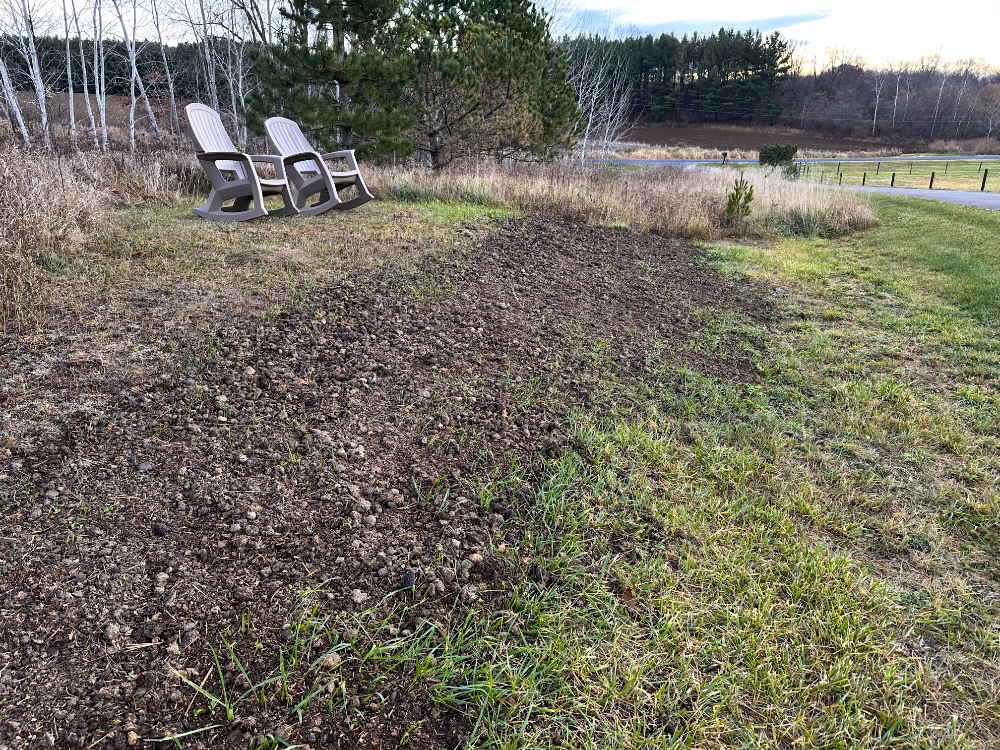
We were planning to plant grass seeds on the improved slope in the spring, but why wait? Cyndie raked up as much of the leftover hay scraps as possible from the ground where the hay wagon had parked. Logically, much of the grass seed probably stayed behind to thicken the grass already growing there, but any fraction remaining is now moved to the lookout knoll.
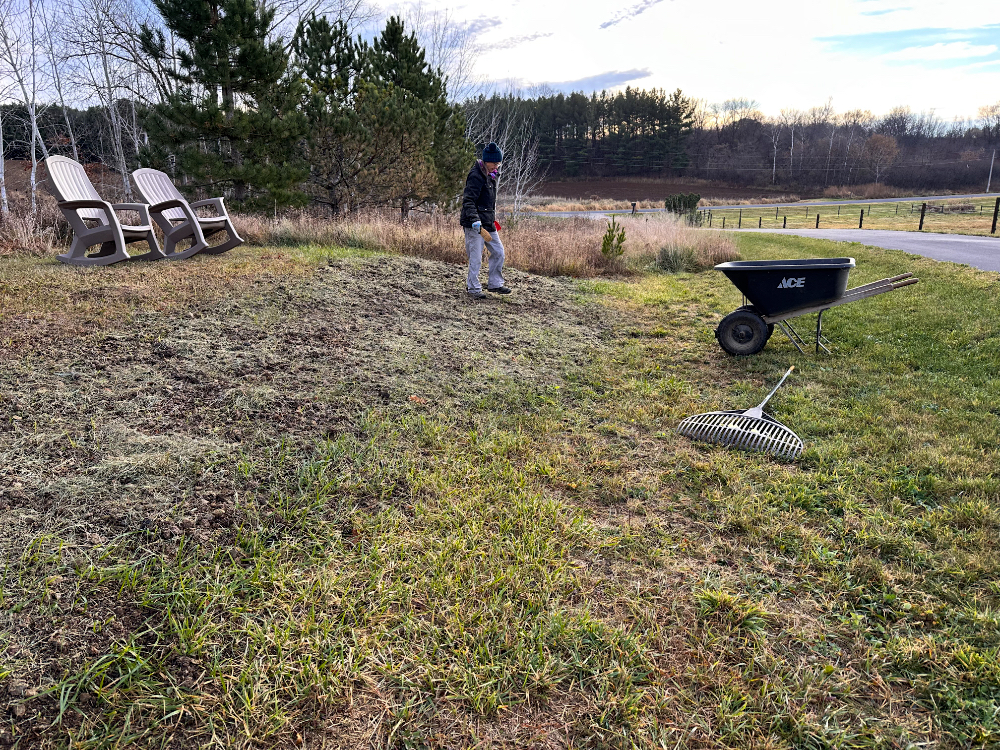
We’ll still probably toss more seeds on the slope in the spring, but it feels like we are helping nature to work with us a little bit by covering the surface with hay scraps.
Especially since the horses are showing us that it’s good quality hay.
.
.
A Portrait
The author, in a rare moment of leisure.
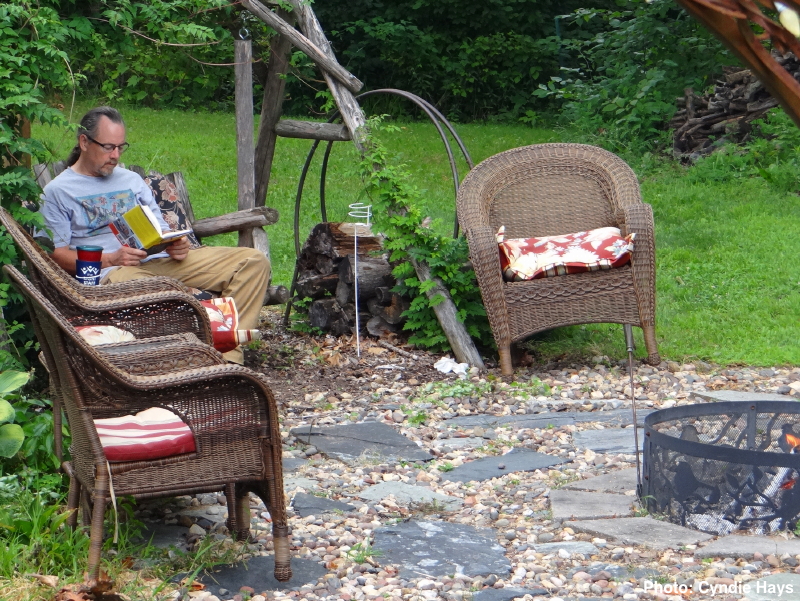 Cyndie took the picture of me reading while keeping an eye on the fire last night. See, I was still working. I was tending the fire so it would be hot enough to cook burgers when company arrived. Oh, were those burgers good! Probably made even more so by the homemade buns that Cyndie freshly baked moments before.
 Earlier in the day, Cyndie had hosted guests who had some lawn games out and it inspired me to improve the croquet setup. I made my own little “sport court” out of grass. It is set up for croquet, but could just as easily double as a bocce ball space.
Now all I have to do is figure out how to find time for that much leisure.
I need to move composting manure to make room for piling the fresh collections. Production never slows, despite my running out of space to cook it.
Before I can get to that project, we need to head out with the trailer for another load of hay to be purchased. We will be silently chanting, “No rain, no rain, no rain” the whole way there and back.
With our lawn growing faster than I can tend it, it’s a shame I can’t bale it up and save those clippings for feeding the horses in the dead of winter.
Our experience with trying to acquire good quality grass hay for horses this year, hoping to improve on the several years of less than desired content we’ve previously had, has been enlightening. We initially dove into the task of getting hay with such naiveté.
We have discovered that what constitutes “good,” when it comes to baled hay, can be a very individualized opinion. On top of that, what nature provides and farmer skills harvest, in terms of moisture content, involves a very narrow target range. Too dry and the nutrition value to animals drops considerably. Too wet and it will mold and/or spontaneously combust in a conflagration that destroys storage buildings and turns planned food stores to ash.
Different livestock have varying needs from baled fodder. One version of hay does not work for all cattle, sheep, goats, and horses. Some of the local farmers are growing hay for their cows and are kind enough to offer to sell some of it to us if we want to feed it to our horses.
It can work, but it’s a bit of a guessing game. We ended up with a batch that had too much foxtail grass which caused mouth sores in our horses. We’ve had some with an annoying amount of sour dock weed and woody stems that the horses labor to work around when grazing. It creates a mess and interferes with them getting what they want. Both horse and human get irritated.
This year we found a batch that looked like ideal grass bales. They turned out to be too wet. Then we found an even better batch, and got caught in a downpour bringing it home.
We are hoping the third time’s the charm this morning. Then maybe I’ll sneak some time to finish that book later this afternoon.
.
.
.
.
.
.
.
.
.
.
.
Another Source
The air is completely still outside this morning. Maybe that is why my internet connection is more stable today than it was yesterday. The signal is not being disrupted by waving tree leaves.
The calm is in contrast to the disruption swirling in my mind. We have been stretched into another batch of new experiences over the last two days, taking us places we’ve not been, introducing us to new people, and giving me an opportunity to pull a flatbed trailer behind our sometimes trusty old pickup.
I’ve never done that before.
Luckily, I didn’t need to do any backing up.
We own horses. We need hay. Over the now several years that we’ve been on this equine adventure, that’s the key priority that pushes me into doing tasks for which I have no previous experience.
Last year I was feeling pretty smug over having found hay to purchase and hauling it myself in small batches with the truck, and augmenting that with bales from our own field. Now I have come to understand that what we purchased wasn’t considered prime quality fodder by our horses, and we’re admitting to ourselves that our field isn’t yielding much better.
Cyndie checked with new acquaintances and then made a connection with another hay grower. Grass hay is the term used to clarify what we are after for our horses.
I was on the far side of our property yesterday, trimming the 4-foot tall weeds that have grown along the southern border of our back pasture, when Cyndie and Delilah appeared and interrupted me. The new hay source was available immediately and leaving town for a two-week vacation tomorrow. We had to act now.
Suddenly we are checking maps and venturing down dead-end roads among farms that don’t get many visitors, looking to connect with someone we won’t know when looking at them. Kids on bikes check us out immediately, when we pull in a driveway and try to figure out where to go.
 We are not surprised to discover Lonnie is friendly guy, and the kids are his grandchildren who live across the road and they love to help with hay. Mostly, they like to talk while we toss and stack bales. Lonnie offered up his flat-bed trailer to allow us to haul a hundred bales in one load and off we dove into another of my firsts.
I relied on his method of stacking and strapping to secure the load. He generously offered to come rescue us if any of the tires went flat on the trip there or back. How reassuring. I noticed he put a registration sticker on the trailer before we hooked it to the truck. I guess it hadn’t seen any road use for some time.
We made it most of the way home before a middle bale worked loose and dropped off the front. I had just turned off Highway 63 onto a rural road, so the drama was moderately reduced. I know now that we should have used that 3rd strap he considered putting across the load, but didn’t.
.
.
.
.
.
.
.
.
.
.
.
More Hay
Honestly, I think we pretty much nailed it on the quantity of our hay supply over the winter. The new growing season is now upon us and farmers are talking about cutting their first crop of the year, as soon as next week if the weather is dry enough. We are down to our last rows of the bales harvested from our field last year. There are still a fair number remaining from the batch we purchased 2-years ago from a local farmer, but many are showing some mold and our horses have pretty much refused to eat them.
Given all that, Cyndie still prefers to have a larger backup supply than we ended up with, so we have been in the market for a small batch of insurance hay. We did drive up to check on offerings available from our previous source, but the bales he had left from last year looked too similar to those we already have that our horses don’t eat.
He suggested we consider some second-cut bales he will have later this summer. Second-cut hay doesn’t tend to have as many stemmy grasses, and probably has a few less weeds.
For now, Cyndie kept looking, and on Thursday she drove to investigate some hay advertised in the free Shopper publication that is distributed locally. She said it looked good, and more importantly, it smelled good, so she brought home a small load of bales. Yesterday, since I was home from work, we went together to bring back a larger load.
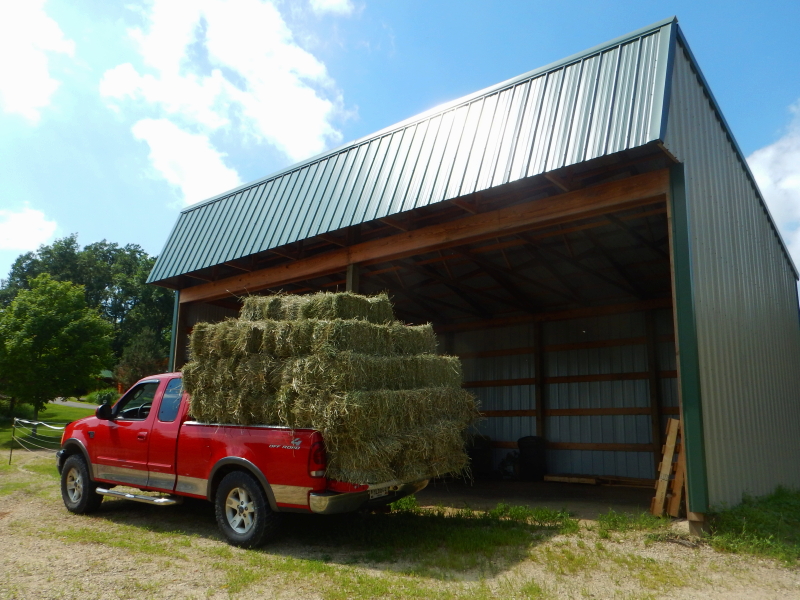 We had to wait until the rain stopped before venturing out, because wet hay becomes moldy hay. After lunch, she provided directions while I drove. We were given free rein to pick our choice from the barn loft, so Cyndie tossed bales down and I organized them in the truck bed. Using the skills I honed in 13-loads two years ago, I stacked the hay so we wouldn’t need to tie it down. The bales above, hold the ones below in place.
We made it home just as a new wave of precipitation threatened, forcing us to hastily unload the bales into the hay shed.
The task served as a gentle reminder of the work that lies ahead of us soon. Hay season is not far off. It’s a time of anxious weather-watching and intense effort over several long days that are both thrilling and exhausting at the same time.
At least now I feel comfortable knowing how many bales we want to put up to last a whole winter —plus some insurance— after several years of varying results. Simply having that one concern removed from the process makes it all a little less daunting.
.
.
.
.
.
.
.
.
.
.
.
Growing Grass
I have developed a new fascination with growing grass, which seems funny to me, since I put so much energy into not growing grass during the 25 years we lived in Eden Prairie. Now, as I drive through the countryside, I take note of the neighbors who have grass fields for cutting hay. There are a couple on the way into Ellsworth that look pristine, and have inspired me.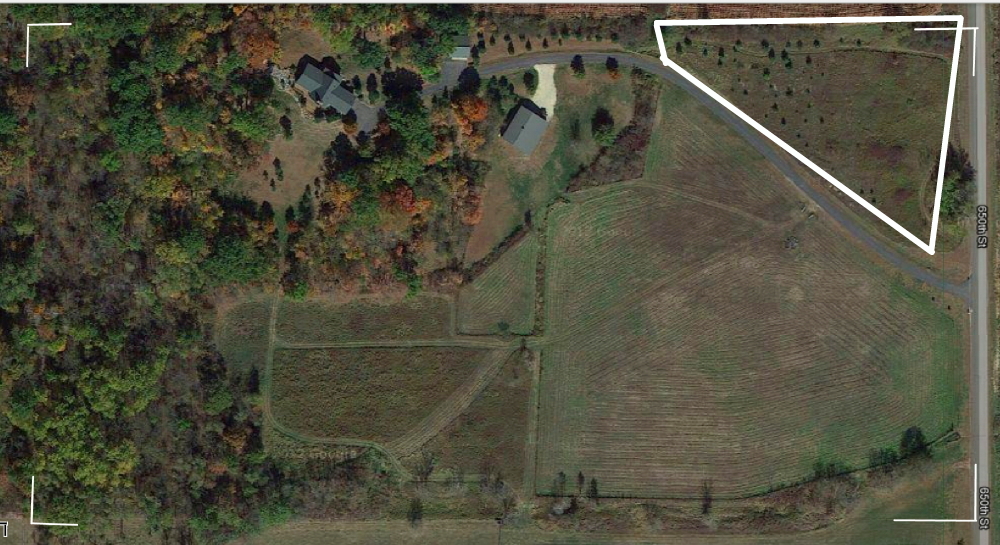 The other thing that inspires me is watching the horses graze. I want to give them the best of what they want, and I’d sure like to have more than they need.
Toward that goal, we decided to mow the area to the north of our driveway. Cutting down the weeds rejuvenates the grass that is already there. I used the brush hog behind the big tractor, and had to navigate around the pine trees planted in the west portion of that area, which made it a bit of a challenge.
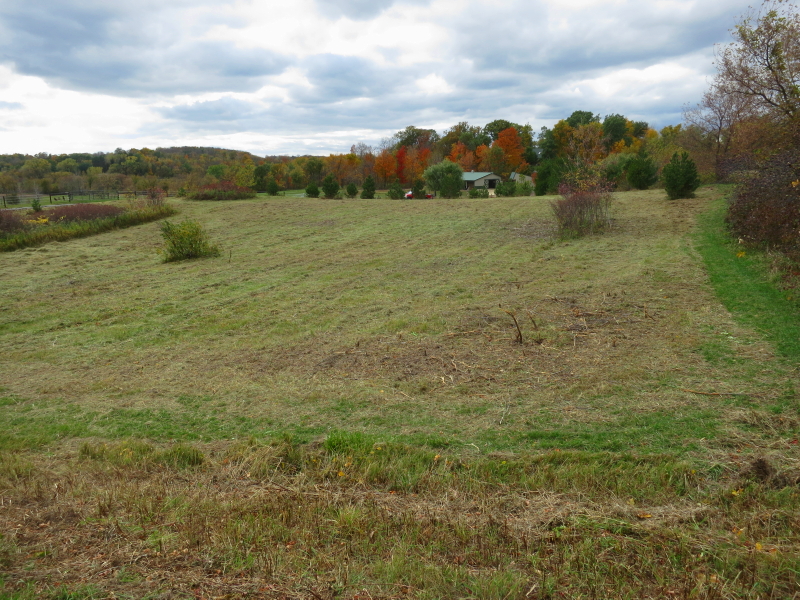
I took pictures of the ‘before and after’ view. One of the first things you can see in these images is how the weather changed yesterday. It got chillier as I worked, becoming a dramatically different day over a span of just a few hours.
The other thing to notice is the trail we had that was cut around the border of the field. You can see how green the grass is where it was mowed. That’s what we are after.

 .
.
.
.
.
.
.
.
.
I wish it was as simple as knocking down the weeds to get what we are after, but it’s not. We plan to have this area for grazing, and to keep the big field for cutting hay. If we are to let the horses graze here, we need to get it fenced. How complicated is it to add fence? Now we know. We need to think ahead to where access through a gate, or gates, will be located. We have to establish the most logical perimeter, which won’t necessarily end up being the area that’s cut.
Fencing the area will block our trail. We could move the fence that will contain the grazing area in a bit, to leave space for a trail around the outside, but that can tend to make the northern property border ambiguous. The existing property border has remnants of rusty barbed wire fencing, which we want to replace. If we update the border fence line and fence the grazing area inside that, we end up with double the fence.
That’s a tough decision for me. I don’t want more fence, I want less fence.
It’s not as simple as just cutting the area to get everything we want, but at least just cutting it will be a pretty simple way to grow grass. That’s a start.


 Relative Something