Posts Tagged ‘hay’
Grass Management
There is an ebb and flow to managing a 20-acre property and animals in a rural setting that on the surface is significantly different from my old life in the suburbs. From my perspective, it’s not as dissimilar as one might think, beyond the obvious increase in scale.
I was thinking about how it feels like I pay more attention to the weather now than I ever had before, but that’s not really the case. I’ve always been fascinated by the weather. I fretted about the dilemma of either too much, or not enough precipitation impacting the growing things on our suburban lot, just not on the same scale as I do now. Back then, it didn’t get the same degree of attention from me, I suppose because there was less at stake.
I’m sure I had the neighbors chuckling over my activities yesterday, as I rode my little lawn tractor to mow part of the big hay-field beside our driveway, racing to beat the rain. The back field looked so darn nice that I overcame my hesitation to look foolish, and cut as much as I could before time ran out. Just like we had done two days before, I started by pulling a rake behind the Grizzly ATV to scar the surface to be seeded, switched to the lawn tractor to pull the seed spreader, then set about mowing as much of the rest of the field as I could.
Most of what I was doing was in sight of the horses, and they seemed to take great interest. This is the field where we let them roam for most of the time since they arrived last fall. I expect they are feeling a bit frustrated to not be given access now that the snow has melted. Our plan is to graze them on other fields and to grow this space for hay.
I only cut about half of the field before the precipitation started. I think it will be a challenge to get the rest done, because what’s left is thicker grass to start with, it will be wetter, and the new moisture will help trigger a growth spurt. I had wanted to get the field cut before spring growth started, which is the reason I was using the lawn tractor in the first place. It is light enough that it can work before the ground is dry and not leave wheel ruts.
If I’m not able to get that second half mowed, it could provide comparison to show the difference mowing made.
Whether our plan to improve the grass in that field works instantly, or not, it sure looks better right away. It is likely the improvement toward getting good quality hay will be incremental over a few years. I’m okay with that. I spent a lot of years slowly transitioning our suburban lot from a lawn to a natural, leaf-carpeted forest floor.
By the way, word has gotten back to us that the folks who bought our old place are changing it back into a lawn.
Such is the ebb and flow of grass management.
.
.
.
.
.
.
.
.
New Hay!
Of the many blessings we have experienced in the time since we first learned about this place we now call home, the ones that involve our animals seem to have a special preciousness for us. Our horses have been with us for less than half a year, and every success we achieve in caring for them brings a welcome sense of relief, since we are pretty much figuring everything out for the very first time. Managing the hay to keep them properly fed has been one of our primary lessons.
Back in September, as complete novices in all things hay related, we didn’t have a clue about what we were looking for in a bale. Even after learning a few things, we are still humbled to discover that even “good” hay can develop some mold, or contain sections with undesirable contents. The bales we acquired from two different sources, and have been feeding to our horses all winter, turned out to have some of both problems.
A month ago, I wrote about the discovery that we had too much foxtail grass in some of our hay, which was giving the horses mouth sores. We ended up losing many large bales from our stash due to that problem. Our struggle with finding mold inside other bales has been consistent, showing up in hay from both providers. We eventually deduced that some of the hay we purchased from the unfamiliar supplier must have been what is called, “ditch hay.” The grass in the bales proved to be dusty, like grass beside a gravel road is dusty, and included bits of plastic refuse and many large sticks.  The dustiness is not appealing to the horse’s keen sense of smell, and it confounds our efforts of identifying whether we are seeing clouds from mold spores, or not.
Recently, a reliable source surprised us with the wonderful news that they had some small bales they could make available. Their message was a blessing that couldn’t have come at a better time. Yesterday, to make room for the new bales, Cyndie and I removed the pile of moldy hay that has been tossed aside.
Within minutes of Jack and Joanie pulling into our driveway, we felt the thrill of connecting with good-hearted people and sensed the hay would be ideal for our horses. In our bliss over having good quality hay, we neglected to think ahead about how we stacked it. Chatting while we worked, Jack tossed bales almost faster than we could stack them, I tried to think about fitting the bales into the smallest space possible, and Cyndie placed them at every which-way orientation. Later in the evening, I asked Cyndie if she counted the bales.
“No.”
“Me neither.”
What that reveals is that neither she nor I felt any concern about trusting the quantity delivered. Unfortunately, our lack of concern about counting bales relates to our not having a logical pattern to the way we stacked them, which means we will never actually know how many bales remain on hand after we’ve used a bunch. Another lesson learned.
Happily, the horses seemed as thrilled with the new hay as us. I captured Dezirea and Legacy breathing in the delicious smell, while Hunter and Cayenne wasted no time in chomping away.


 .
.
.
.
.
.
.
.
.
.
.
.
Vet Visited
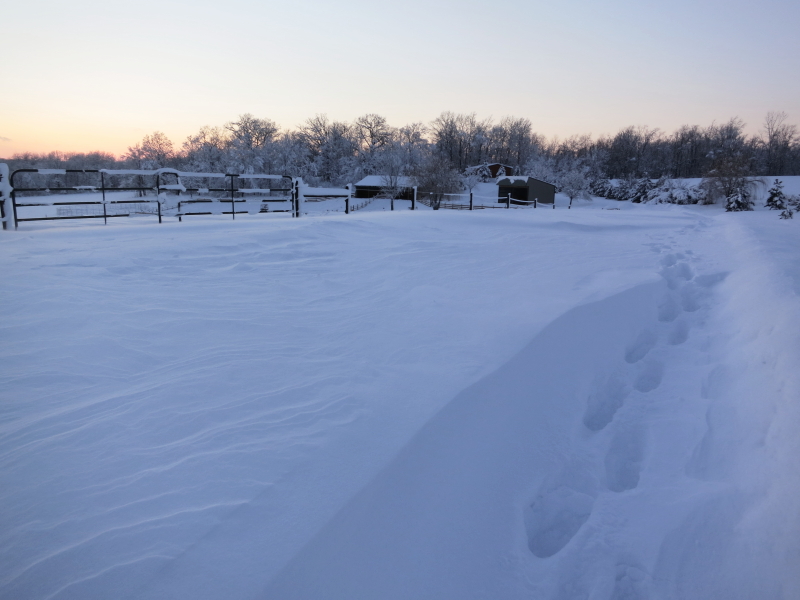 Before our thoughts became totally consumed with this latest blast of a winter storm –which has drifted snow across the 4 foot banks of our driveway, filling it completely– we received a visit from our veterinarian for a well-check of our horses.
It was Thursday, and Cyndie and I had both stayed home from work in the face of the posted winter storm warning. We had cleaned up the stalls in the barn, and moved the horses inside out of the rain that was falling in prelude to the snow.
We weren’t entirely surprised to receive a phone call from the vet’s office checking to see if we wanted to reschedule. We weren’t the ones doing the driving, so we definitely wanted this appointment to happen, if the vet didn’t mind navigating the icy roads.
Cyndie headed down to our barns at the appointed time, to find the vet already inside, making her own introductions to our 4 horses. She really loved “our gray,” Legacy, saying he was “cute.” 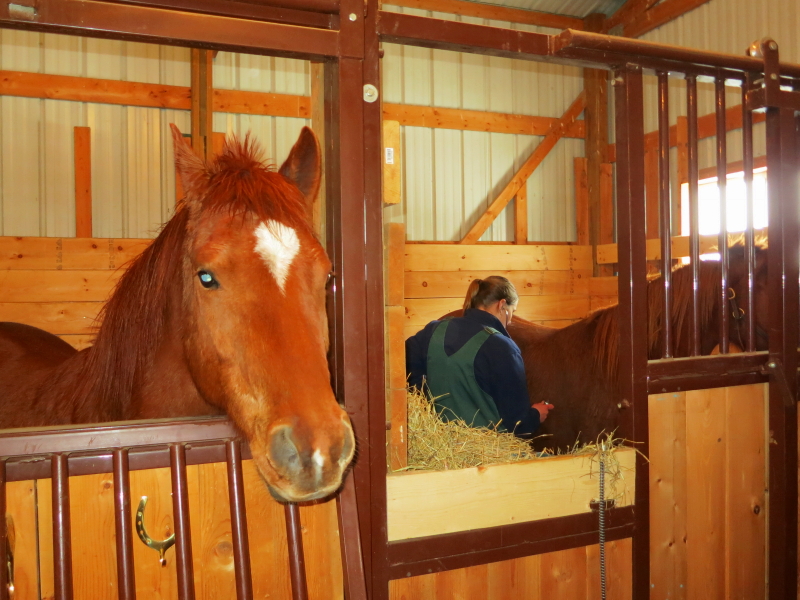 As the rain began to change over to snow, the vet stepped into each stall to listen to heart beats and lung sounds, feel their teeth, and do an overall survey of their condition.
The horses had blood samples drawn, and received a vaccination shot and dose of deworming paste. There were two valuable things we learned. First, we can begin to cut back on their feed rations. With the cold temperatures we have been facing this winter, we have been making sure they were well fed. The vet said our horses are not overweight, but we don’t want them to get any bigger. We can change the feed we are giving them to one that provides just essentials and nothing more.
She instructed us to be very careful about the transition back to grazing fresh grass. We cannot allow them uncontrolled access to the fields. They need to be restricted to the sacrifice area of our paddocks, with brief, but increasing visits to the grass.
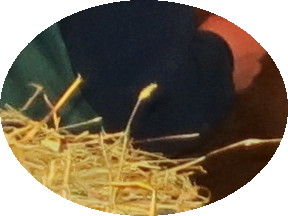 The second thing the vet discovered is that the latest bale of hay we have been serving has too much foxtail grass in it. The awn, that stiff bristle at the top of the stem, can become embedded in their cheeks and tongue and create ulcers. Three of our horses showed some signs of sensitivity or ulcerations in their mouths.
We invited her to look at our remaining bales to give us her opinion of what we have on hand. From her review, we think it will be okay to just work around the worst bale and pick and mix from the remaining two batches of bales we have.
Next fall we will make another appointment to have the vet “float their teeth,” which is what they call it when they file down any sharp points that develop. With that, her visit was done and she drove off into the wicked weather. We are relieved to know our horses are doing well and that the two things deserving attention are well within our ability to manage.
That is a really good thing right now, because it allows our attention to get back to being all-consumed by the tonnage of snow that remains to be removed from our driveway and barn paths today. Yesterday I heard Cyndie wondering out loud about seeing if George Walker might want to bring his Belgian draft horses over to teach us how to drive the team while clearing snow with them. That’s not such a bad idea, because the way “horse power” is measured, he has a lot more in his team of horses than I have with my 44hp Ford New Holland 3415 tractor.
.
.
.
.
.
.
.
Rambling Randomly
Late Sunday afternoon we got the horses fed, ushered Delilah outside to her kennel and then set out toward the far side of the twin cities from us, to the far side of Lake Minnetonka, joining our friends Barb and Mike at their house for the Superbowl game. It seems like it should be too far to go for a short evening visit, but spending time with them proved more than worth the drive. Plus, it being a Sunday evening, there was minimal traffic on the road and we made excellent time. It inspires me to avoid letting the drive interfere with staying connected to friends.
It’s now well over a year since we moved from the suburbs to farm country and I have finally taken the steps of transferring to a local doctor and dentist. I scheduled appointments with both for checkups next week. The transformation is becoming ever more complete. Now, if I could just learn to recognize good horse hay when I see it.
We have a number of bales that are moldy. We have a lot to learn about hay. Right now we are dealing with the accumulation of bad hay that we can’t feed to the horses. Online searches haven’t easily revealed any brilliant descriptions of what to do if you discover your stored hay is moldy. I don’t know if we need to get the bad bales away from the good ones. The most common suggestion is to use moldy hay for mulch in gardens. Maybe I need to advertise that we have garden mulch for sale.
While I was outside moving firewood up on the deck and splitting logs by the wood shed yesterday, Delilah was freely romping in the snow and exploring our woods. Eventually, she appeared with a kill clenched in her jaw. I have no idea what kind of animal it is –or, was. It is interesting to witness her demeanor change when she gets possession of a dead animal. Instinct seems to take over and she slips into wild carnivore mode. When she comes back in the house, I get nervous about the way she looks at the cats.
Gutter and soffit replacement resumes on the house tomorrow. I have made their work a little easier by clearing the most recent snowfall off the eaves and away from the vents at the peak. It had gotten so deep that our vents were covered completely. I haven’t heard anything from the builder who ordered our replacement window, but that should be arriving sometime soon. As much as I want to see progress there, I think it would be best if gutter and window replacements don’t overlap.
I’m back at the day-job 3 days a week now. I think it has me rambling randomly to process Wintervale responsibilities in my head so there will be some room for work related thinking that needs to happen. Don’t know if it will help any, but I see the rambling as a valuable exercise, regardless.
Brush Hoggin’
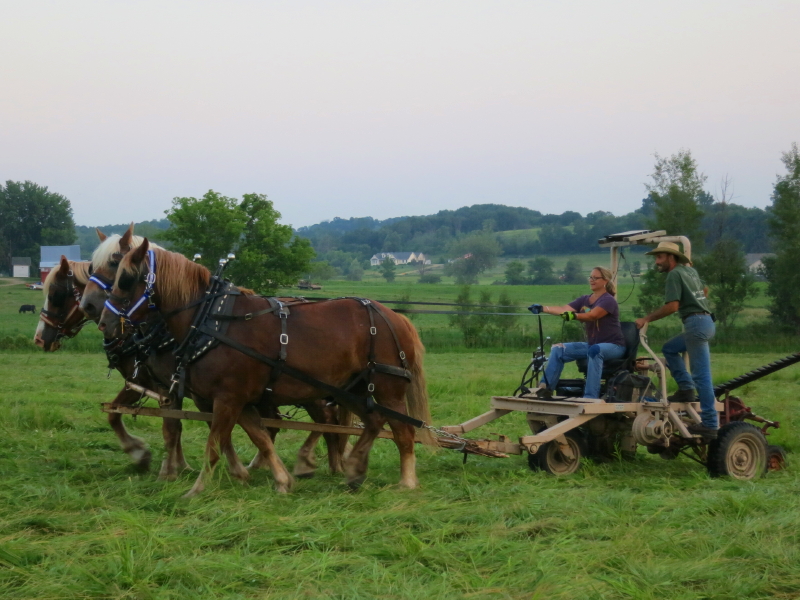
After the excitement of having our hay-field cut by a team of 3 horses last week, we were very happy to learn that our neighbor got 1 and 1/2 wagon loads of bales out of it. That is a good result. He has inspired us to consider keeping the front field for cutting hay, instead of using it as pasture. He said it would save us a lot of money if we are able to produce our own hay.
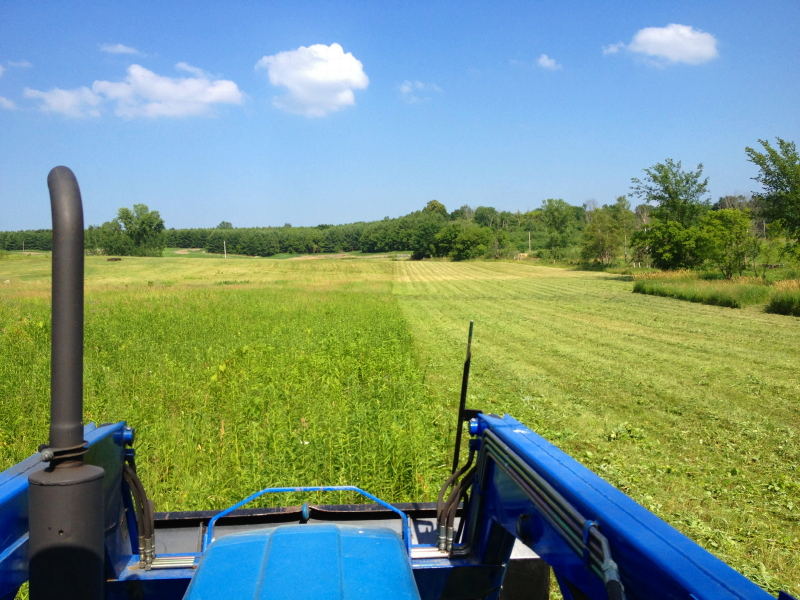 He only cut the front field, so I needed to knock down the uncut growth on the back portion. There used to be a fence between the two, but that is now gone, so I was able to make a clean line by cutting straight through, making the fields look like one. By cutting the back field, we can get rid of the weeds, and let more grass come through. Hopefully, we can include that portion when it comes time for the second hay cut of the season.
I also needed to trim portions of the front field where he wasn’t able to steer the horses precisely enough to avoid missing spots. Now it is all ready to grow into an excellent second crop.
We have learned that the second cut is a much better hay, for our purposes. Not all hay is alike, and what we have growing on our property should be just what we want to have. The first cut commonly includes more grass that has grown tall and develops a woody stem. Some of that won’t grow back a second time. What will grow in after the cut will be more of the soft, wide blades.
The key to how much of our fields we cut for hay in the long run will be, what portion of our fields do we need for pasture. If we are lucky, and manage things well, we should have just the right balance to support our goal of keeping 4 horses. I don’t think we’ll really know for sure until we get them here and see what they eat.
I’m looking forward to that, because then I won’t have to do so much dang brush hogging. You know how much I dislike cutting grass!
Horse Power
 Yesterday, I was sitting in our kitchen, with Delilah at my feet, sprawled out on the cool of the tile, when I heard a new sound coming up the driveway. It was our neighbor from the CSA farm, arriving with a team of horses to cut hay. What a wonderful sight to see. I grabbed my camera and followed them down to the pasture, calling Cyndie on my cell phone as I walked. I knew she would really love to see this, and how much she wanted to learn how to drive his team of horses. She was over an hour away, but I could hear in her voice how interested she was in getting home as quickly as possible.
Delilah and I wandered the hills around the field, watching the action. My favorite part was how quiet the process is. The cutter is a sickle bar, and is powered by the forward motion of the rig being pulled by the horses. It was a truly bucolic scene.
Cyndie made it home just in time to get out and learn some details of the process, and watch him make the last few passes. Then, he gave her chance to do the driving, luckily, without needing to navigate a row or position the cutting blade. She’s a pretty quick study, and soon was directing them to make a couple of turns and urging them up the hill. One more skill that she fearlessly adds to her already amazing repertoire.

 .
.
.
.
.
.
.
.

Finally Fencing?
 This week, I have been getting a taste of what it is like to live in the deep freeze of winter out in the country. It seems to me that things slow down a lot more than in the big city. We haven’t had any action on the fence project, so it has been more quiet around here than any other time since we arrived. It seems hard to fathom, but during this below zero spell, the most action I have seen comes from tiny birds, and a few squirrels. You’d think that creatures with so little body mass would need to stay snuggled somewhere sheltered when it gets extremely cold, but there they are, right out in the open, picking away at the food, as if it was just like any other day.
There is another factor in the pause of our fencing work. We need to decide on a place to store hay. Before we commit to locating the paddock fence lines, we have to decide where the hay shed will be. Before we can determine the location of the hay shed, we need to decide how big it needs to be. To determine the proper size, we need to figure out what form of hay bales we will be be purchasing.
About here is where our friend Mike might point out that the old rectangle bales have been discontinued, because the animals weren’t getting a well-rounded diet. The big round bales are certainly becoming more common. If we go that route, we need to figure out the necessary attachment for the tractor to move the bales around.
One factor that will help us determine what form of bales we will buy, will come from the discovery of who we will be able to purchase the hay from. It’s not like we can just go to some pet store and pick up a grocery cart of hay for the winter. It is a little more specialized a process for the agricultural industry, and we are complete outsiders, needing to find our niche in the limited local market.
So, where do we put the fence?
Yesterday, we took another step toward that decision. We are relying significantly on the local knowledge and experience of our chosen fence contractor, and comparing his advice with the research Cyndie has done. They seem to agree on the size of hay shed that should support our plan of four horses. He seems a bit hesitant to assume we will be able to stop at owning just four, based on what he has witnessed with other clients over the years, so he continues to push us to consider ALL possibilities.
We have an estimate on materials for a shed, and a couple leads on potential carpenters with skill and knowledge to build it. We measured, again, to prove it can fit. Most significant, we came up with a way to locate the shed in the best orientation, and still allow front access to receive a delivery from a typical hay-wagon trailer. We are going to add to the driveway approaching the barn, converting it to a drive-through, to eliminate any need to back up a trailer.
With that decided, they can proceed with building us some fence …when the arctic high-pressure weather system finally releases its icy grip.


 Relative Something