Posts Tagged ‘hay’
Still Winter
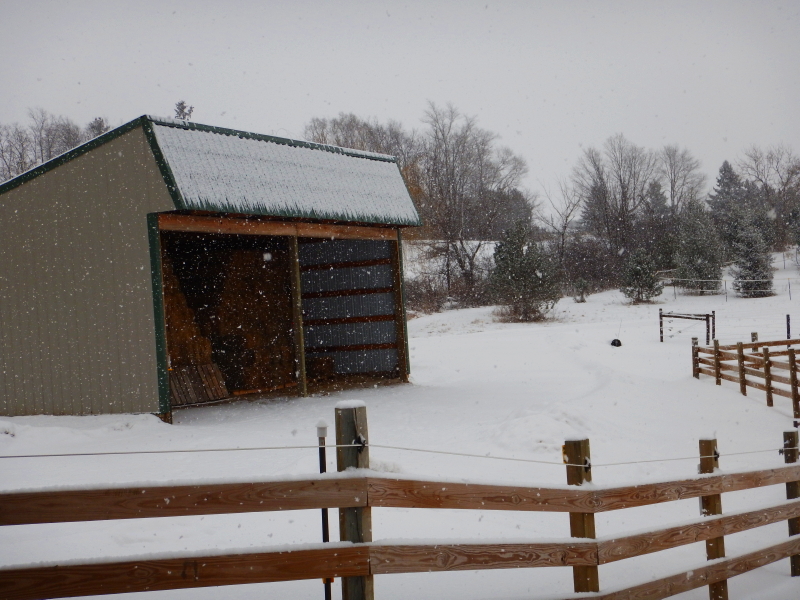
Our general region has had it pretty easy as far as weather goes this winter, especially as compared to the heavy snowfall events that have occurred in the northeast of the US. We’ve had less snow and warmer temperatures than usual. But the past doesn’t define the future. It’s still winter, and yesterday we enjoyed a return of both snow and cold.

.
.
.
.
.
.
.
With the temps low, the snow crystals were perfect and we received about 2 inches of wonderful powder snow that came floating down in a windless calm. The woods took on a mystical appearance with snow cradled in every “Y” of all the branches.

 .
.
.
.
.
.
.
.
.
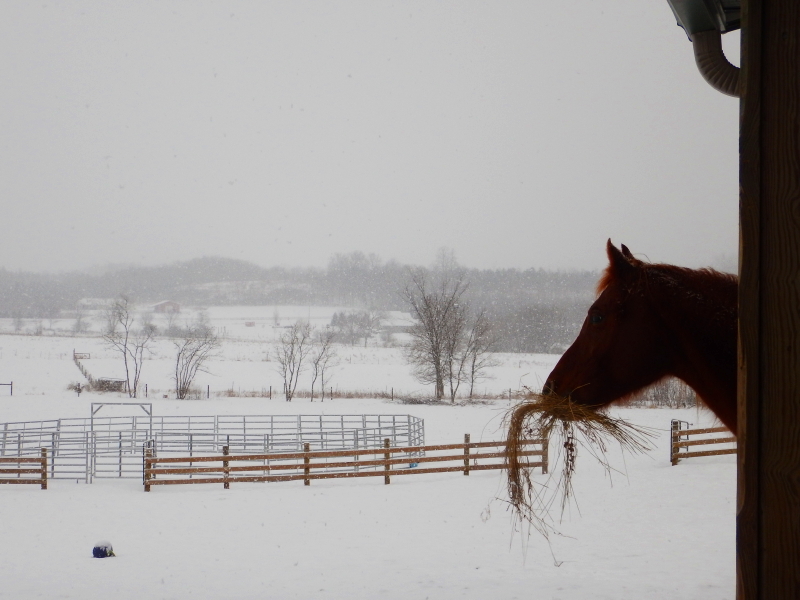
As is typical for our horses, they stood out in the middle of the hay-field during the heaviest snowfall. I coaxed them back under the overhang by bringing some loose hay and putting it on top of the slow-feeder grates. It probably would have been wise to put their blankets on prior to the snow, but they aren’t showing any signs of having a problem with the relatively small amount of precipitation.
Poor Cyndie had to endure a prolonged evening commute as a result of the backed up traffic, but that gave me a chance to get the driveway plowed before she got home. Since the snow was dry and light, that chore was a breeze.
I was walking Delilah when I decided the precipitation had slowed enough to justify some shoveling and plowing. She sat calmly while I shoveled the front steps, walkway, and apron in front of the garage doors. Then she began to demonstrate an interest in moving on. I willingly accommodated her since it was already past her usual dinner time, setting the shovel down to head indoors.
I still wanted to get to the plowing, so I left my jacket on and rushed to put food in her bowl, before heading back out. I figured she should be fine on her own while I worked.
When I opened the door 45-minutes later, I found her laying right inside of it. She looked uncharacteristically subdued. Then I noticed food in her bowl. That is an anomaly. I worried that something was wrong with her and bent down to give her some love and attention. As I stood up to remove my outdoor gear, she got up and walked over to eat everything in her bowl.
To my great surprise, she chose to wait by the door for my return rather than eat her food! I had no idea. It does add meaning to a behavior I have noticed during our routine of coming in the door after a walk. I make her wait in the entryway with me while I remove her leash harness and blaze-orange vest. Then I tell her, “Okay,” as a release to run off and do whatever is tempting her more: chase Pequenita the cat or madly chomp on any available squeaky toy.
I’ve noticed that she doesn’t run off until she sees me taking off enough outdoor wear to feel satisfied I will be staying inside along with her.
.
.
.
.
.
.
.
.
.
.
Hay Games
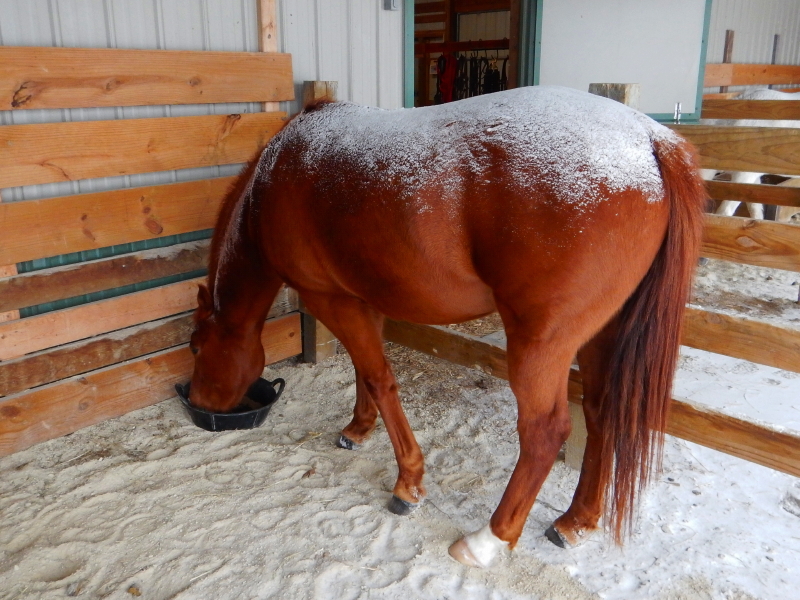 February has arrived right on schedule, showing up with a new frosting of snow for us. The horses have been doing just fine without blankets, but that meant this morning they are wearing blankets of snow that make them look like powdered sugar treats.
Makes them down right irresistible.
Until I find they have been behaving badly. I don’t know if it was intentionally malicious or just bad planning, but somebody’s butt dropped a pile of nuggets into one of the slow-feeder boxes overnight.

.
I bet they can identify who the culprit is. Wonder if they chastise the offender. What would we say to a member of our family who contaminated our food? I think that person would catch a lot of flack.
We’ve got something of a new routine going for serving up the daily hay. Even though the slow-feeders are working like a dream, there is no denying a horse’s love of eating freely out in the open.
I have placed the feeder boxes beneath the overhang to keep the hay protected from precipitation. It is pretty clear the horses would prefer being out from under that roof.
Recently, I had cleaned out the bottom of both boxes of dusty remains and decided to dump it on the ground beneath the willow tree. Since Hunter, the youngest and lowest in the herd hierarchy, usually has to wait for a turn at the slow-feeder boxes, he came right down and started nosing around in the scraps I had dumped.
That got the attention of one of the other chestnuts and they left the box to come down and make sure he wasn’t getting a better deal. Soon the three chestnuts were doing a comical slow dance of rotation as they moved from the ground below and the box above.
The next time I was filling the boxes, I decided to throw Hunter a bone and dropped a whole flake under the tree for him. Oddly, it is right next to the old feeder, but they like the hay down low so much better, and I was still of a mind to move their focus away from the old feeders to the new slow boxes, so I am completely ignoring them.
Our hopes with the old feeder was to keep hay off the ground where it gets trampled, peed and pooped on, so as to reduce waste. That didn’t really work as imagined, because they still spilled a whole bunch anyway. 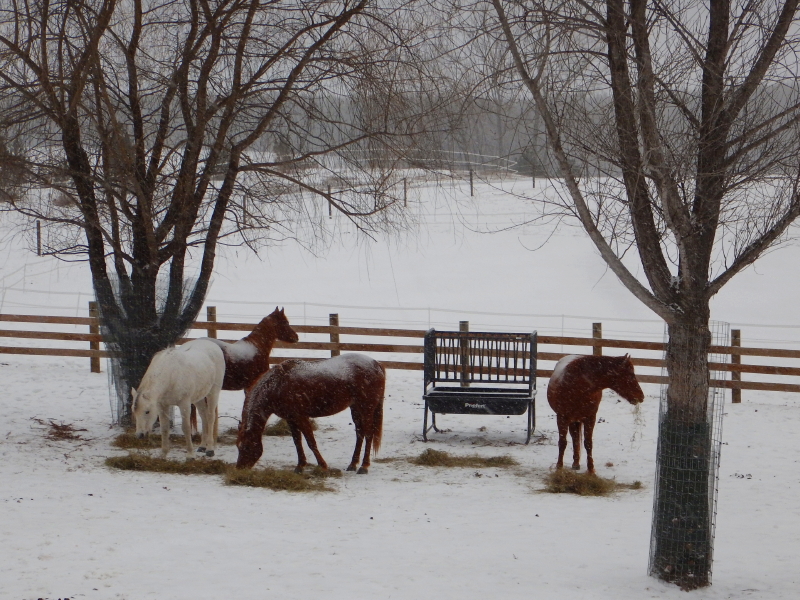 Now with the new boxes, waste has been greatly minimized, and it is starting to feel like we enough hay that such a loss factor is hardly a concern.
Since one of the boxes had been soiled this morning, I threw out several flakes for them while I cleaned up and refilled the boxes. All four of them were quick to show me they much prefered the unobstructed ground-hay under the tree.
Sure, until one of them goes and poops on it.
.
.
.
.
.
.
.
.
.
.
.
Slow Hay
I want to chronicle my project to get slow-feeders for providing hay to our horses, especially since my initial intent was to buy feed boxes because I didn’t want to build them myself. It didn’t quite work out that way in the end. I searched online and found most images were of home-made versions. One site offered to sell a set of plans to build your own. I opted to order a plastic box that most closely matched a version that appealed to me.
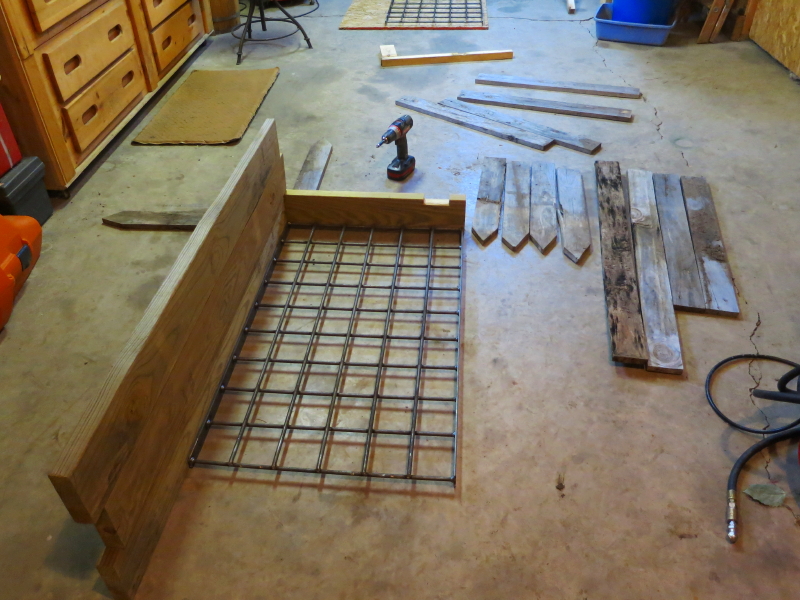
As I described in an earlier post, that online order flopped and I got my money back. I gave in and decided to try making two of them myself, based on the images of others that I liked. What primarily inspired me to follow through was an introduction to a local welder who said he could make custom grates to my specifications.

 .
.
.
.
.
.
.
.
.
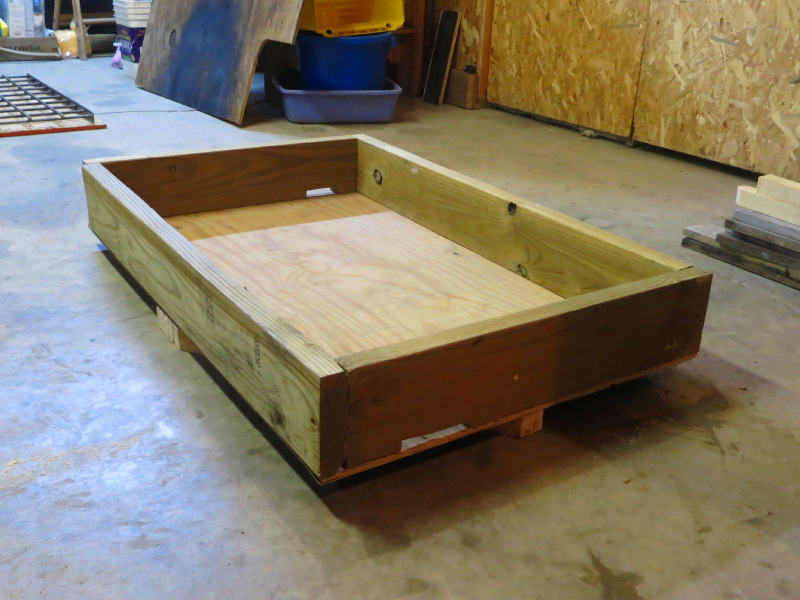
I had him make two. It wasn’t cheap, but since I planned to use materials I already had lying around to build the boxes, I would still be able to do it myself for a third of what it cost to buy them. I used plywood for a base and 2×6 boards for sides on the first box. The second box ended up being a combination of plywood and boards for the sides. I had a bunch of 1×1 lumber that I played with to brace the bottom and lift the base off the ground.
 .
.
.
.
.
.
.
.
.
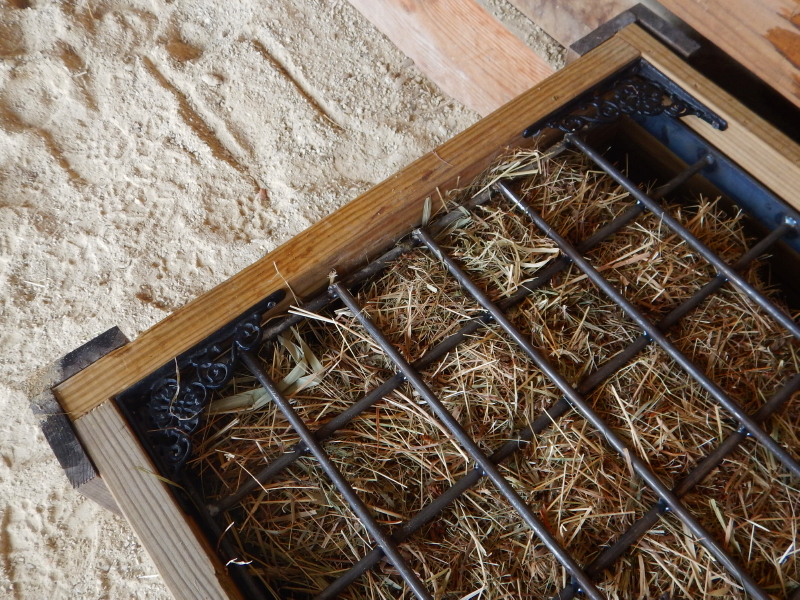
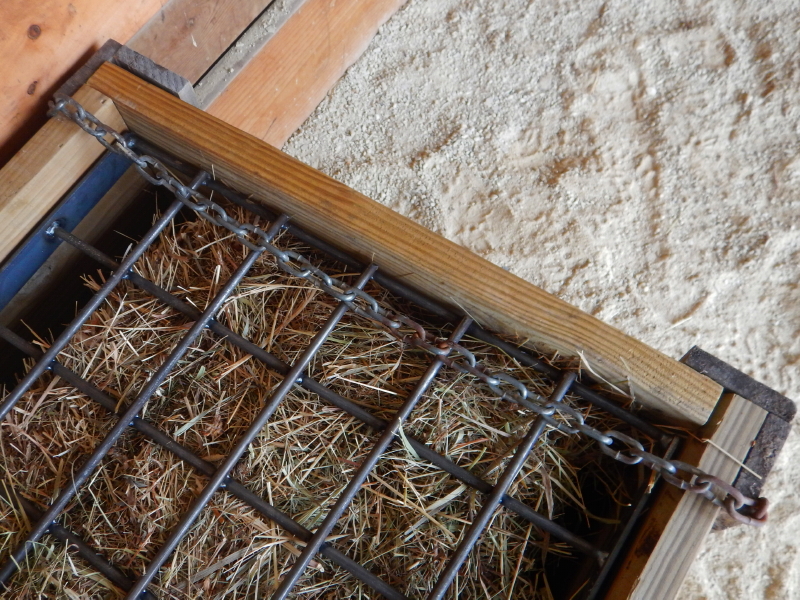
To prevent the horses from lifting the grate out of the box, I added iron corner pieces on one end and a chain on the other. The horses are comfortable with the chain because it is what we use to secure all our gates. To add hay, I unhook the chain and the grate comes out easily. I added handles on each end to make it easy to pick up and turn over to remove the hay dust that accumulates in the bottom. I thought about using slots on the ends to sweep out debris, but it ended up being easier to just tip the box and dump it out.
 .
.
.
.
.
.
.
.
.
It has been working well for us to add flakes as needed, instead of trying to always fit a full bale beneath the grate. We basically just fill it so the grate is up to the top. As they eat, it drops as the level of hay goes down. Sometimes they eat all of one end first and the grate ends up at quite an angle, but mostly they eat it fast enough that I find the grate almost level and near the bottom by morning. Best of all, they are eating every bit of the hay, instead of tossing it on the ground.

 .
.
.
.
.
.
.
.
.
I am particularly thrilled with how well it works to mimic natural grazing. The horses nibble to get a bite and then pull it out between the grate squares and munch away. Their heads are down, as opposed to the other feeders we have that hold the hay up at their standing head level. Those feeders allow the horses to push their noses deep to get at some morsel of a bite they want, and then they can toss their head and flip the hay they passed up onto the ground. The slow-feeder grate only lets them get a modest mouth-full of a bite and they need to tear it out with a motion that is identical to how they naturally break off bites of grass.

 .
.
.
.
.
.
.
.
.
Our horses have proved to me that they can eat together, two at a box, but I often have found them taking turns. I think it is part of their hierarchy playing out. When all four had 360° access to the old feeders, they would do this dance of moving each other around all the time. The new set up makes it easier to force a subordinate horse to wait its turn, instead.
I am absolutely thrilled that the horses have adapted to this new method of being fed hay, and that my (begrudgingly) homemade boxes are performing as I hoped they would. It is working so well, I am contemplating how I will adapt the design to work in a corner of their stalls in the barn. It all starts with the grate, and I’m thinking about testing a cheaper option than the custom welded solution, because this time, I will need 4 of them.
.
.
.
.
.
.
.
.
.
.
Hay Thoughts
We experienced a distinctly different sky Monday from that which we enjoyed on Sunday. In fact, we even received a short burst of heavy snowfall for a few minutes from the gray clouds overhead. However, the above freezing temperatures of the middle portion of the day sufficiently evaporated the fresh snow cover off of any surface that wasn’t already a snow base.
 The cloudy sky kept things from being very melty, but didn’t completely stop the loss of snow cover. The ground is peeking through in multiple places, especially where I had plowed a path for walking around the back pasture fence.
At this time last year, there was so much snow on the ground that I don’t think I would have been able to keep that path open. This year has been quite a different story. I am itching to find out how our new drain tile installation will work for us in the spring. If the winter ends with below-average snow levels, I am expecting to see noticeable improvement in how the paddocks dry out. Although, it will be hard to judge how much better the drainage is when basing it on a reduced amount of melting snow from this year.
Not that I’m complaining. After the amount of wetness we endured during the first two spring seasons that we lived here, we are due for a break this year. If a dryer spring happens in 2015 and we don’t get a real test of the new drain system, so be it. I’ll welcome the break.
One of the things that would be a nice change is a chance to cut hay sooner. Our hay crop was far from pristine, as our field is long on weeds and short on desirable grasses, but our horses seem to prefer it to the bales I purchased from a farm to the north of us.
(Jack and Joanie, if you are still reading: I recently found a few bales of your hay left over that we had stowed inside the barn, instead of the hay shed. Our horses really liked your hay! We were able to feed it to them during the severe cold nights.)
I am still hoping that we will gain ground on improving our hay simply by cutting it regularly. If we can get on the field to cut it before it gets too long for a first cut, and early enough to give us a good shot at getting a second cut later in the summer, I believe, based on the yield we got last year, we can put up enough of our own hay to feed our herd through a winter. That would be a real special success.
It would be just like we planned it, back when we didn’t have a clue about any of this.
.
.
.
.
.
.
.
.
.
.
Slowly Learning
I finished my first slow hay feeder box for our horses yesterday. I wish they had been around when I was placing it under the barn overhang and loading it with hay. The herd was on the far side of the hay-field at the time, happily grazing in the warm winter fog. Later, when the time came for them to come up for the afternoon serving of their feed supplement, surprise sightings of the new box in their space startled the heck out of each one as it came into their view.
If they had been there while I was working on it, they would have been putting their noses all over it in curiosity about what I was up to. I didn’t have time to linger with them, because I had a date planned to get Cyndie to a movie and out grocery shopping for the first time since her surgery. We even ate out at a burger joint to make it feel like a real event. It was a grand success, and she surprised me with her endurance traipsing the food aisles on her feet for the long duration.
I figured the horses might completely avoid the foreign object, but this morning discovered one or more of the brave souls figured out there was hay in there. Overnight there was enough activity to leave scraps on the ground around the box and create divots in the bale beneath the metal grate. Looked to me like one or more of the horses had spent enough time there to get comfortable with it.
We don’t want the horses to become frustrated by this obstructed source of hay, so I will continue to provide it in the existing feeders for now to allow them options. The hope is that this new system will be easy enough for the horses to accept as a pleasing source of grazing that is always available to them.
In that regard, I felt there was something wrong with my method after inspecting the results of their progress after one night. It appeared they were only able to make limited headway into the bale, leaving the grate resting high on spots they hadn’t pulled apart. My initial intuition was that I had designed the whole thing wrong, based on the bale positioned with the cut edge to the side.
If I turn the bale 90° so that cut edge is up, it resembles the appearance of growing grass. The ends all point up. It will be easier for them to pull a bite from between the squares, and the grate will be more inclined to drop down as they consume the bale. It seemed to me that would be less frustrating for them. So I tried it.
 I immediately discovered a problem in that the bales aren’t symmetrical. When dropped in there on its side, the bale is too tall for the box! Back to the drawing board. That is why I only built one to start. I laid the grate on top and stood there for a while as Legacy took to the sideways bale right away. Eventually Cayenne joined him and they seemed to be having a fine time with it, until the loose grate laying on top suddenly shifted as she pulled aggressively at a bite. It banged the wall and they bolted away in a panic.
The thing is, I may be jumping the gun. I have a couple of thoughts about it now, after giving it some time. I don’t know for sure that the first way wouldn’t work, given enough time. Also, I put an entire bale in there, and maybe it was too tight that way. If there was just a portion of a bale, maybe they could make better headway.
I’m not sure how I will proceed. Maybe if I give them more time, they will teach me what to do. I am slowly learning.
.
.
.
.
.
.
.
.
.
.
.
Morning Routine
We are in the third weekend since Cyndie’s surgery and things are going really well. Struggles have been minor and triumphs have been many. This morning I am experiencing a bit of a longing to be able to sleep in. Normally, weekend mornings are Cyndie’s chance to greet the horses she has been missing during the week, allowing me the opportunity to wake slowly, linger in bed, and compose my weekend blog posts.
I’ve long heard stories about dairy farmers who needed to get up early every day of every week, without exception, to milk cows. I am feeling an increased appreciation for that commitment.
My morning routine has normalized for all of us and is flowing very comfortably of late. Delilah has pleasantly announced her waking with soft mutterings, remaining stretched out on the bed in her overnight crate after she hears sounds of me getting up. I switch on the kitchen light and she lolls in place luxuriously while I get myself dressed and ready to take her out and feed the horses. It is a very soothing pace to start the day.
We step out and locate the horses during our stroll to the barn. It takes the herd no time at all to sense our approach, whereupon they begin something of a controlled stroll toward their morning feed. It is as if they don’t want to appear too eager.
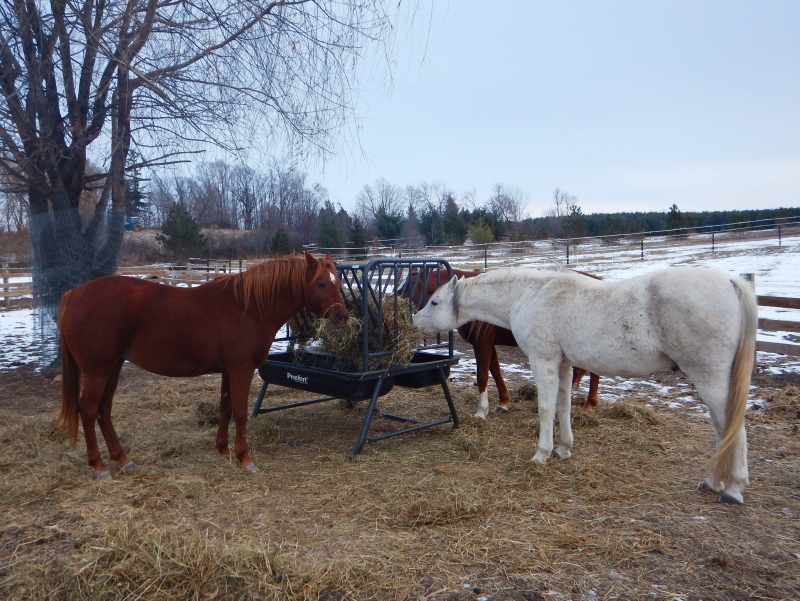
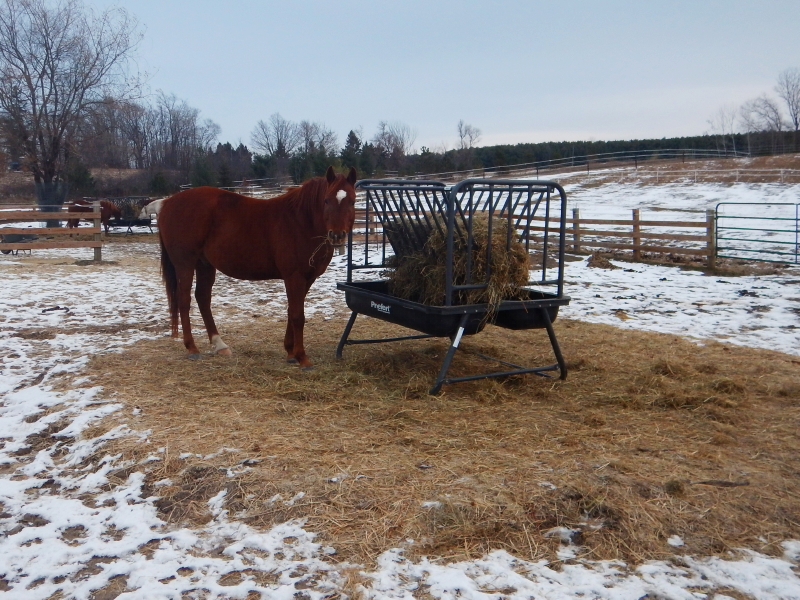
The one variation in the pattern happens as they select who gets which feed pan. Some days it is very straight forward, and sometimes it becomes a complicated exercise of gamesmanship as the chestnuts take turns flaunting domination by driving each other off one pan to another.
If it is windy, or something else has them already on edge, feeding under the roof overhang is fraught with multiple emergency response drills as they all erupt in a hasty dash out from under cover whenever any one of them even flinches at the slightest thing. Just as quick, they seem to figure out it was a false alarm and come right back, but that doesn’t stop another panic from happening 20-seconds later.
It’s interesting that my presence is sometimes a contributor to their alarm, but more often completely ignored. I need to stay alert to be out of the way when they panic, and they surprise me that they don’t react at some of the clanging and banging noises I make when I am fumbling about.
 .
.
.
.
.
.
.
.
.
While they are focused on the feed pans, I wander over to the hay shed to fill the wheelbarrow with flakes that I distribute to the two feeders. As soon as the horses have licked the feed pans clean, they come munch hay. Hunter most often chooses to wait until the other three dive into the first station I have filled, then he chooses the other one. Sometimes another horse might meander over to join him, sometimes not.
After horses are fed, Delilah and I head out on an exploration of our trails. I will often let her choose the route, and I just follow along, stopping wherever she chooses to linger, examining the source of some scent that has dramatically grabbed her full attention.
Once back to the house, both she and Pequenita are served their breakfast, after which there settles a wonderful calm over the house.
When Cyndie gets back to full mobility, and we get back to the old weekend morning routine, that calm moment will be about the time I think about finally getting up.
.
.
.
.
.
.
.
.
.
.
.
.
Multiple Priorities
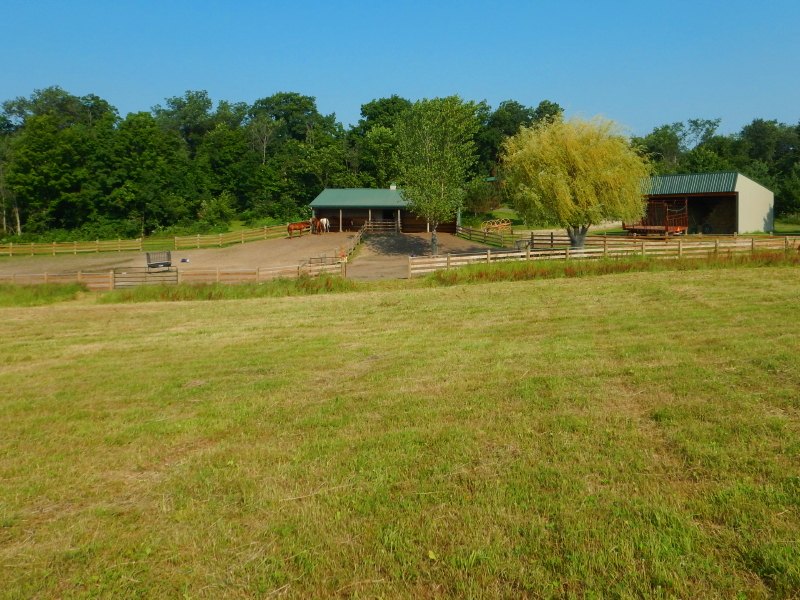 It is such a pleasure to have our hay-field cut and baled, and to have our hay shed filled with what should be enough hay to get us all the way through next winter. The field looks great freshly cut. We opened it up to the horses after the baling was complete, thinking they might run out and revel in the wide expanse of space with available grass to eat. It was rather anticlimactic, because they instead chose to stay close to the paddock fence and graze on the grass growing in the unmowed drainage swale.
Finally yesterday, I witnessed them slowly making their way up the hill along the driveway fence line, tightly grouped in their little herd of four. I guess they are just being cautious.
I opened up the cover of the wood chipper and reclaimed the locking pin I inadvertently tossed in there on Monday. It was a simple procedure, giving me the opportunity to see the cutting blades and how the whole thing works. I sure hope I can put it to use before the end of this week.
With hay under control, it is time to move on to other business. I do hope to mow down the weeds on the small area to the north of the driveway, but cutting down trees and chipping up branches is a high priority that needs to happen before the fencing company shows up to finally start work on enclosing the entirety of the grazing pasture between the hay-field and the woods/labyrinth.
Another high priority for us is finding a landscape company that can take on the task of installing drain tile around the paddocks, and providing gravel and/or sand to improve the ground inside the paddocks during wet times. The one referral we were given is not responding. I’m guessing it is his way of indicating he’s not interested in the job, but a second source said it is likely that he’s just too busy. My neighbor said his prices are good, which is probably why he is too busy.
We really want to get this done while things are dry enough to support trucks loaded with gravel navigating our property. The way things have been around here the last two years, that time period ends up being rather short.
.
.
.
.
.
.
.
.
.
Bountiful Harvest
You would be wrong if you thought the only thing we harvest at Wintervale is hay. Although, you gotta love that hay is one of our big crops, when our last name is, “Hays.” Of course, you may also be remembering that our horses produce an impressive amount of fertilizer, but as much as I boast about our compost pile, it will be a long time before we will be making any money off that.
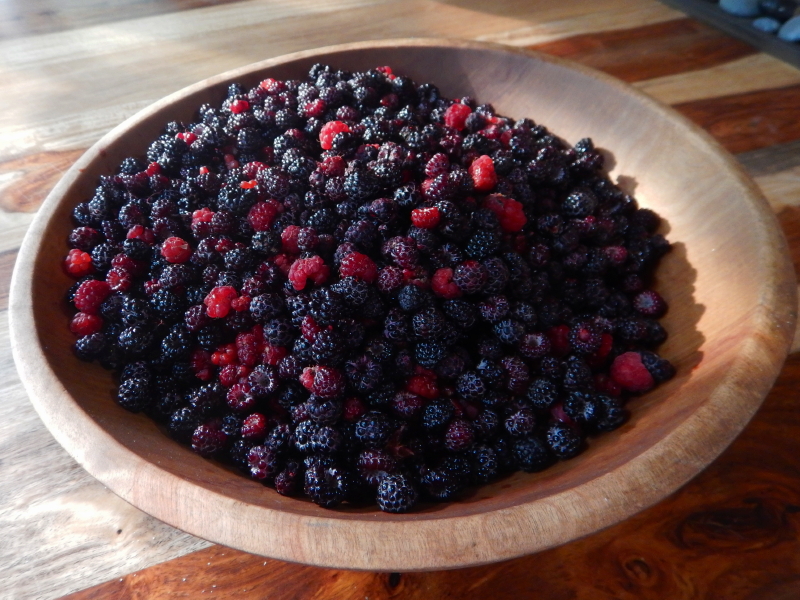 The lesser known crop we have here, and the one with probably the best potential of becoming a future money-maker, is black raspberries. When Cyndie cans them as “blackcap” jam, they turn into liquid gold.
The wild bushes we have all over the place sprout a surprising amount of fruit in a short amount of time, often overnight. Cyndie has gotten in the habit of bringing a container along when she takes Delilah for walks, because new fruit seems to burst forth in places we didn’t even realize had the potential.
There is something special about the jam these berries produce. Their tantalizing aroma is almost as satisfying as the taste. If you already know and love that flavor, one whiff of the smell will trigger the irrepressible urge to consume.
 We had no patience once the berries appeared, and Cyndie cooked up the first small batch she picked, to create a topping for waffles. A little local maple syrup over the top and we had our taste buds doing flips of joy over their good fortune.
This year, when conditions have been miserable for a lot of things, the raspberry plants seem to be doing quite well.
We’ve got a year’s supply of hay stacked in the hay shed, but I don’t think we’ll ever be able to stock enough of her blackcap jam. It’s just too irresistible.
.
.
.
.
.
.
.
.
.
Never Dreamed
A few years ago, I had no clue about how much my life experience would be changing by the middle of the year 2014. Yesterday was the culmination of a possibility that bloomed after we bought our new property in the fall of 2012. I found myself out driving my tractor in our field, pulling a rake to create windrows for baling hay. What a kick. A very humbling kick that I never dreamed I would be experiencing.
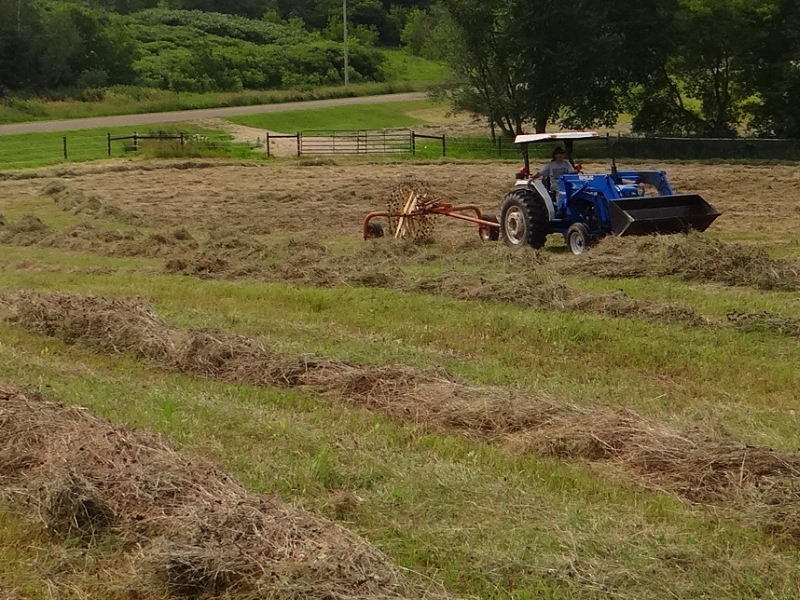 For the life of me, I couldn’t figure out how to make this raking work the way I wanted. My instructions from George were pretty basic, and he rode with me as guide for about two passes, before heading home to trim some horses. He’s a farrier, you know. One big challenge with the rake he brought over is that you aren’t able to back up, and it keeps raking while you reach the end of the field and have to turn around before the fence.
Turning around was a trick, and the goal of creating straight, single rows repeatedly evaded me. It will take a few tries to figure out how to manage the shape of this field. Ed, the man who cut it for us last week, had never been on the field before and just picked a pattern which suited him. George and I started down one fence line and then he suggested I just continue that line, but it ended up putting me across many of the rows Ed had cut.
The result of my “student driving” exercise made for a pretty crazy sight, but George was kind and soldiered ahead with his baler to make it work, despite many areas where the hay had been tumbled into piles instead of rows.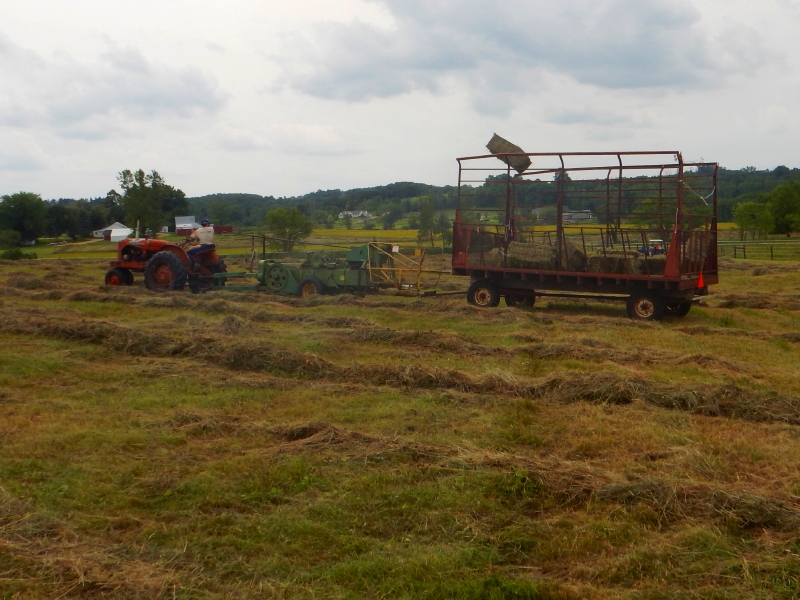
The problem with the piles is that they would plug the intake and George would have to stop and climb down to pull grass out or kick the piles into place as prevention.
We both feel our system will improve as we figure out an optimum way to work the odd shape of this field. There is more to it, though, than just the irregular shape, because it is also not flat. Navigating up that hill becomes an increasing challenge as the hay wagon gets heavier and heavier with bales.
As always, needing the field to be dry enough to work is a primary factor. George got stuck several times, and I needed to push the back of the hay wagon with my tractor to get him moving again. The one that surprised me most was on higher ground, where his back wheels sunk into what must be a ground spring where water pushes up near the surface. It seems like an illogical location for a soft spot.
Now, after days of stacking purchased hay in our shed, we have two more wagons full of bales that need to be stacked. It is a LOT of work, but it is a labor of love.
Especially for the horses. They love having us stock piling all these bales where they can see and smell them.
.
.
.
.
.
.
.
.
.
People Energy
This morning the sound of wind through the trees is providing a perfect ambiance for the idyllic experience we are enjoying of late. Once again, what takes it from a truly pleasant solitary adventure for us is the inclusion of other people. After 13 trips to visit our hay supplier over the last week and a half, I drove it one more time yesterday morning —this time in Cyndie’s convertible on the beautiful rolling country road— to take Cyndie to meet Tom and deliver payment for 520 small bales.
While we stood in his driveway visiting, a couple of guys arrived to pick up some bales of straw to mulch their garden and we had the opportunity to meet two more kindred spirits who live nearby. Tom took a moment to share a vivid story that had us all busting a gut with laughter, and the endorphins were flowing. Getting to know Tom and his son, Dan, has been a pleasure beyond the mere fact they are exactly what we dreamed of finding in terms of a local source of hay, baled in small squares. They are good people.
 Later in the day, while I was trying to hustle to get the lawn grass mowed before it caught up to the growth in our hay-field, neighbor George Walker drove up the driveway, pulling a hay wagon in preparation to bale our field. After an informative visit, we walked out to test whether the cuttings were dry enough and I got a bit more education about the process. It is quite possible I may end up being the one to rake the field into windrows, pulling his rake behind our tractor today. He expects to be available to come do the baling shortly after that.
We parked the hay wagon in front of our hay shed and I drove my truck to his place to help him unload a second wagon, so that I could tow it back home as well. Things seem to be falling in line, in the nick of time. George and Rachel are two more people who we are blessed to have met and come to know.
 While I was at their farm, I spotted a cat napping on the conveyor and wandered over to take a picture. As I got closer, I spotted kittens peeking out from within. It wasn’t until later, when I brought the image up on my computer, that I spotted one more cat laid out just above the first one that originally caught my eye.
Somehow, even with all the other activity that filled the day, when I got home, I squeezed in the completion of mowing all our grass, and in the final minutes before sunset, ran the reel mower through the labyrinth after I spotted Cyndie down there pulling weeds.
I think it was all the precious people energy that fueled my last burst of activity, allowing me to get the absolute most done by the end of the day.
.
.
.
.
.
.
.
.
.


 Relative Something