Posts Tagged ‘genealogy’
Genealogic Gem
About that new relative that contacted me, which I made mention of in yesterday’s post… She shared a most interesting tidbit in subsequent email exchanges.
First, let me say that the whole reason I started investigating my family history was because I wanted to learn why the surname, “Hays,” in my family, is spelled without the “e” that people so commonly choose to insert when writing my name. “Hayes” is more often than not, the default spelling. The short answer to the question of why the two similar names have different spellings is most likely related to the place of origin. Spelling without the “e” aligns more with an Irish or Scottish source, while the spelling with the “e” identifies as more English. The root of the Irish name goes back to “Hay.” If the spelling had stayed at that, it would have simplified everything.
When I received the message through Ancestry.com a couple days ago, the very first thing I noticed was that the name of the ancestor in question appearing in the subject line was spelled, “Hayes.” It is like finger nails on a blackboard irritating. Of all places, in my own family tree!
I did a little quick research to clarify that the “Charles W. Hayes” being referred to, matched my data collected thus far. I found a record of the 1910 United States Federal Census in which Charles’ entire family, including his mother –my great, great-grandmother– were listed with the last name spelled, “Hayes.” Charles was definitely part of my family tree, but why in the heck the “e” in the spelling?
I queried my new contact and was more than intrigued at her response:
“Yes, according to my grandfather he and his brother John had a falling out when they were very young and grandfather added the e to his name. He and his brother never saw each other after that.”
I never would have guessed at something like this. Family drama aside, the discovery that family members were choosing to insert the “e” when I am on a quest to identify why we don’t spell it with an “e” just boggles my mind. Meanwhile, what could my great-grandfather and his brother have been at odds about that would lead to such animosity?
It’s enough to inspire a person toward genealogy research. It’s not all just about names. There are stories connected to all those people.
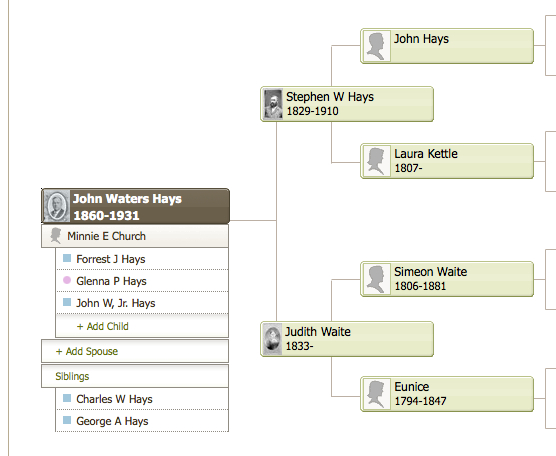
Brothers John Waters and Charles W. were the two who had a falling out.
Census Love
 .
.
.
s a genealogist, I find that I have a great love for census records. More than any other resource (birth, death, and marriage records, do provide plenty of hard data) I prefer the census for the picture it can paint. Or, more precisely, the picture that a series of decade’s census records can paint.
There is actually a limited period of time for which this works best. If you get too far back, say, into the early 1800’s, the information is less complete. You might only get the name of the head of household and a tally of how many free white males of a range of age groups, then free white females, and lastly, slaves. I get to overlook my disgust for the slave category because for the geographic areas I have been researching, either people were too ashamed to report such or they didn’t keep any, because I have yet to see any entries listed under that column. Race discrimination, demonstrated by holding whiteness specifically worthy of counting, above all other humanity, is as blatant as can be, right from the very start. But that is straying back to yesterday’s topic and away from what I had in mind for today, and it totally interrupted my point…
If we look too recent, we don’t find anything later than 1930, because individual information is kept confidential for 72 years by Federal law. In a couple more years, we will finally have access to the details of the 1940 census. Inbetween the early, rudimentary records of the early 1800’s, and the most recent available data of 1930, there is an opportunity to uncover some amazing portraits. Records reveal people growing up in households filled with siblings and hired help, children mature and leave home, and frequently, elderly parents end up living with their kid’s families. It is so great to pull up a record in hopes of attaching it to someone I am researching, and then discovering the familiar names of brothers and sisters listed in the household results.
It is also exciting to view the records for people of the houses nearby, sometimes on the same page, or maybe 1 or 2 pages either direction, to discover relatives by marriage. They often really did marry that girl/guy next door. I have seen people counted as children, and then by the next census, they are married to a neighbor. I like watching the parents age, 10 years at a time, and seeing the number of children grow. Then the older kids disappear, sometimes even as new young siblings continue to be added. Some folks had a heck of a lot of kids, back in the day. Occasionally, parents might be found living alone in their 70’s or 80’s. After all those kids, I can’t say that I blame them.
It seems like people didn’t count so well, because it appears rare that folks actually aged 10 years between decades. That level of detail can matter a lot when you’re trying to make a solid confirmation a couple of hundred years later.
I hardly need to point out how that silly habit of naming children the same as a parent is a nasty hassle for researchers. I never can be sure if, when the numbers seem off, it is because it is actually a different generation person by the same name, or if someone erred on reporting the age of the person I am seeking.
If you are reading here today, I encourage you to do all those future ancestry hunters out there a big favor by thoroughly and accurately filling out your census forms, and doing so promptly. But if you want to mess with those researchers a bit, fudging your actual age is too obvious. How about under the question for race, you select, “Other” and write in Oak or Pine or Maple.


