Posts Tagged ‘genealogy’
Methodical Research
Since our weather pattern yesterday offered just enough periods of rain to keep grass too wet to mow, Cyndie and I busied ourselves with indoor pursuits much of the day. While Cyndie unleashed her creative artistry on making spectacular custom cards for persons known and to be determined, I resumed an attempt to gather local news reports from the 1800s that mention the names of my ancestors.
I find myself easily distracted down rabbit holes of stories both trivial and dramatic on the pages of the old editions of The River Falls Journal, even though they don’t contain family names.
There are simple, yet creative mentions of babies born, comments of individual comings and goings, reports of illnesses and serious injuries, and brief mentions of crop successes and failures. Occasionally, there are official statements of “found” livestock on one’s property that will be kept for their own if not otherwise claimed.
There was a report of a horse that attempted to leap a picket fence but it was unsuccessful and did not survive. In another incident, a man allowed horses pulling his wagon to enter a lake for a drink of water. They began to sink up to their necks! In that case, somehow all were saved.
I decided to transcribe just the portions in which my ancestors were named and sort them by date to better organize the information I was uncovering. I regret that in this form it lacks some of the exciting drama of others in their community being mentioned simultaneously.
These should really be in an olde-timey font, but here is what I gathered yesterday afternoon:
River Falls Journal March 29, 1877
Esdaile
Mr. Betcher has the largest and best stock of hub and spoke timber on hand now that has ever been in this place. S. W. Hays is foreman here for Mr. Betcher at present, and evidently understands his business.
River Falls Journal November 15, 1877
Esdaile
The officers of Green Valley Lodge, I. O. G. T., installed last Wednesday evening are S. W. Hays, W. C. T.; Miss Alice Butterfield, W. V. T.; K. W. Lewis, S.; J. Sleeper, T.; Miss Effie Isham, I. G.; J. P. Johnson, O. G.
River Falls Journal May 5, 1881
Esdaile Echoes
S. W. Hays is at home again for a few days visit with his family
Joseph Sleeper has sold his house and lot in this village to C. Betcher, of Red Wing, for $450.
A little daughter of Mr. Sleeper received so severe a fall the other day as to render her senseless for some time, but she is now all right again.
River Falls Journal June 12, 1881
Esdaile Echoes
C. Betcher has recently been remodeling his horse barn.
E. Hoover has rented a part of S. W. Hays’ house and is now occupying the same.
Henry Bently has decided not to occupy the Sleeper house as was stated a short time ago.
Messers L.C. Rice, L. H. Rice, Joseph Sleeper, and L. Turner, are building a saw mill and bending machine at Brookville, St. Croix county.
River Falls Journal May 25, 1882
Brookville Brevities
S.W. Hays, of Esdaile, called on us last week. He talks of making St. Croix County his home.
Esdaile Echoes
Mrs. Church and mother, Mrs. Sleeper, of Minneapolis, are spending a few days in town.
For reference:
Joseph & Abigail Sleeper are 3rd-Great Grandparents
Charles & Sarah [Sleeper] Church are 2nd-Great Grandparents
Stephen W. Hays (wife Judith [Waite]) are 2nd-Great Grandparents
John W. & Minnie [Church] Hays are Great Grandparents
Charles Betcher (unrelated) was the lumber baron who Stephen W. Hays worked for
.
.
Mostly Rain
Amid a heavily broadcast series of warnings about the chances of severe weather, I dawdled indoors much of yesterday until time was dwindling in a break between bouts of precipitation. It felt like now or never to get anything productive accomplished outside.
 I gassed up the power trimmer and went after as many easy targets as I could hit, with particular interest in two of the most needed places. I reached the strip of longest grass just beyond the culvert as the sky began to grow dark again. It wasn’t pretty, but as raindrops started falling, I finished what I had set out to do.
The area of that strip is now a sloppy mess of long, wet cuttings, but it is a cut sloppy mess. If I’d had time before more rain, I would have used a pitchfork to pick up the mass of wet chopped grass left behind.
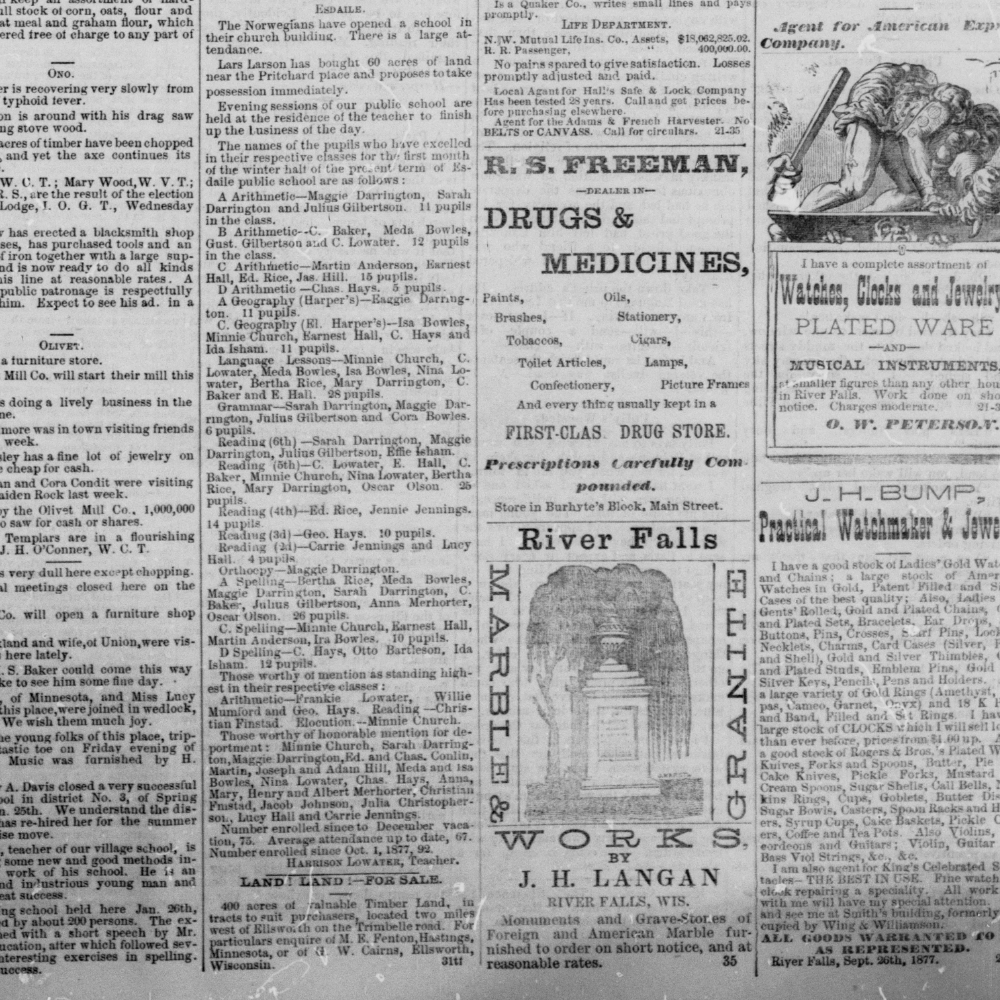
Earlier in the day while it was raining, I spent a little time perusing old newspapers for ancestor names again. Focusing on the River Falls Journal in the latter half of the 1800s, I found a treasure in 1878 under “Local News” for Esdaile. It lists the names of “pupils who excelled in their respective classes in the first month of the winter half of the present term.”
My search term was, “Hays” so it was easy to spot my great-granduncles, George and Charles Hays. Those two are the younger brothers of my great-grandfather, John W. He would have been 17 years old at the time. Charles was 9 and George was 8.
What made this find such a treasure was the name of one other excellent student: Minnie Church.
Minnie is my great-grandmother. She was 10 years old that winter when the grades were published. I would imagine the younger three knew each other well, spending their school years together. Ten years later, in 1888, Minnie and John (seven years her senior) were married in Minneapolis.
I wonder how the younger brothers felt about John getting the girl in the end.
Discovering those records was a lot of fun for a mostly rainy day.
.
.
Time Travel
By simply driving south on the gravel road winding along Isabelle Creek, I felt transported to the time my ancestors lived there in the second half of the 19th century. We were on our way to the Pierce County Historical Association.
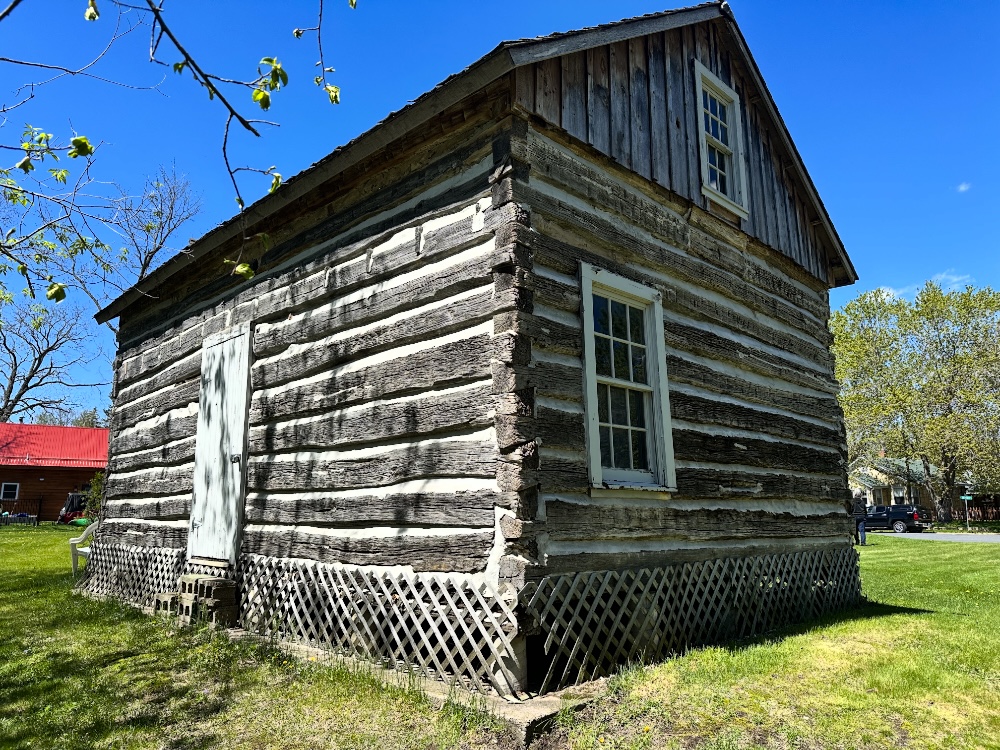 Our visit to their office in Bay City was a treasure. The old log cabin they have preserved is from near the community of Esdaile where the Sleeper mill was located. Standing in that structure made it even easier to imagine we were no longer in the year 2024.
Our conversations with volunteers covered multiple subjects, including how quickly things changed when the railroad arrived. I learned how to interpret the symbols for structures on old property maps: round = log; square = frame; triangle = brick.
Something I didn’t anticipate was a tip that old newspaper information is available from the Library of Congress online through their Chronicling America site where it is possible to search historic newspaper pages from 1756-1963.
I took a stab at “S. W. Hays” in Wisconsin between 1855-1895 and found this morsel in The River Falls Journal:

Now, this is particularly cool because, in addition to my ancestor Stephen Hays, it includes mention of my 2nd-great grandfather Charles Church and refers to “C. Betcher” who owned the lumber business Stephen (S.W. Hays) worked for. The only family missing is someone from the Sleeper clan. That’s okay though because when I searched for Joseph Sleeper there are a large number of pertinent results.
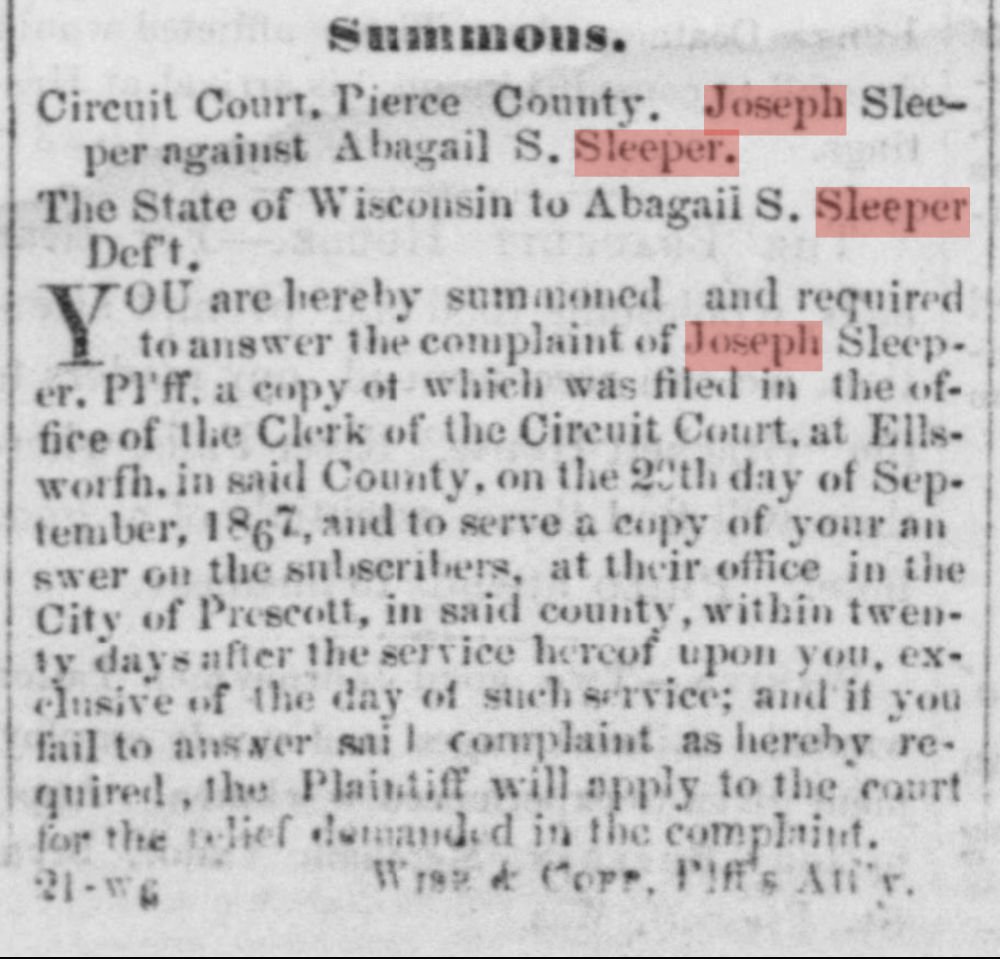
In fact, I discovered there was a summons published in the Prescott Journal about a complaint between Joseph and his wife, Abagail:
Spring is the wrong time of year for me to be discovering a new resource for losing hours on end searching old newspapers for the names of my ancestors. There are acres of grass that need mowing outside!
I hope today will be a little dryer out there than it was yesterday.
.
.
Ethnicity Estimate
Kiss me, I’m [almost] Irish! I don’t know if you can tell, but I am writing with an Irish accent this morning. In honor of my great connections to the fifth-century patron saint and national apostle of Ireland, Patrick, I am acknowledging this special holiday by revisiting my ancestral links.
But, wait. Ireland has always been a dead end in my attempts to verify the origin of the surname Hays. I haven’t identified the father of my 3rd-great-grandfather John Hays. I have always been led toward Ireland because a mention in an 1860 Canadian census that lists place of origin as Ireland.
Confusion was added when information on that John Hays (born abt.1795), found on the death record of his son, John B. (born 1834 or 1837) listed the father’s (John born 1795) place of birth as Vermont, USA. I have never been able to verify that.
However, I have DNA records to connect with my ethnicity so surely that will verify this family line to Ireland. Umm, no. It doesn’t.

The missing link is whoever the father was of the John born in 1795 and where he was from.
My cells indicate the top three places matching my ethnicity are England and Northwestern Europe, Wales, and Scotland.
So, I guess I’ve actually been writing in a Scottish accent all this time. Not sure if you can hear the difference.
Regardless, Happy St. Patrick’s Day!
.
.
Ancestor Cloud
I made a word cloud that includes 5 generations of surnames of our children’s ancestors. That is 64 names: 2 parents; 4 grandparents; 8 great-grandparents; 16 great-great-grandparents; and 32 great-great-great-grandparents.
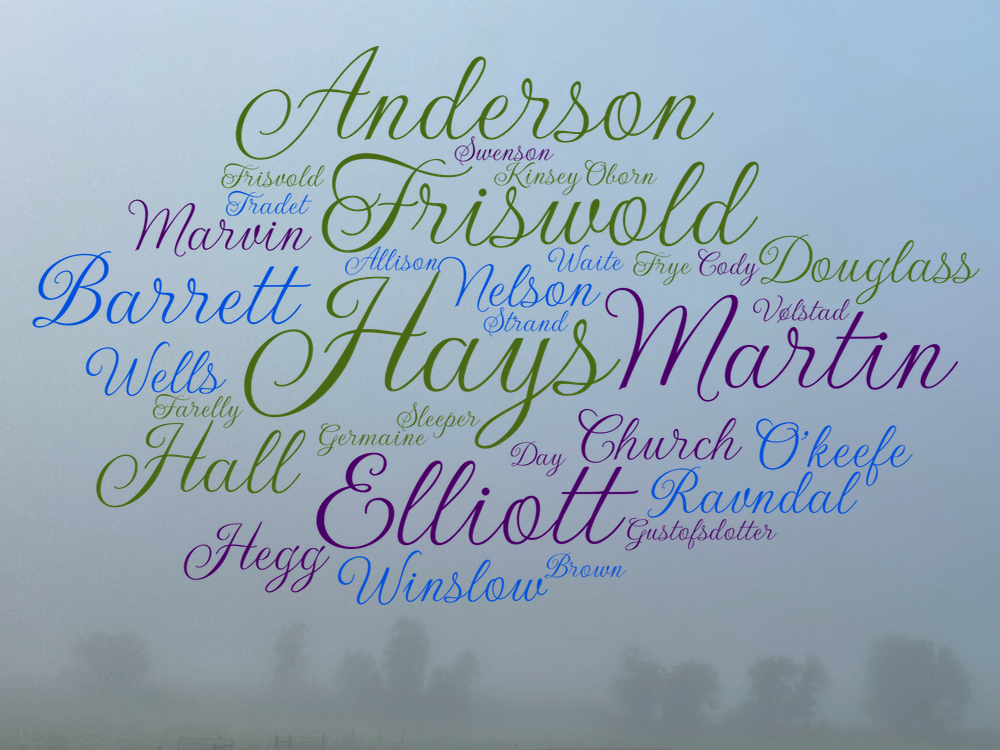
The name Hays occurs 5 times but there are only 4 Friswolds because that name changed from Frisvold four generations back. Cyndie’s mother’s and my mother’s maiden names show up 4 times each.
Our kids are all those people. I’m only half of the people named and Cyndie is the other half.
The kids visited yesterday for our immediate family Christmas gathering and I was mentioning how different from each other Cyndie and I are. Julian then pointed out, “And I am both of you.”
We definitely contain multitudes.
.
.
Comparing Generations
In my random occasions dabbling with research into my family ancestry, I’ve too often limited my focus to a narrow few surnames at the expense of so many others. The case of not finding any evidence of a person I’m seeking should be enough to push me on to other lines of the family, but sometimes I can’t get myself to give up.
Something that has helped me to appreciate how many people’s blood we share is the display of doubling numbers for each generation above us in our family trees.
- 2 parents
- 4 grandparents
- 8 great grandparents
- 16 great-great grandparents
- 32 great-great-great grandparents
- 64 great-great-great-great grandparents

I’ve got names for all 16 great-great grandparents, but only 25 of 32 third-great grandparents.
It can get confusing sometimes to keep track of generations and relationships, especially when parent and children names can be the same or very similar. Since I was listing out the generations, I decided to make note of the range of birth years for each.

It’s interesting to see how much the range of years increases with each generation, but understandable with the increased number of people involved.
Cyndie and I can serve as an example of how the difference of birth year can be so great within a familial generation. There is a 17-year difference in the birth years of our parents. Cyndie was the first-born child of 20-year-old parents and I was the fifth-born child of 40-year-old parents.
The birth date ranges of my ancestors shows that one of my 3rd-great grandparents was born after one of my 2nd-great grandparents. No wonder I can get confused sometimes about who is who and in which generation they belong.
It’s a mind boggling trip to contemplate being equal parts of 32 or 64 people in a generation.
It would be a shame to neglect any one part of our history when looking at the rest. My next priority on the genealogy puzzle is to identify those seven missing 3rd-great grandparents. From the looks of it, Ancestry.com has hints waiting to be investigated on several of them.
.
.
Chasing Ghosts
In my experience, imprecision seems to define searching historical vital records data. It’s certainly the case after the effort I put forth yesterday, scouring the Vermont, USA, vital records for 1760-1954 that I was able to locate online in a quest to learn anything new about my 3rd-great grandfather, John Hays (b.1795).
I know where and when he died and much about his wife and children because I have his last will and testament and have seen the headstone over his grave. It doesn’t include much detail: “JOHN HAYS (line) DIED (line) Sept. 25, 1840 (line) Aged 45 years” The only reason I believe that he was born in Hinesburg, VT is from the 1922 death notice of his youngest son, John B. Hays (1837-1922).
Yesterday, I focused on trying to find a record of his birth by hunting for an official record from Chittenden county in Vermont in the latter 1700s. What if his birth was recorded as being in Burlington instead of Hinesburg? What if he wasn’t 45 years old in 1840?
What if the archivists were not entirely precise in their record-keeping?
Here are some issues that are complicating my search:
- Using search features of online genealogy sites relies on the interpretation of humans who have typed out the archaic cursive handwriting of census recorders and town clerks. I have seen instances of mistakes. Just because a search brings up no results doesn’t mean an actual record doesn’t exist.
- I may find a record with a name I’m seeking, but if there is incomplete information recorded in the other fields of that record, it isn’t very reliable.

The record above is one of very few with 1795 as date of birth. Anecdotally, I can say that Vermont had a bit of a baby boom around 1858-1861.
Was this birth of Jonathon Hayes the mother’s first? We’ll never know by looking at this card. I can tell you that Mary and Eleazer Hayes did have other children because their names showed up on several other birth notices. I didn’t keep track because my confidence in this record is low.
Where were the parents from? Wish I knew.
Where did the birth occur? Luckily, they scanned both sides of the cards and the location is written there. It was Strafford, seventy miles away from Hinesburg, on the other side of the Green Mountains.
The records were “sorted” (imperfectly) alphabetically by the primary subject person. That resulted in a constant mix of birth, marriage, and death records, but frequently meant I could see the person born, get married, and die in three consecutive cards.
I searched for three primary spellings: Hay, Hayes, and Hays. I came across one card that had the father’s name spelled “Hays” and the just-born child written as “Hayes.”
One thing that inspired me when I started looking at these cards was the inclusion of birth records where there was no name given yet for the newborn. I never would have found these by only searching online digitized (transposed) information. If there was a nameless birth in 1795, that could have been my guy!
I didn’t find one.
My 4th-great grandparents Hays remain ghosts to me.
.
.
Different Puzzle
My love of toiling away on jigsaw puzzles and searching for specific shaped “needles” in the haystacks of pieces has a correlation to another of my treasured hobbies. This is probably not the first time I’ve come to the realization that I feel the same about the hunt and discovery of missing people in my family tree each time I return to my genealogy project.
I just began looking anew at my 3rd great-grandfather, John Hays (1795-1840) because he is the primary dead-end, or his father is the primary “missing piece” I would next like to find.
Just like with jigsaw puzzles, when I can’t find what I’m looking for, I will settle for other, easier pieces along the way. Because I haven’t been able to find out who John’s parents are, I have tracked down a lot of other people on different branches of my family tree.
But I always find myself returning to the missing link in the path toward confirming the precise origin of our surname.
According to information taken from the 1922 death certificate of one of John’s other sons, John was born in Hinesburgh, Vermont, USA.
In 1828, John married Laura Kittle (born 1807 in Lachute, Qc) in a Cushing Presbyterian church in Argenteuil, Quebec, Canada.
Their firstborn, Stephen W. Hays (1829-1910) has the birthplace of Vankleek Hill, Ontario, Canada.
Take a look at the proximity of the three locations on a map:
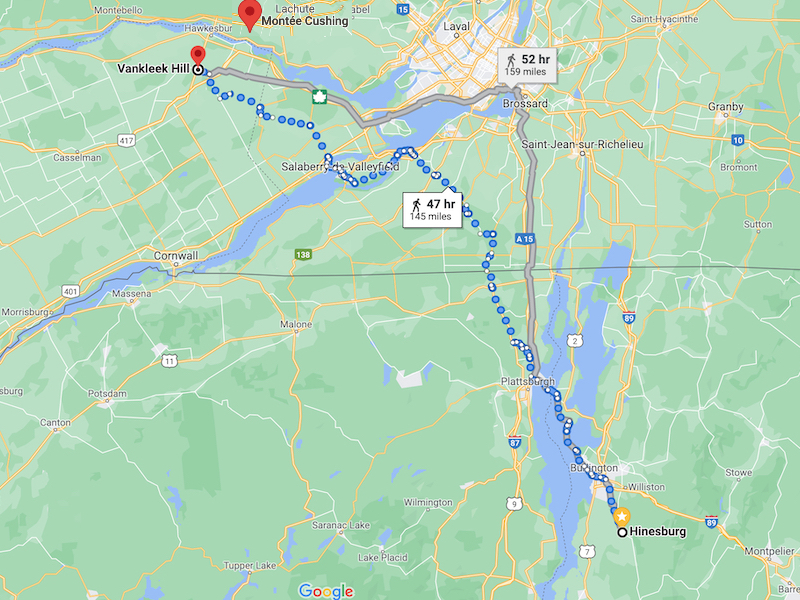
I haven’t found any record of who John’s parents were in Vermont in 1795.
When Cyndie and I traveled to Ontario in the early 1980s (with absolutely no genealogy experience whatsoever) we stumbled onto the plot of farmland owned by John, as well as his hand-written last will and testament. His will began with the fact he was ill of health but of sound mind. It was all very fascinating, but we had no way of knowing at the time that he had originally come from Vermont.
I wouldn’t mind visiting Hinesburg to see what we might stumble upon there in the present day. It looks like it might be a nice place to explore on my new bicycle.
Not having a good knowledge of history, I am curious what it was like to travel between countries in the early 1800s. Or, even fifty years later when Stephen W. traveled from Vankleek Hill with my very young great-grandfather, John W. Hays (1860-1931) to come to Redwing, Minnesota.
Was it a big deal to them to be crossing the national borders?
What took John from Vermont? Did that move happen when he was young and as a result of his unidentified parents’ decision?
How did John meet Laura Kittle whom he married in 1828?
Their son, Stephen W. married the girl who lived on the farm next door near Vankleek Hill. Maybe the answer to John marrying Laura Kittle will be revealed by a similar proximity of residence in the 1820s.
One thing I am sure of, it will be a huge rush if/when I find one of these key missing puzzle pieces of who John’s parents were.
.
.
Irish Maybe
Growing up, I had no clue about my family’s ethnic origins. I’m pretty sure my father responded with “American” when I brought up the question. Today, since it’s St. Patrick’s Day, everybody is a little bit Irish, aren’t they? I’ve never really identified with the occasion, but I probably should.
Even after my many sporadic plunges into my family ancestry, I’m still not convinced about the ultimate origin of the “Hays” name. When a second cousin enlisted the help of professionals, they pointed to a pretty focused area of the counties of southern Ireland, yet the result from my DNA hint at the surrounding region excluding Ireland.

At this point, I’m more inclined to cling to what I know and claim my obvious Canadian heritage.
Cyndie occasionally shares a wonderful recollection of her earliest query about her family ethnicity. The simplified version from so many kids where it gets described as half of one nationality and half of another led her to ask her father, by way of a written note slipped under the bathroom door, “What am I half of?”
She was shocked when the answer came back, “Half-wit.”
I am half my mom and half my dad; a quarter of each of my grandparents. Sometimes I feel a little like a half-wit.
On March 17th, I’m possibly a little Irish.
Don’t tell my DNA.
Happy St. Patrick’s Day!
.
.
Missing Credit
In my giddy excitement over the discovery of pages and pages of informative details about my ancestors who made Pierce County their home in the 1860s last week, I neglected to credit the Pierce County Historical Association and more specifically, properly cite the copyright holder of the book!

Krogstadt, Roland J. 2010. Hartland Heritage: A History of Hartland Township, Pierce County, Wisconsin, edited by Donna M. O’Keefe. Madison, WI
That has since been remedied, with proper citations subsequently added to last week’s post.
On Sunday, I took Cyndie for a drive and showed her the beauty of the high-walled gorge of Isabelle Creek valley. She agreed with my impression that the majority of the steep slopes look no more modern than the images we’ve seen from the 1800s. It is easy to ignore the rare street sign or occasional dwelling and imagine we are back in time.
Immersing myself in so much historical research has me thinking about my trivial day-to-day activities like brushing my teeth in preparation for a night’s sleep or dressing for the day in the comfort of my modern bedroom and comparing it to what the equivalent daily tasks must have been like for my ancestors beside the creek.
The minutia of an individual’s daily little tasks doesn’t tend to be chronicled in much detail in historical journals written a hundred-plus years later.
I can’t help but share one more morsel from Roland Krogstadt’s book, “Hartland Heritage: A History of Hartland Township, Pierce County, Wisconsin” that mentions my 2nd-great-grandfather, Stephen W. Hays (S. W. Hays).
Chapter 10, page 311, under the heading, “Weather”
The Hartland correspondent reported to the Herald, “Last Wednesday night, this town was visited by the most terrific and destructive storm of wind and rain ever known in this locality.” The details followed:
About 11 o’clock the rain began to descend and in a few minutes increased to a perfect deluge, while almost continuous and vivid lightning lit up the blackened sky as bright as day, and the thunder rolled with an ominous, heavy, and deafening roar that added to the solemnity of the occasion and awed all who witnessed it by the grandeur and magnificence of this, the greatest of nature’s pyrotechnical displays it was ever our lot to behold. It secured as though the god of storm and flood had turned out the vials of his wrath upon this once beautiful valley, which at sunset of that evening in seeming security lay clothed in peace and verdure, and which but a few hours later was destined to present a scene of destruction and desolation that words cannot but fail to describe.
A list of over 30 properties and the estimated losses followed and included: “S. W. Hays, house flooded, $50.”
In addition to that, “Strickland & Knowlton’s flouring mill, entirely destroyed with contents, $6,500; …Betcher & McDougall, mill dam washed away, steam factory undermined, east wing of factory, 14 wagons, sleighs, cutter woods, hubs, spokes, wagon lumber, logs and lumber washed away, flume and race filled up with mud, fences gone, &c., $4,000.”
I believe that the Strickland mill was associated with my 3rd-great-grandfather Joseph Sleeper and the Betcher mill was the one Stephen W. Hays was managing.
It helps me to better understand how or why Stephen may have moved away after a few more years. It also has me wanting to be less whiny about the comparatively minor suffering we have endured from so many downpours here over the last seven years.
Nature’s wrath is nothing new.
.
.


 Relative Something