Posts Tagged ‘forest management’
Pinnate Leaves
Back when our regional DNR Forester paid us a visit, he pointed out how many ash trees we have. I had been mistaking many of them for butternut trees, but closer inspection, and a noticeable lack of nuts, changed my perspective.
As a result, now my first impression of our trees with pinnate leaves is that they are likely ash.
While we were sitting with the chickens on the edge of our driveway the other day, I gazed skyward and became aware of a large umbrella of the pinnate leaves looming over us. Mentioning it out loud to Cyndie, I assessed it as a big ash that we didn’t even know was in that spot.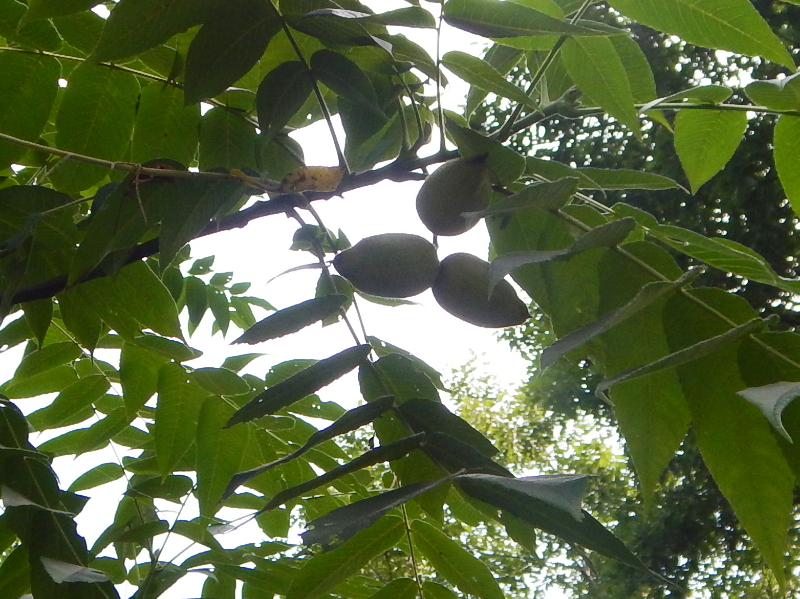
Until I saw the nuts.
Oh! So, it’s back to a butternut again.
From the class we look last winter, I was quickly able to detect one of the simplest identifying differences: the petioles or leaflets of the compound leaf.
The ash tree has about 7 leaflets arranged in opposing orientation along the stem.
On this butternut, I counted repeated occasions of 13 leaflets, and they are arranged in alternate orientation along the stem. Combined with the obvious groupings of nuts, there was little question about what kind of tree this was.
I’m a bit surprised by the significance of the canopy of leaves on this tree because the butternut canker disease is stunting the progress, or outright killing most of the butternut trees in the area. It is possible this tree has an inherent resistance to the fungus.
That would be great luck. Offspring from this tree could lead to additional trees with resistance. Invert the pyramid, I say!
On another note, I received a reply from our Forester about my findings on root girdling on the red pines. He found the report interesting and surmised the trees weren’t planted properly. He still concluded with, “Your trees may have still actually been killed by Diplodia.”
Another fungus. What’s up around here?
I blame climate change.
.
.
New Information
Sixty years ago today, before I was even born, the best thing that could ever happen for me took place. With eternal gratitude to Fred and Marie Friswold, today, June 4th, I boast to the world that it is Cyndie’s birthday!
Happy Birthday, my love!
After a jam-packed weekend of social events and more, we begin this week with new information and new energy.
First, after a scheduled appointment for our vet to visit and give the horses their spring shots, we came up with a plan for how we will proceed into the summer grazing season. Both Cayenne and Hunter are showing signs of good health with their sensitive laminitic front hooves. The diet of reduced portions has their weight under control, and more importantly, it has been achieved with minimal evidence of angst from the horses.
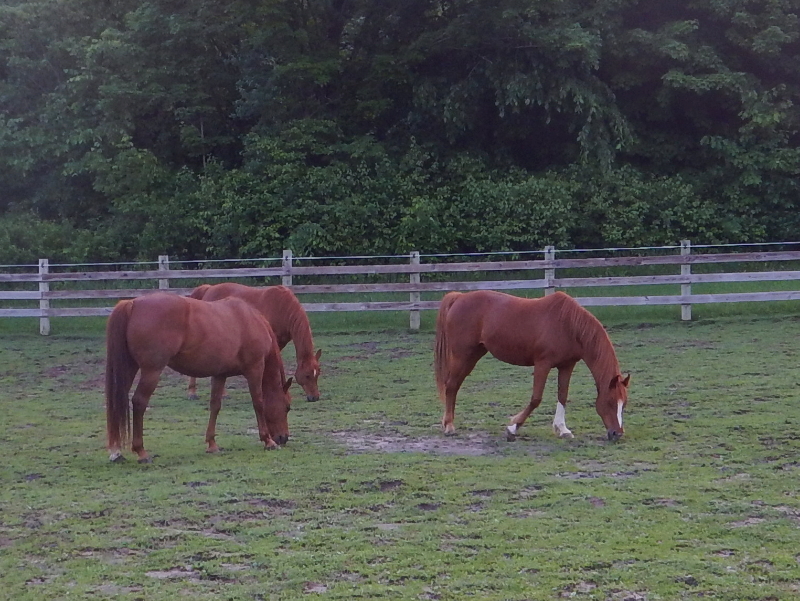 Going forward, we are going to work on getting them used to wearing muzzles to slow down their pasture grazing. We will then feed them dry hay in the morning to fill them up and give them muzzled access to a previously mowed (shorter grass = smaller bites of cake) pasture in the afternoons. They will be confined to the dry paddocks overnight, with no added hay available until the next morning.
Most important for us will be the attitude the horses have about their situation. If they are okay with it, that will be the definition of acceptability. If they balk over any of it, we will work to adjust accordingly. Our goal is to keep their weight down, yet give them some time to enjoy the freedom to move about in the open pasture and “graze” as close to normal as possible.
The next big thing that we learned came as a result of a visit from our local DNR Forester yesterday. My key takeaway from that consultation was the value of cutting trees beneath the canopy of mature trees we favor. Growth that reaches up to encroach on the lower branches of the favored tree should be removed.
He asserted that the primary focus is on providing the most sunlight to encourage growth, but protecting lower branches from competition will also help keep the mature trees healthy.
My first inclination is never to cut down any tree, but our Forester convinced me that cutting some will enhance others. I need to get more comfortable pruning entire trees, in the way I am comfortable pruning a few branches to shape a single tree.
He suggested clear cutting some areas, like stands of aspen, to open up sunlight and entice energized bursts of new growth to expand the grove. It seems so counter-intuitive. I want more trees, not less. Apparently, a little loss now, produces bigger gains later. In his mind, it doesn’t take that long.

Time is a relative thing. I’m not feeling that patient.
I was surprised to learn that he felt our highest priority should be to work on removing invasive garlic mustard. I did a quick Google search and the response was rich with states battling the troublesome intruder. Our Forester said we should pull the plants, bag them in plastic garbage bags and throw them in the trash.
Among the many other battles we are already waging, like vines, common buckthorn, and poison ivy, we now will move garlic mustard to the top priority.
Oh, joy.
.
.
Prickly Problem
Historically, I have been much less inclined than Cyndie to worry about identifying and controlling all the multitudes of potentially problematic invasive plants that loom as threats to our fields and forest. My main beef was with the Common Buckthorn tree. Cyndie had discussions with an agent from the county extension office who pointed out many other troublesome plants, first hand, on a visit to our property.
I quickly got on board against one other invader when Queen Anne’s Lace grew to dominate our hay-field. A review of the Wisconsin DNR invasive species photo gallery provides a whopping 118 examples of potential problems. I find it too much to bear.
Cyndie is able to focus on battling dandelions in our lawn, where I see the effort futile. This translates to most other plant invasions as well, so when she would verbalize concern about the dozens of other threats appearing around every turn, I would tend to glaze over and save my focus for challenges already known.
In the fall, when all the leaves have dropped, except for the Common Buckthorn, I kick into a high gear of eradication. In the spring, when the leaves haven’t sprouted yet, except for the prickly bushes that drive Cyndie nuts, she wants to do the same.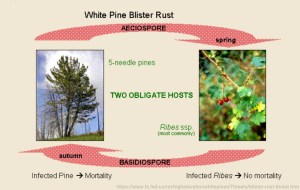
I wasn’t so inspired, until she spent time to identify the thorny pest. When she came upon the Prickly Currant, one detail got my attention. It plays the role of host for a blister rust that kills pine trees.
Well, why didn’t you tell me that in the first place?
Now I care as much as her about not wanting these painfully prickly nuisances growing everywhere.
 Once I started looking for them, it became clear the bush is thriving on our land. It is very easy to spot this time of year, as the leaves are some of the first to appear. Luckily, I discovered they are relatively easy to pull out of the ground.
It grows a lot like the raspberry bushes, with the long sprouts drooping over to the ground and taking root in a new spot. Since the stems are so thorny –worse than the raspberries– it makes for a very annoying hazard when walking off the trail, like one might do when hunting to pick berries.
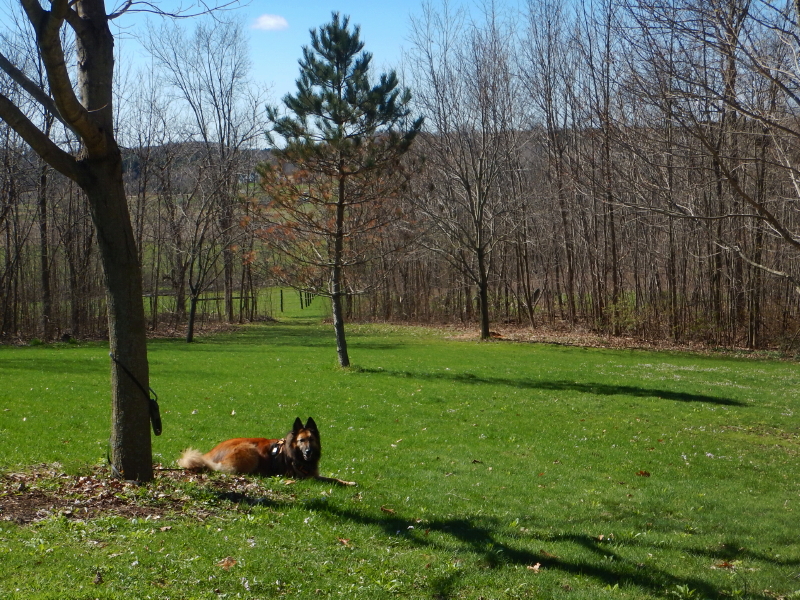
We spent much of yesterday pulling and digging to extricate a surprising number of these stabbing hazards along the edges of our back yard, where there used to be about ten more lovely pine trees, back when we bought this place.
Now there are only two on the back hill, and they aren’t looking very good.
 I never imagined how much knowledge and effort would be involved in being a good steward to manage what grows on the land. I figured nature would take its course and come to a healthy balance. Unfortunately, one plant’s ‘healthy’ can often lead to another’s demise.
To protect the plants you desire, a little lethal effort is sometimes going to be required.
I am enjoying renewed respect for Cyndie’s capacity to comprehend and react to all these details which too often overload my mental resources..
Now it’s time for me to go fret over getting all our grass mowed.
.
.
.
.
.
.
.
.
.
.
.
Tree Down
Sometimes a simple walking of the dog through the woods feels more like a reconnaissance mission of surveying the ever-changing status of our property. Certainly, after a few days of strong winds there are changes to be expected, but I’ve been surprised more than once about how easy it is to miss what eventually seems to be obvious.
Did this tree make a sound when it toppled?
We didn’t hear a thing. I expect I may have walked past it one or two times in the days since the gale force gusts blasted us for hours on end last week, but yesterday as I joined Cyndie and Delilah for morning chores, I spotted it immediately as we approached.
It fell in a perfect direction to avoid getting hung up in any other trees and pointed away from the trail. With all the other downed wood from our days of tree trimming awaiting attention, it’s possible this old poplar will be left where it lays for nature to process.
If we were intent on cleaning up downed trees and branches throughout the full extent of our meager stretch of forested acres, it would be more than a full-time job for us.
In the last couple of years we have focused our attention on the patch of trees closest to the house by the barn and back pasture, picking up dead wood that has made its way to the ground.
This is the time of year, before green leaves obscure the view entirely, when the extent of branches brought down over winter is so easy to spot that it intimidates. There is so much to be picked up. It doesn’t give any impression of our having done so last year. That is, until one strolls through the forest at the west end of our land to see how much is on the ground where nothing has ever been picked up.
I wonder what a year-long time-lapse recording of the trees and ground in our woods would look like. Timed right, I bet it would appear to be raining limbs and branches.
.
.
.
.
.
.
.
.
.
.
.
.
.
Project Begins
I’m home from work today to guide tree trimming work on our property. It has been over a year since we wanted this to happen, so we are very pleased the project will finally be getting underway. On my drive home yesterday, I received a call from the arborist who quoted the job. I wasn’t surprised to hear that they are now unwilling to bring the bucket truck due to the melted ground from the warm temperatures lately.
They don’t want to risk getting stuck in mud, which is okay with me, because I don’t want to risk having the trails significantly messed up by a heavy truck. However, I am disappointed over the implications they won’t be able to trim as many trees as I had wanted.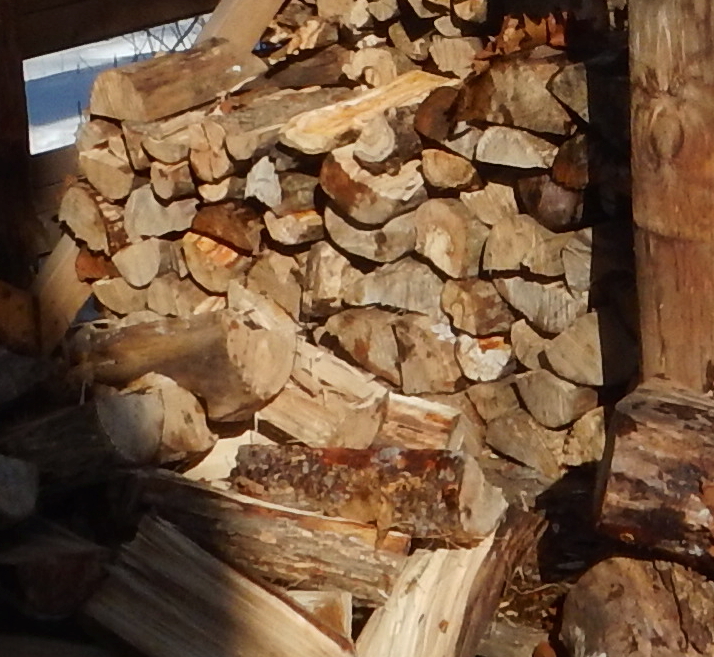
The bright side of that is, it will create less work for me in the realm of chipping, cutting and splitting the branches that will be on the ground when they are done.
Part of me is lamenting the time and effort I spent a month ago plowing and shoveling to make sure the routes through the woods would be wide enough for their truck.
I didn’t know at the time that it would take them this long to fit us into their schedule, or that the weather would be so summer-like that snow wasn’t a problem by the time they arrived.
Our tree guy did mention that instead of the truck, they will bring a lift that will help to a lesser degree. The less time they spend climbing is the more time they can be cutting.
I expect most of my day will be spent standing around gawking, and getting very little else of value accomplished. I want to be present at all times to guide decisions and direct priorities, so the day won’t be conducive to my digging into any other chores.
I suppose I could dabble in some wood splitting when we are back by the shed. It would certainly be a complimentary task to the professional trimming going on overhead.
Guess I should dig out my helmet in preparation for the big day. I’m pretty sure I know what tomorrow’s blog topic is going to be…
We’ll be toiling away to make our trails safe again. It’ll be a win-win project, because in addition to safety from unexpected falling limbs, the trimming will make our trees more healthy and improve their odds of surviving wind and storm damage.
It’s expensive, but I think the investment will be money well spent.
.
.
.
.
.
.
.
.
.
.
.
.


 Relative Something