Posts Tagged ‘fertilizer’
Greener Grass
There was a depression in the ground where the soil had settled along the area where, 2-years ago, we had a water line buried in a trench deep enough to get below the frost line. Since we have a never-ending supply of composting manure, I have often taken to using it as fill around the property, so it was only natural that I did so in that spot to level the ground just above the larger paddock.
 Then I planted some grass seed.
Take a look at how green the grass is in the area I filled.
Next test will be to spread manure in the area of older grass to see if it responds similarly. It certainly has inspired me to look into spreading some in our hay-field. It’s why we are composting it, after all!
For now, it has just been a lot simpler to use it as fill. To spread it on the big field will require my borrowing a manure spreader from George and filling it with the loader bucket on my tractor. It’s not an impossible feat, but it does take things to another level.
Small loads by pitch fork in the ATV trailer just happens to be easier to pull off in a moments notice.
.
.
.
.
.
.
.
.
.
.
.
Prototype Blend
Between the thundering copious downpours yesterday —which by this morning have dropped a 24-hour accumulated total of 5 inches of rain on us— I began production of our first prototype mix of custom horse-manure-fertilized growing soil. It was an extension of my working on the rock pile we received from a neighboring farm field last spring.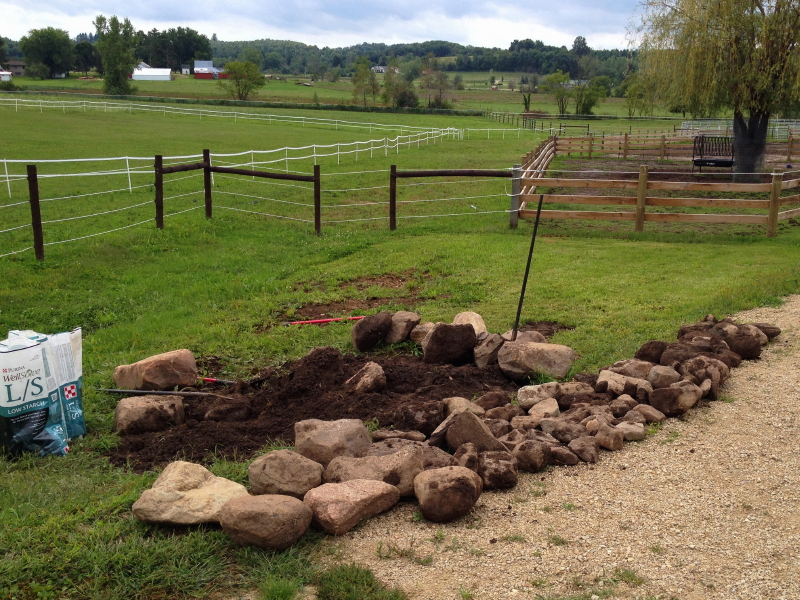
That dump-truck-load of field rocks included a significant amount of dirt that surrounded and buried a lot of the stone. Slowly, but surely, this summer I have been prying out rocks and moving them down near our Rowcliffe Labyrinth Garden. As I am getting closer to the bottom of that pile, it is becoming more dirt than rocks. I decided to shovel that rich field-dirt into bags for future distribution, and in so doing realized the opportunity to mix in some composted manure to create our first dose of Wintervale old souls super soil.
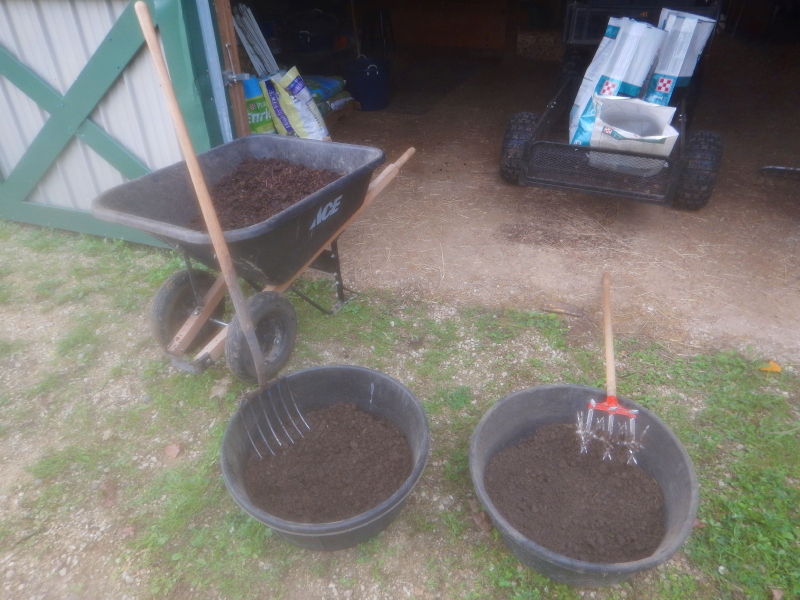 It’s kind of like harvesting our first crop! There is a different reward to mixing the composted manure with dirt, as opposed to just using it to fill low spots around our property.
This will be a long-term process, as I won’t really know how successful my concoction is until a season of growing passes and I can learn the results from growers who receive our initial distribution.
Not that I have any real doubts about the potential. I have seen how robust the volunteer growth was that sprouted out of this rock pile all summer, and I have ample evidence of the accelerated growth around all the places I have used composted manure for fill.
Together, I expect they will produce even greater results.
.
.
.
.
.
.
.
.
.
Fertilizer happens
In about a month we will reach the point of having had our 4 horses for one year. No matter how much reading and planning we could do for manure management, it is nothing like actually seeing and dealing with the real thing. For the uninitiated, a 1000 pound horse can produce around 50 lbs of manure a day. We now have an idea of what that is really like.
 The storage and distribution system I naively devised over time worked adequately for this first year, going from having none at all to a year’s-worth. Now we are approaching the point of starting the second year with a lot less open storage space. It is roughly half-filled with composting manure right now.
There are some refinements to my system of manure management that I hope to accomplish. My effort to thoroughly compost is forcing me to rethink my methods and may require some expansion of space to store ‘in-process’ manure. I like working small-scale, but the sheer volume produced might force my hand to take up the offer from neighbor George to use his manure spreader and my front loader to distribute a bulk amount all at once.
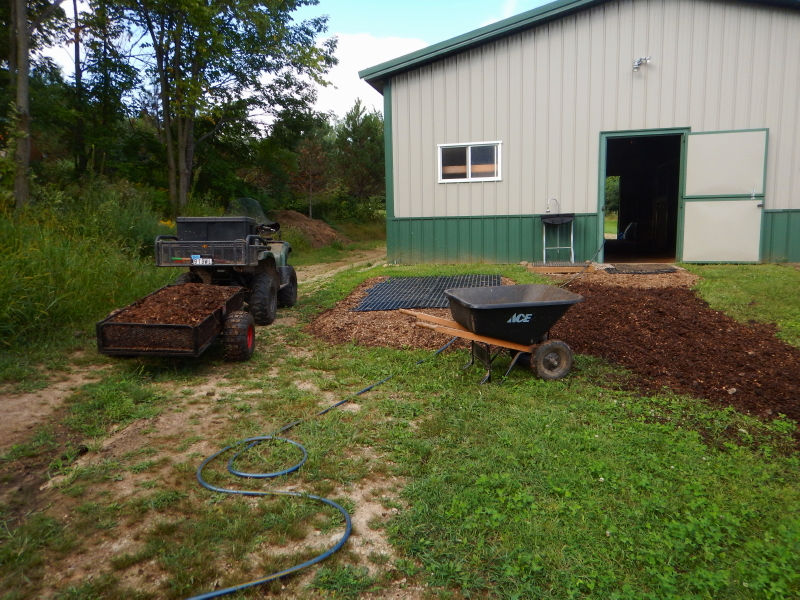 I continue to use the oldest, bottom level of partially composted material as clean fill in a variety of places around our property, but I’m guessing there might come a day when I run out of a need for that kind of use. Maybe by the time that happens I will have perfected a system that allows me to offer (sell?) bagged horse manure fertilizer to interested gardeners as a means of distribution.
The current challenge has been moving the pile around to provide access to that base level of compacted material I want to use. Yesterday, when I was doing so, it became obvious how quickly the composting dries out an inside layer. The pile always seems so wet to me that I haven’t been worrying about adding moisture, but the light bulb came on when I saw the dramatic difference as a result of trying to move the entire upper level to a new location. I got the hose out and watered the pile, and Delilah. She absolutely cannot resist chasing water from a hose.
Unfortunately, that meant she was trying to chase it through manure. Not a pretty picture.
Shitty Education
In the time since our horses arrived late last September, we have been stockpiling manure in one primary location. Based on information Cyndie gathered, we roughed out a spot that we guessed would be large enough. That was about as far as we went in terms of a plan of action for manure management.
In my naiveté, I thought we could start piling at the back of the clearing we designated, and just keep dumping new loads toward the front. If it timed out right, we could access the pile from the back to remove old composted manure for use as tree food and fertilizer for Cyndie’s plants. I planned to scoop the front of the pile with the loader on our tractor, to stir and aerate the material, moving the composting manure back and making new space for fresh loads to be dumped in front again.
The more informed method involves an area divided into 3 separate sections. This allows the first pile to become fully composted and ready for use, the middle one to be in process of breaking down, and the last one for dumping fresh manure.
My system didn’t work the way I imagined because our method of dumping full-wheelbarrows ended up filling the designated space all the way to the front in a very short amount of time. Instead of dumping somewhere beyond our designated space, I chose to go up. I created a ramp and we just kept adding fresh manure on top of the previous batches already beginning to break down.
That has led to a pile with layers in varying stages of decomposition. It is obvious our pile shrinks over time, depending on how much new manure is being added, but the two key elements to accelerating the breakdown are the optimal amount of air and moisture, and our pile hasn’t been getting the correct amount of either. Our location is not covered, so I figured we would suffer from too much wetness, but the process of decomposition uses up moisture and will cause dry spots that interrupt decomposition if not stirred.
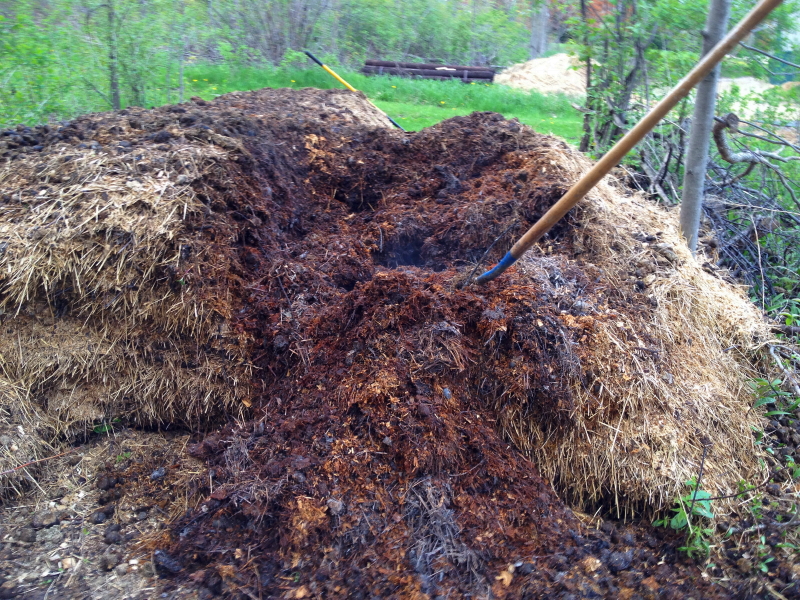 Yesterday afternoon, after I got home from the day-job, I cut deep into the back of our manure pile for the first time. I wanted to move some material from the pile that was already composting, down to the new location I created by the labyrinth. The impetus for that was our desire to give our newly transplanted tree at the center of the labyrinth a dose of horse manure fertilizer.
Even though the tree is showing signs of new buds along its trunk, there is no indication that the buds at the ends of the branches have any life in them whatsoever. It is really testing my patience.
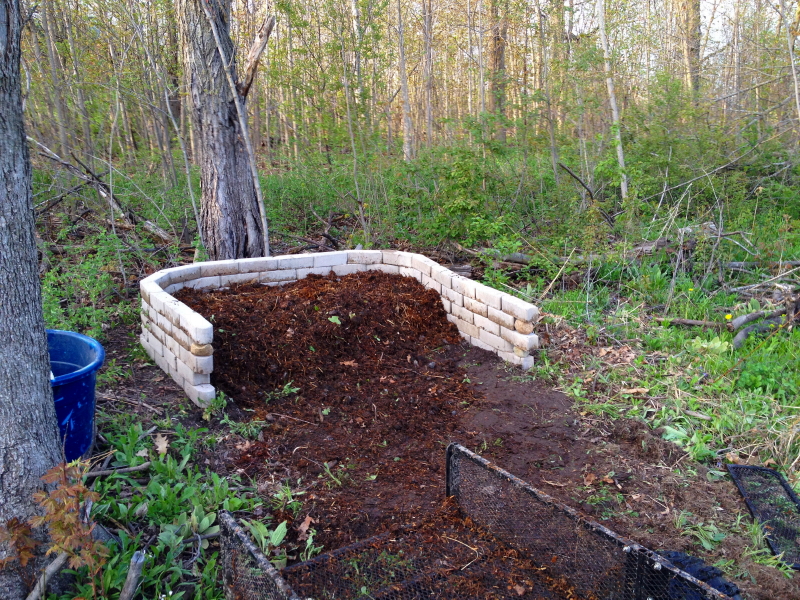 So, I was able to cut into the main manure pile and get educated about what is going on down below, and I got enough cinder blocks stacked to create the start of a satellite pile where I will be better able to control the rate of composting.
Best of all, it will be conveniently located near the garden of plants that help define the form of our labyrinth path.
.
.
.
.
.
.
.
.
It Happens
 It takes some serious skill to land it on the narrow board of a fence.
We’ve already harvested our first crop of fertilizer. The production crew never seems to take a break, so harvesting is an ongoing process. Looks like we are getting a pretty high yield. We decided to expand our processing equipment, adding a two-wheeled wheelbarrow with an 8 cubic foot capacity to our fleet.
Who needs corn? We got poo.


 Relative Something