Posts Tagged ‘family history’
Methodical Research
Since our weather pattern yesterday offered just enough periods of rain to keep grass too wet to mow, Cyndie and I busied ourselves with indoor pursuits much of the day. While Cyndie unleashed her creative artistry on making spectacular custom cards for persons known and to be determined, I resumed an attempt to gather local news reports from the 1800s that mention the names of my ancestors.
I find myself easily distracted down rabbit holes of stories both trivial and dramatic on the pages of the old editions of The River Falls Journal, even though they don’t contain family names.
There are simple, yet creative mentions of babies born, comments of individual comings and goings, reports of illnesses and serious injuries, and brief mentions of crop successes and failures. Occasionally, there are official statements of “found” livestock on one’s property that will be kept for their own if not otherwise claimed.
There was a report of a horse that attempted to leap a picket fence but it was unsuccessful and did not survive. In another incident, a man allowed horses pulling his wagon to enter a lake for a drink of water. They began to sink up to their necks! In that case, somehow all were saved.
I decided to transcribe just the portions in which my ancestors were named and sort them by date to better organize the information I was uncovering. I regret that in this form it lacks some of the exciting drama of others in their community being mentioned simultaneously.
These should really be in an olde-timey font, but here is what I gathered yesterday afternoon:
River Falls Journal March 29, 1877
Esdaile
Mr. Betcher has the largest and best stock of hub and spoke timber on hand now that has ever been in this place. S. W. Hays is foreman here for Mr. Betcher at present, and evidently understands his business.
River Falls Journal November 15, 1877
Esdaile
The officers of Green Valley Lodge, I. O. G. T., installed last Wednesday evening are S. W. Hays, W. C. T.; Miss Alice Butterfield, W. V. T.; K. W. Lewis, S.; J. Sleeper, T.; Miss Effie Isham, I. G.; J. P. Johnson, O. G.
River Falls Journal May 5, 1881
Esdaile Echoes
S. W. Hays is at home again for a few days visit with his family
Joseph Sleeper has sold his house and lot in this village to C. Betcher, of Red Wing, for $450.
A little daughter of Mr. Sleeper received so severe a fall the other day as to render her senseless for some time, but she is now all right again.
River Falls Journal June 12, 1881
Esdaile Echoes
C. Betcher has recently been remodeling his horse barn.
E. Hoover has rented a part of S. W. Hays’ house and is now occupying the same.
Henry Bently has decided not to occupy the Sleeper house as was stated a short time ago.
Messers L.C. Rice, L. H. Rice, Joseph Sleeper, and L. Turner, are building a saw mill and bending machine at Brookville, St. Croix county.
River Falls Journal May 25, 1882
Brookville Brevities
S.W. Hays, of Esdaile, called on us last week. He talks of making St. Croix County his home.
Esdaile Echoes
Mrs. Church and mother, Mrs. Sleeper, of Minneapolis, are spending a few days in town.
For reference:
Joseph & Abigail Sleeper are 3rd-Great Grandparents
Charles & Sarah [Sleeper] Church are 2nd-Great Grandparents
Stephen W. Hays (wife Judith [Waite]) are 2nd-Great Grandparents
John W. & Minnie [Church] Hays are Great Grandparents
Charles Betcher (unrelated) was the lumber baron who Stephen W. Hays worked for
.
.
Mostly Rain
Amid a heavily broadcast series of warnings about the chances of severe weather, I dawdled indoors much of yesterday until time was dwindling in a break between bouts of precipitation. It felt like now or never to get anything productive accomplished outside.
 I gassed up the power trimmer and went after as many easy targets as I could hit, with particular interest in two of the most needed places. I reached the strip of longest grass just beyond the culvert as the sky began to grow dark again. It wasn’t pretty, but as raindrops started falling, I finished what I had set out to do.
The area of that strip is now a sloppy mess of long, wet cuttings, but it is a cut sloppy mess. If I’d had time before more rain, I would have used a pitchfork to pick up the mass of wet chopped grass left behind.
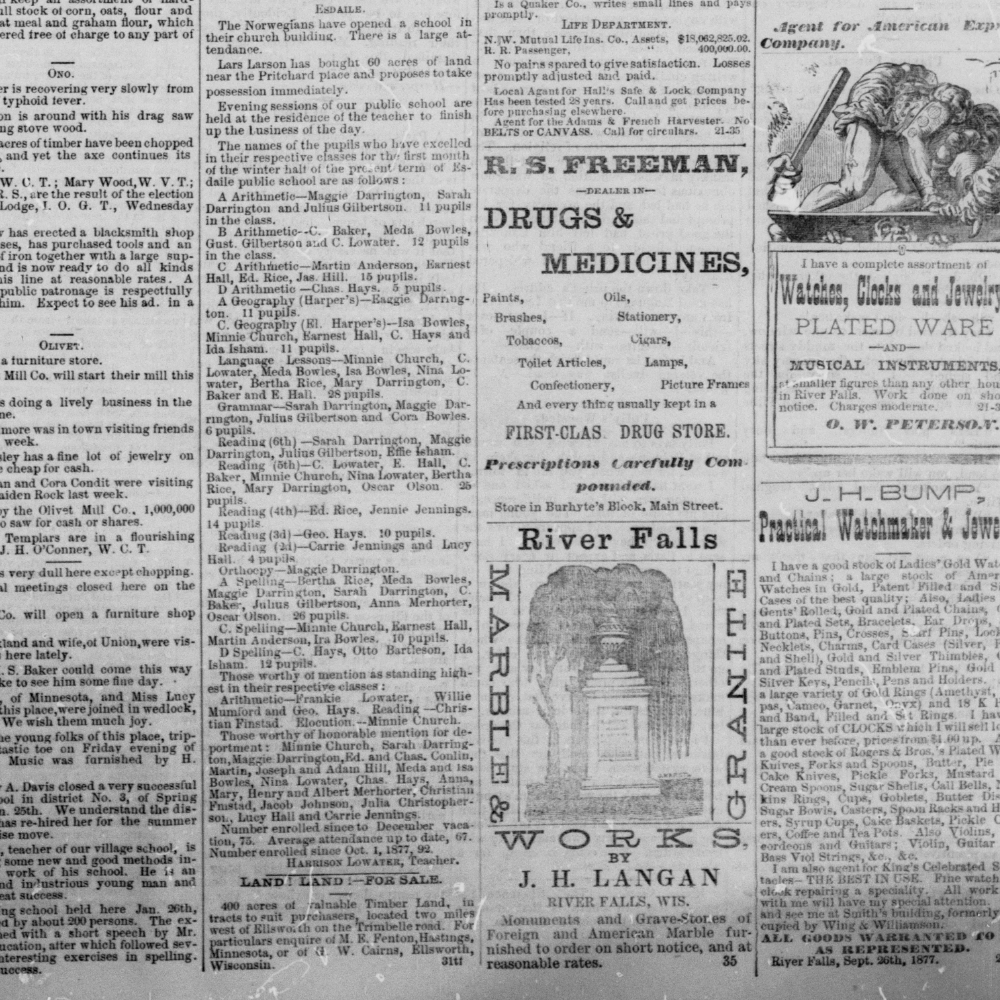
Earlier in the day while it was raining, I spent a little time perusing old newspapers for ancestor names again. Focusing on the River Falls Journal in the latter half of the 1800s, I found a treasure in 1878 under “Local News” for Esdaile. It lists the names of “pupils who excelled in their respective classes in the first month of the winter half of the present term.”
My search term was, “Hays” so it was easy to spot my great-granduncles, George and Charles Hays. Those two are the younger brothers of my great-grandfather, John W. He would have been 17 years old at the time. Charles was 9 and George was 8.
What made this find such a treasure was the name of one other excellent student: Minnie Church.
Minnie is my great-grandmother. She was 10 years old that winter when the grades were published. I would imagine the younger three knew each other well, spending their school years together. Ten years later, in 1888, Minnie and John (seven years her senior) were married in Minneapolis.
I wonder how the younger brothers felt about John getting the girl in the end.
Discovering those records was a lot of fun for a mostly rainy day.
.
.
Time Travel
By simply driving south on the gravel road winding along Isabelle Creek, I felt transported to the time my ancestors lived there in the second half of the 19th century. We were on our way to the Pierce County Historical Association.
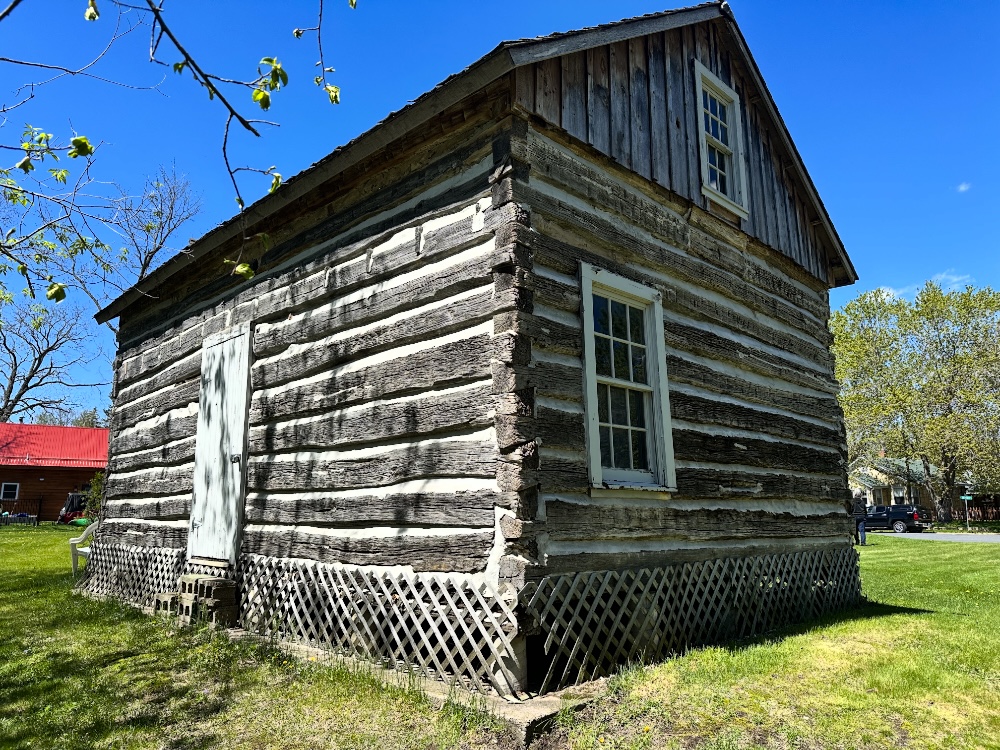 Our visit to their office in Bay City was a treasure. The old log cabin they have preserved is from near the community of Esdaile where the Sleeper mill was located. Standing in that structure made it even easier to imagine we were no longer in the year 2024.
Our conversations with volunteers covered multiple subjects, including how quickly things changed when the railroad arrived. I learned how to interpret the symbols for structures on old property maps: round = log; square = frame; triangle = brick.
Something I didn’t anticipate was a tip that old newspaper information is available from the Library of Congress online through their Chronicling America site where it is possible to search historic newspaper pages from 1756-1963.
I took a stab at “S. W. Hays” in Wisconsin between 1855-1895 and found this morsel in The River Falls Journal:

Now, this is particularly cool because, in addition to my ancestor Stephen Hays, it includes mention of my 2nd-great grandfather Charles Church and refers to “C. Betcher” who owned the lumber business Stephen (S.W. Hays) worked for. The only family missing is someone from the Sleeper clan. That’s okay though because when I searched for Joseph Sleeper there are a large number of pertinent results.
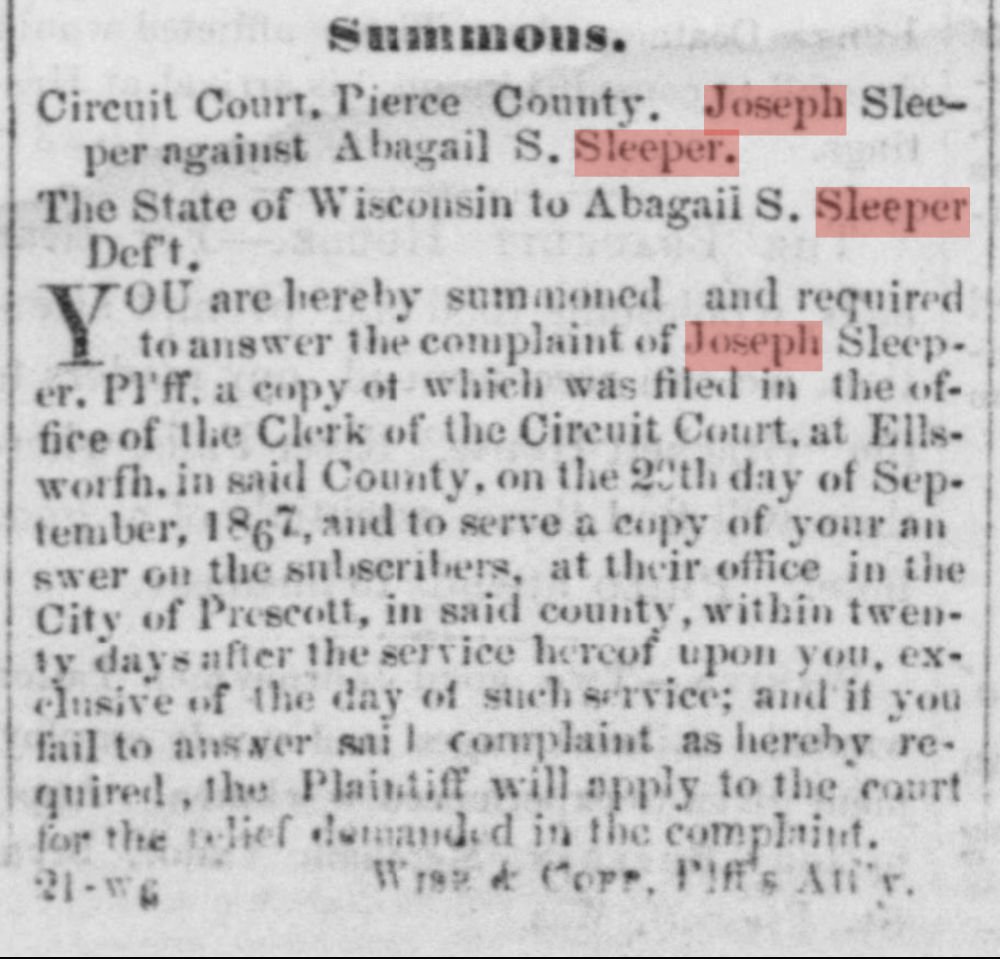
In fact, I discovered there was a summons published in the Prescott Journal about a complaint between Joseph and his wife, Abagail:
Spring is the wrong time of year for me to be discovering a new resource for losing hours on end searching old newspapers for the names of my ancestors. There are acres of grass that need mowing outside!
I hope today will be a little dryer out there than it was yesterday.
.
.
History Open
Today is the first Sunday in May. I can’t count how many first Sundays of the month have passed without me taking advantage of the regularly scheduled open house at my county’s History Society. Today will be different.
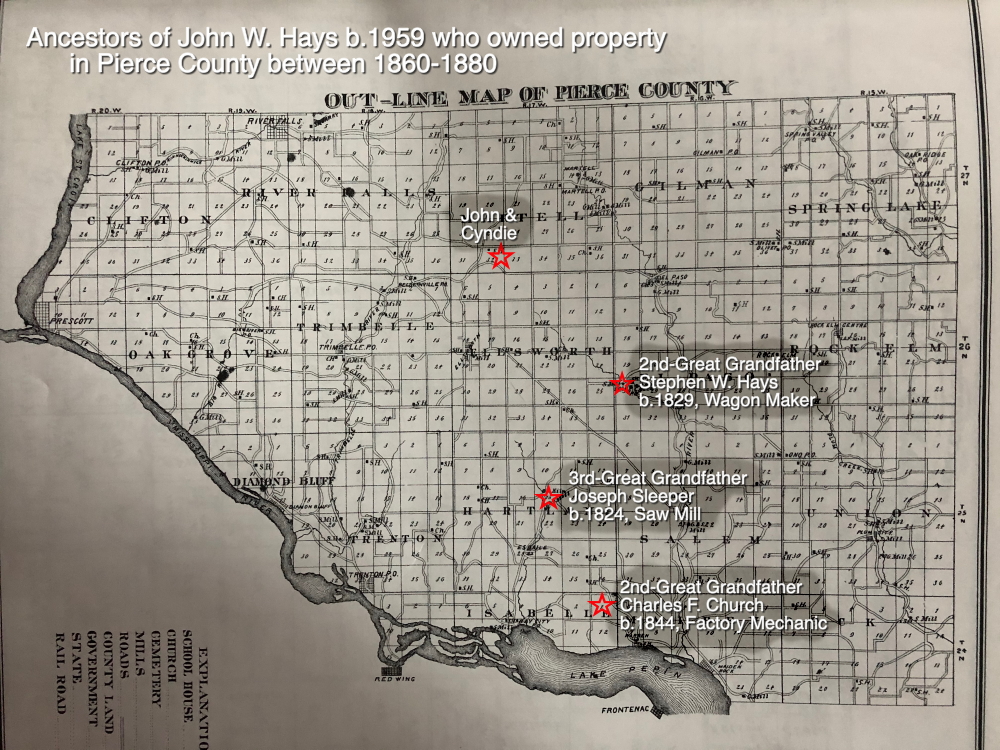 On a day when the sun is shining bright in a clear blue sky, we are going to depart from our little sanctuary and drive past the little village of Esdaile (where my Great-Great-Great Grandfather Joseph Sleeper owned a sawmill) beside Isabelle Creek, on our way to the Pierce County Historical Association in Bay City.
It will be my second visit to the main office of the PCHA. When I first discovered that my Great-Great Grandfather Stephen Hays once owned land in Pierce County, I made my way to Bay City to learn more about him.
I discovered so much more than I bargained for that day. Suddenly, it was revealed that three of my ancestral families were living in the area in the 1860s.
Recently, the PCHA announced that local Historian, Mary Beeler had published (at the age of 92) a book about logging and log buildings in early Pierce County. I want to see if there might be more information about Joseph’s mill or Stephen’s wagon-making.
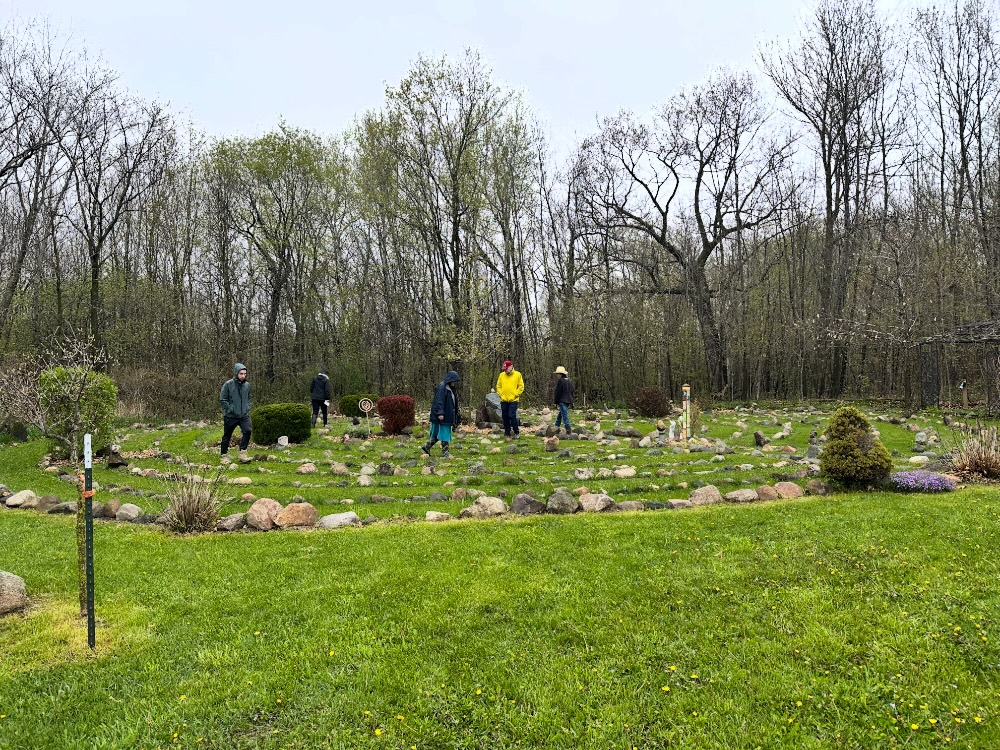 The rain has ended for a day, but the over-saturated ground remains too wet to do much work of substance. A small group of hearty souls stopped by yesterday to walk the labyrinth and enjoy Cyndie’s baked treats in the lingering mist following another half-inch of accumulation.
No other visitors are expected for a while, so I can let the grass grow crazy while waiting for the ground to dry up a little.
I suppose I could pull more weeds out of the gravel loop around the hay shed today, but that’s not as enticing as exploring more local history.
Maybe, in the end, I’ll do a little of both.
.
.
Chasing Ghosts
In my experience, imprecision seems to define searching historical vital records data. It’s certainly the case after the effort I put forth yesterday, scouring the Vermont, USA, vital records for 1760-1954 that I was able to locate online in a quest to learn anything new about my 3rd-great grandfather, John Hays (b.1795).
I know where and when he died and much about his wife and children because I have his last will and testament and have seen the headstone over his grave. It doesn’t include much detail: “JOHN HAYS (line) DIED (line) Sept. 25, 1840 (line) Aged 45 years” The only reason I believe that he was born in Hinesburg, VT is from the 1922 death notice of his youngest son, John B. Hays (1837-1922).
Yesterday, I focused on trying to find a record of his birth by hunting for an official record from Chittenden county in Vermont in the latter 1700s. What if his birth was recorded as being in Burlington instead of Hinesburg? What if he wasn’t 45 years old in 1840?
What if the archivists were not entirely precise in their record-keeping?
Here are some issues that are complicating my search:
- Using search features of online genealogy sites relies on the interpretation of humans who have typed out the archaic cursive handwriting of census recorders and town clerks. I have seen instances of mistakes. Just because a search brings up no results doesn’t mean an actual record doesn’t exist.
- I may find a record with a name I’m seeking, but if there is incomplete information recorded in the other fields of that record, it isn’t very reliable.

The record above is one of very few with 1795 as date of birth. Anecdotally, I can say that Vermont had a bit of a baby boom around 1858-1861.
Was this birth of Jonathon Hayes the mother’s first? We’ll never know by looking at this card. I can tell you that Mary and Eleazer Hayes did have other children because their names showed up on several other birth notices. I didn’t keep track because my confidence in this record is low.
Where were the parents from? Wish I knew.
Where did the birth occur? Luckily, they scanned both sides of the cards and the location is written there. It was Strafford, seventy miles away from Hinesburg, on the other side of the Green Mountains.
The records were “sorted” (imperfectly) alphabetically by the primary subject person. That resulted in a constant mix of birth, marriage, and death records, but frequently meant I could see the person born, get married, and die in three consecutive cards.
I searched for three primary spellings: Hay, Hayes, and Hays. I came across one card that had the father’s name spelled “Hays” and the just-born child written as “Hayes.”
One thing that inspired me when I started looking at these cards was the inclusion of birth records where there was no name given yet for the newborn. I never would have found these by only searching online digitized (transposed) information. If there was a nameless birth in 1795, that could have been my guy!
I didn’t find one.
My 4th-great grandparents Hays remain ghosts to me.
.
.
Different Puzzle
My love of toiling away on jigsaw puzzles and searching for specific shaped “needles” in the haystacks of pieces has a correlation to another of my treasured hobbies. This is probably not the first time I’ve come to the realization that I feel the same about the hunt and discovery of missing people in my family tree each time I return to my genealogy project.
I just began looking anew at my 3rd great-grandfather, John Hays (1795-1840) because he is the primary dead-end, or his father is the primary “missing piece” I would next like to find.
Just like with jigsaw puzzles, when I can’t find what I’m looking for, I will settle for other, easier pieces along the way. Because I haven’t been able to find out who John’s parents are, I have tracked down a lot of other people on different branches of my family tree.
But I always find myself returning to the missing link in the path toward confirming the precise origin of our surname.
According to information taken from the 1922 death certificate of one of John’s other sons, John was born in Hinesburgh, Vermont, USA.
In 1828, John married Laura Kittle (born 1807 in Lachute, Qc) in a Cushing Presbyterian church in Argenteuil, Quebec, Canada.
Their firstborn, Stephen W. Hays (1829-1910) has the birthplace of Vankleek Hill, Ontario, Canada.
Take a look at the proximity of the three locations on a map:
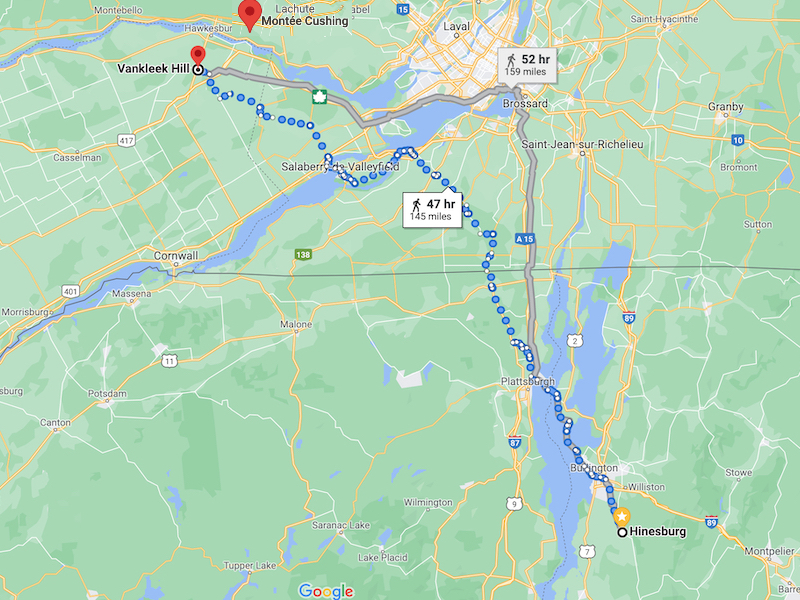
I haven’t found any record of who John’s parents were in Vermont in 1795.
When Cyndie and I traveled to Ontario in the early 1980s (with absolutely no genealogy experience whatsoever) we stumbled onto the plot of farmland owned by John, as well as his hand-written last will and testament. His will began with the fact he was ill of health but of sound mind. It was all very fascinating, but we had no way of knowing at the time that he had originally come from Vermont.
I wouldn’t mind visiting Hinesburg to see what we might stumble upon there in the present day. It looks like it might be a nice place to explore on my new bicycle.
Not having a good knowledge of history, I am curious what it was like to travel between countries in the early 1800s. Or, even fifty years later when Stephen W. traveled from Vankleek Hill with my very young great-grandfather, John W. Hays (1860-1931) to come to Redwing, Minnesota.
Was it a big deal to them to be crossing the national borders?
What took John from Vermont? Did that move happen when he was young and as a result of his unidentified parents’ decision?
How did John meet Laura Kittle whom he married in 1828?
Their son, Stephen W. married the girl who lived on the farm next door near Vankleek Hill. Maybe the answer to John marrying Laura Kittle will be revealed by a similar proximity of residence in the 1820s.
One thing I am sure of, it will be a huge rush if/when I find one of these key missing puzzle pieces of who John’s parents were.
.
.
RS Interview: Marie Friswold
Relative Something is thrilled to be able to present the second interview in a new and ongoing sporadic series where the art of thoughtful question and answer conversation is practiced with participants who are kind enough to respond to my requests.
What a special treat it is for me to be able to present to you, Cyndie’s mom, Marie!
.
RS: Let’s dive right in. If you were told you were going to be featured on the cover of any magazine in the world, which one would you choose, and why?
 Marie: First of all, I would be too embarrassed to be a feature, as I don’t like to have attention drawn to myself. Having said that, I know how to talk to people and make others feel comfortable, so I guess I am not as much of an introvert as I think I am. AT LEAST NOT ALL THE TIME. If there would be any magazine, I think it would have to be a Bon Appetit, Taste of Home, or some baking magazine, or maybe a Martha Stewart magazine where I would feel comfortable and more knowledgeable on the subject of cooking or baking.
RS: Oh, that seems perfect! Your ability to feed and entertain family and friends is legendary. In what ways do you think you have refined your gifts and skills for hosting special occasions over time?
Marie: With the help of Carlos and Barry, I have learned to add style, color, placement of dishes, tablecloths, and of course the wonderful flowers that our gifted Carlos has done for the past 20 years. I have kept all the many recipes, vases, candleholders, napkins, tablecloths, and pictures of the flower arrangements and the way the house and tables should look. I feel I’ve learned from both Carlos and Barry how to entertain with a flare. I loved every minute of learning new ways to present the decorations and the food with a touch of elegance and certainly missed not doing so this year of 2020, as no one could be here to enjoy it with me.
RS: Do you remember the first time Cyndie introduced me to you? (For the record, I don’t remember.)
Marie: I believe the first time I met you was when Steve had you, Bill Daly, Chip Gilbertson, and another guy up to Wildwood for a weekend. Cyndie was also there and knew all of you. I really didn’t know that you were a special friend of Cyndie’s at that time since you were one of the gang that came up to the lake as a group of Steve’s friends.
RS: You know, the only thing I remember about that visit to Wildwood is from the photo we have depicting the gang gathered in the old triangle with me playing guitar. In all fairness, Cyndie and I went back and forth several times (usually my undoing) before we locked in for the long haul, so it is understandable you didn’t know our status early on.
Marie: Then I would add that when Cyndie went to California for college, I didn’t know then how much you meant to her, but she really knew that year how much you were the only one for her, and the rest is history. I do remember the time you came to our house to ask for her hand in marriage while I was arranging the Christmas tree lights all over the living room floor. Fred and I thought that was the nicest part about our whole day – with our answer being YES. Again, the rest is history!
RS: It’s been just over six months since your partner in life, Fred, departed this physical world. How are you doing? There are innumerable ways such a loss impacts a person.
Marie: I am doing very well and am sleeping quite well. I don’t like to show my sadness very much to others. Having said that, I do talk to my family and two or three really good friends to share the way I am feeling at different times. Covid times have not been helpful, as I am a people person and love being with my family and friends, which I have not been able to do at this time. It has been very lonely since Fred died, as we talked about everything (good, bad, different subjects, reading, politics, movies, you name it) and I find it hard to talk to myself about all these various subjects without being sent to a lock-up room. I also reflect on the wonderful life we had together and realize more and more how lucky this person from Manannah was to be the one he chose to be his lifelong partner. I am also frustrated at all the paperwork, file cabinet clean up, business subjects to be addressed, and tons and tons of papers to be looked at and thrown away, so I tell him of my frustration but he doesn’t answer me back. I think there will be ups and downs for the next few months yet to come, but I am aware that eventually there is a brighter year ahead for all of us. Thank goodness for my loving family as they have been the strength that keeps me going and are always there for me.
RS: You and Fred started life together in college and had kids right away, on a rather tight budget. Ultimately, you two succeeded in growing wealth while simultaneously growing your family, raising Cyndie and her brothers to successful adulthood, and gaining grandchildren. What do you feel whenever you look back on how far you’ve come?
Marie: As Fred had been noted for saying… “Ain’t we lucky.” I cannot believe I have had such a rich life and not just financial. As a very young couple, we had no car unless we borrowed from his Mother and Father, we made a pound of hamburger last for two or three meals, I washed diapers on a tabletop washing machine, made our meager salary go a long way, and had the time of our life enjoying what we had. As time went on, we made more money and could save a little along the way. We rented for 10 years before we saved enough money to buy a house and lived in that house for 37 years before buying the house I now live in, which was 17 years ago. During those years, we had the first four children and lived in a double bungalow where we had a lot of other families with children for ours to play with and get to know really well. As a graduate of the NKP teaching degree from the Univ of MN, I learned how teaching young children was an advantage for creating things to do with my own young children. Fred was always so active, funny, and wise and loved reading nighttime stories to the kids. When our fourth child died of Leukemia at the age of four, our family had just built a home in Edina that we moved into just two weeks after her death. The next years were the most difficult of our life and for the remaining three siblings of hers. I think something good may have resulted as a result of our grief, that somehow we learned how to cope, live, and move on when things were tough. Then a beautiful new child came into our lives when our baby son, Benjamin, was born in December 1971. A new chapter was in store for all of us and our children went on to become the gifted, talented, wonderful, precious people they are today. I have been blessed with a rich and wonderful life with Fred, who was doing so much to give back to the community, church, YMCA, University, with kindness to all, and left me with the title that I now believe I will say… — “AIN’T I LUCKY.”
RS: You were a little girl when WWII disrupted the world and now we’ve got the turmoil of a global pandemic some 75 years later. You’ve been through all the events between, assassinations, civil rights protests, and most personal, the loss of a young Michelle to leukemia and most recently, the loss of your husband. As long as I’ve known you, your perspective has been pretty pragmatic and generally positive. What’s your secret? How would you frame our current moment relative to all that you’ve experienced before?
 Marie: I grew up with a very loving, caring, beautiful childhood and had the greatest older sister for my friend all my life. My mother and father were the kindest and most thoughtful parents, and I learned at this young age that there was always a safe place to bring friends home. I was taught how to do things for myself at a young age and I learned to be helpful to my invalid Grandmother. I think I became very thoughtful during the time the war ended because my dad was now going to be out of a job and I could sense that he was sad, yet we were happy the war had ended, but then so did his job. It was then that we moved back to Manannah where I had been born and our family became the store owners in this small town of 100 people. My mother was a one-room schoolhouse teacher and a darn good one from all that I have heard. She graduated from college with her four-year degree at the age of 58. She taught me a lot so I guess she had to be really good. My Dad always had a joke to tell and a smile on his face. Never a harsh word came out of his mouth and he was very aware of the needs of others. There was always a solution or a positive answer to my questions. I believe that during the tough times my glass was more half-full than half-empty, and I believe Fred always had his glass half-full or more, as well. We hope we have been able to give some of the positive and not the negative to our lovely children, but also to all our fabulous, wonderful grandchildren in hopes they can truly live a fulfilling and happy life. This current moment is the longest, most difficult everyday life experience to stay positive. There is so little I can do to help others, due to my age and slight difficulties doing things right now. I truly feel there is going to be a better future for us this coming year and hopefully a better understanding of people of all races, religions, and countries to live in peace and kindness.
RS: Amen to that.
Thank you, Marie, for sharing your thoughts so eloquently. I’m feeling pretty lucky myself that you took the time to indulge my unexpected inquiries. I suspect the family will make a point of getting everyone together to celebrate at the first post-pandemic chance we get with a grand feast where you can be the Hostess of Honor! Keep your apron at the ready.
.
.
Wagon Wheels
All these years, I’ve been walking past them. Mounted as handrails on either side of the steps to our front door are two wagon wheels.

They don’t actually make for great handrails, so I’ve never been all that enamored with them. In fact, I suspected they were simply replicas. I’m a little embarrassed to admit I’ve never really looked at these wheels closely, despite shoveling snow around them every winter.
Last week, when Matthew was here sealing the logs of our house, he pointed out that the wheels deserved some attention, too, and that they were simply screwed into the steps with three lag bolts each. He advised I remove them to sand each one down and put a couple coats of sealer on them myself.
So, I removed them.
It didn’t take long for me to discover these are REAL wagon wheels. Given the fantastic discoveries this past February that three families of my ancestors lived just about ten miles south of here in the 1860s-70s, and that my 2nd-great-grandfather, Stephen W. Hays was a wagon maker who managed a factory that manufactured wheels… having my hands on these beautiful relics is synchronous to an exponential degree for me.

I doubt it would be possible to verify the provenance of these wagon wheels, but I’m happy to just marvel over the weird coincidence of my working on these genuine wheels, given all I’ve learned about what was happening here 150-years ago that my ancestors’ hands were involved in creating.
I’ve got a second coat of sealer to apply and then I will remount these two to the front steps, and I will never walk past them again with the same cavalier regard as I had before.
Of all the features to find mounted on the front steps of a house we bought while entirely clueless about the history of the region and my ancestors’ contributions to it… It just boggles my mind.
.
.
Waterton Lookout
Continuing with the story I wrote back in 2002 after getting my mother to describe her memories of her and my dad’s time in Glacier National Park in 1947…
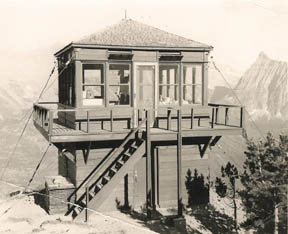
More about life on the lookout…
Glacier Park is actually part of the Waterton-Glacier International Peace Park. I see Porcupine Ridge showing up on current park maps, but not the Waterton tower. Waterton Lake is a long narrow lake that runs north-south, the approximate middle of which crosses the US-Canada border. The town of Waterton is in Canada. The Waterton Lookout Tower is not on the top of a mountain. It was situated on a small outcrop on the edge of the ridge with a view of three different valleys.
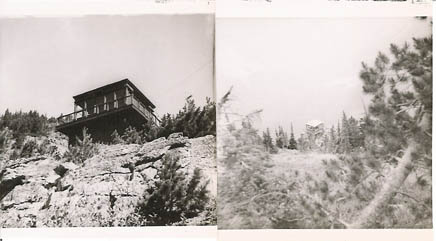
Waterton Tower Lookout on Porcupine Ridge as viewed from below and from above.
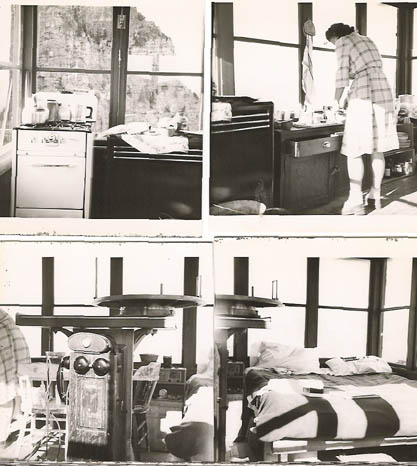
My folks both grew up in well-to-do households in Minneapolis, MN. As newlyweds, they were now living without running water. Betty said the outhouse wasn’t that big a deal because she had visited a good number of them back in those days. She said bathing was all of the sponge bath type. She only recalls washing her hair up there one time. Water was heated on the propane-powered stove.
In the photos you can see the countertop level was quite low, to stay below the windows. The springs for the bed are something Ralph had scrounged that could be rolled up and packed on a horse. He also acquired an old mattress and then built the frame out of spare lumber found on the sight.
Dad would walk daily to a spot where snowmelt flowed out of a pipe encased in concrete. He hauled the water in a pack on his back. Mom said she made the trip once, but it involved traversing a very narrow ledge and she would never try it again. Back at the lookout, he would fill a barrel located in the enclosed space beneath the floor of the tower. At the beginning of their stay up there, he made a conscious effort to keep the barrel full, because as the summer progressed there would be a point when the snow that served as the source would all melt away.
 Mom had never really cooked meals. She tells of being told by Ralph that she needed to learn how to bake bread from the woman she was staying with after returning from Miami. With only a few chances to practice before finding herself on the mountain, she ended up having to hone her skills on the fly. Luckily, the people who were on the tower before [Mom and Dad] had left a lot of flour. She said her less successful loaves were edible while still hot out of the oven. They would eat their fill and then make something of a game of taking turns tossing the rest over the edge and listening to see how long they could hear it tumbling down the ravine. They would then guess what animal was going to find it first.
One day when she was having trouble with making a pie, she said Ralph stepped in and put his hands right into it and whipped it up and made a pretty good pie. The payoff from his days as a cook on the trains.
She didn’t go back down during the span of their six-week duty at the lookout. They were resupplied once during that time. However, there was a point when Ralph absolutely had to have some milk (and ice cream, she whispered) and plotted to go down on a weekend while she was on the payroll. She said he literally slid down the side, shortcutting the back and forth of the switchback trail. He needed to catch a scheduled launch to get him across the lake to the town of Waterton. Later, back across the lake again, at the ranger station, they let him load up one of the horses with items for the trip back up. Once on the ridge again, the stirrups were tied up to keep them from catching on anything and the horse was allowed to wander back down on its own.

Ralph on the trail with water on his back, Betty on the trip up to the lookout.
Mom described witnessing lightning dance down the wires that ran to the ground when the tower would take a hit. She said there weren’t many instances of major cracks of thunder, but there were almost daily storms and plenty of lightning. They were required to record the location of lightning strikes. Those spots would get special attention the following mornings to see if any fires were born.
At dusk, they would locate and count campfires and match them with the number of registered campers. The bed my dad had built was level with the windows, so they could prop up on their elbows over their pillows and see from there. They would report to the ranger station at least once a day via telephone. There was a single wire strung from tree to tree. During the time they were on the tower, there was only one instance when a lightning strike started a fire. Dad was prepared to set out to the location to fight it, she said, but it ended up being taken care of by a crew from below.
Their idle time allowed a chance to feed chipmunks that became regular visitors and watch deer that would wander close. When asked about other daily tasks, Mom mentioned that the windows needed washing almost every day. She said Ralph did that mostly. She had no experience washing windows and he ended up re-doing ones she cleaned anyway. He had worked in a filling station, she pointed out, so he was well practiced at it.
.
.
Recalling Stories

“Betty on way to Apgar Lookout. 6-18-47” [that was in ink, then there is this in pencil] “Pictures lie. In spite of how she looks she was so exhausted she could hardly breathe”.
Even I don’t recall all the details of stories I’ve gathered over the years, despite having actually written many of them out. Yesterday, I was hunting for a picture in my personal digital archives that I wanted to include in a record for my mother’s profile on WikiTree. I located it near a chronicle I’d written from stories my mom was telling me about their days in Glacier National Park in Montana in the 1940s.
I enjoyed re-reading the details of my parents’ story so much I decided to share it here. I was writing it back in the summer of 2002 and a cursory search through Previous Somethings didn’t reveal any indication I’ve already shared it on this blog before now.
This segment is served well by a little of their backstory of that time, prior to getting married…
Mom & Dad, late 1940s
In the later years of WWII my father, Ralph, was working in Detroit for Minnesota Mining as their Personnel Manager. He had been denied entry into the armed forces due to a combination of hayfever, allergies, and a paralyzed soft palate from polio that made it difficult for him to swallow. The Detroit position had opened up as a result of the employee exodus to the military.
During the summers of his college years, Ralph had worked for the Great Northern railroad as a 3rd cook. Mom points out that that is primarily a dishwasher, but that he did learn to cook some things, including making pies. He told her that when the trains went through Glacier Park in Montana he used to hang out the door to look at the mountains and experience the great relief of being able to breathe, enjoying air free of his allergens.
During the war, my mother, Betty, was serving under the Navy in the WAVES as a yeoman, 3rd class petty officer doing office work. She says she started at that rating because she had gone to business school and had worked for 3 years. Before long that advanced to 1st class, but she claims it happened faster than usual because of the activity of the war. She was stationed in Miami.
In September 1945 my parents both returned to Minneapolis to attend the funeral of her father who had died during a fire in the home. Her sister was in the hospital with a broken back and a broken arm. At that time they discussed plans for marriage. They looked around for places to live. Ralph had been looking some while in Detroit. There seemed to be nothing available. They looked at what was available in the seedier parts of Minneapolis but found nothing they considered livable. They were NOT going to live with my father’s parents, and my mother’s family was now confined to a small apartment.
When Betty returned to her post in Miami, she found it had been decommissioned. Her office was gone! They struggled with what to do with her. She had just two months left before the prescribed time for her discharge. She talked them into moving it up, and they gave her the two months.
Meanwhile, with all the personnel returning from overseas, my father saw that he was not long for his present position and headed home to Minneapolis. They were both back in Minneapolis before Christmas, 1945. Ralph found a position selling insurance, but never really settled into the role.
On a day when he was suffering from his hayfever in downtown St. Paul, he went past the Great Northern building and decided, “I oughtta go in and see if I can get a job in Glacier Park.”
The hotels out there were run by the railroad and they would hire kids for the seasonal summer work. There was one job open: Purser on a tourist launch. He did that all summer in ’46, staying in the main hotel. While he was out there he met all the park service people. At the end of the season, he stayed on, using the spare beds near one of the Glacier Park ranger stations, and he worked helping stock snowshoe cabins used by the rangers when they went out into the park to check things through the winter. Eventually, he ended up living with ranger Dave Stimson and his wife Kay. By the time I was born, over a decade later, they would be known to us as “uncle” Dave and “auntie” Kay.
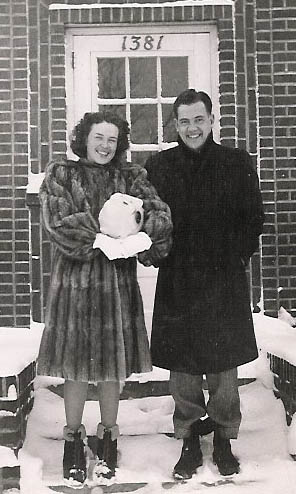 During the next winter, he worked for their highway dept driving snowplow across the mountain passes. When the park department started talking about plans for the next summer, Dad learned they were thinking about hiring married couples to staff the fire watch lookout towers. This set the stage for my parents’ unique start as husband and wife.
Betty and Ralph were married in Minneapolis, Minnesota in April of 1947. They stayed overnight in St. Cloud at a family friend’s place (due to the friend’s insistence at the wedding) and then went on to Brainerd to a cottage owned by the Elliott family. Everything was done on a shoestring. After a couple of days, they came back and packed everything they owned, including wedding presents, and prepared to drive west.
Apgar Lookout Tower was the one at the headquarters of Glacier Park where the “lookouts” were taught what to do in case they spot fire. Waterton lookout, where Betty and Ralph would be stationed, was on Porcupine Ridge. Back then, the man was paid through the week, and over the weekend they paid the wife. That was how the plan devised to use married couples was able to get 2 pairs of eyes for the price of one.
Mom and Dad didn’t go up to their tower until after the 4th of July and they were only on the lookout for about 6 weeks, but this was how they kicked off life together. They lived day and night on this fire lookout tower on a mountain in Glacier National Park in Montana.
.
.


 Relative Something