Posts Tagged ‘drainage’
Periodic Maintenance
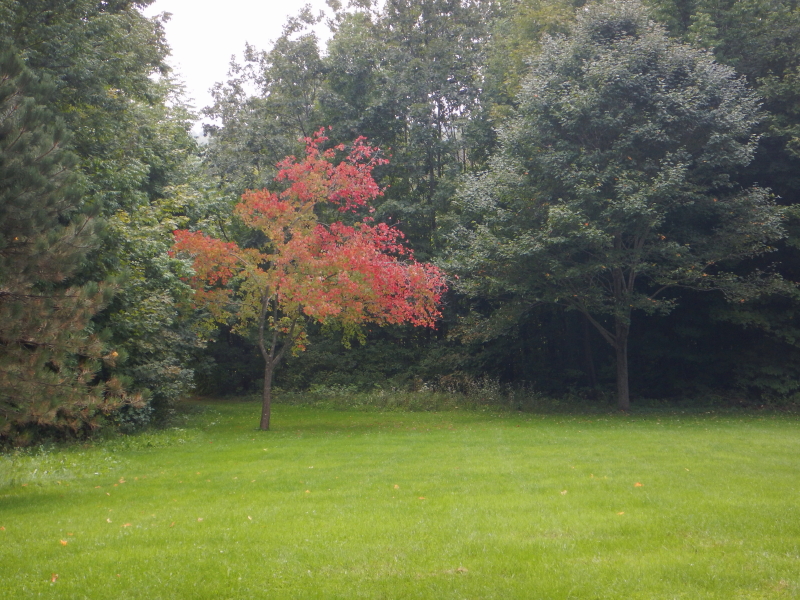 That tree in our back yard which leads the way in changing colors is cranking it up to full blaze now that we have arrived within the month of September. This image doesn’t to justice to the view, because our sunlight was muted by the smoke of wild fires in Canada and the western U.S. most of the day yesterday.
I spent time in the morning consulting with a specialist from our county soil conservation office as he surveyed the situation where the neighbor’s tilled corn field is overflowing my silt fence. According to him, we have done all the right things for drainage on our property, adding that compared to other sites he reviews, our problems are not very significant.
My perfectionism sees it otherwise.
He did basically fault the neighbor, of whom I gathered he didn’t hold a high opinion. The best fix to hold the soil would be for the neighbor to plant hay in that field, instead of corn. I don’t have any idea if that is something I might be able to influence, but I will suggest it at the first opportunity.
On my end, I learned that the silt fence does require maintenance to remove material when it starts to fill, because he said it is obviously functioning as intended.
I will do that, but I will also add another short section of silt fence above it and then start building a berm of branches between the two, eventually creating a thicket of wild growing weeds and trees.
Since it is so late in the growing season, such a barrier will take a year to become the filter I envision, but just having the skeleton of tree limbs in place before winter will provide an additional place for the silt to build up and start a foundation for a natural barrier.
Looking at the drainage swale below our paddocks and across the pastures, the advice was to periodically reshape the high spots by digging those out as well. Funny me. I had it in my head that there was a one-time solution where I could shape the swale properly and then never deal with it again.
Why should it be any different from the periodic maintenance required on everything else?
Lawns need to be mowed, septic tanks need pumping, engines need oil changes, rugs need vacuuming, animals need feeding, relationships need tending. There aren’t many things that can be ignored indefinitely.
Land needs management. I guess I won’t argue with that logic.
Though, given that, seems to me that days need more hours.
.
.
.
.
.
.
.
.
.
.
.
.
.
Standing Corrected
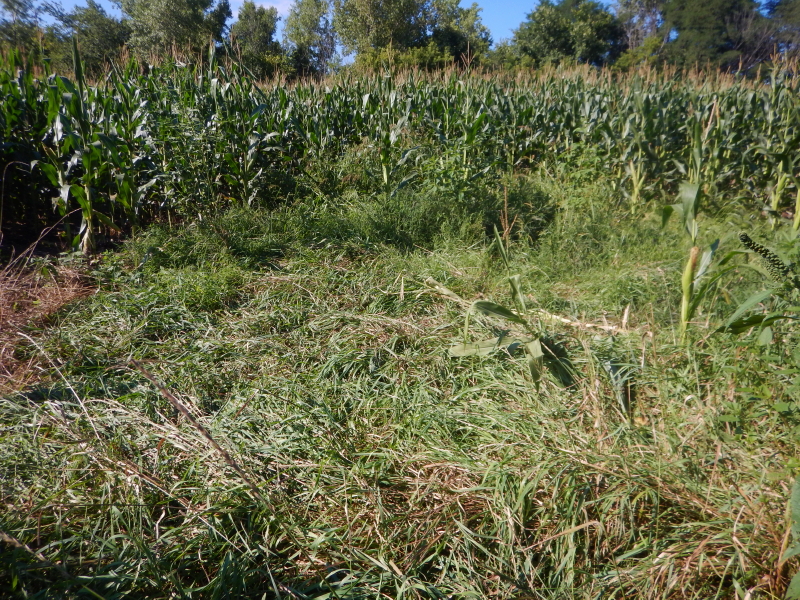
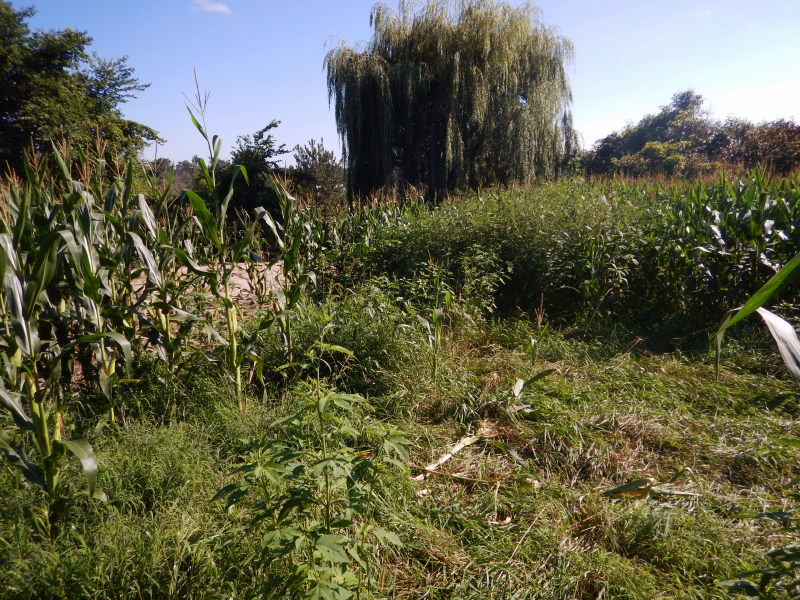
I stand corrected. My neighbor finally got my message and stopped by yesterday to discuss the soil eroding from his corn field. In my angst over the mess, I had jumped to the conclusion that he had neglected to leave a patch of un-tilled grass waterway.
In fact, he did, and it has a wonderful patch of grass, below which are some weeds taller than his corn. I had not walked far enough up into the field to notice the full scope of what was going on. Had I looked just beside my focus of the current source of sandy top soil, I might have noticed.
I think it was the willow tree that obscured a full view.
 .
.
.
.
.
.
.
.
.
The sad truth is that the heavy flow of downpour runoff has simply migrated to either side of his grass waterway.
There isn’t really anything he can do about it right now, but just the fact he is now acutely aware of the current situation helps my mind. When he cuts at the end of the growing season, he will better be able to see the whole picture of what is happening, allowing him to consider options going forward.
It may simply be that he tries making the grass water way wider. I got the impression that he believed it was just an unlucky timing of heavy rain in the spring, before the planted corn had sprouted, that created this situation, so the fix will rely on a hope we get lucky and it doesn’t rain like that next year.
I am more of a mind that the likelihood of heavy downpours will only increase until the global temperatures somehow reverse the current trend and drop a degree or two.
Either way, the solution appears to involve a wider portion of un-tilled soil, but that won’t take effect immediately. For now, I am facing the challenge of dealing with the filled silt fence and finding a way to stretch its effectiveness through the rest of this summer and fall.
I’m trying to decide where I can put the sandy soil if I dig out the front of my silt fence. I’d like it to go somewhere that doesn’t end up just washing away the next time it rains, and that’s a daunting feat. I love the hilliness of our terrain, but the runoff erosion tends to be a constant result.
I’m back to that challenge of striving to work with the natural order and not against it. I want to figure out a solution that involves allowing water to take the easy path it seeks, but without it causing such extreme erosion. It’s hard to convince water to flow gently when the land is not so flat.
.
.
.
.
.
.
.
.
.
.
.
.
.
Nature Wins
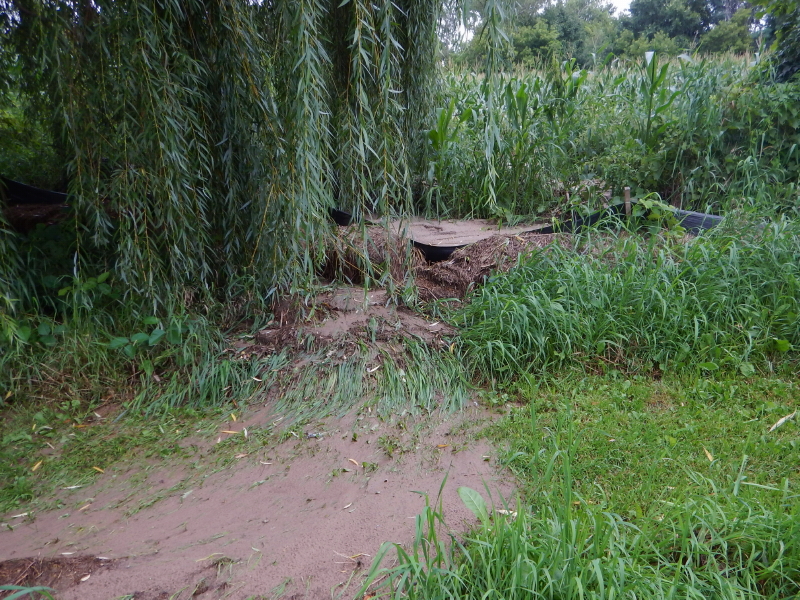 This round goes to Mother Nature.
I’ve heard tell that our warmer climate allows the atmosphere to hold more moisture. With a pattern of increasing frequency, our anecdotal evidence of the years we have lived here is that downpours are increasingly bringing multi-inch totals that overwhelm the old drainage paths.
Overnight Wednesday we received over 2 inches, bringing the 24-hour total to more than 5.5 inches.
When I combine our experience and the recorded data of measurable climbing global temperatures, I get the impression we are seeing the beginning of downpour trend that will, at best, keep happening at this level, or worse, continue to grow more extreme.
This presents a daunting challenge for devising a plan to improve our drainage paths to a point they will be able to handle ever-increasing volumes of massive flow in a manner that avoids major washouts, if that is even possible.
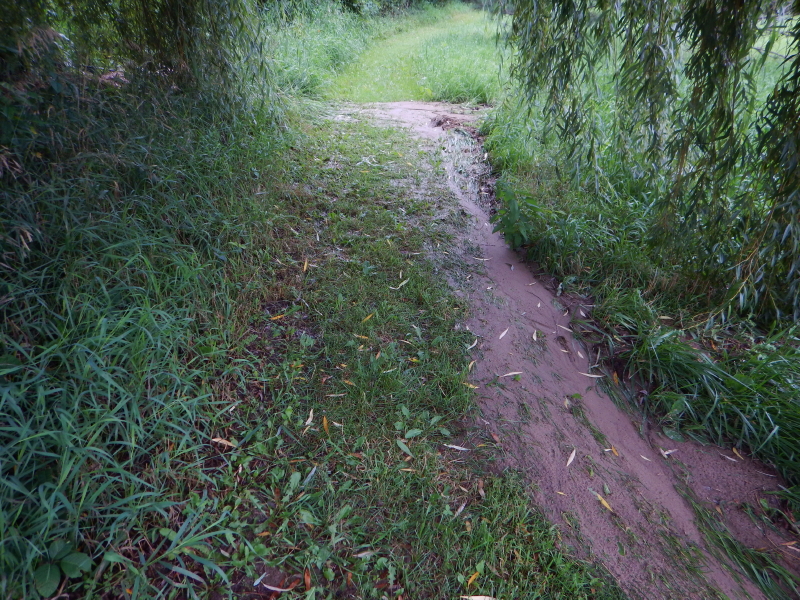 Our attempt to stem the tide of topsoil flowing from the neighbor’s cornfield came up short of successful after not very many storms. I don’t know if there is a more industrial version of a silt fence or we just need to pull out and re-install the one we have, above the new ground level.
Ideally, we would like to enlist the assistance of the neighbor-farmer to get him to not plow the portions of that field where the runoff flows and instead, create a grassed-waterway.
Recent efforts to contact him have thus far failed. I have a sense that his not having already maintained a protective waterway reveals a certain lack of interest in having one, so I’m imagining I may need to be prepared to offer a convincing sales pitch.
I suppose I could pull out the corn plants that washed down from his field and are now growing on our property, and bring them over to his house to see if he wants them back.
If it wasn’t so much work, I’d love to also bring him a load of the mud that poured out of his field and now covers the grass of our walking trail.
Since the rain will likely keep dumping on us, maybe his field will just empty out and that problem will go away. I can switch my attention to marketing the sale of a large amount of sifted soil that magically became ours when it crossed the property line.
.
.
.
.
.
.
.
.
.
.
.
.
.
.
Patch Worked
On Sunday, I just happened to stumble upon the fact that the snow-melt flowing down our drainage swale from beneath the driveway wasn’t coming out of the culvert.
“What the…!?”
I hustled to the other side of the driveway, and sure enough, the rushing water was disappearing beneath the mouth of the culvert. Nice.
I tell ya, property ownership is a trip.
I tried an on-the-fly patch in attempt to plug the opening enough to coerce the water to flow through the culvert, not beneath it. I dumped in sand and hay, plus tried stomping some of the residual snow to fill the void, but the water was moving with such momentum that my plug didn’t stop the flow.
I needed something impermeable. Old empty bags of feed came to mind, especially as they were also closest at hand. I cut open a bag and tried laying it as a sheet over the opening in hope the water pressure would push it in place to fill the opening beneath the mouth of the culvert.
The bag was more inclined to float.
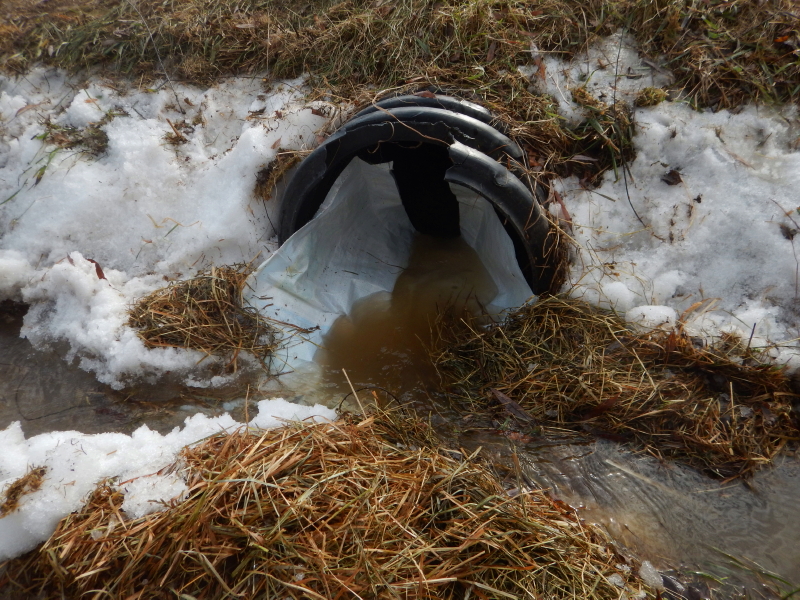 I struggled to hurriedly push it below the freezing-cold water where I could cover it with hay and sand to redirect flow into the culvert. It started to work a little bit, so I worked harder to get the edges down to where water wouldn’t flow beneath it. Soon, it became obvious I needed to do something just upstream from there, so I added a second bag and placed a shovel on it to hold that one in place.
It wasn’t perfect, but it was better than nothing, so I left it at that, fully expecting to find one or both of the bags out of place and wreaking havoc on desired flow sometime later.
Then yesterday’s rain storms arrived. Driving home, I noticed the ditches were filled with standing water and the creeks were running at full capacity with runoff. This time of year, rain water can’t soak into the soil because the ground is mostly frozen. I held little hope for the hastily placed feed bags at the mouth of our culvert.
Draining rain water was running at full tilt through the culvert under the road at the south border of our property when I arrived home. I stopped the car when I reached the problem culvert under our driveway and stepped out into the rain. First, I walked to the outlet side and was pleased to see heavy flow coming out of the culvert.
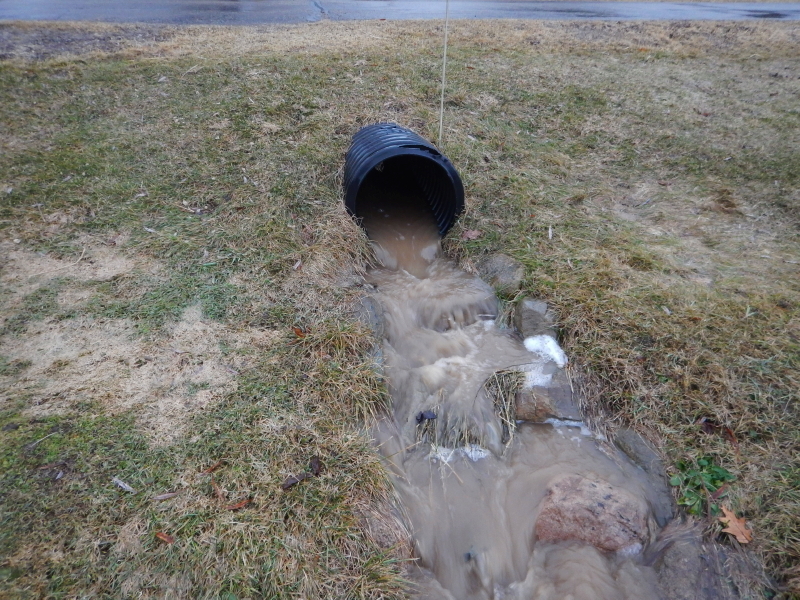
Crossing to the other side, I was amazed to find both bags still positioned where I had placed them. The one funneling water into the culvert had flopped over sideways a bit, but it seemed to be holding in place down below. I pulled it back again to catch as much water as possible and deemed it a success.
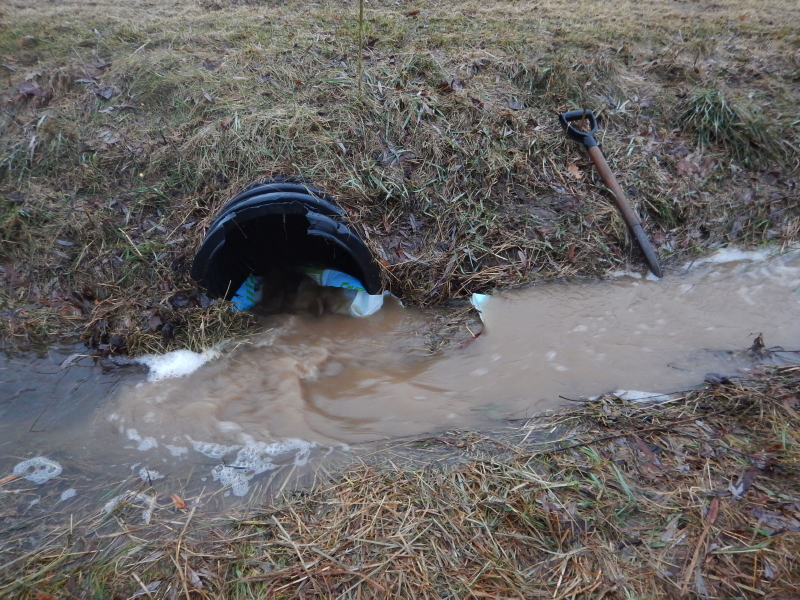
A more permanent fix will wait until there’s no water flowing, but for now, that crazy patch is certainly performing beyond my expectations. With the weather we are experiencing this winter, there is no telling when that opportunity for a permanent fix will arrive.
It will be no surprise to me if I find one or both of those bags down stream before their services are no longer needed. Stay tuned for further developments.
.
.
.
.
.
.
.
.
.
.
.
.
.
Shaping Terrain
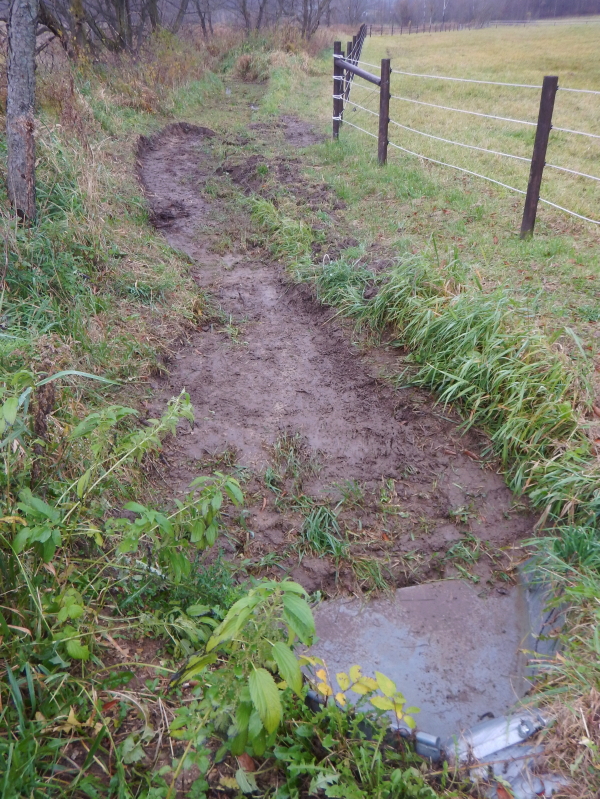 Despite the sprinkling rain that pestered most of the day yesterday, I decided to try moving some dirt and turf from the drainage ditch along our southern property line to the adjacent sloped path.
When the new fence was installed and the drainage ditch improved, there wasn’t much width remaining beside a little bend in the fence. It was an impediment to being able to use the tractor to mow that section of path around the outside of the hay-field fence.
Originally, I envisioned using the loader on the tractor to dig out the sediment that has been accumulating in the ditch, but it hasn’t been dry enough to do that for months.
Since I was already working along that fence line this weekend, I decided to see what I could accomplish using a shovel to dig it out by hand. It was a little messy, and a bit tedious, but it was probably a better method for then using the material removed to improve the path.
Using blocks of dirt and turf that I could barely lift with the shovel, I built up the low side until it was wide enough to fit at least the lawn tractor, for now. Might be dicey fitting the diesel around that bend.
The strip around the fence only received infrequent attention and would grow tall and thick, so I had been mowing navigable portions with the brush cutter. Now that I will be able to drive the lawn tractor around, it will be convenient enough that I can keep it cut short all the time.
Well, as short at the rest of the lawn, which all grows so fast that short is a relative term.
With that little narrow bend of path fixed, there was only one other barrier remaining to allow driving the full circumference of our horse-fenced fields. Back in the corner by the woods there is an old ravine that was created by years of water runoff. Previous owners had dumped a lot of old broken up concrete in it to slow the erosion.
We have created a better defined intentional swale a short distance above that directing the bulk of energized flow into the main drainage ditch. It crossed my mind to fill in the ravine, but some water still wants to follow the ease of that natural route and I’d rather not fight it.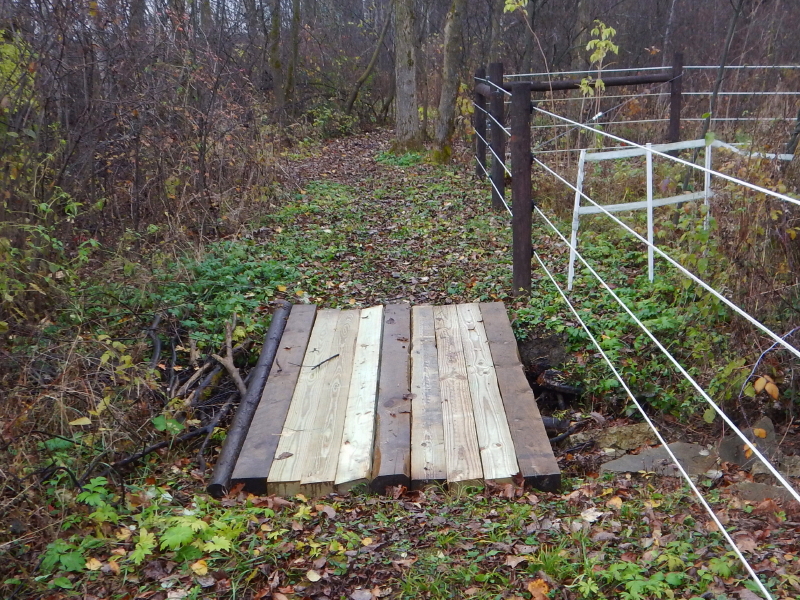
Simple solution: a bridge. For now, nothing fancy. I used a few left over fence posts and then broke down and actually purchased additional lumber to make it wide enough to drive across.
I placed them across the washout yesterday in the rain, leaving the task of cutting a notch in the dirt on each side to level them for today.
Then I will be driving to the airport to pick up George and Anneliese. I’ve come to the end of my solo weekend on the ranch. They are going to return the favor of airport transport after midnight tonight when Cyndie arrives home from Guatemala, so I can get some sleep before the start of my work week.
I’m looking forward to having everyone home again.
.
.
.
.
.
.
.
.
.
.
.
.
Rainy Results
One day later, with the sun shining brightly, I surveyed the results of our crazy mid-summer type of thundershower in October. As I drove in the driveway after work, I could see right away from the car that the grass was laid flat below the culvert.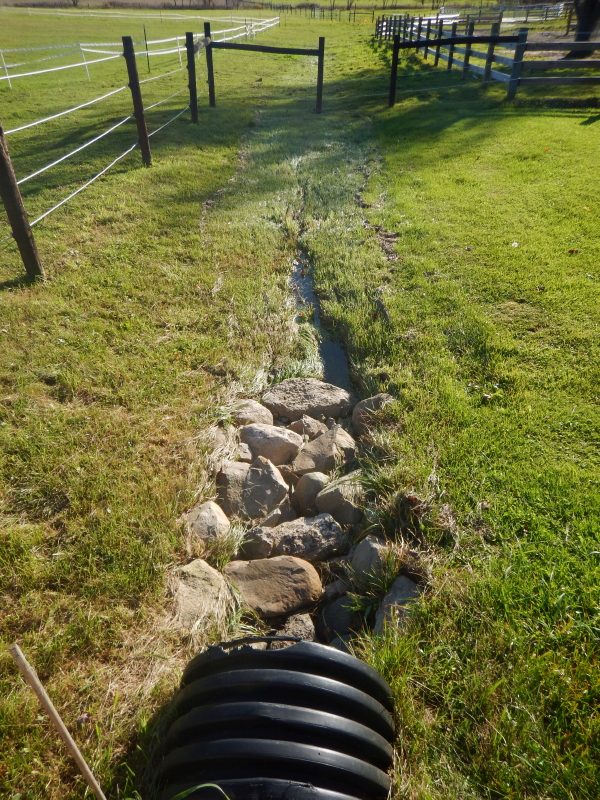
There was a clear impression of how wide the little runoff river rose after the deluge.
Our rain gauge collected over an inch from Monday night’s dramatic evening cloud burst, and that was on top of a previously accumulated inch that Cyndie had dumped out of the gauge after a drenching earlier that same day.
When we moved to this property, which happened exactly 4 years ago this week, we had no idea the warming climate was going to start dishing out the kind of gully-washing downpours that we have witnessed with increasing regularity each year since.
We have tried a variety of ways to manage the flow —or with regard to the sub-soil, the lack of flow— of water across our land. One trick to reduce the muddiness of our paddocks was the installation of drain tile to help dry out the soil in the springtime, but that didn’t do much to help with the immediate surface runoff of heavy downpours.

 .
.
.
.
.
.
.
.
.
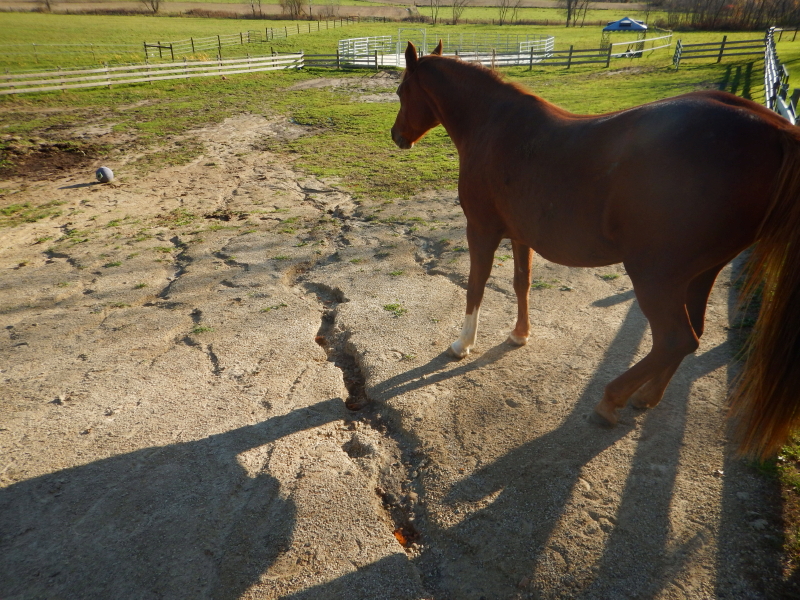
Pouring rains rush down our slopes and carve a multitude of rills around the paddocks below the barn. Dezirea surveyed the sad scene with me yesterday and agreed it kinda sucks.
The geography of our property makes this a difficult thing to prevent, especially since both the frequency and intensity of rainfall have continued to increase since we arrived.
Water will always find a path downhill. The hilly features that we adore so much about this property are also the cause of our erosion problems. We want water to drain from our land, but we would like it to depart with a lot less energy, …preferably leaving all our precious lime screenings behind.
That’s hard to accomplish when the clouds repeatedly unleash inch amounts in spans as short as mere minutes.
Maybe we should look into terracing the paddocks and turning them into rice paddies. Do they make rubber boots that fit horses?
.
.
.
.
.
.
.
.
.
.
.
.
Failure Happens
We received 3-and-a-half inches of rain in the storm that hit this region on Tuesday evening. With reports warning of wind gusts between 60 and 70 mph, we were a bit anxious about what might happen when the full force arrived. Luckily, we did not experience any loss of trees from that high of wind, but the paddocks have the makings of a couple new canyons shaped by the heavy rain.
 While cleaning up manure, I came across evidence of a failure I had been suspicious of for some time. The drain tube that was buried from the barn gutter to the main drainage swale has made its way up to the surface. There is no way it can be draining properly.
That helps explain the dramatic runoff that has been occurring from the corner of the barn. It doesn’t really matter that I cleaned out the bird’s nest from the down spout when the drainage tube the spout is connected to is plugged somewhere down the line.
After work yesterday, I disconnected the down spout from the tube that leads underground and rigged up an above-ground series of tubes as a temporary solution for protecting the paddock from erosion.
I don’t know what I would do different, but the failure of that buried tube reveals a flaw in our plan. Once again I am reminded of how fluid (as opposed to static) the “solid” ground actually is. Buried things don’t tend to stay buried around here.
Each spring farmers find new rocks sprouting in their plowed fields. Those rocks aren’t falling from the sky. They are pushed up from below, just like that section of my drainage tube that now protrudes above the surface.
I probably won’t ever succeed in preventing erosion from runoff of heavy rains, but I would sure like to reduce and confine it as much as possible. My next idea will involve a way to capture the water running off the roof into a giant barrel of some kind.
Then I just need to figure out what to do with the overflow from that vessel whenever it fills up.
.
.
.
.
.
.
.
.
.
.
.
Hazardous Conditions
Yesterday, while working outside for long hours in the spring wind, we exposed ourselves to enough tree pollen to cause significant irritation to our delicate tissues. I think I also successfully altered the weather to shut down precipitation here for some time.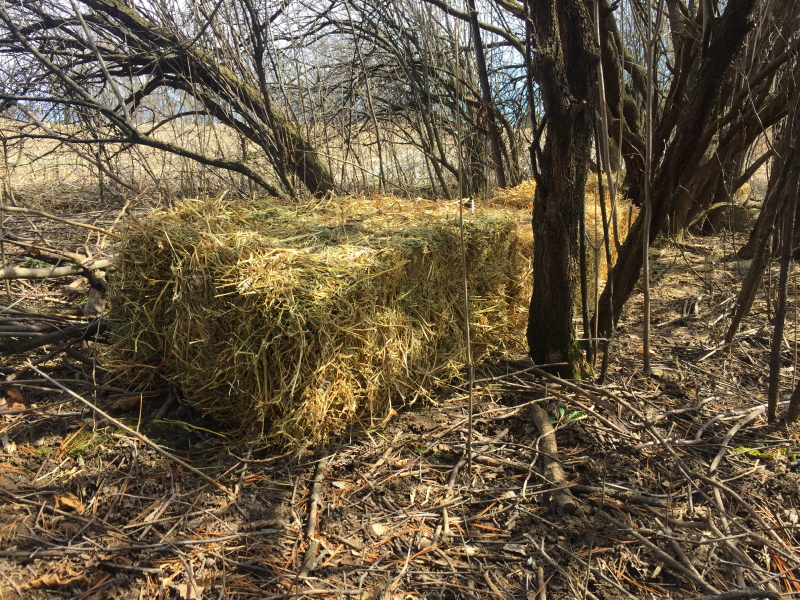
While my nose dripped at an ever-increasing rate, I built a barrier of old, moldy hay bales in the trees by our uphill neighbor’s corn field.
During heavy rain, the water comes off that field in a torrent and washes sediment onto our property. Lately, it has started to fill in a drainage trench beside our driveway.
Oddly enough, I actually wanted it to rain today, so I could see if my creation worked as intended, but the forecast shows no precipitation expected in the days ahead.
Given that, I guess my project worked. It has stopped the sediment from pouring into our trench, hasn’t it?
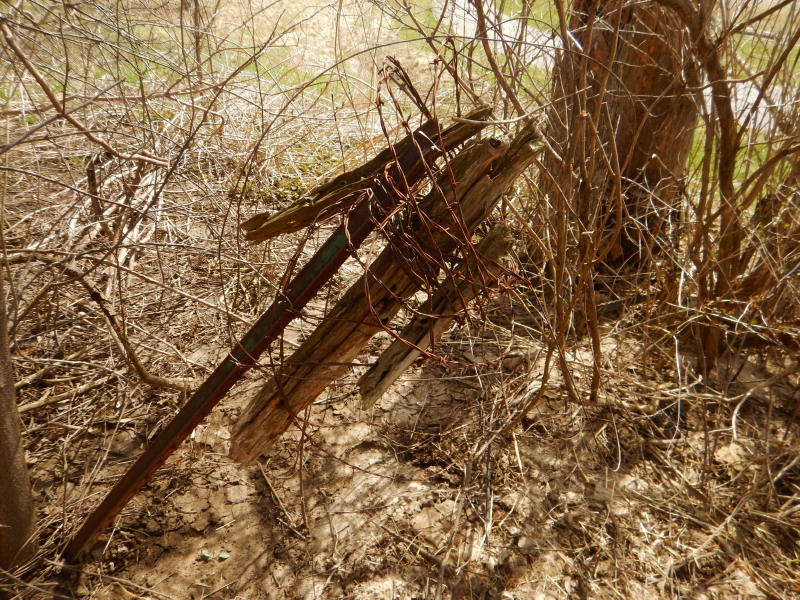
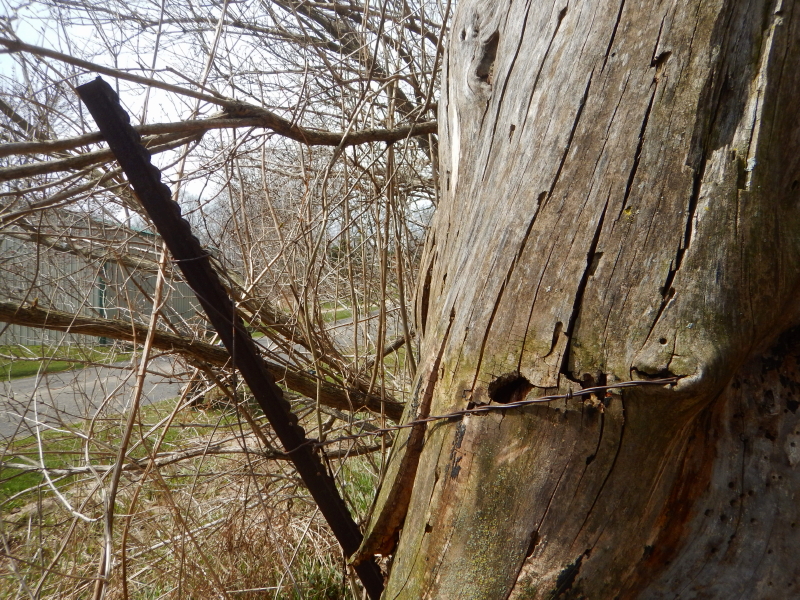
While I was working in the tangled bramble of uncontrolled growth that forms the border between our property and that cultivated field to the north of us, I decided to finally address a remnant of rusted barbed wire fencing that had been swallowed by a tree.
 .
.
.
.
.
.
.
.
.
The tree had long ago been cut off, leaving a stump that was about the height of a fence post. Made sense, since the barbed wire ran through the tree, it was already functioning as a fence post.
Removing the rusted fencing was made easier by the fact the tree was rotting to pieces. So much of it came apart simply by prying at it with one of the old fence posts that I found myself struggling near the end, to finish it off in the same manner. Eventually, logic, and my increasingly irritating allergic reactions to pollen, led me to hasten the task by way of the chain saw.
The area looks like it has been through a serious spring cleaning now, with the added benefit of opening up visibility to the area where water flows off the neighbor’s field. It is easier to see if the barrier I built is doing the job of keeping sediment out of our ditch.
Sneeze. Cough. Drip. Stinging blink. It’s the hazardous working conditions of spring!
.
.
.
.
.
.
.
.
.
.
.
Flowing Along
If the weather predictions for today come true, we may literally be flowing along by the end of the day. Reminiscent of a year ago, when the Tour of Minnesota bike trip faced epic amounts of rain and flooding, today Wintervale Ranch is included in a flash flood watch. Remnants of what was Pacific Hurricane Blanca will be bringing us torrential rainfall with potential flooding this afternoon and overnight.
Cyndie and I ventured out last evening to contemplate our preparedness, and it became apparent there is little we can do but let mother nature have her way and react to whatever aftermath we face. I don’t have any idea yet about how we might mitigate the erosion that is happening on the hill around the barn. Heavy rain today will likely expand on the current ruts created by the last two significant rain events.
After walking the back pasture last night and surveying the drainage swale again, I felt inclined to just leave it be as is and see if flowing water will carve a path through the sediment that has accumulated in order to reach the ditch at our property border. It won’t look like the precise, wide slope of a swale that I had in mind, but I can adapt my vision.
 Delilah received some quality attention in the form of a thorough brushing, which has become a daily occurrence lately in attempt to rid her of the underlying fur left over from winter. Wednesday was an exceptionally hot and humid day for this time of year and she appeared to struggle with keeping herself comfortable.
My exercise in throttling back my daily sugar consumption continues to leave me feeling tired and lacking in stamina. It has me wondering about the intense weight loss regimens that drive participants to do heavy workouts while also making strict diet corrections. I don’t think I could do both at the same time. I know the physical abilities of my former self, and right now I can’t achieve a fraction of what I use to do when I was eating unconscious amounts of sugar.
So, lacking any other strong motivation, I am settling in with a frame of mind to just go with the flow. What will be, will be.
Let it rain.
.
.
.
.
.
.
.
.
.
.
.
Uh Oh
I’ve got a problem with my little drainage swale that we paid to have excavated last fall. It is already filled up with sediment.

 .
.
.
.
.
.
.
.
.
Part of me wanted the swale to be a bit deeper than it ended up, but we had to go with the existing geography of the surrounding land, and to achieve the gentle slope we want, over the full distance we need to cross, it can only be cut so deep.
One source of my problem is that the excavation happened so late in the year that I wasn’t able to get good coverage of grass growing over the full distance to hold the soil in place. The other source of my problem is one I overlooked. There is a lot of runoff coming from the paddocks. I’m not sure what I am going to do about that.
It frustrates me to think that I need to re-dig the swale already, and destroy the areas of grass planted last year that did take, but right now, that seems like the thing to do. Get it dug out now and allow myself plenty of time to get grass growing along the full length.
Solving the runoff from the paddocks is the bigger challenge. I could probably install the little plastic fence that is commonly seen at construction sites, but that is an ugly-looking solution. I want the water to drain, but I don’t want it to carry any topsoil away when it does.
I’m going to need to do some research on that one. Just like so many things in nature, it’s a complex situation with multiple influences and the full range of possible outcomes. Maybe a little pond at the low spot of the paddock to act as a catch basin that can then overflow excess water into the swale, without the sediment.
Then I would just need to dig out the pond occasionally, and I could move the soil back uphill where it came from. I’ll take some time to pond-er the possibilities of that potential solution.
.
.
.
.
.
.
.
.
.
.


 Relative Something