Posts Tagged ‘drainage’
Spring Progress
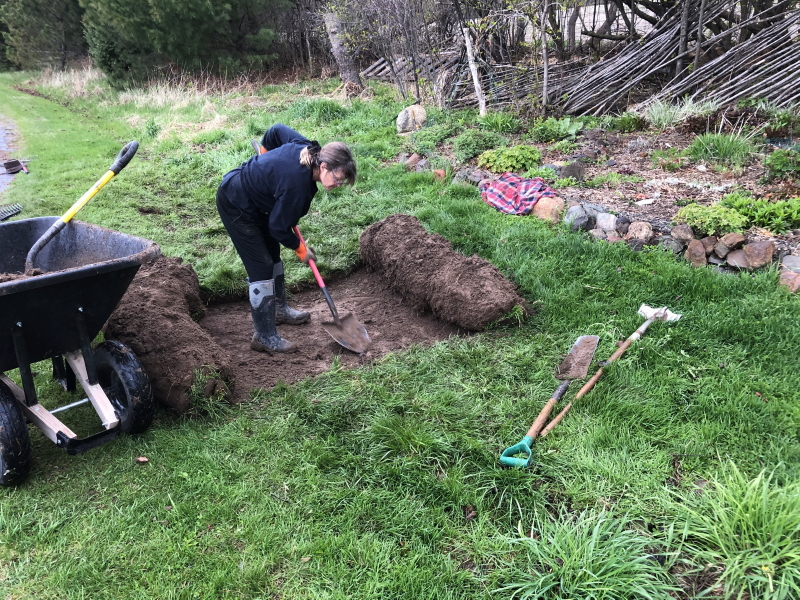
Or lack thereof… We are sorely lacking in the warmth and sunshine department but spring growth is beginning to emerge, not all of it desirable. We are already seeing a growing collection of sediment beginning to fill in where we dug out dirt last year to improve drainage in front of Cyndie’s perennial garden.
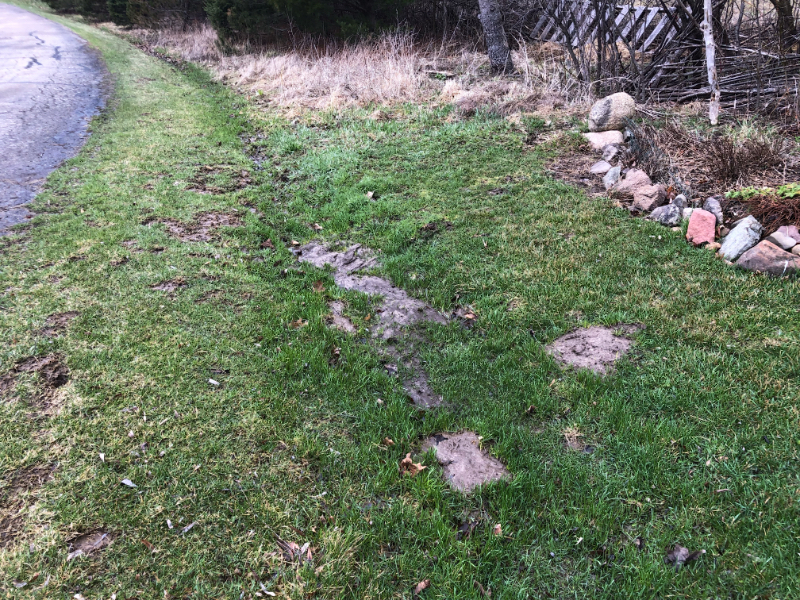
Two steps forward, one step back. -_-
The water pressure in the saturated ground pushes up little geysers in random places and that flowing water is carrying topsoil from the farm field just uphill from us. Just lovely.
The forest floor is about to burst forth with trout lilies along our paths.
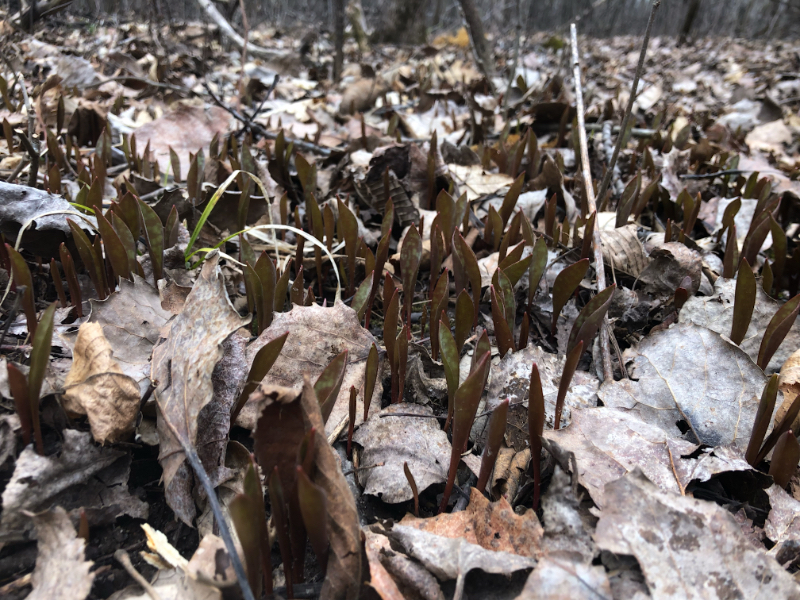
These are the earliest of the wild ground cover that carpets certain areas of our woods. Soon to be followed by bloodroot.
Delilah and I walked through the back pasture to get a closer look at the new grass sprouting. Cyndie wants me to wait for the blades to get more than six inches tall before beginning to slowly give the horses access to grazing green grass.

The only thing we are missing is heat and sun. I know it’s out there. We just need to be patient. There is a reason dull things get compared to watching grass grow but seeing the steady progress every day in the spring is joy to behold. A dull joy sometimes, but still… joyous. 🙂
.
.
Ground Visible
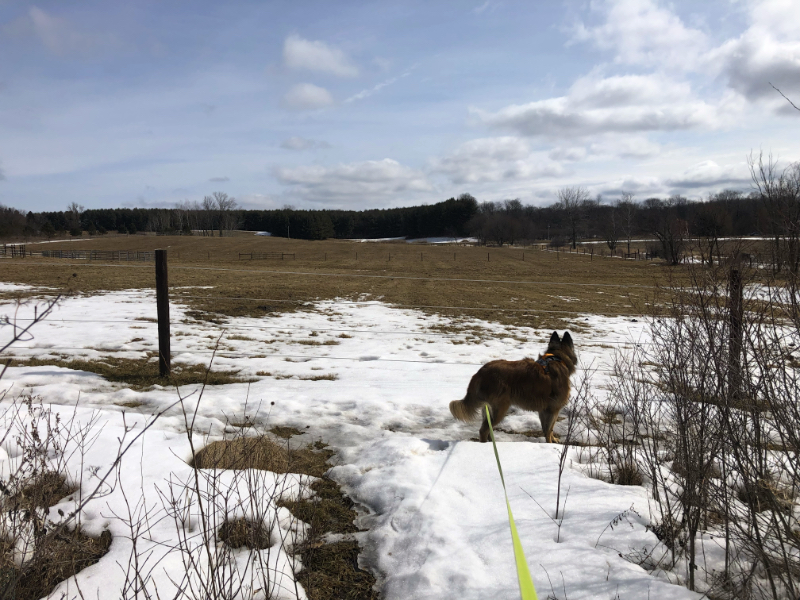
The change of seasons is marching full ahead with great results. I appreciate that our snowpack’s meltdown has been happening at a perfectly gradual pace. It’s been cool enough during the overnights that melting pauses so the runoff has been controlled, for the most part.
 .
.
.
.
.
.
.
.
.
Delilah and I found the fields entirely bare when we emerged from the woods where there was still snow covering the ground on our morning stroll.
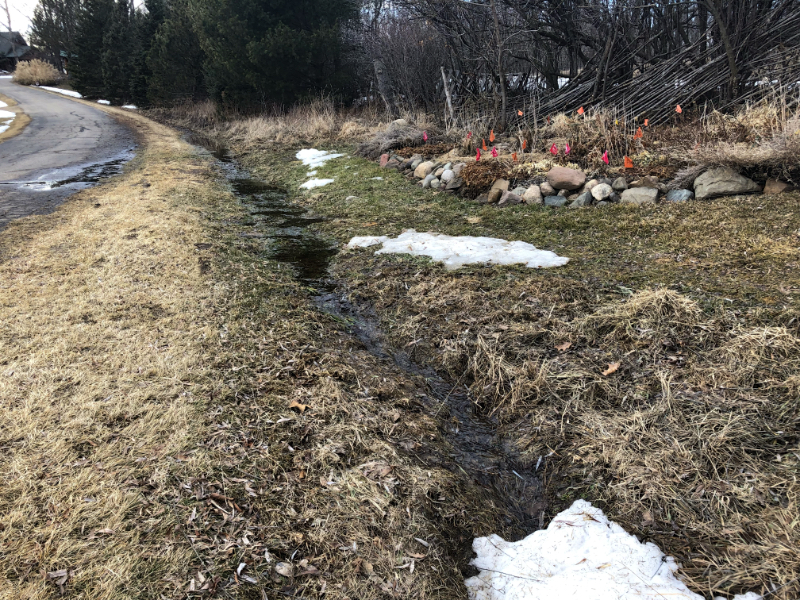
By afternoon, water was flowing as the melting of remaining snow picked up again. It is very rewarding to witness the unimpeded drainage flowing where Cyndie and I worked hard to correct the grade in front of her perennial garden last year.
 .
.
.
.
.
.
.
.
.
My “swale” in the paddock hadn’t maintained its shape nearly as well and the water was draining randomly across the main travel path of two gateways where hoof prints in the soft earth disrupt any coordinated drainage. While cleaning up manure yesterday afternoon, I did a rudimentary job of stemming the flow as best I could, using the flimsy plastic tines of my fork scoop tool.

I want the water to flow out of the paddock to the left of the gate opening to the hayfield, not across the primary travel pattern of the horses. Any attempts I make toward achieving this goal end up getting stomped on by horses who don’t seem to notice what my efforts are intended to accomplish for them.
It’s almost like they have no idea how much they weigh and the amount of disruption in soft, wet soil they create.
One other creature who has no idea how much of a disaster she creates is Delilah. She prances around everywhere she pleases in the snow and mud and then assumes a little toweling off when we come inside the house and she’s good to go.
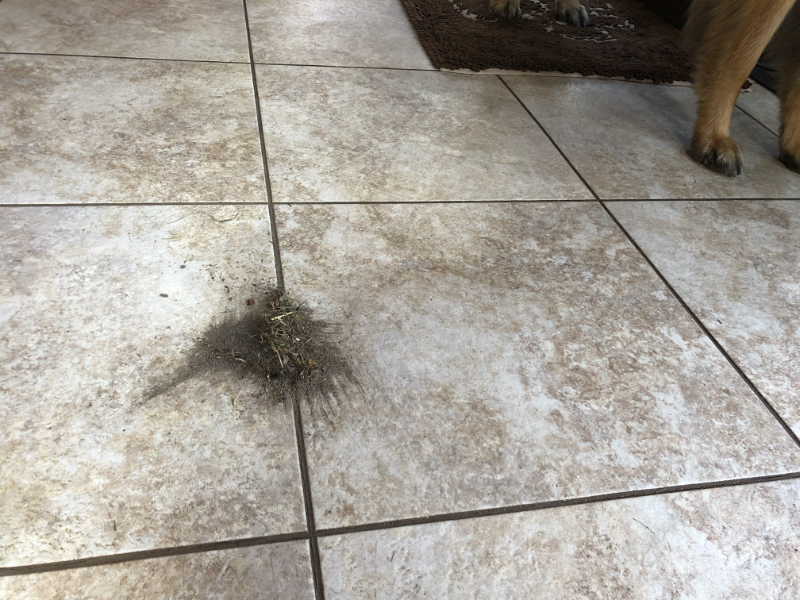
Sweeping the floor is an adventure after practically every outing.
Yeah, the ground is visible alright.
.
.
Snow Coming
I’m usually grateful to have advanced notice of coming weather, but sometimes I don’t like knowing we are about to receive large amounts of heavy, wet snow in April.
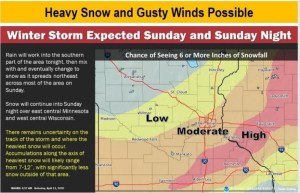
The snow is predicted to come in a narrow band, so it could shift a little, but we are located perilously close to the highest risk of seeing 6 or more inches of snowfall. Look to the right of the letter “e” in the word Moderate, just above Red Wing. Oh, joy.
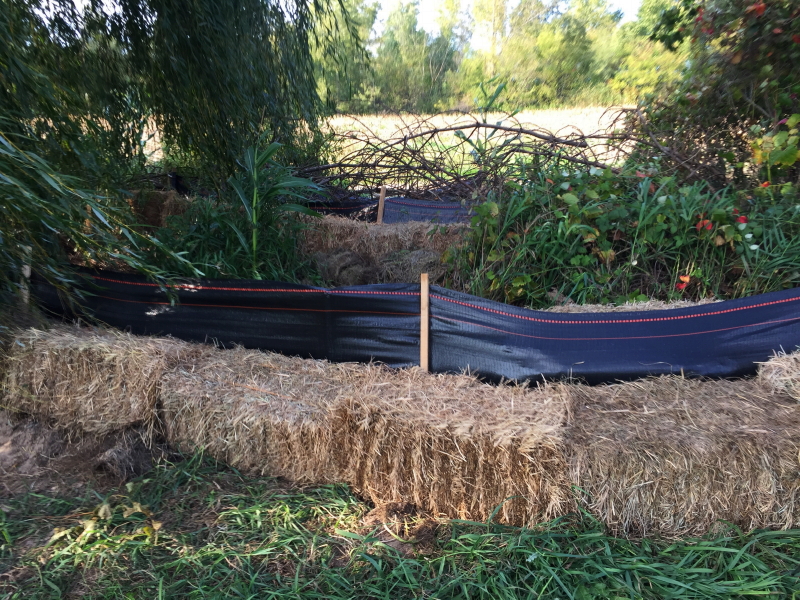
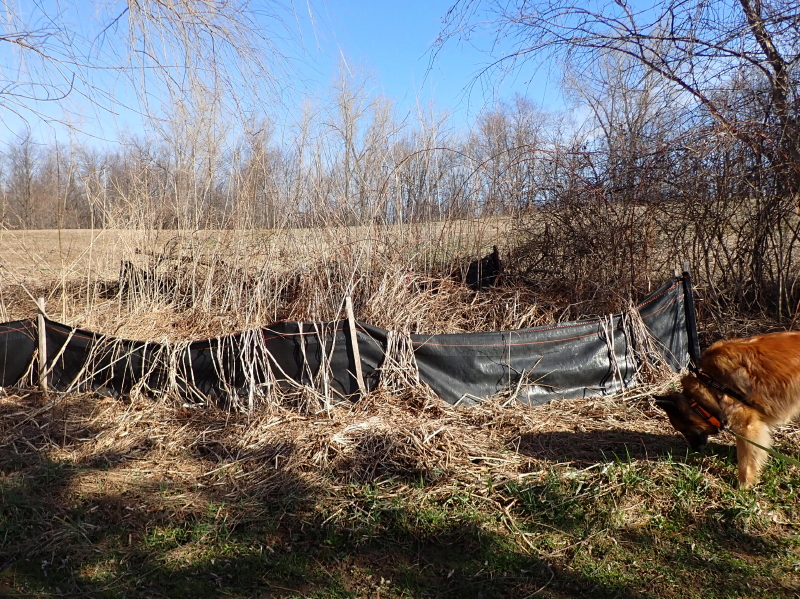
I spent yesterday tinkering with the slowly developing berm we are constructing at the edge of our property where the neighboring cultivated farm field drains onto our land. It’s been 2-and-a-half years since we installed the latest version of erosion fencing and much of that has filled with so much topsoil the fabric is laying almost flat in some places.
Granted, the following photos were taken at different seasons, late summer vs. early spring, but the difference is rather striking.
 .
.
.
.
.
.
.
.
.
The bales obviously disintegrate. Progress that may not be evident can be found in the number of volunteer plants that have taken root and naturally help to hold soil in place. The thing is, though, that helps to hold our soil from eroding, but we still get large flows of the neighbor’s topsoil washing over our property.
If I can get the berm established enough to pool his runoff, it will serve as a natural replacement for the Polypropylene fabric and, most important to my sensibilities, be a less unsightly barrier.
I have found the use of gnarly dead branches that are too big for my chipper makes for great starter material in establishing a natural barrier. The highly fertilized runoff tends to fuel thick growth of tall grasses that ultimately create a tangled wall of live plants weaving through dead wood.
Looks like I’ll have a fresh opportunity Monday to see how my latest upgrade to the barrier yesterday will impact the drainage of many inches of melting snow.
Wouldn’t you know it, I changed the tires on the ATV yesterday to swap out the aggressive treaded winter tires for plowing snow, with the smoother treads of summer tires that are kinder to our land.
I could be in for a complex day tomorrow of clearing heavy, wet snow that will be a big problem for a day or two, and then melt. Then we can get on with spring, which is on the verge of swiftly getting sprung.
.
.
Bridge Built
It hasn’t started raining today yet, but precipitation is on the way. Knowing that, yesterday I made it a priority to finish the bridge I started a week ago. I wanted to get it done while the weather was nice. I’ll let the pictures tell most of the story:
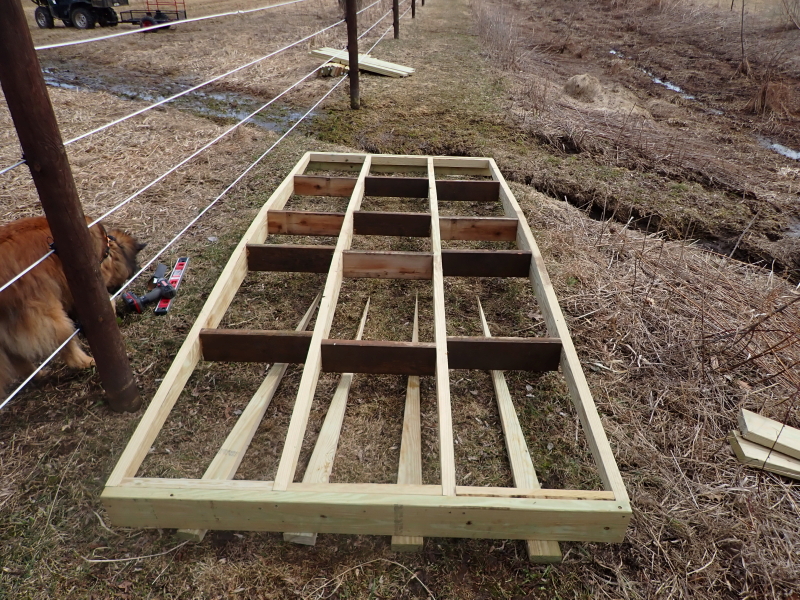
Once the frame was complete, I used the cut pieces (previously employed as shims to level joists during assembly) for reducing friction when I single-handedly dragged the base across the gorge. It was heavy!
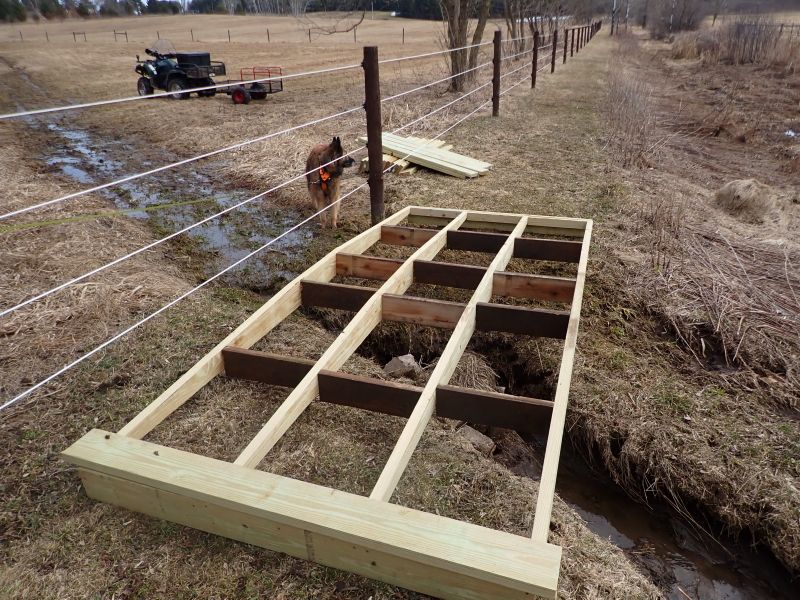
For now, there will be a step up onto the deck, but at some point in the near future, I plan to dig down so the ends will be at ground level so the lawn tractor can roll smoothly up and over.
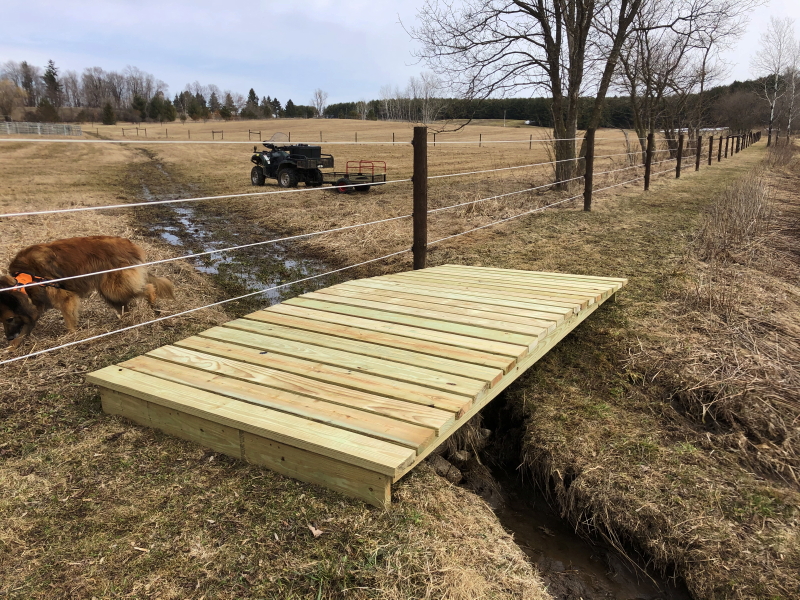
I wonder how heavy it is now.
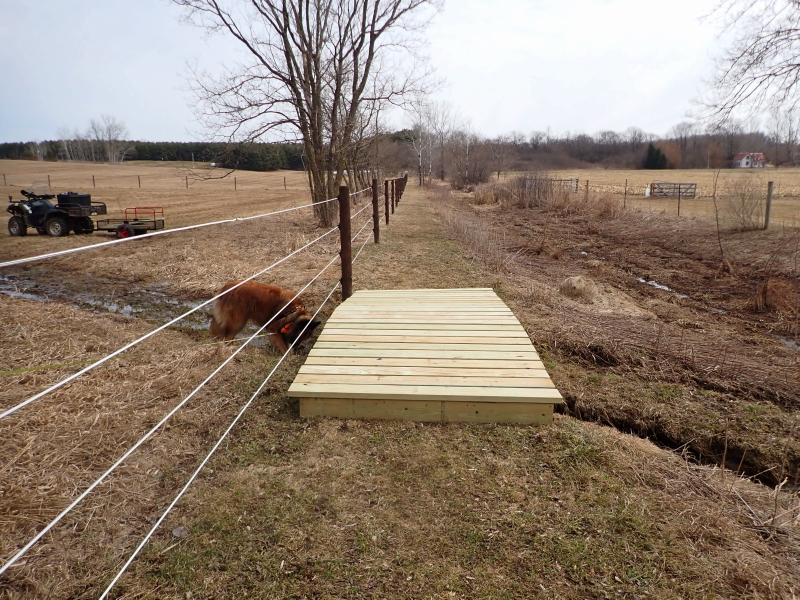
If we get too much water flowing, the whole thing will get pushed out of position. However, if that happens, we will have other flood-related problems to deal with that will make the shifted bridge a minor concern.
I’m going to bank on the likelihood that’s not gonna happen.
.
.
Makin’ Mud
When the snow disappeared from the ground in our hayfield, the ruts from the tractor that had picked up the round bails during winter became clearly visible. Those tire tracks weren’t a concern for me until I could see the drainage swale water was following them instead of flowing straight in the direction we want.
Then I had an “aha moment.”
If the water was following tire tracks, I just needed to make some new tracks.
I decided to try using the ATV. Knowing it wasn’t as heavy as a big tractor, I accepted the chance it might not make the impressions I wanted, but it was safer than bringing out the diesel and getting it stuck in the mud. The surface is already too soft to be in the field with the big tractor.
With the plow blade still on the front, I added cement pavers to the basket on the back for added weight and headed into the field. Back and forth I drove, working to re-establish the track we want the water to follow.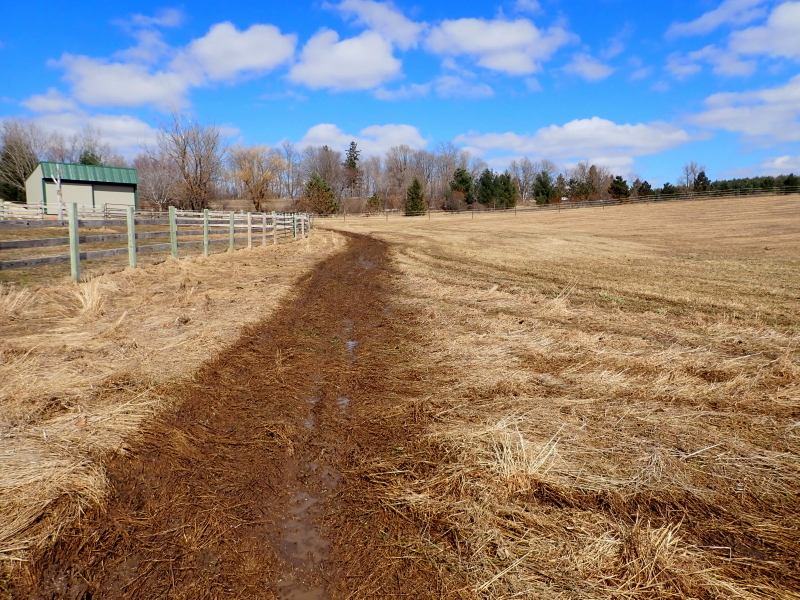
The ATV, plow blade, and I got splattered with mud, even though the path was grass-covered, but I think I succeeded in creating a new preferred route to the curving ruts left by the hay bale tractor.
Now we just wait for the next dose of precipitation to see it work.
.
.
Serious Soaking
First, I want to share an image that I received from Cyndie yesterday morning after she read my post. Exhibit A:
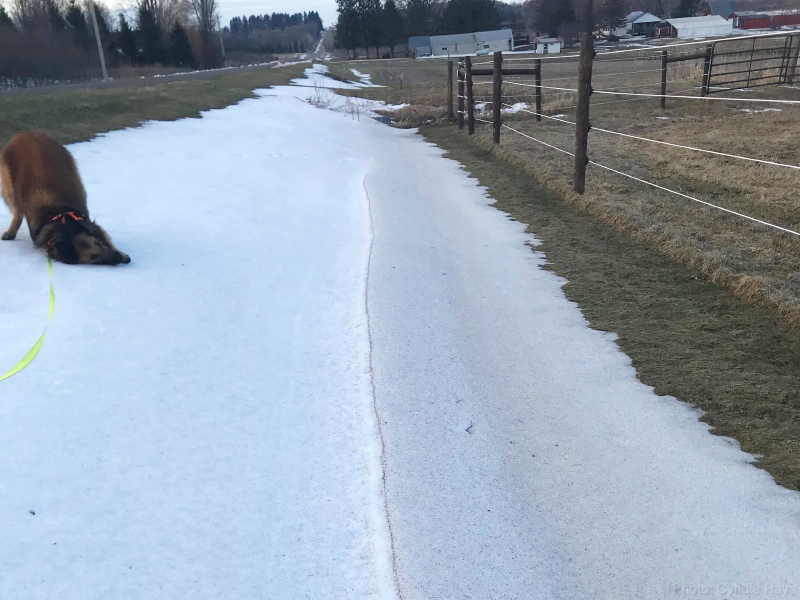
She had forgotten to send it earlier, but my description of how Delilah loves rubbing her snout in the snow reminded her.
Just as I predicted, there is very little snow left now. It was very gloomy all day, and rained throughout, but being mostly chained to my desk, I didn’t really notice how much rain actually fell. All I had to go on for what was happening across the state line at home, was the weather radar.
My main concern was over how the thunder might be upsetting Delilah. I wasn’t sure about what hours she might have the company of Anna, our animal sitter who helps out between classes at University of Wisconsin – River Falls. It’s hard to pinpoint the minutes of big thunder claps booming.
I did find the telltale evidence of a throw rug at the deck door pushed up into a pile, indicative of her usual tizzy of “shouting” down the big bully who is threatening us with all that rumbling noise.
From her location and behavior when I walked in the door, I’m guessing she tired of the stormy weather and took refuge in the one place without windows. She didn’t get up until after I walked in –an uncharacteristic behavior– from the rug in a short hallway between bathroom and bedrooms, where she had obviously been sleeping.
The situation at home turned out to be an anti-climax to the alarming sights I witnessed on my drive after passing through River Falls. The whole way from work was wet, but closer to home there must have been an extreme downpour.
Just south of River Falls, I spotted the first epic flooding, where it was pouring over a side road, making it impassable. A short distance later, I noticed a car turning around on an adjoining County road. As my car moved past the intersection, I saw that a highway crew was trying to deal with a missing lane of asphalt that had washed away.
Five miles from home, I cross what is usually a little meandering stream, but the outlines of the banks were completely indistinguishable beneath what was now a giant flowing lake.
The water flowing in ditches looked like raging rivers. I worried about what I might find at home.
Luckily, although there was an abnormal about of water wherever I looked, the damage was minimal.
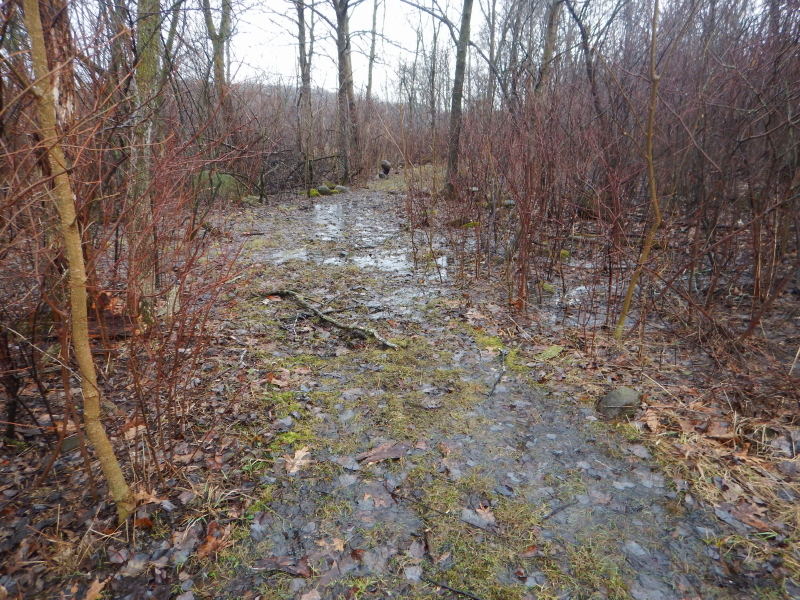

We now have a pretty significant washout on the path around the back pasture. I’m afraid I will need to resort to a bridge over that gully now, if I want to keep mowing that route with the lawn tractor.
It used to be a slight depression that I could drop into and drive up out of, to keep mowing without interruption. Any attempt to repair the gulf with fill, so I could continue to drive over it, would just get washed away with the next heavy rain.
That spot is calling for a load of field rocks, which then leads me to the plan of needing a bridge for the lawn mower.
Our land is in a constant state of change. I think the rate of change is accelerating due to a certain alteration of the global climate.
It’s intimidating.
.
.
Big Changes
Last Sunday, Wintervale declared a “Snow Emergency,” restricting any parking on either side of our driveway until June, but it looks like that will be rescinded very soon. The weather has changed in a big way, from cold and snow, to chilly rain. 
The liquid precipitation yesterday made short work of the snow that had collected on tree branches, instantly changing the landscape views. The woods now have an incongruous appearance with so much snow still on the ground, but the trees all wet and dark.
At this point, the deep snowpack is absorbing the bulk of the water that is falling from the sky, but the situation should get interesting after a couple days of increasingly intense rain.
After the saturation point is reached, the water will start the great migration that ultimately takes it to the Gulf of Mexico. Can you say, “flooding?”
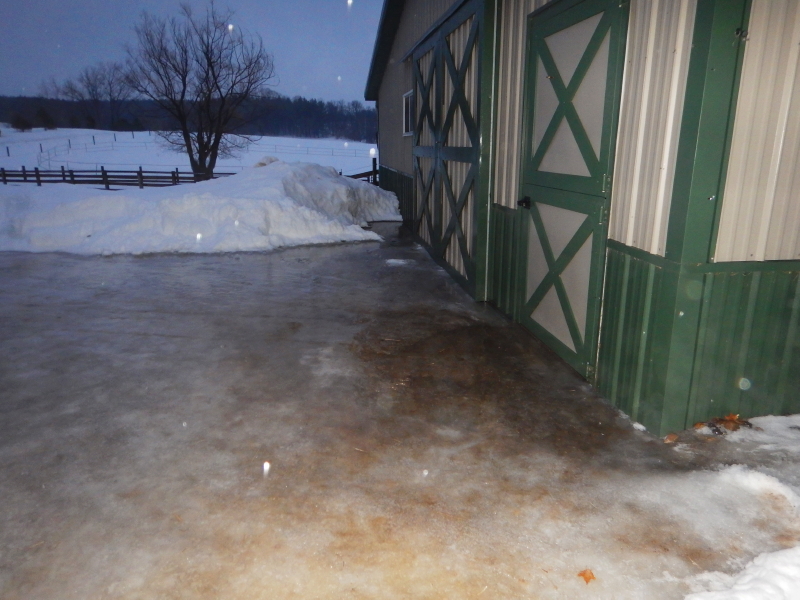 The glacier on the front side of the barn already has a lake forming on top, and the piles of snow on either side look like they aren’t going to offer an outlet any time soon. I may resort to a little creative drainage engineering to avoid the water choosing its own alternative route through the inside of the barn.
Up by the house, on the hill where I boasted about not worrying about flood concerns, I noticed the water running down the gutters wasn’t flowing out the end of the ice-packed downspout.
As a result, it isn’t directed away from the house, finding its way, instead, right where we don’t want it, along the foundation.
That situation shouldn’t last long, but in the land of freeze and thaw, I never like seeing any water pooling where it isn’t welcome.
Funny, how the landscaping which used to slope away from the house in November, takes on a variety of gradients after months of settling, being heaved by frost, and burrowed in by rodent pests. The results are rarely favorable.
Meanwhile, it is refreshing to have this glimpse of the next season making its rapid appearance. It’s WAY too early to expect such luck, but I would be thrilled if don’t have to plow again until next year.
On that note, I should probably make sure the lawn mower blades are sharp and ready to go.
Big changes are underway!
.
.
Snow Wrecker
The worst thing to happen during snow season is a rainstorm. Dry snow is so much better than wet snow. Wet snow becomes slush after a time, and after the day-long rainfall we experienced yesterday, we ended up with nothing but a soupy slush.
The ground is frozen enough below the snow that water won’t soak in. Instead, it pools until the water reaches an outlet to the next lowest spot.
The drainage from the paddocks that flows across the back pasture was running like a river when Delilah and I braved the rain for her mid-day walk.
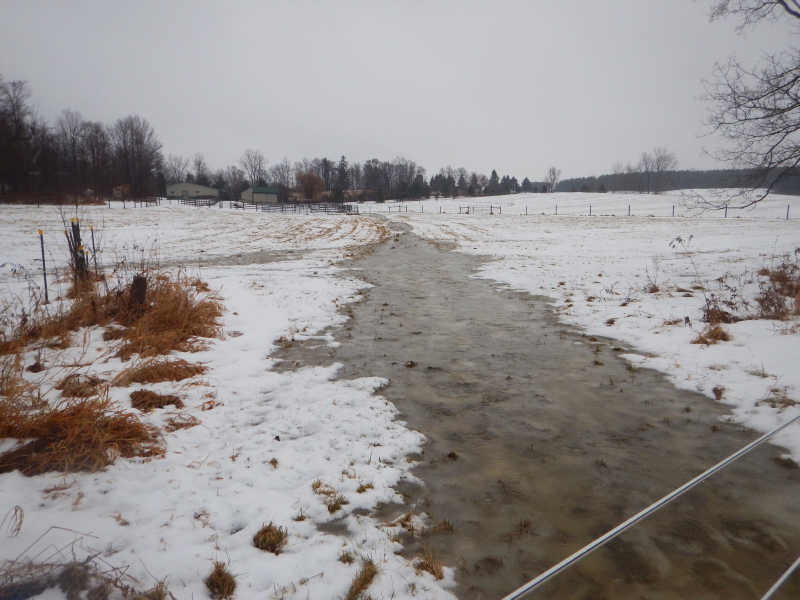
She made it across without much effort, but my big feet were going to make a definite splash. I stopped to gather my courage and plan my maneuver. Delilah busied herself with a face wash while waiting for me to take some pictures.
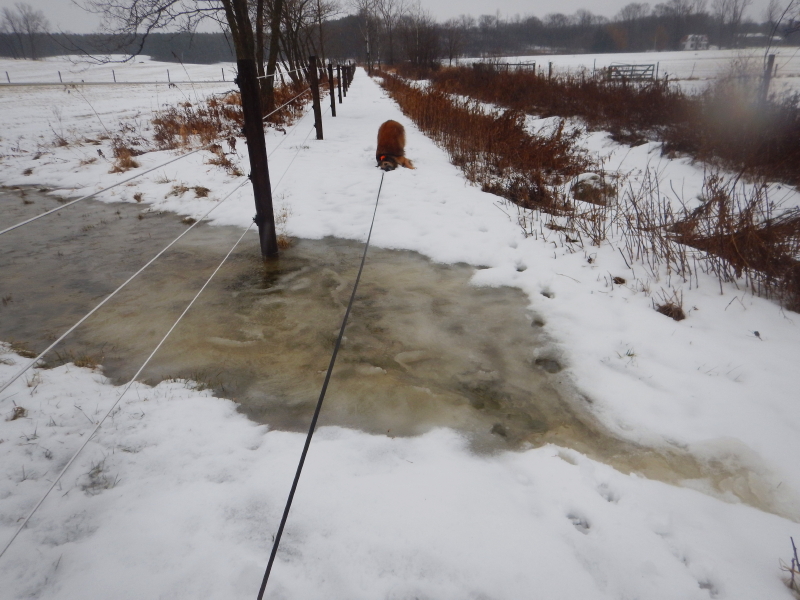
Everything I tried to do was made significantly more complicated by the umbrella I was fumbling to keep over my head.
As we neared the road on this typical trek around the property, I spotted the stump where our mailbox is usually mounted. That meant a snowplow must have roared past and tossed up a blade-full of the slush; a mass that packs more punch than my plastic mailbox can survive.
We found the box portion unceremoniously discarded upside down in the ditch, soaking up rain. Luckily, the plow had blown by before the mail delivery arrived, so there were no drenched bills inside.
Delilah growled at the odd scene as we approached.
I guess I kind of growled, too. Expletives.
The paddocks are a disaster of packed down slush, transformed into a dangerously hard and slippery wet surface against which the horses struggle to maneuver their hefty weight. We didn’t bring them inside overnight Wednesday, despite it ending up being the smarter thing to have done.
I brought them inside last night, with hope they might appreciate it even more, after their previous misery.
Even Pequenita was able to express her opinion about the nasty conditions outside yesterday, even though she is supposed to be an exclusively indoor cat.
Before the rain had totally destroyed the several inches of new snow that had fallen on the deck at the beginning of this weather event, I was preparing to light a fire in the fireplace. I opened the door to grab some kindling from the box out there, without noticing the cat had positioned herself right in front of me.
‘Nita walked outside before I had a chance to corral her.
Two steps into the sloppy snow, she just stopped. It was not a good day for an escape.
Maybe not good for her. Escape is pretty much all I want to do from this weather fiasco.
Rain has no place in our northern snow belt during winter. Bah, humbug!
.
.
Drainage Tweak
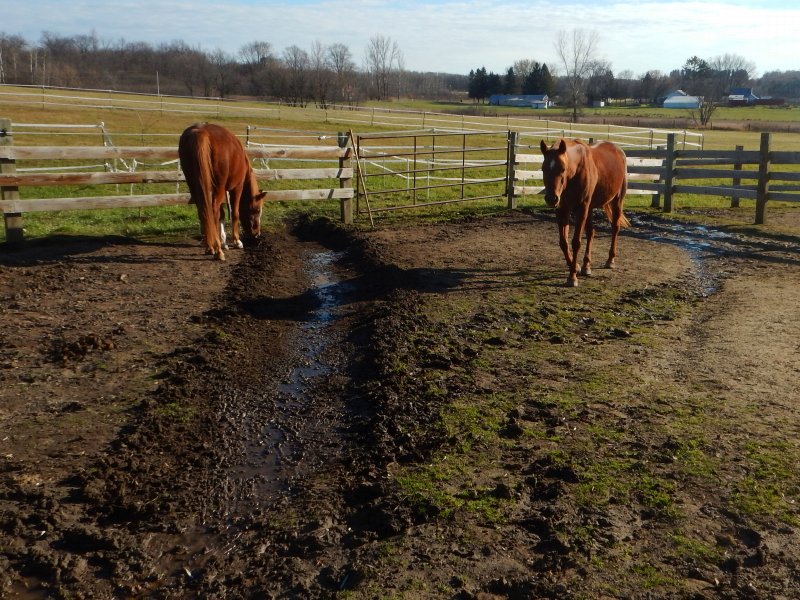 Before all that sloppy snow fell yesterday, I spent some time on Friday refining a drainage path in the paddock. The horses took immediate interest, more so because I was working near a gate they hoped I would open. I had no intention of giving them access to graze in the arena at the time, but they eventually charmed me into allowing it.
Unfortunately, Cayenne violated my trust and stepped through the web fence out there and spoiled it for everyone.
I had to stop what I was doing to go into the barn for a halter and then march out after her in order to walk her back into the paddock.
I was not happy about the interruption.
We have not had much luck keeping a path open to drain that side of the paddock because the perpetually wet soil there is constantly disrupted by hoof prints in the mud. I’m trying to create a wider swale with a lip on each side, knowing that it will still require repeated maintenance to prevent hoof traffic from plugging it up.
In the long run, I’m hoping to shape the lay of the land enough that their normal activity doesn’t interfere with the way it drains. Water will always flow down the easiest route available.
Meanwhile, I’m wondering if the initiative shown by Cayenne to venture astray on Friday has any relation to the behavior I noticed yesterday under the overhang. Is she taking on a leadership role in the 3-horse herd?
Look how they lined up behind her to wait until she was done eating.
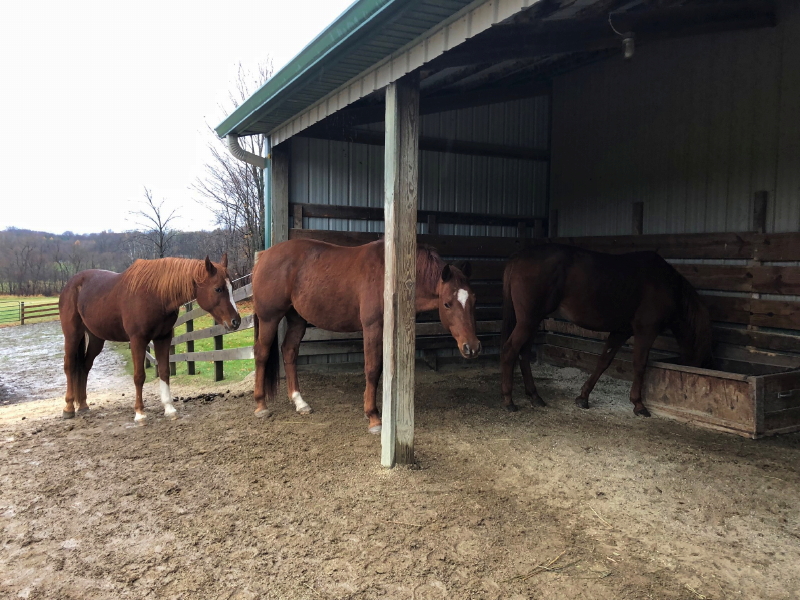
Gives the impression she is the one in charge. Time will tell whether this settles into a new normal among the three of them.
.
.
Triple Fenced
The heat and humidity have broken and it finally feels a little more like September now. We were expecting the transition to involve a lot more rain than showed up yesterday. The line of precipitation slowly moving west is doing so at an angle that is sliding from the southwest to the northeast and for some reason, most of the rain moved around, rather than over our region.
Ironically, now I am wishing we would actually receive a heavy dose of rain, because last Friday we put a lot of energy into shoring up the silt fence at the property line adjacent to our neighbor’s corn field. In fact, we turned it into a bit of a terrace with three-tiered layers of silt fence.
The first two are short sections to slow the flow before it reaches our long fence. Between the top two sections there is the skeleton frame for a berm, in the form of piled dead pine trees. The soil runoff will accumulate around the branches and hold them in place. Eventually, weeds and grasses will grow through the branches and that forms a nice natural barrier that will hold soil in place but allow water to flow.
We have added support to the fabric fence by using old hay bales that we can’t feed to the horses because they have gotten moldy.
If I am able, I hope to trek out there in the middle of heavy rain to observe the action as it happens. At the very least, I now know that we need to check it after every big rainfall and remove excess soil if it accumulates.
I don’t know why I originally assumed the soil fence wouldn’t need regular maintenance, but after the soil conservation consultant pointed it out so very matter-of-factly, digging out accumulation makes total sense to me now.
If our enhancements work to mitigate the mud overflow messing up that area, we will be one step closer to being able to enjoy a good cloudburst when it happens. There still remains a problem in the paddocks, where a terrace or silt fence is not an option.
We plan to do some digging to create a couple of better defined routes directing runoff straight to the drainage swale beyond the wood fence, hoping to reduce the amount of flow traveling to one spot with energy that washes away our precious lime screenings and creates a deep canyon of a rill.
It’s fine if a little flow goes that way, but it is currently a problem because most all of the flow is combining to rush sideways along the fence, instead of straight under it out of the paddock.
The trick in the paddocks is, our solution needs to be horse-proof. Their heavy hooves have a way of disrupting all of the simple spade-width channels I’ve created in the past, causing runoff to flow every which way, and ultimately not where we really want it to go.
The next version we have in mind will be scaled up. Maybe I should triple-size it.
.
.


 Relative Something