Posts Tagged ‘composted manure’
Interrelated Accomplishments
One thing conveniently led to the next in the series of projects we chose to take on in yesterday’s unseasonable heat. While we had been working in the woods the day before, Cyndie discovered a spot that looked promising for digging up more rocks for use in the labyrinth. There remained a surprising number of plaster fake rocks defining the pathway that we have always intended to replace when we find suitable real rocks.
I can no longer recall how many of these faux stones were left behind by the sellers of our property because it’s been so long since we used them all up in the labyrinth. Since we started reclaiming them again and storing them on a pallet, we’ve reached roughly five layers of the plaster half-rocks now being stored in the hay shed. That is more than enough to keep in reserve for replacing ones that fall from the veneer of supposed field rock plastered around the foundation of our log home and the shop garage.
Yesterday’s rock exchange in the labyrinth resulted in a wheelbarrow full of the faux stones which I needed to purge. Convincing myself that we didn’t need to store any more fake rocks, I came up with a good use for them. I dumped them on the corner where our loop around the hay shed meets the new pavement of the driveway.
I have been working to build up the corner to support the lagging trailer wheels that follow off-track in a turn onto the narrow driveway. After adding rock to the shoulder of that corner, I have been covering it with composted manure, our most available natural fill.

 .
.
.
.
.
.
.
.
.
Our great need for fill along the driveway is conveniently coinciding with my goal of clearing out space in the compost area to make room for the coming winter.
So, to review:
- We replaced faux stones that were temporarily used in the labyrinth.
- I was able to use the faux stones as fill for building up the turn from the hay shed loop to the driveway pavement.
- I’m using composted manure to cover the added material along that turn.
- Using that compost helps to clear out space for winter collection of new manure and possibly bedding from the barn stalls.
It is wonderfully satisfying to be making these improvements and having our efforts pay off in advancing other projects concurrently underway. It feels like we are getting two rewards for one effort, multiple times!
.
.
Two Soils
It’s a tale of two soils at Cyndie’s new garden plot. First, she turned over the turf, then she used a garden spade fork to break up the soil. In so doing, the clay content of that slope became very clear. Cyndie started tossing aside the clay clumps that were coming up in solid blocks.

Look at the difference in color of the dirt she tossed over the end compared to the composted manure soil we brought in yesterday from two different places where it’s been stored on our property for a few years.
I’m not really sure why it even matters. The grass was growing like gangbusters in that clay soil before we dug it all up.
Now, if the overnight temperatures would stop dipping down below freezing, that would be just great. Maybe she could start growing vegetables in that black gold.
.
.
Well Supervised
When the rain finally moved beyond our location yesterday, I headed out with the intention of spreading the rest of our composted manure.
Since the horses were in their stalls overnight Friday, we now have several wheelbarrows-full of soiled wood shavings to be removed, and need to have the space to dump them.
Cyndie needed to make a run to the drug store, so I took Delilah with me and meandered toward the barn. The piles of compost looked a little wet, so I decided to delay digging into them and turned my attention to the uninvited sprouting trees that show up in the hay-field.
What transpired next is something that I wish could be experienced by everyone who comes to Wintervale to see our horses. Delilah and I entered the paddock through one of the gates, clanking the chain on the metal in the process, which inevitably draws the attention of the herd.
I had no intention of disrupting the herd from whatever was occupying their attention at the time, as I was focused on seeking out the sprouting trees. Delilah and I walked out into the hay-field where I released her to roam and then set about my task.
Slowly, almost imperceptibly, the horses made their way over, in the process of their grazing. Hunter led the way, eventually becoming the most obvious. It took probably around 15 minutes, maybe more, of me ignoring them while focused on my project, for them to close the distance and make their intention transparent.
They wanted to be with me, to check on what I was doing, to engage with my presence.
It’s an amazing thing to experience. Four horses grazing peacefully, but purposefully in your proximity. Occasionally, one will break from eating and step right up to smell me, share an exchange of breath, and invite me to scratch them.
It is a slow process that happens silently and takes both time, and lack of expectation on my part. That is the primary reason it is so difficult to make happen on demand when visitors stop by. It is a priceless experience.
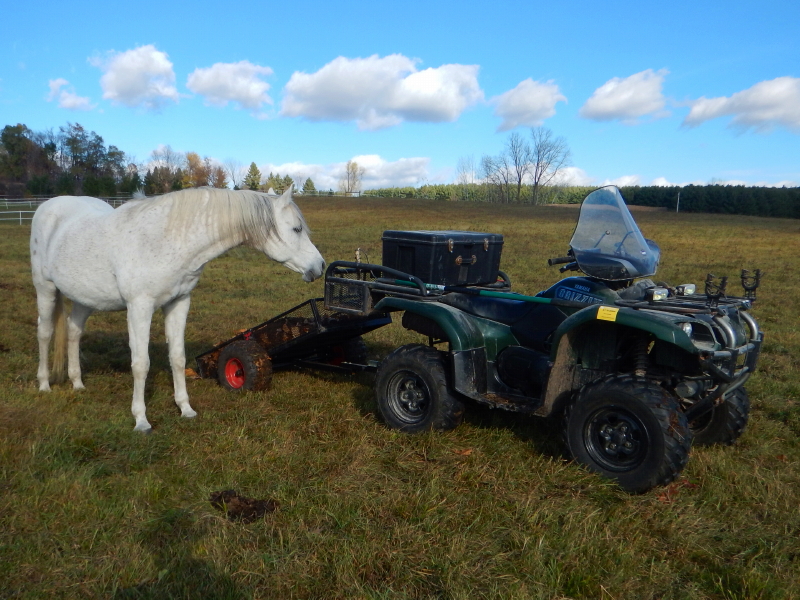
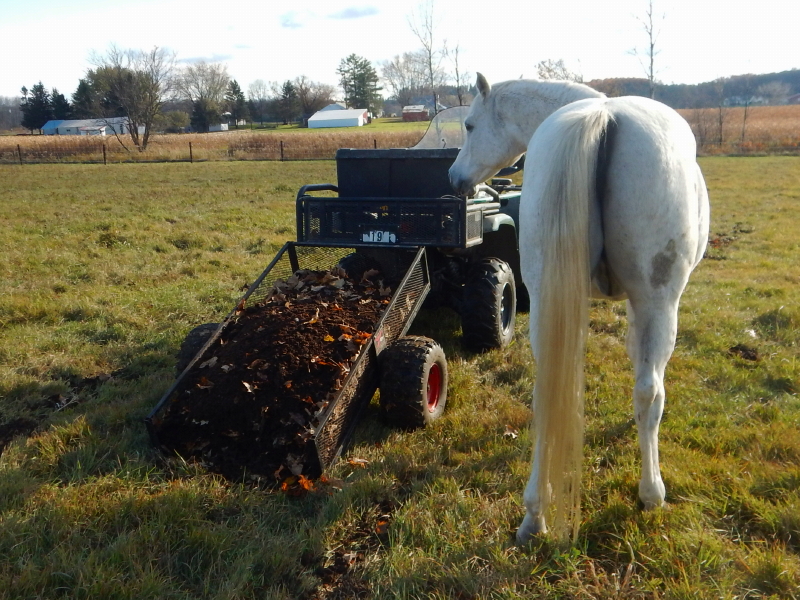
After I had dispatched all the volunteer sprouts, I turned my attention to spreading the compost. This time I remembered to pause to take pictures of the ATV and tipped trailer ready to go in the field. As soon as I stopped, Legacy stepped up to inspect my activity.
.
.
.
.
.
.
.
.
.
.
.
.
.
.
.
.
Spreading Manure
 After I finished cutting up the fallen tree, I talked Cyndie into helping me see if we could spread our composted manure on the hay-field by way of our ATV trailer. It occurred to me that I had moved similar amounts with this trailer when previously using manure for fill around our property. The only difference would be spreading it thinly over a wide area, as opposed to dumping it all in one place.
We tried a couple methods of unloading the trailer, but they were a bit cumbersome. I tried pitching forkfuls to and fro. We took turns trying to drive slowly while the other person used a rake to pull manure off the trailer.
It was getting the job done, but it felt like we were working harder than the mediocre results warranted.
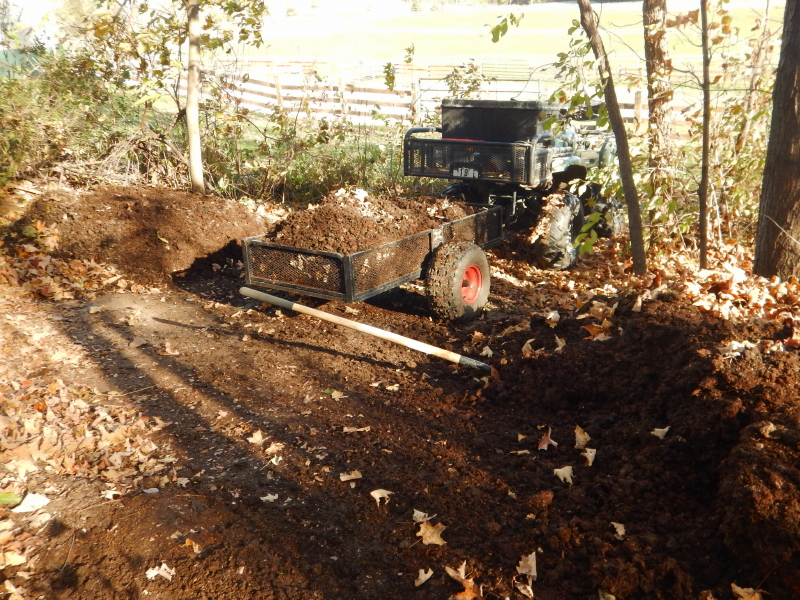 On my third trip back to the hay-field with a trailer full, it struck me that I could simply remove the tailgate and drive fast enough to bounce most of the contents out. I figured doing so would spread it thinner than we were achieving by hand. What’d I have to lose?
It still wasn’t very precise distribution, but I was definitely able to lose the entire contents of the trailer, simply by driving wildly around the field. It was less work, so we deemed it an acceptable method.
I was thinking that I should have Cyndie take my picture while I caromed past her with the trailer tilted back and manure spilling out, but she headed in before we had that chance.
As I was taking the picture of the filled trailer, I decided I could stop out in the field after dumping half the load and at least snap a picture of the ATV and tipped trailer, but then completely forgot about the plan while bouncing the Grizzly and trailer over the rough terrain of the field.
There’ll be another chance for that shot. We probably got about half way through the amount that is available to spread yesterday. I would like to get the rest of the composted manure cleared out so that we will have the maximum available space open for the winter season.
We end up with a lot more material when the horses spend nights in the barn during wet or extreme cold nights of winter. Also, the composting slows down a bit, and it is hard to keep turning it when it gets buried with snow. The end result: we store more “product,” and therefore need all the space that we’ve set aside for this purpose.
.
.
.
.
.
.
.
.
.
.
Prototype Blend
Between the thundering copious downpours yesterday —which by this morning have dropped a 24-hour accumulated total of 5 inches of rain on us— I began production of our first prototype mix of custom horse-manure-fertilized growing soil. It was an extension of my working on the rock pile we received from a neighboring farm field last spring.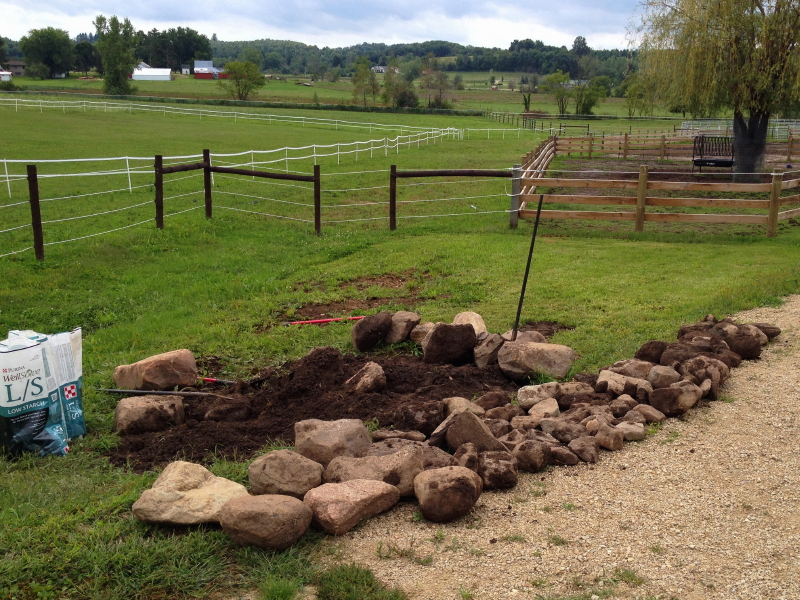
That dump-truck-load of field rocks included a significant amount of dirt that surrounded and buried a lot of the stone. Slowly, but surely, this summer I have been prying out rocks and moving them down near our Rowcliffe Labyrinth Garden. As I am getting closer to the bottom of that pile, it is becoming more dirt than rocks. I decided to shovel that rich field-dirt into bags for future distribution, and in so doing realized the opportunity to mix in some composted manure to create our first dose of Wintervale old souls super soil.
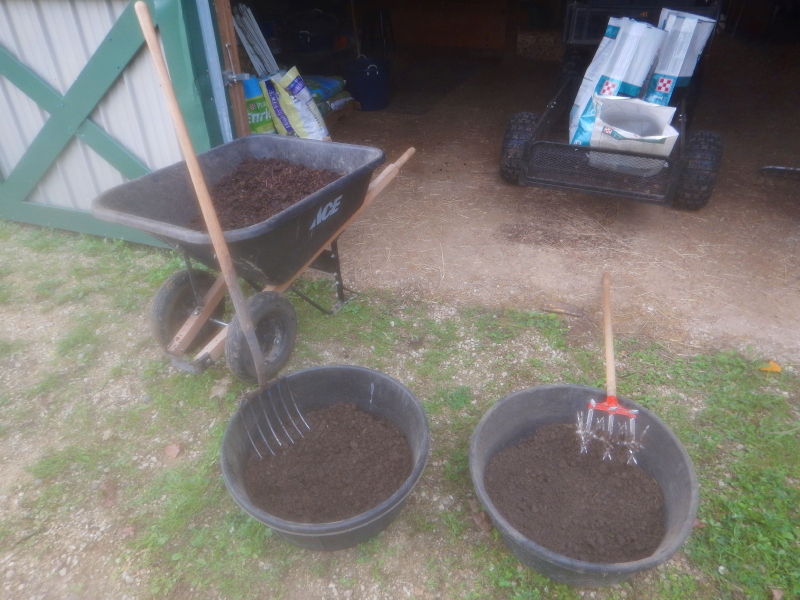 It’s kind of like harvesting our first crop! There is a different reward to mixing the composted manure with dirt, as opposed to just using it to fill low spots around our property.
This will be a long-term process, as I won’t really know how successful my concoction is until a season of growing passes and I can learn the results from growers who receive our initial distribution.
Not that I have any real doubts about the potential. I have seen how robust the volunteer growth was that sprouted out of this rock pile all summer, and I have ample evidence of the accelerated growth around all the places I have used composted manure for fill.
Together, I expect they will produce even greater results.
.
.
.
.
.
.
.
.
.


 Relative Something