Archive for the ‘Chronicle’ Category
What Happens
How many roles do we juggle in living our days? I have been grumbling a lot lately that rehabilitating a hamstring muscle injury could easily be a full time job. What I wish I had available to help me return to previous levels of athletic activity is entire days to stretch, exercise, stretch, strengthen, stretch, receive therapeutic sports massage and also appropriately rest; not only for my ailing leg, but the healthy one, too, ultimately hoping to recover with some semblance of balance. It ain’t gonna happen.
The other morning, while I was too-hurriedly trying to inhale my breakfast while standing, in order to make up for time spent sleeping-in a little bit to give my liver every possible chance to accomplish its overnight recovery (since I got to bed late after working long hours on overhauling my bicycle the day before) I gazed out at the landscape around our house. Just last week, everything was finally released from the grip of the long winter’s snow, and I was struck by the amount of attention it all now deserved. For the most part, our landscape gets left to fend for itself until one sunny weekend day when Cyndie and I will labor intensively to do what we can to influence some control toward appearances of order and intent. I mourn the fact that what we are able to accomplish is limited by having arrived at the tasks later than each chore deserved. Much of what we deal with could be refined by timely pruning or culling in advance, which would allow us to focus more on helping support the things we actually want growing and less on fighting back undesirables. It ain’t gonna happen.
The list of other areas of interest and/or responsibility that suffer similar limitations is long. The majority of them would be much better served given full-time attention.
As I was lingering (longer than the task realistically deserved) with cleaning the greasy sludge that persisted in sticking to my bicycle chain the other day, it occurred to me how this very situation reflects a common quandary I find myself facing. I have started in on the cleaning, and then believe it worthy to complete the task to the extreme, yet have not really prepared in advance to be as effective as my noble intentions now expect. I end up spending a lot of time toiling with improvised methods. The thing is, I enjoy that level of tedium. It becomes somewhat meditative. It has a component that I liken to my pleasure for assembling a jigsaw puzzle.
Unfortunately, one big problem with operating this way is that it runs right in the face of my inability to commit full-time to my projects. A lot more things linger unfinished than ever get entirely accomplished in my world.
There’s a thread in all that which is integrated with the depression I have experienced. My decisions and choices set up the situations and in that way I contribute to being my own worst enemy. My mental exercises to alter the dysfunctional process have revealed the power to change things for the better. But when I grow weary, and when I lose one of my supporting activities, it is surprising how quick I can revert to the sickly comfortable patterns of depressive feelings, behaviors, and when it really gets away from me, depressive thinking patterns.
Yesterday morning I heard the familiar lyrics of a song that John Prine wrote and Bonnie Raitt recorded for a hit, “Angel from Montgomery”
How the hell can a person
go to work in the morning
and come home in the evening
and have nothing to say
Unfortunately, I know all too well how.
A New Day
It doesn’t feel any different to me today. But it is Spring and they passed the Health Care bill. I won’t fret either of them for a while. Spring will taunt with warm days and then dump snow on us. The new Health Care laws will offer solutions to some, opportunities for others and provide plenty of angst for those who are in opposition of anything related to it. Mostly, I think it angers people who did not want to see the current President succeed at anything. In all things, there is both good and bad. For every rule, there will be an exception.
Just yesterday, my lovely wife was more than happy to point out one of my socks she found in the laundry that was rolled up in a ball. This being not long after I had clued her in that I was able to tell when she was stealing my socks for her own use because they turned up in the laundry all rolled up in a ball after she took them off. I don’t do that. I pull them off by the toe so they get a decent washing and drying. If there are rolled socks in the clean laundry, she has been wearing them. And how clean can they actually be at that point, anyway?
No sooner do I point out to her that I don’t do something a certain way, there appears evidence to the contrary. Maybe I should tell her that I don’t ever play hooky from work. It would be for the good of science, to test a theory. Of course, it might be best to wait until a time when I’m not about to take an entire week off for vacation. It will be best that I get an entire 5-days of work in since next week Cyndie and I will be in sunny (I hope) Florida to visit her parents. I’m sure we’ll find plenty of opportunities there to test my theory that for everything I can claim, there will quickly appear exceptions to humble me.
Just like opposites that attract, the more I learn, the less I know. You know?
Happy healthy Spring!
Minutiae
A cold Saturday morning dawns clear blue and all sunshine with little regard for the strange dream about that yellow 747 commercial airliner on the ground on Pioneer Trail across from the Flying Cloud baseball fields and the back-up of traffic as investigators moved the population of gawkers lined up, toward rows of banquet tables based on alphabetical order of their last names.
I can’t help thinking such craziness may have been caused by the small setback in hamstring rehabilitation that occurred as I tried dipping my toes in a little floor hockey action last Wednesday evening. I sensed that I wasn’t up to the ability of participation at full speed, but it caused no pain to run at something of a jog. Then, without warning, Ouch!, there it goes again. Tried too hard, too soon, and I’m back to ice and ibuprofen treatments and just that much farther from being my old active self. Frustrating, I tell ya. Like a weird dream with fragments of familiarity sprinkled about.
It is funny how quickly the change occurs from having us comfortable with temps in the 30’s when that first big melt commences to having that same temperature seem so uncomfortably cold after a couple weeks in the 40’s, 50’s and those two days of almost too hot 6o’s in March. Today is sunny, but too cold. Today I don’t have to work, but I can’t do anything athletically strenuous.
Yahoo! I can watch the March Madness tournament and root around in Ancestry.com nooks and crannies. I am just several last names short of being able to present our children with the 32 great, great, great grandparents who contributed to them through us. One striking revelation in just the surnames alone is that their mother provided a lot of Scandinavian lineage and I appear to have mostly English names of folks born in the eastern US and Canada. Both of us share enough Irish to fully warrant wearin’ o’ the green on St. Patties Day, even though I mostly don’t bother.
Of course, for the purposes of the US Census, none of that matters. We are White, you know.
Brrr.
Abundance Awareness
I watched the movie Hurt Locker a couple of nights ago. Among the many scenes that pack a punch, there was one in particular, completely removed from the military battle zones, that really made an impression. In an attempt to avoid spoiling the movie for anyone reading who hasn’t seen it yet, I’ll make reference to a generic situation that happens all the time for combat soldiers. Those that survive and return home find their old life so entirely out of context it is near impossible to function.
Anyone returning from an extended absence, especially if they have been living in a foreign culture, will recognize a mild version of that same feeling of alienation from what was once the comfort of home. I can’t imagine how a soldier is able to accomplish returning from living a life of combat terror in a bleak and primitive setting, to the comforts of frivolous overindulgence found in our society. I’ve struggled with returning from simple camping trips from time to time. It is interesting that what were once the “comforts of home” can conversely appear as undesirable, or even to the extreme of being objectionable.
What is maybe even more fascinating to me, in the long run, is how I have pretty much always found that the disdain for the excesses that come across as annoying, fades away under the relentless onslaught of the return to a daily routine. All too soon I have re-acclimated myself to a state of dull obliviousness for the overabundance of self-indulgences present in our convenient lives. The contempt never lasts. However, if I found myself suddenly in the company of someone suffering a life of scarcity, I would quickly become aware again of the embarrassment of riches we tend to take for granted.
I guess it is kind of like that frog in a pan of water being heated. If you throw him in when it is already hot, he jumps right back out. If you put him in when it is cool and heat it over time, he adjusts and stays in even after it becomes too hot. When everyone I find myself surrounded by tends to take our lifestyle for granted, I tend to fall into a similar pattern.
Census Love
 .
.
.
s a genealogist, I find that I have a great love for census records. More than any other resource (birth, death, and marriage records, do provide plenty of hard data) I prefer the census for the picture it can paint. Or, more precisely, the picture that a series of decade’s census records can paint.
There is actually a limited period of time for which this works best. If you get too far back, say, into the early 1800’s, the information is less complete. You might only get the name of the head of household and a tally of how many free white males of a range of age groups, then free white females, and lastly, slaves. I get to overlook my disgust for the slave category because for the geographic areas I have been researching, either people were too ashamed to report such or they didn’t keep any, because I have yet to see any entries listed under that column. Race discrimination, demonstrated by holding whiteness specifically worthy of counting, above all other humanity, is as blatant as can be, right from the very start. But that is straying back to yesterday’s topic and away from what I had in mind for today, and it totally interrupted my point…
If we look too recent, we don’t find anything later than 1930, because individual information is kept confidential for 72 years by Federal law. In a couple more years, we will finally have access to the details of the 1940 census. Inbetween the early, rudimentary records of the early 1800’s, and the most recent available data of 1930, there is an opportunity to uncover some amazing portraits. Records reveal people growing up in households filled with siblings and hired help, children mature and leave home, and frequently, elderly parents end up living with their kid’s families. It is so great to pull up a record in hopes of attaching it to someone I am researching, and then discovering the familiar names of brothers and sisters listed in the household results.
It is also exciting to view the records for people of the houses nearby, sometimes on the same page, or maybe 1 or 2 pages either direction, to discover relatives by marriage. They often really did marry that girl/guy next door. I have seen people counted as children, and then by the next census, they are married to a neighbor. I like watching the parents age, 10 years at a time, and seeing the number of children grow. Then the older kids disappear, sometimes even as new young siblings continue to be added. Some folks had a heck of a lot of kids, back in the day. Occasionally, parents might be found living alone in their 70’s or 80’s. After all those kids, I can’t say that I blame them.
It seems like people didn’t count so well, because it appears rare that folks actually aged 10 years between decades. That level of detail can matter a lot when you’re trying to make a solid confirmation a couple of hundred years later.
I hardly need to point out how that silly habit of naming children the same as a parent is a nasty hassle for researchers. I never can be sure if, when the numbers seem off, it is because it is actually a different generation person by the same name, or if someone erred on reporting the age of the person I am seeking.
If you are reading here today, I encourage you to do all those future ancestry hunters out there a big favor by thoroughly and accurately filling out your census forms, and doing so promptly. But if you want to mess with those researchers a bit, fudging your actual age is too obvious. How about under the question for race, you select, “Other” and write in Oak or Pine or Maple.
Those Who Make Rules
And you thought I was worked up yesterday! Last evening I found the census form had arrived in the mail and made sure to pull it from the abyss of untended household piles and opened it up to be filled out right away. More and more in the 5th and 6th decades of life I am finding myself uncomfortable being counted as a member of a larger group that includes vocal members whose beliefs and behaviors I find offensive. Sometimes it is as extreme as the group called human beings. We are all human, but the behaviors of some can be so despicable that I find myself preferring something from the animal kingdom. There are even a few versions of tree that would suit me more.
I have also found discomfort with being grouped in categories for spiritual belief and for being male. Now the census has me feeling distinctly uncomfortable declaring my race as white. When they can claim that for the purposes of this census, hispanic or latino is not a race, and then on the following question ask what race a person is, it seems to me to reveal how ridiculously made up the social construct of race really is. Maybe it’s a way to manipulate statistics to the number of non-white races so they won’t officially outnumber the white population in the eyes of those with the power of making the rules.
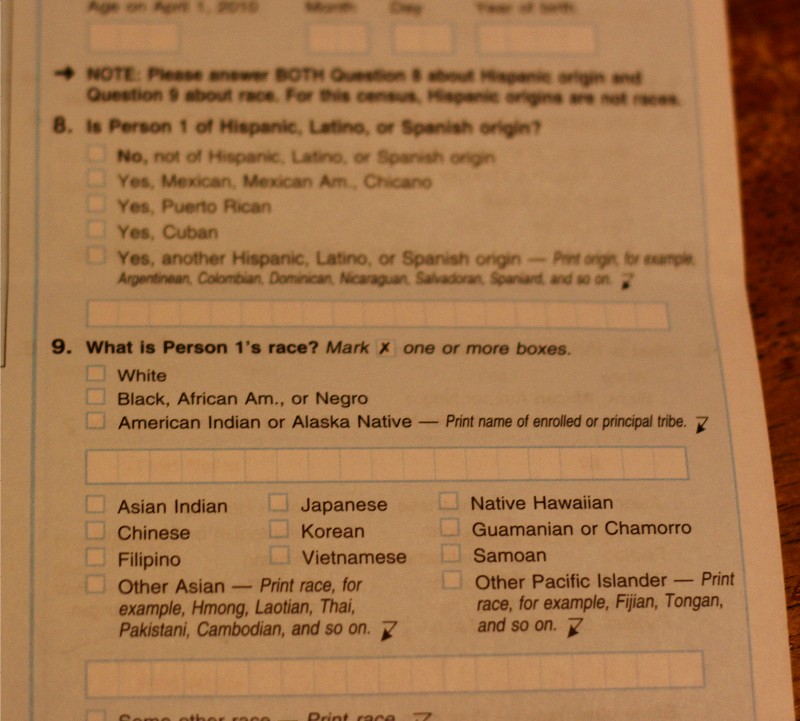 Since race is defined by law, the definition can be changed to suit whatever purposes are desired. What percentage of African heritage would define me as “black”? Is it the same percentage of Anglo heritage would define an Africa American person as “white”? The history of the American legal system would reveal that it hasn’t been a balanced formula. If the court was petitioned by an individual desiring to be classified as “white,” the definition was allowed to be morphed to continue to exclude whomever those in power chose, and white people were always the ones in power.
Logic would have it that the collection of racial data is justified, and for righteous reasons. How can we help people of non-white races if we don’t know how many people that is and where they are located? One example of the folly of that logic is the results achieved by affirmative action to level the playing field for women and people of color seeking employment. It hasn’t equitably increased the number of people of color getting hired. There was some increase in white women entering the workforce, but they have yet to earn equal pay.
I posit that there is no need to even ask the question about identity of race. It is unnecessary. You don’t need to ask. We are all members of the human race and have the same needs for food, shelter, transportation, education, and health care. Count us, and then serve the public.
I don’t like the simple fact that there is a comparison between white and non-white races. The distinction is racist in the first place. It is all so stupid. I’d rather be a tree.
Fan Frustrations
As many distractions as I mustered to keep from solely focusing on sports outcomes yesterday, the negative vibes of witnessing the abuse that referees allowed to continually occur in last night’s hockey game between Minnesota and North Dakota left me stewing. It’s too bad, given I had a great start to the sunny, warm March day, taking a long, brisk walk with Cyndie that worked wonders to stretch out the ol’ hamstring and lift my spirits. Plus, there’s that news which broke about an hour before the hockey game had even started that the basketball team is in this year’s NCAA Tournament! Such a shame that all that good potential got lost in the angst of my suffering the malicious intentions displayed that seem to have a history of occurring in games I’ve witnessed involving the Dave Hakstol coached UND Souix. It frustrates me to the extreme.
I truly love the game of hockey, but I have never understood the culture of allowance for post-whistle chippy activity that permeates the sport at most all levels. That fighting is still woven into the NHL and other professional leagues is mind boggling enough, but then the game barely looks any different in the levels below where fighting is supposedly not allowed. It starts with checks that would earn unsportsmanlike penalties in most other sports, and includes post-whistle punches, stick hacks, and passive aggressive intentional contact that deftly provokes under a guise of innocence. Nine times out of ten, the officials just skate in and separate all the players, as if that will end it. Ridiculous.
I dream of someday watching a game where every time a player smacks a stick or pushes their glove into a player’s face mask after the whistle has blown, they get sent to the penalty box without hesitation. I’m pretty sure they would get the message real quick. Imagine what the game could be like if they had to channel all that miscreant behavior into actual skating, passing and shooting the puck.
A fan can dream, can’t he?
Time Shifting
Big deal, move the clocks. I’m not a fan of shifting the clocks, but it’s not so significant to me that it causes me to have health problems. I saw one report that indicated an increase in heart attacks in the three days following changing the clocks. This morning was dictated to be the time for moving the clocks ahead one hour to Daylight Saving Time. Imagine dying from this time change. Wow. That’s extreme.
I would expect more heart attacks this time of year to come from trying to follow your hockey team or your basketball team in the post-season tournaments. I join my good friend, Rhonda, in having a weakness for the drama of Minnesota Gopher basketball games. Even as much as we love the team and the sport, it’s hard to endure the rough parts of their performance. They made it easy on us yesterday, (although past experience as a fan leaves one weary that any lead can be lost) as they overwhelmingly dominated Purdue to advance to the championship game of the Big 10 tournament today. This is the first time in the history of the event, which began in 1998, that Minnesota has made it to the championship game.
The Gopher hockey team squeaked out a victory last night against North Dakota to force a third and deciding game today in their playoff for access to the Final Five of the WCHA tournament. So, today I run a much higher risk of succumbing to anxiety as a local college sports fan than from the adjustment of the clock.
At least there will be more sunlight later in the day to console me if the sports outcomes are dreary for me.
Just move the clocks, and suddenly there is more sunlight in the day! It’s a miracle!
Humans. Aren’t we just so silly?
For Friday
Fun for Friday. First, find four faces from forever for fresh friendship flavored familiarity. Freely flail five flexed fingers feigning frightful fits filled full from fluttering fanaticism. Fraternize freely foisted floundering fists fixed fruitfully following flowing flowers from fall festivals forever.
Forget it.
Have you ever noticed how letters and numbers can hold the impression of a specific color in your mind? For me, the letter F looks like this:

After spending many adult hours looking at blocks and magnetic boards of letters and numbers with my infant children as we exercised their amazing minds to learn, it struck me why it would be logical to picture these as associated with a certain color. I have taken a few informal polls to learn the variety of color associations friends have for letters and numbers. I’m of a mind that with enough research we could probably identify which kids played with the same devices in their formative years based on their color associations.
However, there are a few situations that complicate it. New things come along to disrupt our initial associations. One in particular that impacted me was a fascination I developed later in my childhood with color-by-number drawings. That re-oriented my color/number associations, for sure.
If you think about it, one of the most significant things to mess with our early impressions developed of colors of letters must be learning to read books. Every dang letter suddenly becomes black. Just plain black. Isn’t that just packed full of symbolism for a variety of situations related to moving from the colors of our innocence to the structure of life as an adult?
First Impression Lesson
When is a chair, not a chair? I know one way. When the chair is actually a band of fabric that supports a person’s lower back by way of straps looped around the knees. It helps you sit upright when you don’t have a chair to lean back against. Many years ago, Cyndie and I discovered just this kind of ingenious concept that presents itself with a distinctly persuasive first impression. It ultimately taught us a lesson that we refer to over and over again. When something similar pops up in our lives, it always gets credited by applying the moniker of that first band of fabric and loops.
Ingeniously marketed at places like a state fair, this device caught our attention after we’d been walking for hours at the Great Minnesota Get-Together. Little did we think about at the time, just sitting down would feel wonderful. Then we strapped on the device that supports the lower back and, Shazam!, they had a sale. We bought two. It was so simple and felt so great, it was a deal at twice the price.
Then we actually used the device. When you aren’t fatigued from having been on your feet for hours on end, some of the magic goes away. Any duration of more than about ten minutes use led to discomfort of the knees that the straps wrap around. In the end, we realized we had fallen for the ultimate sales pitch. It was a great lesson. One we have revisited many times since.
I could hope that sharing our little lesson like this would provide benefit to others, but it doesn’t seem to work like that. I think you need to experience these lessons yourself to get the lasting impact. However, maybe now that you’ve read our story, if something like this does happen to you, your lesson will resonate with a bit more familiarity.
Things just might not be as good as they seem. Simple, huh? Makes me wonder how people ever fall for becoming victims of a ponzi scheme.


