Wicked Cold
One hard part about surviving a bitterly cold winter night is when the following day and night offer no relief. In fact, the second night proves to be even more harsh. Ouch. It would be great if we could just hunker down inside beside a warm, glowing fireplace during extremes such as -20°F with crazy windchill numbers making it feel much, much colder.
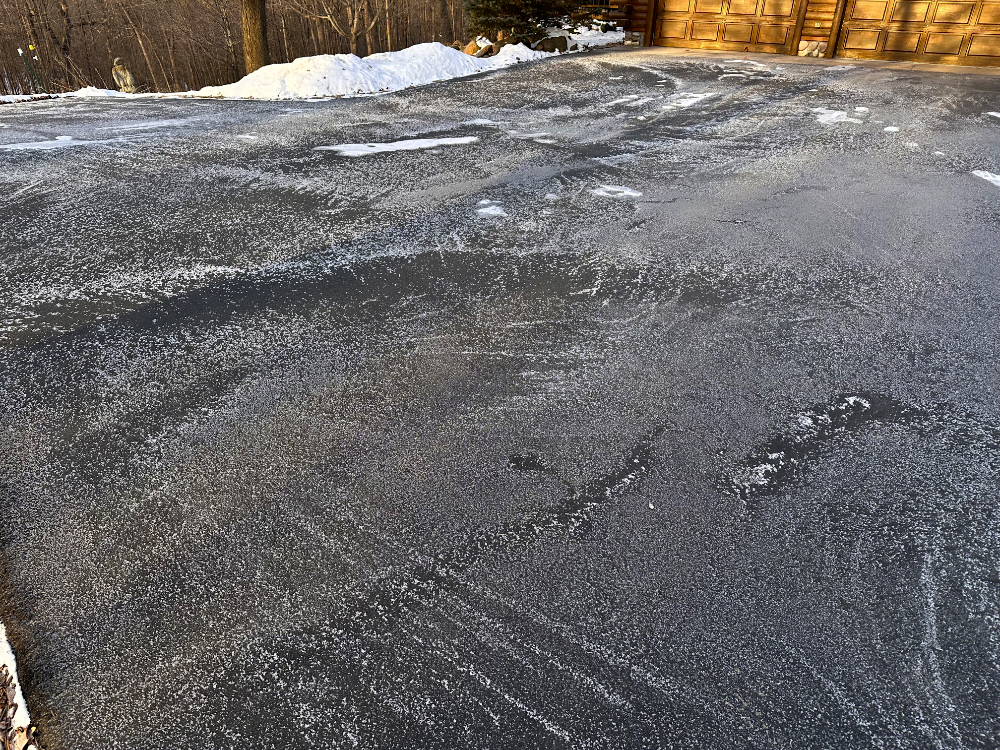
Wisps of deep-freeze ice crystals decorate the driveway.
With outdoor animals that need to be fed and a pet dog that needs to be walked, we don’t have the luxury of staying inside. Adding insult to the brutal conditions, yesterday afternoon I discovered there was no water in our Ritchie waterer in the paddock. Something was frozen. The question was, what to do about it? Of course, Cyndie had the right idea.
She placed a call to the guy who originally installed it and who also repaired the leaking valve last fall. He was at a funeral. She left a message and called the office. The owner answered (which is how she learned our guy was at a funeral), and he tried to offer some suggestions. It was just enough to help me with an idea.
I dug up a heat lamp that was stowed in the vacant chicken coop. Meanwhile, our guy at the funeral checked his messages and called Cyndie back. He provided more specific instructions about where the most common freezing occurs and how to address it. She heated water and came down with an insulated carafe. While the heat lamp was pointed into the inner workings from a side access panel, we chipped away at the frozen cover.
When the cover came loose, Cyndie slowly trickled hot water on the exposed float valve and feeder tube until the carafe was empty. When she returned to the house to get more, I held the heat lamp strategically over the valve. In about one minute, I heard some action. The water was starting to move. The heat lamp was doing the trick, and soon, water filled the metal pans of the double-sided waterer.
Earlier, we had put out electrically heated buckets of water under the overhang to encourage the horses to drink more water during the cold spell. Now, they were showing curiosity about what all the fuss was down at the waterer. I’m hoping they will keep drinking from it because that will move water through the valve, and maybe slow any refreezing likely to re-occur at these wicked cold temperatures.
If it is frozen again this morning, at least we know exactly what we can do to solve it.
.
.


 Relative Something
I have a suggestion… Have you considered using Heat Tape? This can be found at most hardware stores, or Amazon. It is basically heating wire that is electrically protected in heavy rubber and plastic that comes in various lengths and plugs into a standard 15 amp outlet. And of course, it’s controlled with a thermostat. You simply run it the length of the exposed pipe, and wrap the pipe in a tiny bit of insulation (I’ve used cheap black electrical tape to secure the insulation). Having lived within a few miles of Canada, I’m sadly all too familiar with pipe freezing. Let me know. 🙂
Thomas Slatin (She/Her) 🏳️🌈
January 21, 2025 at 7:14 am
You are spot on, Thomas. Heat tape is an integral component of the waterer. Actually, tapes, plural! The valve that freezes up is either not wrapped well enough, or the tape needs to be replaced. Further testing will happen when temperatures moderate to a more sane level for extended minutes outdoors.
johnwhays
January 21, 2025 at 10:57 am